

TL;DR:
- Page citations in medical AI are structured reference tags that link each claim to the specific page of the source PDF it came from, so the supporting text can be traced back and confirmed. Producing them involves OCR transcription, embedding page-level cite tags as the language model extracts each fact, and resolving every tag back to its exact source page: which is what makes the output trustworthy enough for legal and clinical use. Proper handling of complex layouts and clear evaluation criteria like faithfulness and completeness are essential to prevent citation failures and maintain auditability.
Page citations in medical AI are explicit reference tags that link each extracted claim to the precise page within a source PDF where the supporting text appears, so a reviewer can confirm it before signing off. This traceability is the technical foundation of defensible AI-generated medical summaries. Without it, a workers' comp attorney citing an AI-produced chronology or a QME physician relying on a normalized vitals table has no reliable way to confirm the underlying evidence. Tools like ChartInsight have made page-level traceability a production-grade standard, and independent research shows why it matters: a 2025 Stanford study found that leading legal AI research tools still hallucinate between 17 and 33 percent of the time, even when marketed as "hallucination-free." Understanding how page citations work in medical AI is no longer optional for practitioners who sign their names to record summaries.
How page citations work in medical AI: the technical pipeline
Medical AI systems generate page citations through a three-phase pipeline: OCR transcription, LLM extraction with embedded cite tags, and deterministic resolution of each cite tag back to its exact source page. Each phase is sequential and dependent on the one before it. A failure at any stage propagates forward, which is why production systems treat each phase as a discrete checkpoint rather than a continuous flow.
The process works as follows:
- OCR transcription. Every page of the source PDF is converted to machine-readable text, preserving reading order and page boundaries. The output is an indexed text corpus keyed by file and page number.
- LLM extraction with cite tags. The language model reads the transcribed text and, as it extracts each fact, embeds a structured page-level reference (e.g.
doc:GUID?page=N) at the point of that fact. These tags are machine-readable anchors, not decorative footnotes. - Deterministic cite verification. A rule-based step, not the model, parses each embedded tag and maps it back to the exact file and page it points to, so the citation can be opened and checked against the source. Because resolution is deterministic rather than model-generated, the same tag always resolves to the same page.
- Fuzzy matching layers. When a reviewer searches the indexed text, fuzzy matching tolerates OCR noise and spelling variation (edit-distance scoring that scales with term length) so a term still surfaces even when the scan is imperfect. This is a retrieval aid for finding evidence in the record, separate from how a citation resolves.
Pro Tip: If you are evaluating a medical AI platform, ask whether every citation resolves deterministically back to a specific source page you can open and read, not just a number printed next to a sentence. A system you cannot click into to see the underlying page has no meaningful auditability.
 A page number printed in the text is only a convenience. What makes a citation defensible is being able to open that exact page and read the supporting text yourself. This distinction matters in depositions and peer review alike, because a page number alone does not prove the claim appears where the AI says it does. The proof is in the click-through to the source page.
How complex PDF layouts affect citation reliability
Biomedical and medical-legal PDFs are structurally hostile to automated extraction. Multi-column layouts, floating tables, figure captions, header and footer repetition, and scanned pages with variable OCR quality all create conditions where a naive extraction pipeline will misattribute claims to the wrong page or the wrong text.
Layout-aware, page-level processing combined with schema-constrained extraction addresses this directly. The key principles are:
- Deterministic chunking. Pages are processed as discrete units with explicit boundaries. This prevents text from one page bleeding into the provenance record of another, which is a common failure mode in systems that chunk by token count rather than document structure.
- Schema-constrained extraction. Each extracted value is tied to the specific page it was drawn from at the time of extraction, not reconstructed after the fact. If the schema calls for a blood pressure reading, the extracted value carries a reference back to the page it came from.
- No over-inference. Well-designed systems include explicit rules against attributing a claim to a page when the supporting text is ambiguous or absent. The system either cites or it does not. It does not guess.
- Verbatim quoting for auditability. The source page text is preserved and shown to the reviewer verbatim, not as a paraphrase. This is what lets a reviewer confirm that the AI's interpretation of the source is accurate.
"Page citations depend heavily on the AI model's understanding of document layout and reading order, making robust preprocessing and chunking essential to avoid provenance drift." — Schema-constrained AI for auditable biomedical evidence extraction
OCR and structural segmentation errors in multi-provider scanned records are among the most common causes of citation failure in practice. A mis-segmented table can cause a lab value from one provider's record to be attributed to a page from a different provider's record entirely. This is not a theoretical risk. It is a documented failure mode in production systems processing the kind of stitched, multi-source PDFs that workers' comp and personal injury cases routinely involve.
What evaluation criteria determine citation quality?
Presence of a citation is not the same as quality of a citation. Citation quality breaks down along five dimensions: faithfulness, completeness, sufficiency, verification, and reliability. Each addresses a distinct failure mode.
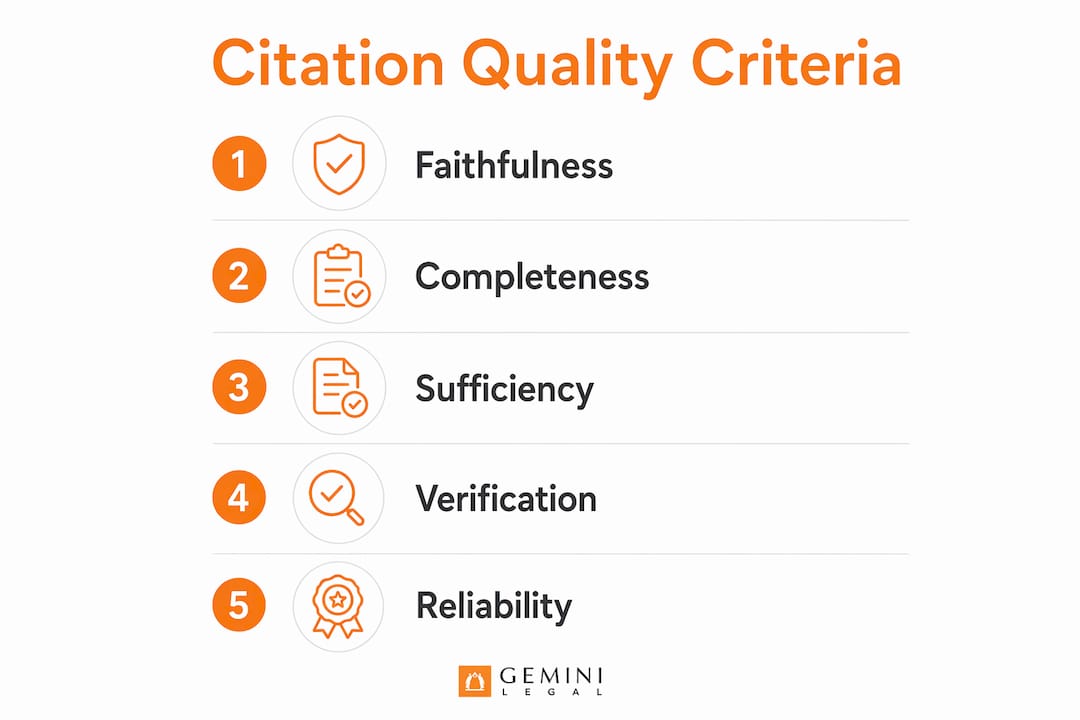 The Citation Quality Criteria is described as follows:
| Criterion | What it measures | Why it matters for medical-legal use |
|---|---|---|
| Faithfulness | Does the cited text actually support the claim? | Prevents hallucinated citations that point to real pages but irrelevant text |
| Completeness | Does the claim capture the full message of the source? | Prevents cherry-picking that distorts clinical findings |
| Sufficiency | Is the evidentiary strength of the source adequate for the claim? | Prevents weak evidence being cited for strong conclusions |
| Verification | Can a reviewer open the cited source and confirm the claim independently? | Ensures every citation can be checked at the source, not just trusted on its face |
| Reliability | Does the same citation resolve to the same source every time? | Ensures citations stay stable and defensible when the record is revisited or challenged |
Faithfulness is the most critical dimension for legal practitioners. A citation that points to a real page but to text that does not support the stated claim is functionally a hallucination. It looks credible, passes a surface-level review, and fails under deposition. Formal evaluation work points the same way: research on evaluating machine-generated reports, including NIST's evaluation framework, holds that a report must be complete, accurate, and verifiable, with every claim mapped back to a source document. A reliable way to check how the source supports or fails each claim is what lets a QME or an attorney defend the output under scrutiny.
Pro Tip: When reviewing an AI-generated medical summary, do not stop at confirming the page number exists. Confirm that the verbatim text on that page actually supports the specific claim made. Faithfulness failures are invisible until someone checks.
Human-curated corpora and automated checks work together in mature evaluation frameworks. Automated checks catch systematic failures at scale. Human review catches the edge cases that automation misclassifies. Neither alone is sufficient for high-stakes medical documentation.
How user interfaces present page citations for verification
The technical accuracy of a citation is only as useful as the reviewer's ability to act on it. In a well-designed interface, each page citation is a clickable link that opens the source PDF directly at the cited page and highlights it, so the reviewer never has to leave the workflow or manually hunt for the reference.
Practical UI implementations for medical AI citation systems include:
- Direct page navigation. Clicking a citation opens the source PDF at the exact cited page, not the document root. This eliminates the manual page-flipping that consumes hours in traditional record review workflows.
- Graceful fallback. When a citation has no usable page marker, the link still opens the source document rather than breaking, so the reviewer always lands on the record instead of a dead link.
- The real page on click. Clicking a citation opens the actual source PDF page, so the reviewer reads the original text as it appears in the record. Seeing the page itself is what makes the AI's interpretation checkable
- Cited-page highlighting. The cited page opens with a visual highlight, and multi-page citations open across the full page range, so the relevant location is unambiguous even in long, dense records.
The stakes here are well documented. When reviewers cannot trace a claim back to its source, errors slip through, and the Stanford findings show how often that happens even in tools marketed as hallucination-free. Reviewers adopt AI tools when they can verify the output for themselves, quickly, and they reject them when they cannot. Click-through to the cited page is what makes that verification practical instead of theoretical.
UI designs that allow click-through to verbatim page spans reduce the risk of accepting erroneous AI claims. For a paralegal preparing a med-legal report or an IME physician documenting P&S status, that risk reduction is the difference between a defensible output and a liability.
What challenges and limitations affect medical AI page citations?
Even well-engineered citation pipelines encounter failure modes that practitioners should understand before relying on AI-generated summaries in high-stakes contexts.
The strength of a pipeline is measured by how well it contains these failure modes. High-quality OCR and layout-aware preprocessing prevent most of them before they ever reach a citation.
- OCR-induced segmentation errors. Scanned records with poor image quality, handwritten annotations, or non-standard fonts can produce OCR text that does not accurately reflect the source. Robust, high-quality OCR keeps this rare, but when the underlying text is wrong, a citation can point to a real page whose text does not actually support the claim, producing a reference that looks valid but is semantically incorrect.
- Layout drift. Multi-column PDFs, rotated pages, and tables that span page breaks can cause text to be read in the wrong order. Page-level chunking and layout-aware processing are what keep this in check, because without them a claim attributed to page 47 may actually derive from text the OCR engine placed on page 48 due to column-ordering errors.
- Paraphrase mismatch. LLMs sometimes paraphrase source text rather than quoting it. The underlying claim can be accurate while the wording on the cited page does not match the summary word for word, which makes manual verification slower and is exactly why being able to open the page and read it yourself matters.
- Hallucinated citations. This is the highest-risk failure mode for legal and clinical use: a model produces a plausible-looking citation that points to a page which does not actually contain the claimed information. ChartInsight is built specifically to prevent it. Every fact ChartInsight extracts, from a diagnosis in the narrative summary to a reading in the vitals table, carries a citation that resolves deterministically to the exact source page it came from. The model never self-certifies its own sources, and the reviewer clicks each citation to confirm the page supports the claim before signing off. Grounding the output in cited source pages, resolving each citation deterministically, and keeping a human reviewer in the loop is what keeps hallucinated citations out of the final record..
- Confidence reporting gaps. Confidence is often reported at the level of an answer or a section rather than for each individual citation. A single high-level score can obscure which specific claims are weakest, so reviewers still need to open and check the citations that carry the most weight.
Pro Tip: Ask any AI vendor whether you can click any citation and land on the exact source page to confirm it yourself, and whether the system flags answers it is less confident about. Granular signals like these tell you which claims to double-check. A single confidence score buried at the document level does not.
Citation metadata stored alongside the output, rather than baked irreversibly into generated text, makes the system easier to audit. It lets any single citation be opened and checked on its own, without regenerating the entire summary, which would be expensive and introduce variability.
For legal document drafting workflows and digital discovery processes, the same principles of traceability and sentence-level provenance apply. The medical AI context adds the complexity of clinical terminology and multi-provider records, but the underlying requirement is identical: every claim must be traceable to its source.
Key takeaways
Reliable page citations in medical AI require a deterministic, rule-based step that resolves each model-generated citation back to its exact source page, plus quality criteria like faithfulness and completeness to confirm the cited page actually supports the claim.
| Point | Details |
|---|---|
| Citation pipeline structure | OCR transcription, LLM cite-tag embedding, and deterministic resolution of each tag to its source page are three separate, sequential steps. |
| Fuzzy search aids retrieval | Edit-distance fuzzy search helps a term surface in the record despite OCR noise and spelling variation. It is a retrieval aid for finding evidence, separate from how a citation resolves. |
| Layout complexity is a real risk | Multi-column PDFs and scanned records require page-level chunking and schema-constrained extraction to maintain provenance stability. |
| Evaluation needs more than presence | Faithfulness, completeness, sufficiency, verification, and reliability each catch distinct failure modes that the mere presence of a citation cannot detect. |
| UI design determines usability | Click-through to the cited source page, with that page highlighted, is what converts technically accurate citations into practically useful verification. |
Why citation fidelity is the only metric that matters in practice
I have reviewed AI-generated medical summaries where every citation number was present and every page reference was technically populated, and the output was still indefensible. The citations pointed to real pages. The pages did not contain the claimed information. That is a faithfulness failure, and it is invisible to anyone who does not click through and read the source text.
The practitioners I work with, QMEs, IME physicians, workers' comp attorneys, and paralegals, are not asking whether the AI is impressive. They are asking whether they can sign their name to the output. That question has one answer: only if every cited claim can be traced to the specific page it came from, and only if the interface makes that verification fast enough to be practical in a real workflow.
The trend I find most significant is not the improvement in LLM accuracy. It is the separation of how a citation is generated from how it is resolved. The model proposes a citation as it extracts a fact, but a deterministic, rule-based step, not the model, resolves that citation to a fixed source page. The model generates. The system resolves each citation to a page that cannot drift. The reviewer opens the page and confirms it. Those are three different jobs, and conflating them, or trusting the model to be its own source of truth, is where most citation failures originate.
The emerging direction toward interactive evidence verification, where a reviewer can open the cited page directly and query the record to get answers grounded in citations back to the source, is the right direction. It puts the reviewer in control of the evidence, which is where control belongs in a high-stakes medical-legal context. Automation handles the volume. The reviewer handles the judgment. That division of labor only works when the citations are real.
— Nicola Riker
See how Chartinsight handles page citations in production
 Chartinsight produces structured, page-cited outputs for every medical record it processes: a chronology, a nine-section narrative summary, normalized vitals, a medications table, and any custom analyses your team configures. Every extracted fact carries a live citation back to the exact page it came from. Clicking that citation opens the source PDF inside the app at the correct page, so you never leave the workflow to verify a claim. For QME physicians, IME reviewers, workers' comp attorneys, and paralegals who need defensible documentation, Chartinsight reduces days of page-flipping to hours of focused review. Book a demo to see the citation pipeline in action on a real record.
FAQ
What is a page citation in a medical AI system?
A page citation is a structured reference tag embedded in an AI-generated claim that links the claim to the specific page in a source PDF where the supporting text appears. Each tag is resolved deterministically to that page, so a reviewer can open it and confirm the claim against the source.
How does ChartInsight prevent hallucinated citations?
Three things work together. The output is grounded in the source, with each fact tied to a citation as it is extracted. Each citation tag is then resolved deterministically, by a rule-based step rather than the model, to a fixed page that cannot drift. And the reviewer opens that page to confirm it supports the claim before signing off. Because the model is never treated as its own source of truth, unverified claims do not slip through unnoticed.
What are faithfulness, completeness, and sufficiency in citation evaluation?
They are three of the core dimensions used to judge citation quality. Faithfulness confirms the cited text supports the claim. Completeness confirms the claim captures the full message of the source. Sufficiency confirms the evidentiary strength of the source matches the strength of the claim. Formal evaluation work, including NIST's framework, holds that a report should be complete, accurate, and verifiable, with every claim mapped back to a source.
Why do complex PDF layouts cause citation failures?
Multi-column layouts, floating tables, and scanned pages can cause OCR engines to read text in the wrong order, so the citation index no longer reflects the document's structure. This is exactly why OCR quality matters so much. Chartinsight pairs high-fidelity OCR with page-level chunking and schema-constrained extraction, processing each page as a discrete unit with explicit provenance binding, which keeps this class of error rare.
How does Chartinsight implement page citations for legal and clinical reviewers?
Chartinsight embeds live citations across its outputs, from chronology entries to vitals readings to narrative summary content. Clicking any citation opens the source PDF at the exact page inside the app, with no need to download files or navigate separately. This applies to psychiatric record reviews and all other med-legal use cases the platform supports.