

TL;DR:
- The California panel QME selection process follows strict statutory rules to ensure neutral medical evaluations in workers' compensation cases. Missing deadlines or requesting the wrong specialty can lead to procedural delays, an administrative restart, or losing control over the choice of evaluator. Strategic use of strikes and thorough preparation are critical for accurate, timely evaluations.
The panel QME selection process is the legally mandated procedure under California Labor Code §4062.1 and §4062.2 for selecting a neutral Qualified Medical Evaluator from a randomly generated list of three certified physicians to resolve medical disputes in workers' compensation claims. The Division of Workers' Compensation (DWC) Medical Unit administers this process, and the resulting QME report carries substantial evidentiary weight in Workers' Compensation Appeals Board (WCAB) proceedings, directly influencing injury causation findings, permanent disability ratings, and future medical treatment. Getting the selection right is not a formality. It is one of the highest-leverage decisions in any California workers' comp case.
What is the panel QME selection process?
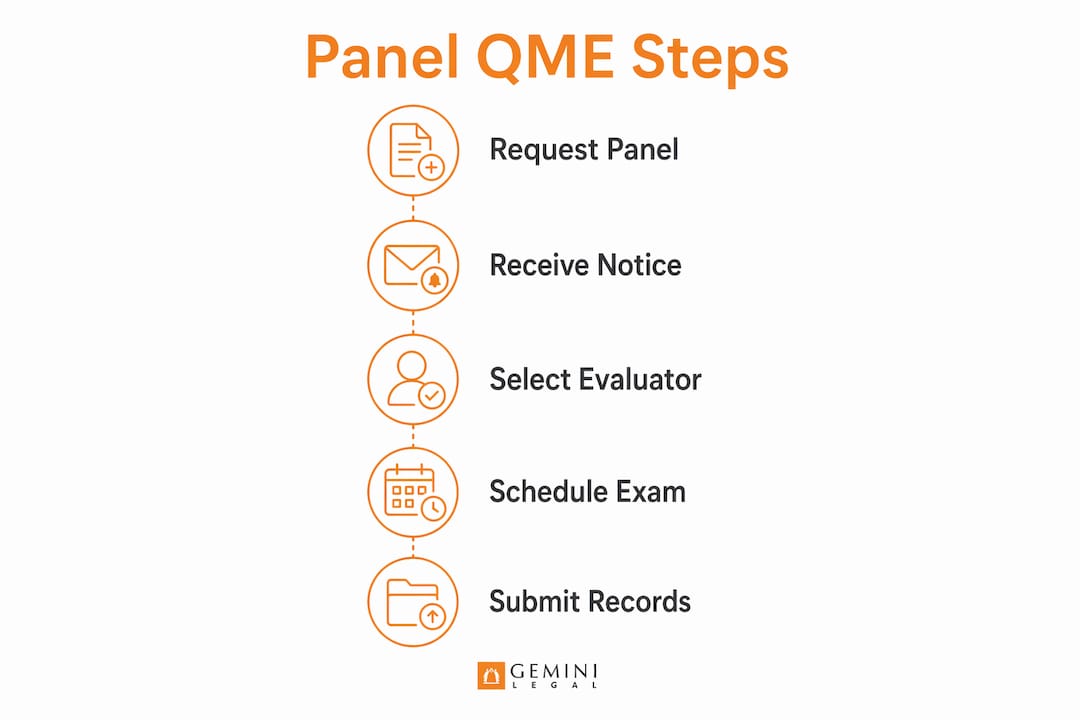
The panel QME selection process is the formal mechanism by which an independent medical evaluator is chosen when a dispute arises over a workers' compensation claim. The DWC Medical Unit generates a random panel of three physicians, filtered by the requested medical specialty and the injured worker's geographic area (based on zip code or residence). From that panel, one physician is selected to conduct the evaluation and produce the QME report.
The QME report informs injury causation, disability ratings, and future treatment in WCAB proceedings. That scope makes evaluator selection a strategic case priority, not an administrative checkbox. The process differs significantly depending on whether the injured worker is represented by an attorney, and each pathway carries its own deadlines, rights, and risks.
Two California Labor Code sections govern the framework. Labor Code §4062.1 covers unrepresented workers. Labor Code §4062.2 governs represented workers. Both sections impose strict timelines that, if missed, can shift control of the selection to the opposing party.
How does the panel QME process work for unrepresented workers?
For workers without legal representation, the process follows a defined sequence under Labor Code §4062.1. Each step has a deadline, and missing one carries real consequences.
- Submit Form 105. The injured worker or claims administrator files DWC Form 105 with the DWC Medical Unit, specifying the disputed medical issue and the requested specialty. Once the employer furnishes the form to the worker, the employer cannot submit it until 10 days have passed without the worker doing so.
- DWC generates the panel. The Medical Unit issues a list of three QMEs randomly assigned by specialty and the worker's geographic area. Regional availability shapes the panel, so workers in rural areas may receive fewer options or longer wait times.
- Select within 10 days. The injured worker has 10 days from the issuance of the panel to choose one of the three physicians, schedule the appointment, and inform the employer (Labor Code §4062.1(c); 8 CCR §31.3). This deadline is strictly enforced.
- Failure to select transfers control. If the worker does not inform the employer of the selection within 10 days, the employer may select the QME from the panel. That shift can place the evaluation with a physician the employer prefers.
- Schedule the examination. Once selected, the worker contacts the QME's office to schedule the appointment. Medical records should be submitted to the evaluator in advance.
Specialty selection at step one determines which physicians appear on the panel. Requesting orthopedics for a back injury, or psychiatry for a stress claim, is not optional. An incorrect specialty request can be challenged and reviewed by the DWC Medical Director, and may require a replacement panel (DWC QME process Q&A).
Pro Tip: Document the exact date the panel is assigned and the date you receive it. The selection clock runs from the panel's issuance, and panels served by mail carry an additional allowance for mailing under the DWC rules. Tracking these dates precisely protects against deadline disputes.

How does the process differ for represented workers?
When an injured worker is represented by an attorney, the process shifts to Labor Code §4062.2 and introduces both an alternative pathway and a strategic selection mechanism.
The represented worker process works as follows:
- AME first. The parties must first attempt to agree on an Agreed Medical Evaluator. If both sides agree, the AME replaces the panel process entirely. An AME is often preferred when both parties want a mutually trusted evaluator and want to avoid the uncertainty of a random panel.
- Panel if no AME agreement. If the parties cannot agree on an AME, either party may request a three-member QME panel under the same specialty and geographic criteria used for unrepresented workers.
- Strike process. Each party strikes one name from the panel. The physician who remains after both strikes becomes the selected QME (Labor Code §4062.2(c)). This is the primary bias-mitigation mechanism built into the represented worker process.
- 10-day strike deadline applies. Each party must strike within 10 days of the panel's assignment (Labor Code §4062.2(c); 8 CCR §30). If a party fails to strike in time, the other party may select any physician who remains on the panel.
- Strategic use of strikes. Attorneys use historical knowledge of evaluators' reporting tendencies to eliminate potentially unfavorable physicians. The strike is not random. It is a deliberate legal tool.
The AME pathway is worth pursuing when the case involves complex causation questions or when both parties have confidence in a specific evaluator. The panel pathway is the fallback, but it is not without strategic value. A well-researched strike can be as effective as an AME agreement.
Pro Tip: Before the panel arrives, build a short reference list of QMEs in the relevant specialty who are known for thorough, balanced reports. When the panel issues, you can act on your strike decision immediately rather than scrambling under deadline pressure.
What specialty criteria determine panel QME effectiveness?
Specialty selection is the single most consequential decision in the panel QME process. The DWC only generates a panel from physicians in the requested specialty, so a mismatch between the injury and the specialty produces a panel that cannot adequately evaluate the claim.
Common specialties and their appropriate use cases:
| Specialty | Appropriate Injury or Dispute |
|---|---|
| Orthopedic Surgery | Musculoskeletal injuries, fractures, spine conditions |
| Neurology | Nerve damage, traumatic brain injury, radiculopathy |
| Psychiatry / Psychology | Stress claims, PTSD, psychiatric injury |
| Pain Management | Chronic pain, complex regional pain syndrome |
| Internal Medicine | Systemic conditions, occupational disease |
Selecting the correct specialty is critical to obtaining a relevant evaluation. An incorrect specialty selection can cause delays, requiring a specialty objection and review by the DWC Medical Director and, potentially, a replacement panel. That kind of procedural detour can add months to case resolution.
Beyond specialty, evaluator quality matters. Red flags to watch for when reviewing panel candidates:
- High-volume clinic operations where evaluators see dozens of patients per day, leaving minimal time for thorough review.
- A documented pattern of one-sided reports across multiple cases.
- Reports that consistently ignore or dismiss treating physician opinions without clinical justification.
- Lack of board certification in the requested specialty.
Practitioners recommend researching QME history to avoid biased evaluations. Resources include DWC evaluator directories, peer referrals, and case management databases. For psychiatric evaluations specifically, the stakes are particularly high because the evaluator's clinical framework shapes how the entire mental injury claim is interpreted. ChartInsight's psychiatric record review resources offer practical guidance on identifying problematic evaluators in that specialty.
How are deadlines and administrative issues managed?
Deadline management in the panel QME process is not a background task. It is a core case management function. A single missed deadline can transfer selection rights to the opposing party or trigger a procedural dispute that delays resolution by months.
The critical timelines are:
| Deadline | Trigger | Consequence of Missing |
|---|---|---|
| 10 days (unrepresented) | Issuance of the QME panel | Employer may select the QME from the panel |
| 10 days (represented) | Assignment of the QME panel | A party that fails to strike loses its strike; the other party may pick from the remaining names |
| 20 working days (unrepresented) | Valid panel request submitted | If the Medical Unit does not issue a panel in time, the worker may select any QME of their choice |
In an unrepresented case, if the DWC Medical Unit fails to issue a panel within 20 working days of a valid request, the worker may select any QME within a reasonable geographic distance, rather than waiting on a panel (DWC Form 105 instructions; DWC QME process Q&A). This remedy depends on documented proof that the request was valid and timely. Without that documentation, the remedy is difficult to assert.
Geographic factors add another layer of complexity. Panel composition depends on the worker's location, meaning workers in underserved regions may receive panels with limited options or evaluators located far from their residence (8 CCR §30(e)). This affects scheduling timelines and, in some cases, the worker's ability to attend the examination. Attorneys and adjusters working rural California cases should anticipate longer lead times and build that into their case calendars.
Workers' compensation deadlines also interact with broader California legal timelines. Understanding how statute of limitations rules apply to the overall claim helps practitioners contextualize where the QME process fits within the full case timeline.<!-- internal link: insert canonical chartinsight.ai URL for the statute of limitations article -->
Pro Tip: Submit all panel requests through the DWC's online portal or by a method that produces a confirmation receipt. If a delay dispute arises later, you need a timestamped record of when the valid request was submitted.
Proactive case management also means preparing medical records for submission before the QME appointment is even scheduled. Submitting records on time and being ready to challenge unfair reports with rebuttals or at trial are standard practice for experienced practitioners.
Key takeaways
The panel QME selection process determines who evaluates the claim, which specialty governs the report, and ultimately how disability and causation are decided in California workers' compensation cases.
| Point | Details |
|---|---|
| Two statutory pathways | Labor Code §4062.1 governs unrepresented workers; §4062.2 governs represented workers with a strike process. |
| The 10-day deadline matters | Missing the selection or strike deadline can transfer control of the QME selection to the opposing party. |
| Specialty match is non-negotiable | Requesting the wrong specialty can trigger a specialty objection, Medical Director review, and a replacement panel. |
| Strikes are strategic, not random | Represented parties use evaluator history to eliminate unfavorable physicians before the final selection. |
| Document everything | Timestamped records of panel requests protect the unrepresented worker's 20-working-day remedy if the DWC delays issuance. |
What i've learned about QME selection that most guides skip
At ChartInsight, we build the software that sits at the intersection of medical records and legal defensibility, and we do it inside Gemini Legal, a company that has processed 100M+ workers' compensation pages over 20+ years. The panel QME selection process is one of those areas where the procedural rules are well-documented but the practical intelligence is not.
The thing practitioners underestimate most is how much the strike decision depends on institutional knowledge that is rarely written down. Attorneys who handle high volumes of workers' comp cases build informal databases of evaluator tendencies over time. They know which orthopedists in a given county write thorough causation analyses and which ones produce boilerplate reports that fall apart under cross-examination. That knowledge is the real competitive advantage in represented cases, and it is not available in any DWC directory.
The second pattern we see consistently is that deadline management is treated as a calendar problem when it is actually a documentation problem. The 10-day strike clock, the 20-working-day panel-issuance remedy, the AME negotiation window: all of these depend on being able to prove exactly when you received a notice or submitted a request. Practitioners who lose deadline disputes almost always lose them on documentation, not on the underlying facts.
The QME report is the evidentiary spine of a workers' comp case. Treating evaluator selection as a formality is the fastest way to lose control of a case you should have won. Every hour spent on thorough pre-selection research pays back in avoided rebuttals, avoided delays, and reports that hold up before the WCAB.
— ChartInsight, built by Gemini Legal
How Chartinsight supports defensible QME record review
Preparing for a QME evaluation means getting the medical record in order before the appointment. For workers' comp attorneys, adjusters, and clinical reviewers, that often means working through hundreds or thousands of pages across multiple providers under tight deadlines.
ChartInsight converts that process from days of page-flipping to hours of structured review. Every output, whether a chronology, a narrative summary, or a medications table, carries a live citation back to the exact source page. Clicking that citation opens the PDF directly inside the app. There is no separate download, no lost place in the record, and no unverifiable claim. For QME preparation, that means the records you submit to the evaluator are organized, accurate, and defensible. Book a demo to see how ChartInsight handles a full workers' comp record from intake to export.
FAQ
What is the panel QME selection process in California?
The panel QME selection process is the DWC-administered procedure under Labor Code §4062.1 and §4062.2 for selecting a neutral physician from a randomly generated list of three certified evaluators to resolve medical disputes in workers' compensation claims.
How long does a worker have to select a panel QME?
An unrepresented worker has 10 days from the issuance of the panel to select one of the three listed physicians, schedule the appointment, and notify the employer. Missing this deadline lets the employer make the selection (Labor Code §4062.1(c)). In a represented case, each party has 10 days from the panel's assignment to strike one name (Labor Code §4062.2(c)).
What happens if the DWC does not issue a panel in time?
In an unrepresented case, if the DWC Medical Unit fails to issue a panel within 20 working days of a valid request, the worker may select any QME of their choice within a reasonable geographic distance, provided the original request is documented (DWC Form 105 instructions).
Can represented workers skip the panel process?
Yes. Represented workers may agree on an Agreed Medical Evaluator instead of using the panel process. If the parties cannot reach AME agreement, either party may request a three-member panel and each party strikes one name (Labor Code §4062.2).
Why does medical specialty matter in QME panel selection?
The DWC generates the panel exclusively from physicians in the requested specialty. Requesting the wrong specialty produces an evaluator who may be unqualified to assess the disputed condition and can trigger a specialty objection, Medical Director review, and a replacement panel, adding delay (DWC QME process Q&A).