

TL;DR:
- A workers comp settlement valuation checklist organizes medical, financial, and legal factors to assess settlement fairness accurately. Properly verifying P&S status, PD ratings, future medical costs, liens, Medicare Set-Aside (MSA) handling, and benefit rates is essential for a defensible claim resolution. Building a detailed line-item worksheet and reviewing all legal documents before signing ensures the claim's true value is properly protected.
A workers comp settlement valuation checklist is a structured tool that organizes every medical, financial, and legal factor needed to assess whether a settlement offer is fair. In California workers' compensation practice, the difference between an accurate valuation and a lowball acceptance often comes down to whether you verified P&S status, priced future medical care against the official fee schedule, confirmed the correct permanent disability (PD) rating under the AMA Guides, and addressed Medicare Set-Aside (MSA) obligations before signing anything. This guide walks through each component in the order you need to address it.
1. Workers Comp Settlement Valuation Checklist: Start With Settlement Type
The single most consequential variable in any settlement valuation process is the type of settlement on the table. A Compromise and Release and a Stipulated Award are not interchangeable, and confusing them is the fastest way to undervalue a claim.
A Compromise and Release (C&R) pays a lump sum and closes future medical permanently; under California Labor Code §5001, a release of liability in a workers' comp case has no effect until approved by the appeals board. A Stipulated Award (Stip) pays structured periodic benefits and keeps the medical claim open. The DWC Guidebook for Injured Workers describes both settlement structures and the surrounding claim process. That distinction changes everything about what you must value.
| Feature | Compromise & Release (C&R) | Stipulated Award (Stip) |
|---|---|---|
| Payment structure | Lump sum | Structured periodic payments |
| Future medical | Closed at settlement | Remains open |
| Flexibility | High for claimant | Lower; carrier controls medical |
| Valuation priority | Must price all future care upfront | Focus on PD rating accuracy |
| Best suited for | Stable conditions, clear prognosis | Ongoing treatment needs |
When you take a C&R, you are buying out every future medical dollar. That means your valuation must include surgeries, medications, durable medical equipment (DME), and likely complications. With a Stip, the medical stays open, so your valuation centers on the PD rating and indemnity stream.
Pro Tip: Never let the carrier frame the settlement type before you have run your own valuation. The structure should follow the numbers, not the other way around.
2. Confirm Permanent and Stationary Status Before Valuing Anything
Permanent and Stationary (P&S) status, also called Maximum Medical Improvement (MMI) in federal and other state systems, is the legal threshold that triggers the right to settle. Valuing a claim before the injured worker reaches P&S produces unreliable numbers because the treating physician has not yet defined the permanent impairment.

The claim process moves from injury through treatment, MMI determination, impairment rating, and then settlement, as outlined in the DWC Guidebook for Injured Workers. Skipping ahead on the checklist before P&S is confirmed means the PD rating, future medical plan, and apportionment analysis are all provisional. Provisional numbers become the basis for lowball offers.
Confirm P&S in writing from the treating physician or the QME/AME report before any valuation work begins. If the QME and the treating physician disagree on P&S date, that dispute must be resolved first. The P&S date also anchors the calculation of any temporary disability (TD) still owed.
3. Validate the Permanent Disability Rating
The PD rating drives the indemnity value of the claim. Under California's DWC system, the whole person impairment is derived from the AMA Guides to the Evaluation of Permanent Impairment, Fifth Edition, then adjusted for the worker's occupation and age before any apportionment to non-industrial causes is subtracted. For injuries on or after January 1, 2013, California Labor Code §4660.1 replaced the older future-earning-capacity adjustment with a uniform 1.4 modifier applied to the whole person impairment. A one or two percent error in the whole person impairment (WPI) translates directly into thousands of dollars in permanent disability indemnity.
Insurance carriers anchor offers on conservative impairment and medical forecasts. That means the first PD rating you receive is often the lowest defensible number, not the most accurate one. Your checklist must include an independent review of the QME or AME report, a cross-check against the AMA Guides, and a verification that apportionment was applied correctly and not used to artificially deflate the rating.
If the rating feels low, request a supplemental QME report or retain an AME to provide a second opinion. The cost of that evaluation is almost always recovered in the improved settlement value.
4. Price Future Medical Costs Line by Line
Future medical valuation is where most settlement checklists fail. A single lump sum estimate for "future medical" is not a valuation. It is a guess. Granular pricing of procedures and items is the standard that avoids critical underwriting omissions.
Build a future medical workbook that prices each of the following against California's Official Medical Fee Schedule (OMFS) and treats the Medical Treatment Utilization Schedule (MTUS) as the standard for medically necessary care:
- Surgeries and re-operations: Include the primary procedure and any anticipated revisions or hardware replacements.
- Medications: Price both current prescriptions and likely future formulary needs, including compounded medications if applicable.
- Durable medical equipment: Wheelchairs, braces, TENS units, and orthotic replacements over the claimant's life expectancy.
- Diagnostics: MRIs, EMGs, and lab panels that the treating physician's plan identifies as periodic monitoring needs.
- Home health and attendant care: Often omitted entirely; include if the treating physician's plan references any functional limitations.
- Complications: Infection risk after surgery, adjacent segment disease in spinal cases, and hardware failure are foreseeable and priceable.
Pro Tip: Use the treating physician's formal treatment plan as your source document, not the carrier's nurse case manager summary. The treating physician's plan is the legally recognized basis for future care under California workers' comp.
5. Address Medicare Set-Aside Requirements
Protecting Medicare's interests is a legal obligation under the Medicare Secondary Payer (MSP) Act in any settlement that closes future medical. Submitting a Workers' Compensation Medicare Set-Aside (WCMSA) to CMS for review, however, is a voluntary process. There is no statutory or regulatory requirement to submit one. CMS will only review a proposed WCMSA when its workload review thresholds are met: the claimant is a current Medicare beneficiary and the total settlement exceeds $25,000, or the claimant has a reasonable expectation of Medicare enrollment within 30 months and the anticipated total settlement exceeds $250,000. Falling below those thresholds does not remove the underlying duty to account for Medicare's interests.
The MSA is a portion of the settlement set aside to pay for future medical care that Medicare would otherwise cover. Getting the MSA number wrong in either direction creates problems. Too low, and Medicare may deny future injury-related coverage until the shortfall is corrected. Too high, and the claimant's net recovery shrinks unnecessarily.
Total settlement allocation should reflect indemnity, future medical, attorney fees, liens, and settlement advances. When CMS does review a WCMSA, it considers the full picture, not just the MSA line item. Protective language in the settlement agreement is also expected to document Medicare's secondary payer role. Treat Medicare compliance as a structural requirement, not a negotiating detail.
6. Identify and Negotiate All Liens
Liens reduce net recovery. Every dollar paid to a lienholder is a dollar the claimant does not receive. The workers compensation claim checklist must identify every lien before valuation is complete, because the net settlement value is what matters, not the gross offer.
Common lien types in California workers' comp include:
- Medicare and Medi-Cal liens: Federal and state health programs assert reimbursement rights for treatment they paid for. These are non-negotiable in terms of existence but often negotiable in amount.
- Health insurance subrogation: Private carriers may assert liens under ERISA or state law.
- Employment Development Department (EDD): California's EDD asserts liens to recover State Disability Insurance (SDI) benefits it paid when workers' comp temporary disability was delayed, denied, or unpaid.
- Child support: Active child support orders can attach to settlement proceeds.
- Medical provider liens: Treating physicians and facilities who treated on lien basis must be resolved before or at settlement.
Lien negotiation and document review must be separate checklist steps. Combining them creates errors. Run your lien inventory first, negotiate reductions where possible, then finalize the net recovery calculation.
7. Verify 2026 Benefit Rates and Wage History
Benefit rates in California workers' comp change annually. Effective January 1, 2026, the DWC set the maximum temporary total disability (TTD) rate at $1,764.11 per week and the minimum at $264.61 per week. These caps, along with the permanent disability weekly benefit limits, affect the indemnity value of the claim, so using outdated rates produces a valuation that is wrong before you even start negotiating.
A proper settlement checklist verifies the claimant's average weekly wage (AWW), confirms that TD was paid at the correct rate throughout the claim, and calculates any TD underpayment still owed. The 2026 benefit rates also set the ceiling for PD weekly payments, which affects the commuted present value of the permanent disability award.
Wage history documentation should include pay stubs, W-2s, and any concurrent employment the claimant held at the time of injury. Concurrent employment wages are included in the AWW calculation under California Labor Code §4453, and carriers routinely omit them.
8. Build a Line-Item Valuation Worksheet
A settlement valuation worksheet is the document that converts your checklist into a defensible number. Separating valuation inputs from deal structure prevents the common error of letting the C&R vs. Stip decision contaminate the underlying math.
A complete worksheet includes these line items:
| Worksheet Component | Description |
|---|---|
| Past TD owed | Any unpaid temporary disability from the claim period |
| Future PD (commuted present value) | Discounted present value of the weekly PD benefit stream |
| Future medical costs | Line-item priced workbook using OMFS and treating physician's plan |
| Medicare Set-Aside allocation | Amount carved from future medical to protect Medicare's interests |
| Lien totals | Sum of all confirmed liens after negotiation |
| Net settlement value | Gross offer minus liens and MSA; this is the claimant's actual recovery |
A high-quality valuation worksheet with line-item future medical pricing avoids underwriting omissions like missing DME or anticipated re-operations. Validate every data input against the AMA Guides, the OMFS, and the current DWC benefit caps. A worksheet built on verified sources is a negotiating document. One built on estimates is a liability.
Pro Tip: Run the worksheet under both C&R and Stip assumptions before entering negotiations. The comparison often reveals which structure actually favors the claimant, and that knowledge changes the negotiation entirely.
9. Review All Settlement Documents Before Signing
The settlement agreement and release language define what the claimant actually gives up. A valuation that is accurate on paper can still produce a bad outcome if the release is overbroad or contains errors.
Review the Compromise and Release or Stipulated Award document for these specific issues: incorrect injury date or body parts listed, release language that extends beyond the workers' comp claim to third-party rights, incorrect AWW or PD rating reflected in the document, and missing or incorrect MSA protective language. Each of these errors affects the claimant's rights after settlement.
Common document errors include transposed dates, body part descriptions that do not match the QME report, and boilerplate release language that inadvertently waives future claims the claimant intended to preserve. An attorney review of the final document is not optional. It is the last checkpoint before the settlement becomes final and binding.
Key Takeaways
A defensible workers comp settlement valuation requires verified P&S status, accurate PD ratings, line-item future medical pricing, lien resolution, and Medicare compliance before any offer is accepted.
| Point | Details |
|---|---|
| Settlement type determines valuation scope | C&R requires full future medical pricing; Stips focus on PD rating accuracy. |
| PD rating errors are costly | A one or two percent WPI error translates directly into thousands of dollars in lost indemnity. |
| Future medical needs line-item pricing | Lump sum estimates miss DME, re-operations, and complications that are foreseeable and priceable. |
| Liens reduce net recovery | Identify and negotiate all Medicare, Medi-Cal, EDD, and provider liens before finalizing any number. |
| MSA compliance is structural | Protecting Medicare's interests is mandatory; formal CMS review of a WCMSA is voluntary and threshold-based. |
What Most Settlement-Valuation Guides Skip
The most common failure in settlement valuation is not a missed checklist item. It is running the checklist in the wrong order. Reps often start with the carrier's offer and work backward, trying to justify or refute a number that is already on the table. That is the wrong direction.
The valuation worksheet should be complete before the carrier's offer is known. A number built independently is a defensible negotiating position; a number built in reaction to the carrier's offer is anchored to the carrier's assumptions, not the claim's actual value.
A second trap is treating the MSA as a negotiating chip rather than a Medicare-compliance question. Pushing for an unsupported, artificially low MSA creates real exposure. Disputes over future Medicare coverage are expensive and slow, and they fall on the claimant, not the attorney.
A third recurring issue is document review happening too late. A valuation can be solid and the negotiation can go well, only for an error in the final C&R release language to change the outcome. Document review is not a formality. It is a substantive checklist step, and it belongs at the end of every settlement, without exception.
QME and AME reports are the evidentiary foundation of the entire valuation. If those reports contain errors in the WPI calculation, apportionment analysis, or future care recommendations, every number downstream is wrong. A supplemental report or an AME agreement, when the QME report looks thin, is almost always worth the cost.
How ChartInsight Supports Defensible Settlement Valuation
Building an accurate settlement valuation requires pulling facts from medical records that often run into thousands of pages across multiple providers. ChartInsight converts that record into a structured, page-cited output: a chronology, a nine-section narrative summary, extracted vitals, and a medications list, with every extracted fact linked back to its exact source page.
For workers' comp attorneys and paralegals working through a settlement valuation, ChartInsight cuts record review from days to hours. The live PDF viewer means you never leave the app to verify a citation. Every claim in the output is defensible because every claim points to its source. If your team reviews medical records to support settlement negotiations, ChartInsight is built for that workflow.
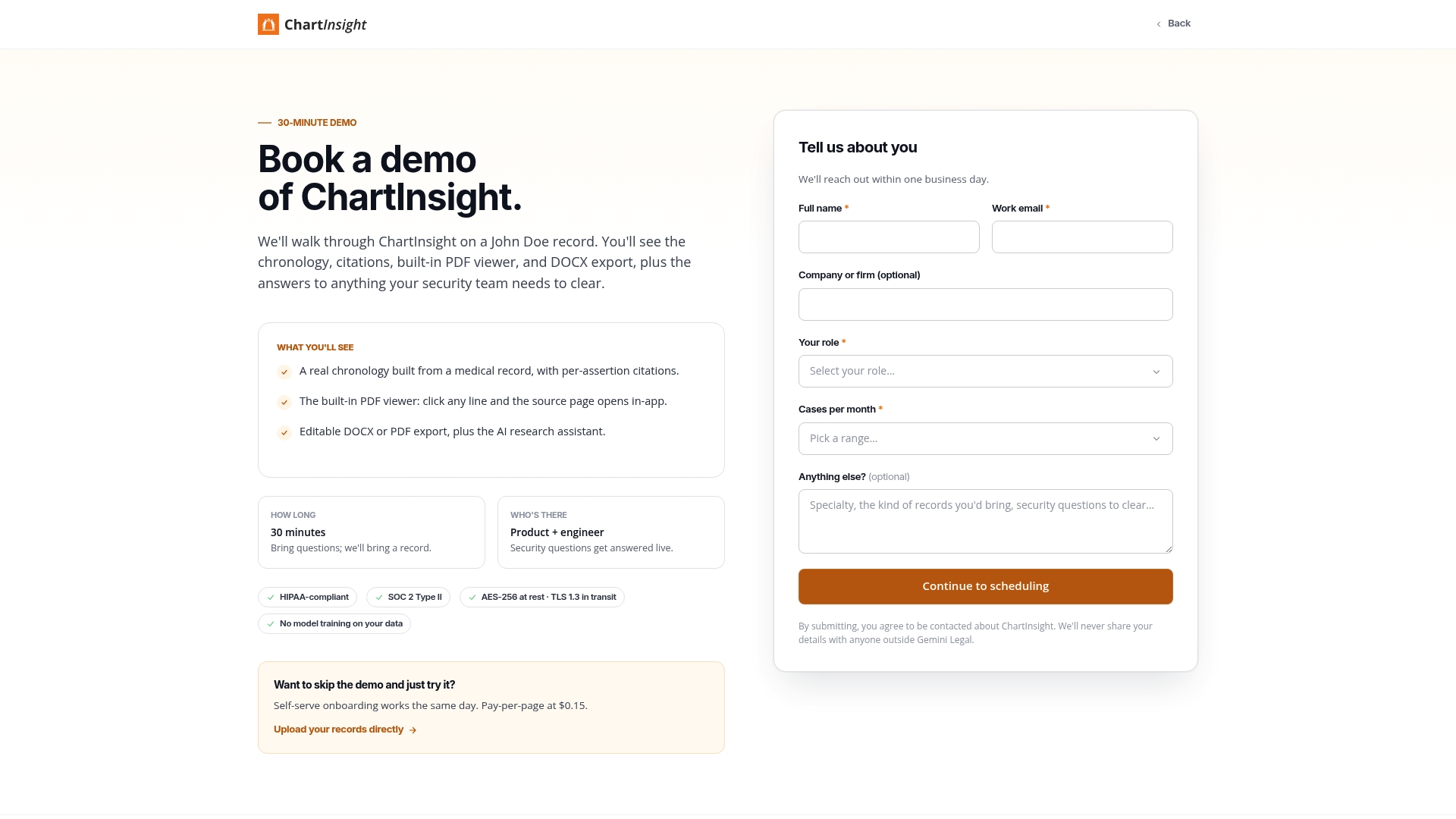
Book a demo to see how ChartInsight turns a multi-thousand-page record into a page-cited chronology your team can defend.
FAQ
What Is a Workers Comp Settlement Valuation Checklist?
A workers comp settlement valuation checklist is a structured list of medical, financial, and legal factors that must be verified before accepting a settlement offer. It covers P&S status, PD rating, future medical costs, liens, Medicare Set-Aside obligations, and benefit rates.
What Is the Difference Between a C&R and a Stipulated Award?
A Compromise and Release pays a lump sum and closes future medical permanently. A Stipulated Award pays structured benefits and keeps the medical claim open, which changes the valuation priorities for each settlement type.
When Is a Medicare Set-Aside Required in a Workers Comp Settlement?
A formal CMS review of a Workers' Compensation Medicare Set-Aside is voluntary, not mandatory. CMS will review a proposed WCMSA only when its workload thresholds are met: the claimant is a current Medicare beneficiary and the total settlement exceeds $25,000, or the claimant has a reasonable expectation of Medicare enrollment within 30 months and the anticipated total settlement exceeds $250,000. Even below those thresholds, the parties must still reasonably protect Medicare's interests under the Medicare Secondary Payer Act.
Why Does the PD Rating Matter So Much in Settlement Valuation?
The PD rating directly determines the indemnity value of the claim. A one or two percent error in the whole person impairment calculation under the AMA Guides can shift the settlement value by thousands of dollars.
What Liens Must Be Resolved Before a Workers Comp Settlement?
California workers' comp settlements must address Medicare, Medi-Cal, EDD (State Disability Insurance reimbursement), health insurance subrogation, child support, and medical provider liens. Each lien reduces net recovery and must be identified and negotiated before the final valuation is complete.