

TL;DR:
- Effective appellate record organization emphasizes issue preservation, strict compliance with FRAP 30 and local rules, and verified citations.
- Poor document selection or disorganized folders cause costly errors, delays, and credibility damage in appeals.
Organizing records for an appellate brief is a precise process of curating relevant documents to directly support your legal issues on appeal. The appellate record, governed by Federal Rule of Appellate Procedure 30 (FRAP 30), is not a complete trial file. It is a curated appendix of excerpts that frames every argument you make. Attorneys who treat it as a bulk upload invite sanctions, cost-shifting, and credibility damage with the panel. The attorneys who win on appeal build their record around preserved legal errors, not trial chronology.
What federal and local rules govern record organization in appellate briefs?
FRAP 30 sets the baseline for every federal appeal. Under the current timing requirements, the appellant must serve a designation of record parts and a statement of issues within 14 days after filing the notice of appeal. The appellee then has 14 days to respond with any counter-designations. Missing these windows does not just create procedural headaches. It can result in a deficient appendix that the court refuses to consider.
Local rules add another layer of specificity that FRAP 30 does not cover. The Ninth Circuit requires that excerpts exceeding 300 pages include a separate index volume, with all pages numbered sequentially starting with the caption page as page 1. Documents are typically organized in reverse chronological order within each volume. That reverse-chronological structure is not optional in that circuit. Filing in forward order will draw a corrective order or rejection.
Formatting mandates apply to the brief itself as well. Federal appellate brief formatting is governed by FRAP 32, which requires proportional fonts of at least 14-point (or monospaced fonts of no more than 10.5 characters per inch), and limits a principal brief to 13,000 words, with multiple paper copies required by many local rules. These requirements are not suggestions. Courts enforce them through word-count certifications and clerk review on intake.
Key formatting and timing obligations under FRAP 30 and local rules:
- Appellant designates record within 14 days of filing notice of appeal
- Appellee has 14 days to file counter-designations
- Ninth Circuit requires a separate index volume when excerpts exceed 300 pages
- Sequential pagination starts at the caption page (page 1)
- Reverse chronological order is required in Ninth Circuit filings
- FRAP 32 requires at least 14-point proportional type and caps a principal brief at 13,000 words
- Multiple paper copies are required under most local rules
Non-compliance carries real consequences. Courts have issued cost-shifting orders against parties who submit bloated or misordered appendices. A deficient appendix can also result in the court striking the brief entirely.
How to categorize and prioritize appellate record materials effectively?
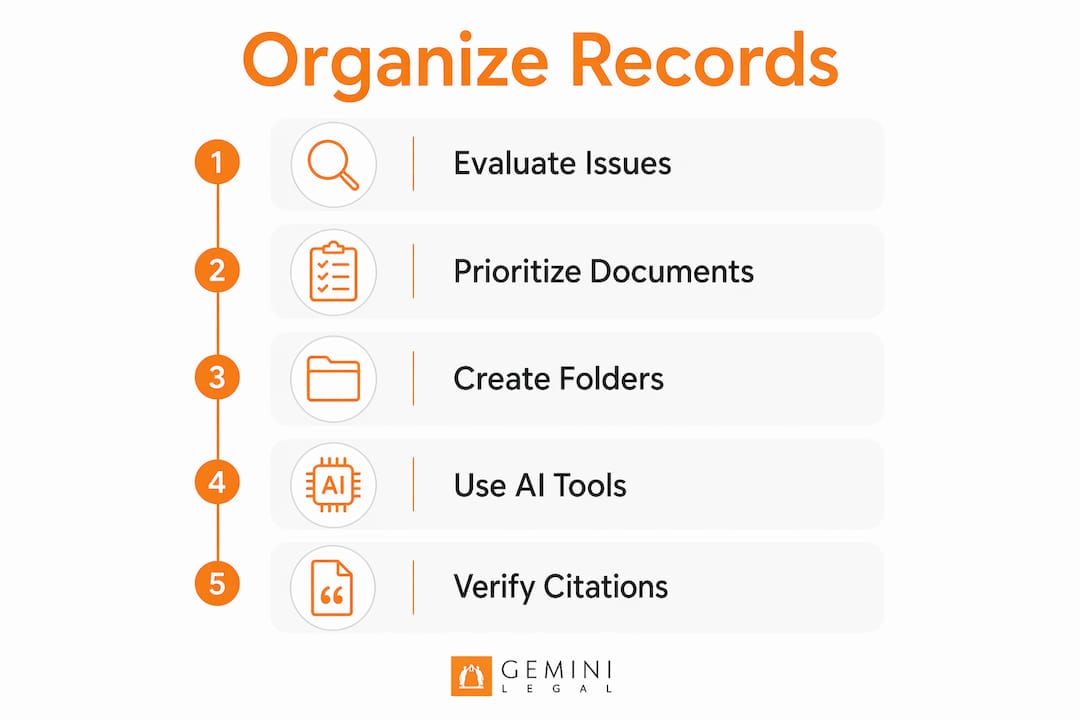
The first step in effective record organization is a threshold evaluation. Appellate courts review records focused on legal error, not the trial story. That means your organization should map to legal issues, not to the sequence of events at trial. Separating questions of law from questions of fact is not just good practice. It is the organizing principle that determines what belongs in the appendix at all.
Issues not raised at trial are forfeited on appeal. Before you pull a single document, confirm that each issue was properly preserved below. An argument built on an unpreserved objection wastes space in the appendix and signals to the panel that the brief was not carefully vetted. The standard of review for each preserved issue also shapes what record evidence matters. A de novo issue requires the full legal record on that point. A substantial evidence issue requires the specific findings and the evidence that supports or contradicts them.
Over-inclusion causes cost-shifting or sanctions under FRAP 30. Appellate judges use the appendix as a selective reference tool, not a comprehensive file. Padding it with every deposition transcript and exhibit from trial signals that counsel did not do the analytical work of identifying what actually matters. It also buries the key documents that the panel needs to find quickly.
Essential components of a well-organized appellate appendix:
- Relevant portions of the docket sheet
- Notice of appeal
- Judgment or order being appealed
- Jury instructions (if jury trial)
- Findings of fact and conclusions of law
- Relevant trial court orders on preserved issues
- Transcript excerpts tied to specific legal arguments
- Exhibits directly cited in the brief
Pro Tip: Build your appendix table of contents before you draft the brief. If a document does not appear in the table of contents, it should not be in the appendix. This discipline prevents padding and forces early clarity on which issues you are actually pursuing.
What folder structures and document management techniques optimize record organization?
Flat file storage is the most common and most damaging mistake in appellate document management. Dumping every PDF into a single folder makes targeted retrieval slow and makes AI-assisted queries unreliable. Structured folder organization using top-level divisions of Authorities, Briefs, and Record with issue-based subfolders produces faster retrieval and more accurate AI outputs. The structure forces categorization decisions early, which is exactly the analytical work that strengthens the brief.
A practical folder hierarchy for a federal appeal looks like this:
- Record/ with subfolders by issue (e.g., Record/Jurisdiction, Record/Damages, Record/Evidentiary)
- Briefs/ containing draft versions, filed versions, and opposing briefs
- Authorities/ organized by circuit, statute, and secondary sources
- Working/ for chronologies, timelines, and AI-generated summaries
AI tools assist with digesting records, creating chronologies, extracting citations, and verifying accuracy. That assistance is only as good as the folder structure feeding it. An AI query run against a flat file of 10,000 pages returns noise. The same query run against a folder scoped to a single issue returns usable results.
ChartInsight produces structured, page-cited outputs from large medical records, including chronologies, narrative summaries, and medications tables. Every extracted fact carries a live citation back to the exact source page. For appeals involving medical evidence, that means a paralegal can verify a factual claim in the brief by clicking a citation rather than manually searching a 5,000-page PDF. The live PDF viewer keeps the reviewer in one place rather than toggling between a summary document and the underlying record.

Pro Tip: When using AI to assist with record review, scope each query to a single issue folder rather than the full record. Narrow inputs produce cited, usable outputs. Broad inputs produce summaries too general to cite in a brief.
What are best practices for citing and cross-referencing records in appellate briefs?
Every factual assertion in an appellate brief requires a precise record citation. Uncited facts are disregarded by the panel and read as fabricated. That is not a stylistic preference. It is the standard of practice in every federal circuit. Pincites to specific pages and line numbers are required, not optional. A citation to a 200-page transcript without a page number is functionally useless to the reviewing judge.
Citation verification is a separate step from citation drafting. Shepardizing case law before filing confirms that cited authorities remain good law. Record citations require their own verification pass: confirm that the page cited actually contains the fact asserted, that the excerpt is included in the appendix, and that the appendix page number matches the citation in the brief. These three checks catch the most common citation errors before filing.
Standardized citation formats reduce friction for the panel. Most federal circuits follow the Bluebook, but local rules sometimes require circuit-specific formats for record citations. The Ninth Circuit, for example, uses "ER" for Excerpts of Record followed by the page number. Using the wrong format signals unfamiliarity with local practice and can draw a corrective order.
Steps to verify citations before filing:
- Confirm every factual statement in the brief has a record citation with a specific page number
- Verify the cited page is included in the appendix
- Confirm the appendix page number in the brief matches the physical document
- Shepardize every case citation for current validity
- Check that citation format complies with local rules, not just the Bluebook
Pro Tip: Run a final citation audit the day before filing. Search the brief for every instance of "ER," "R.," or your circuit's record citation abbreviation and confirm each one resolves to a real page in the appendix. This takes two hours and prevents a corrective order.
How to avoid common mistakes in record organization?
The most common mistake is over-inclusion. Attorneys who are uncertain about which documents matter tend to include everything. Appendix padding risks cost-shifting and sanctions under FRAP 30, and it signals to the panel that counsel did not exercise judgment. A 2,000-page appendix for a single-issue appeal is a red flag, not a sign of thoroughness.
The second most common mistake is omitting required documents. The docket sheet and notice of appeal belong at the end of the final volume in Ninth Circuit filings, placed there for clerk reference. Missing either document can result in administrative rejection before the brief reaches a judge. Some attorneys also omit the judgment or order being appealed, which is the single most important document in the appendix.
Relying on unverified citations is the third major failure point. A brief that cites a record page that does not exist, or that misquotes a transcript, destroys credibility with the panel. Courts notice. Some panels have noted citation errors in published opinions.
Pre-filing compliance checklist:
- All designated record parts served within 14 days of notice of appeal
- Appendix includes judgment, notice of appeal, and docket sheet
- All documents cited in the brief appear in the appendix
- Pagination is sequential and matches citations in the brief
- Index volume included if excerpts exceed 300 pages (Ninth Circuit)
- Citation format complies with local rules
- Word count certification completed and accurate
A deficient appendix does not just create procedural problems. It tells the panel that the attorney did not take the appeal seriously. Courts have discretion to tax costs for unnecessary appendix materials, and they use it.
Key takeaways
Effective appellate record organization requires issue-focused selection, strict compliance with FRAP 30 and local rules, and verified citations at every level of the brief.
| Point | Details |
|---|---|
| Issue-focused selection | Organize the appendix by preserved legal issues, not trial chronology, to match appellate review standards. |
| FRAP 30 timing compliance | Serve record designations within 14 days of filing to avoid deficiency orders or waiver. |
| Avoid appendix padding | Include only documents directly cited in the brief; over-inclusion risks cost-shifting under FRAP 30. |
| Structured folder hierarchy | Use top-level folders (Authorities, Briefs, Record) with issue-based subfolders for accurate retrieval and AI queries. |
| Verify every citation | Confirm each record citation resolves to a real page in the appendix before filing. |
What ChartInsight has learned from working with appellate teams
The attorneys who struggle most with appellate record organization are the ones who treat it as an administrative task rather than a legal one. Teams routinely spend days assembling appendices that a judge will flip through in minutes, only to receive a corrective order because the docket sheet was missing from the final volume. The document selection decisions are legal decisions. They require the same analytical rigor as the argument section of the brief.
The most effective appellate teams build their appendix table of contents before they write a single word of argument. That discipline forces them to identify which issues are actually viable, which record evidence supports each issue, and which documents are genuinely necessary. It also makes the brief faster to write because the record is already organized around the arguments.
AI assistance changes the time equation significantly, but only when the underlying record is structured correctly. A well-organized folder hierarchy fed into an AI tool produces cited chronologies and issue summaries in hours rather than days. A flat file of thousands of pages produces noise. The tool is only as good as the structure behind it. For medical record-heavy appeals, tools like ChartInsight that produce page-cited record summaries cut verification time from days to hours and keep every factual claim defensible.
The uncomfortable truth about appellate practice is that most citation errors are not caught before filing. They are caught by opposing counsel or by the panel. A two-hour citation audit the day before filing is the single highest-return investment a paralegal can make on any appeal.
ChartInsight for appellate record management
Appellate teams working with large medical records face a specific problem: the record is often thousands of pages across multiple providers, and every factual claim in the brief must trace back to a specific page.

ChartInsight takes that full medical record and produces structured outputs including a chronology, a nine-section narrative summary, and a medications table, with every extracted fact carrying a live citation to its source page. The built-in PDF viewer lets attorneys and paralegals verify a citation without leaving the application or downloading a separate file. For workers' comp appeals, personal injury cases, and med-legal matters, that means record review time drops from days to hours. Every output exports to DOCX or PDF with page citations preserved, so the brief and the record stay aligned through every draft.
FAQ
What is FRAP 30 and why does it matter for appellate briefs?
FRAP 30 governs the content and timing of the appendix in federal appeals. It requires the appellant to designate record parts within 14 days of filing and prohibits over-inclusion, with sanctions available for unnecessary materials.
How should documents be ordered in an appellate appendix?
The Ninth Circuit requires reverse chronological order within volumes, with the docket sheet and notice of appeal placed at the end of the final volume for clerk reference. Other circuits may vary, so check local rules before filing.
What happens if the appendix is missing required documents?
Courts can issue corrective orders, reject the filing administratively, or tax costs against the offending party. Missing the judgment or notice of appeal is the most common cause of administrative rejection.
How does AI assist with appellate record organization?
AI tools can create chronologies, extract citations, and summarize large records when the underlying files are organized in structured, issue-based folders. Flat file storage reduces AI output quality significantly.
What is the most common citation error in appellate briefs?
The most common error is citing a record page that does not appear in the appendix, or citing a page that does not contain the fact asserted. A pre-filing citation audit that checks each citation against the physical appendix catches both errors.