

TL;DR:
- Liens in personal injury cases are third-party rights to be paid from settlement funds before the plaintiff receives remaining proceeds. Proper identification, documentation, and negotiation of liens help limit their impact on the plaintiff's net recovery. Early lien resolution and understanding legal rules are essential to avoid delays, overpayment, and liability.
A lien in a personal injury case is a third party's legal right to be paid from your settlement proceeds before you receive any remaining funds. Lienholders include healthcare providers, Medicare, Medicaid, private insurers, and workers' compensation carriers. The lien personal injury process reduces your net recovery but does not eliminate it. Understanding which liens apply, how they are calculated, and how they can be negotiated is the difference between walking away with a fair recovery and being blindsided at disbursement.
What are the main types of personal injury liens?
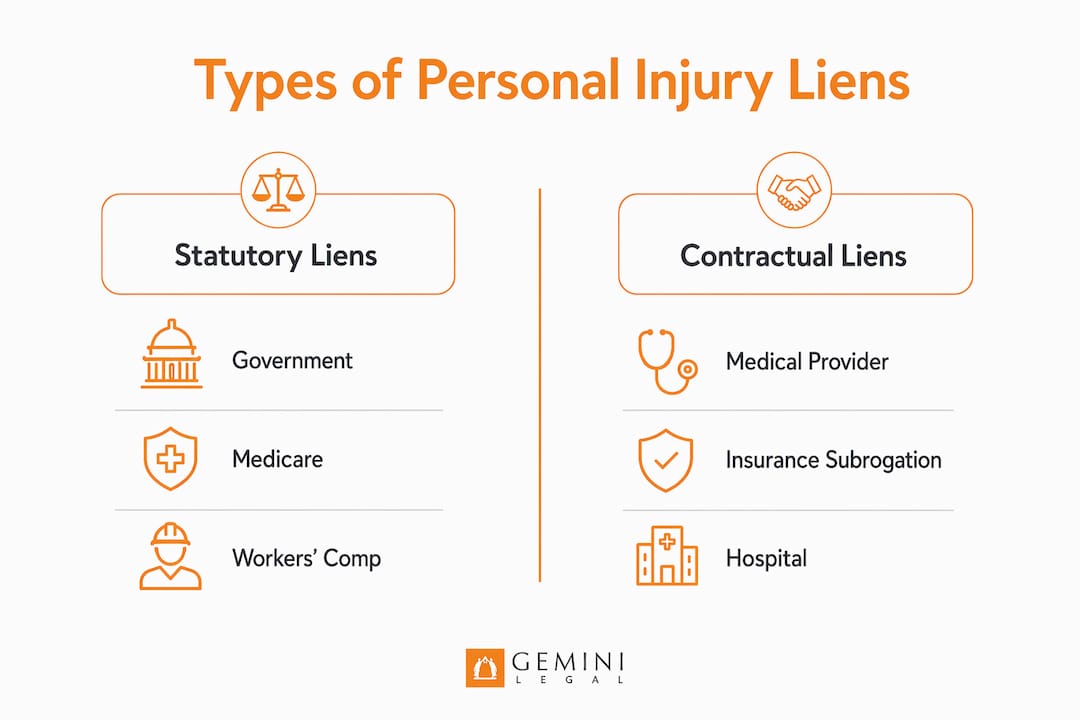
Personal injury liens fall into two broad categories: statutory liens and contractual liens. Statutory liens arise from federal or state law and carry mandatory repayment obligations. Contractual liens arise from agreements between a provider and a patient, and they are generally more negotiable when case value is limited by policy limits or comparative fault.

Medical provider liens are the most common contractual liens. A hospital or physician treats an injury victim on a lien basis, deferring payment until settlement. The provider records the lien and expects repayment from proceeds.
Insurance subrogation liens arise when a private health insurer pays medical bills related to the injury. The insurer then asserts a right to reimbursement from the tortfeasor's settlement funds. ERISA-governed plans carry especially strong subrogation rights that limit a plaintiff's ability to negotiate reductions.
Government liens are the most legally rigid. The Medicare Secondary Payer framework, codified at 42 U.S.C. § 1395y, mandates repayment of conditional payments when a primary payer is responsible. Medicaid enforces recovery from settlement portions allocated to medical care, though non-medical damages are generally protected under the Medicaid Act framework.
Workers' compensation liens apply when an employer's carrier has paid benefits for a work-related injury that is also the subject of a third-party personal injury claim. The carrier holds a statutory right to recover its outlay from any third-party recovery.
| Lien Type | Legal Basis | Negotiability |
|---|---|---|
| Medical provider lien | Contractual | High |
| Insurance subrogation | Contract or ERISA | Moderate to low |
| Medicare (MSP) | 42 U.S.C. § 1395y | Limited by formula |
| Medicaid | Federal/state statute | Limited |
| Workers' compensation | State statute | Moderate |
How do liens affect your net settlement recovery?
Lienholders are paid from proceeds before the plaintiff receives any distribution. That payment priority is not optional. The order typically runs: attorney fees and costs first, then government liens, then private insurer subrogation, then medical provider liens, with the plaintiff receiving whatever remains.
A common misconception is that a lien wipes out the entire settlement. Liens only reduce net recovery. A plaintiff who settles for $100,000 with $30,000 in attorney fees and $20,000 in total liens still receives $50,000.
How procurement costs reduce Medicare liens
The most underused tool in Medicare lien resolution is the procurement cost formula under 42 C.F.R. § 411.37. Attorney fees and litigation expenses are classified as procurement costs. Medicare must reduce its conditional payment demand to reflect its proportional share of those costs.
A concrete example from LegalClarity: on a $100,000 settlement with $38,000 in attorney fees and expenses, the procurement cost ratio is 38%. If Medicare paid $15,000 in conditional payments, Medicare's share of procurement costs is $5,700 ($15,000 x 0.38). The final repayment obligation drops from $15,000 to $9,300, and it requires nothing more than documenting the attorney fee percentage and submitting it to the Centers for Medicare and Medicaid Services (CMS).
The steps for calculating the reduction are straightforward:
- Obtain the current conditional payment amount from the CMS Medicare Secondary Payer Recovery Portal (MSPRP).
- Calculate the procurement cost ratio: total attorney fees and costs divided by gross settlement amount.
- Multiply the ratio by the total conditional payment amount to determine Medicare's share of procurement costs. Subtract that share from the conditional payment to determine the reduced repayment amount.
- Submit the calculation with supporting documentation to CMS before final settlement disbursement.
- Wait for CMS's final demand letter before releasing any funds.
Pro Tip: Document every litigation expense, including expert witness fees, deposition costs, and court filing fees. Each dollar of documented expense increases the procurement cost ratio and directly reduces the Medicare repayment obligation.
Plaintiffs often treat the initial CMS conditional payment letter as the final number. It is not. CMS conditional payment demands represent an interim snapshot, and the final repayment amount is calculated only after settlement reporting. Disbursing funds before receiving the final CMS payoff confirmation exposes the attorney to personal liability for the unpaid balance.
What are best practices for identifying and resolving injury liens?
Lien resolution for accidents starts at intake, not at settlement. Attorneys who wait until a settlement offer arrives to identify liens routinely face delays, holdbacks, and angry clients who expected a larger check.
Early identification steps:
- Request a Medicare eligibility verification at intake for any client over 65 or receiving Social Security Disability Insurance.
- Send a written lien inquiry to every treating provider within 30 days of engagement.
- Request the client's health insurance Explanation of Benefits statements to identify insurer payments and potential subrogation claims.
- Check for workers' compensation claim numbers if the injury occurred in a workplace context.
- Pull any hospital records to identify whether treatment was provided on a lien basis or billed to insurance.
Negotiation levers and legal limits
Contractual provider liens are the most negotiable category. When a case settles for less than the full claimed damages, providers often accept a reduced payoff rather than receive nothing. The negotiation argument is simple: the plaintiff's recovery is limited, and the provider's lien competes with other obligations.
Government liens operate under different rules. Medicare reductions follow the procurement cost formula. Medicaid reductions are governed by state-specific statutes and federal coordination rules. ERISA subrogation claims are the hardest to reduce because federal law preempts most state anti-subrogation protections.
Pro Tip: Request itemized billing from every lienholder before negotiating. Providers sometimes include charges unrelated to the injury. Removing those charges from the lien amount is a faster reduction than negotiating a percentage discount.
Managing simultaneous provider, insurance, and government liens requires creating a prioritized payoff schedule that reflects each lienholder's legal recovery rights. Attorneys who skip this step and disburse funds prematurely face personal liability under the Medicare Secondary Payer statute for the unpaid conditional payment amount.
How do California's rules affect hospital liens specifically?
California's Hospital Lien Act, codified in Civil Code sections 3045.1 through 3045.6, gives hospitals that provide emergency care a statutory lien against a patient's injury recovery. The lien attaches to the recovery, not to the patient personally. That distinction matters: a hospital cannot pursue the plaintiff's personal assets under the Hospital Lien Act alone.
Section 3045.3 caps the lien at the reasonable and necessary value of the services provided. Section 3045.6 excludes attorney's fees from the lien's reach. The practical effect is that the hospital cannot recover more than the reasonable value of its services, and only from the portion of the recovery that excludes attorney's fees.
| California Hospital Lien Act Feature | Rule |
|---|---|
| Lien cap | Reasonable and necessary value of services (section 3045.3) |
| Lien attaches to | Injury recovery, not personal assets |
| Enforceability requirement | Proper notice and perfection (section 3045.2) |
| Consequence of noncompliance | Hospital loses statutory lien rights |
Enforceability is the critical variable. Hospital Lien Act liens are procedurally fragile. The hospital must serve written notice on the patient, the patient's attorney if known, and the insurance carrier or tortfeasor before any payment is made on the claim. The notice must be served by registered or certified mail with return receipt requested (section 3045.2). Failure to meet these requirements means the hospital loses its statutory lien rights against the recovery. The hospital retains a separate patient debt claim, but that claim does not attach to settlement proceeds and cannot be enforced against disbursed funds.
Pro Tip: Always request proof of lien perfection from any hospital asserting a California Hospital Lien Act claim. A lien that was not properly noticed and recorded is unenforceable against the settlement, and many hospitals miss the procedural deadlines.
The distinction between a statutory hospital lien and a contractual provider lien also affects negotiation strategy. A properly perfected Hospital Lien Act lien carries the reasonable-value cap as a ceiling. A contractual lien has no statutory cap, but it is more susceptible to negotiation based on case value and comparative fault.
Key Takeaways
Personal injury liens are mandatory repayment obligations that reduce net settlement proceeds, but proper identification, documentation, and negotiation can significantly limit their impact.
| Point | Details |
|---|---|
| Liens reduce net recovery | Lienholders are paid before the plaintiff, but the plaintiff still receives remaining funds. |
| Medicare liens follow a formula | The procurement cost ratio under 42 C.F.R. § 411.37 can substantially reduce CMS repayment demands. |
| Early identification prevents delays | Lien discovery at intake, not at settlement, keeps disbursement on schedule. |
| California hospital liens are capped at reasonable value | The Hospital Lien Act limits recovery to the reasonable and necessary value of services (section 3045.3), but only if the lien is properly perfected. |
| Premature disbursement creates liability | Attorneys who release funds before final CMS confirmation risk personal liability for the unpaid Medicare conditional payment amount. |
Why lien management is harder than it looks in practice
The pattern in hundreds of personal injury files is consistent: the settlement closes, the attorney sends a demand to each lienholder, and then the file sits for weeks while CMS processes the final payoff confirmation. The client is frustrated. The attorney is exposed. The problem started at intake.
The procurement cost reduction is the most undervalued tool in practice. Attorneys document their fee percentage but rarely itemize every litigation expense. Expert fees, deposition transcripts, and court costs all count. Leaving those out of the procurement cost calculation is leaving money on the table, specifically the client's money.
The interaction between multiple lien types is where cases get genuinely complicated. A plaintiff with Medicare coverage, a workers' compensation carrier, and a hospital lien faces three separate legal frameworks with different priority rules, different negotiation limits, and different documentation requirements. A lien payoff schedule assembled the day before disbursement is too late. A payoff schedule built at intake, updated at each stage of litigation, and reconciled against the final settlement allocation is the only workflow that holds up under scrutiny.
The other risk that appears consistently is treating Medicaid and Medicare as interchangeable. They are not. Medicaid recovery is governed by a mix of federal coordination rules and state-specific statutes. The protections for non-medical damages differ by state. An attorney who applies Medicare logic to a Medicaid lien will get the math wrong and potentially expose the client to a recovery claim on funds that should have been protected.
ChartInsight cuts medical record review time for lien work
Lien compliance in personal injury cases depends on accurate, defensible documentation of treatment timelines, provider charges, and injury causation. Pulling that information from a multi-provider medical record that runs to thousands of pages is where review time disappears.

ChartInsight, built by Gemini Legal, processes the full medical record and produces a structured chronology, a nine-section narrative summary, a medications table, and normalized vitals, with every extracted fact carrying a live citation back to the exact source page. For attorneys managing Medicare Secondary Payer compliance or building a lien payoff schedule, that means the treatment history and charge documentation needed to support a procurement cost calculation is ready in hours, not days. The original record is never altered. Every output is exportable to DOCX or PDF with page citations preserved. Book a demo to see how ChartInsight fits into your lien resolution workflow.
FAQ
What is a lien in a personal injury case?
A lien is a third party's legal right to be paid from a plaintiff's settlement before the plaintiff receives any remaining funds. Common lienholders include healthcare providers, Medicare, Medicaid, private insurers, and workers' compensation carriers.
Can Medicare liens be reduced?
Yes. The procurement cost formula under 42 C.F.R. § 411.37 reduces Medicare's conditional payment demand based on the ratio of attorney fees and litigation costs to the gross settlement amount. Proper documentation of all litigation expenses is required to apply the reduction.
What happens if an attorney disburses funds before Medicare confirms the final payoff?
The attorney faces personal liability under the Medicare Secondary Payer statute for the unpaid conditional payment amount. Funds should be held in trust until CMS issues its final demand letter confirming the repayment amount.
Are California hospital liens always enforceable?
No. California Hospital Lien Act liens require proper notice served by registered or certified mail on the patient, the patient's attorney, and the insurance carrier or tortfeasor before payment is made on the claim (section 3045.2). A hospital that misses these procedural requirements loses its statutory lien rights against the recovery.
How do medical liens differ from insurance subrogation?
A medical provider lien is a contractual claim by a treating provider who deferred payment. Insurance subrogation is a statutory or contractual right allowing an insurer that paid medical bills to recover those payments from the settlement. ERISA-governed subrogation claims are the hardest to reduce because federal law preempts most state anti-subrogation protections.