

TL;DR:
- AI medical chronologies are defensible only when every extracted fact resolves back to a specific page of the source record that a reviewer can open and read.
- ChartInsight produces page-level citations, and clicking a citation opens the source PDF at that page inside the application, so verification is a click rather than a search.
- Courts evaluate these outputs under existing evidence rules, principally Federal Rules of Evidence 901 and 702, and the attorney filing them remains responsible for verifying every citation.
An AI chronology with page citations is an automatically generated, date-ordered record of medical and case events where every extracted fact links back to its source page in the original document. For personal injury litigation, that traceability is not a convenience. It is the difference between a chronology an attorney can defend and one that creates liability.
Here is what a properly built AI chronology delivers:
- Automated event extraction: AI parses medical records to pull dates, provider names, diagnoses, treatment notes, and clinical findings without manual data entry.
- Page-level citations: Each extracted fact carries a reference to the specific page, or page range, in the source document where it appears.
- Source document linkage: Citations connect directly to the original PDF, so any reviewer can verify a claim in seconds.
- Structured medical event sequencing: Events are organized chronologically, making it straightforward to trace injury onset, treatment progression, and recovery milestones.
- Auditability: Every output can be traced to its source page, which is what an attorney needs in order to authenticate the underlying record under Federal Rule of Evidence 901 and to meet the supervision duty the ABA describes in Formal Opinion 512.
Without source linking, AI-generated summaries carry real risk. Courts have sanctioned attorneys for submitting AI outputs containing hallucinated citations. In Mata v. Avianca, Judge P. Kevin Castel imposed a $5,000 penalty on two attorneys and their firm for filing a brief built on non-existent judicial opinions produced by ChatGPT, then standing behind those opinions after the court questioned them. A public database maintained by legal-data researcher Damien Charlotin now tracks more than 1,800 court decisions worldwide addressing AI-hallucinated material. A chronology that cannot be verified page by page is a liability, not a tool.
How AI medical chronologies support personal injury litigation
Personal injury attorneys and paralegals deal with medical records that routinely run into the thousands of pages, often assembled from multiple providers with inconsistent formatting. AI medical chronologies address that volume problem directly, but the use cases go further than simple organization.
Pre-demand case screening is where many firms see the fastest return. An AI chronology lets a paralegal or legal nurse consultant assess the strength of a claim before significant attorney time is invested, identifying gaps in treatment, inconsistencies in provider notes, or missing diagnostic records that would undermine a demand.
Demand letter preparation benefits from the same output. When every medical event in the chronology links to a source page, the attorney drafting the demand can cite records with confidence rather than relying on a summary that may have introduced transcription errors.
For deposition and trial support, a page-cited chronology gives counsel a reliable reference during cross-examination of treating physicians or expert witnesses. If a defense IME physician contradicts a treating provider's finding, the attorney can pull the exact page immediately.
Causation and pre-existing condition analysis is the most contested area in most PI files, and it is where source linking earns its keep. The pre-incident diagnosis buried in a years-old primary-care note is exactly what both sides fight over. A structured, source-linked extraction makes it findable instead of a matter of luck.
The contrast with traditional manual chronologies is significant:
- Manual chronologies take days to build from voluminous records and are only as accurate as the reviewer's attention across every page.
- AI chronologies are generated in hours, with citations attached at extraction rather than added afterward.
- Manual methods rarely carry a source reference on every entry; AI tools built for litigation attach one to each extracted fact at the moment of extraction.
- Errors in manual chronologies are discovered late, often during deposition prep. AI citation errors surface during review, when they are still fixable.
Firms that also carry California workers' compensation matters get the same benefit on a different deliverable. A physician preparing a permanent and stationary report is required to review the record, and no tool changes that obligation. What a source-cited chronology removes is the manual assembly work: locating the relevant treatment dates, transcribing them, and hand-building the citation list. The reading still happens; the clerical work does not.
How AI automates medical record analysis to build cited chronologies
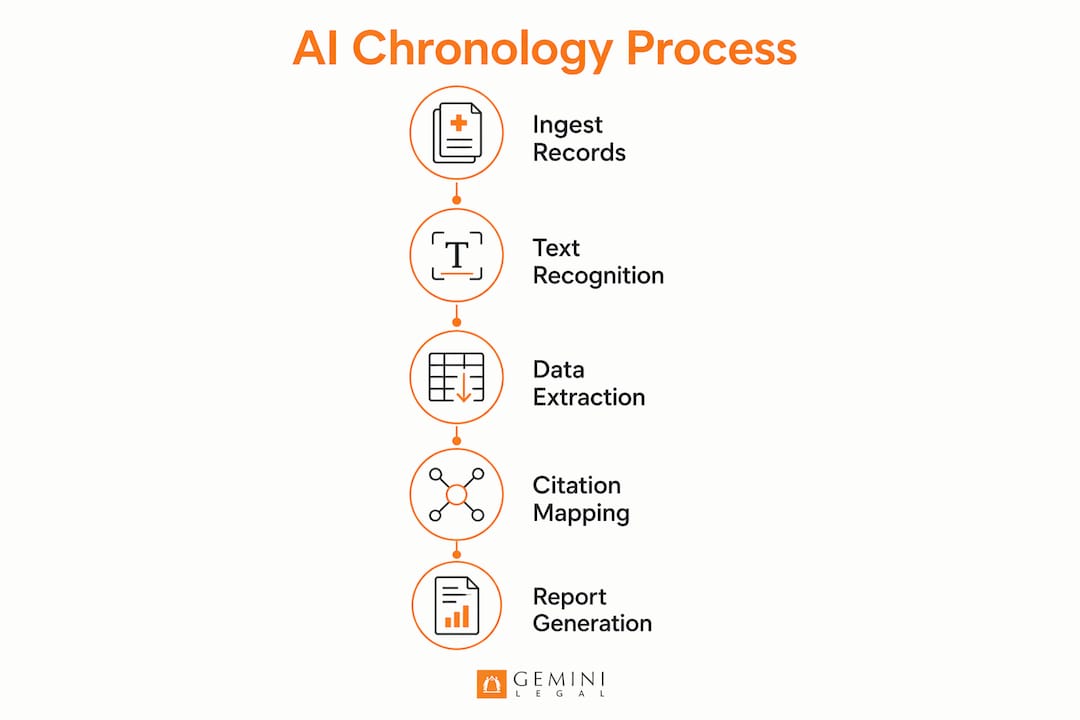
The extraction process starts at the document level. AI tools ingest the full medical record, typically a multi-provider PDF, and apply natural language processing to identify structured data points: dates of service, provider names, diagnoses, procedure codes, medication changes, vital signs, and clinical findings.

Text recognition handles records that were scanned rather than digitally generated, converting image-based pages into machine-readable text before extraction begins. Once the text is processed, the system assigns a citation to each extracted fact, recording the file and the page number, or a page range where a finding spans several pages. That citation travels with the fact through every downstream output: the chronology, the narrative summary, the vitals table, and the medications table.
The practical result is a workflow where AI extracts event dates, providers, diagnoses, and findings automatically, attaching a source reference to each item. A 2,000-page file takes roughly 6 to 10 hours to review by hand. Automated extraction compresses the assembly step into hours, and because each item carries its source reference, the verification pass is a click rather than a search.
The reduction in manual data entry also reduces transcription errors. When a reviewer copies a date or diagnosis from a record by hand, small errors accumulate. AI extraction reads the source directly, and the citation points back to that source, so any discrepancy is immediately visible during review.
What to look for when evaluating AI chronology tools
Not all AI chronology tools meet the bar for litigation use. The criteria that matter are not about interface design or feature counts. They are about whether the output can be defended.
- Deterministic citation resolution: Every extracted fact must carry a source reference that resolves to a specific page you can open, every time, without the model regenerating it. A page number printed next to a sentence is not the same thing as a citation you can click into.
- Integrated PDF viewer: Reviewers need to verify citations without leaving the application. Tools that require downloading source files or switching between windows break the audit trail.
- HIPAA compliance: Medical records contain protected health information. Any AI tool handling personal injury records must meet HIPAA security standards, including data encryption and access controls.
- Hallucination risk controls: AI systems can generate plausible-sounding facts that do not exist in the source record. A Stanford RegLab study found that leading commercial legal research tools marketed as "hallucination-free" still hallucinated between 17% and 33% of the time. Look for a tool where every entry is editable and traceable, so a reviewer can catch and correct an error against the source page rather than trusting the output.
- Citation export: Confirm that DOCX and PDF exports preserve the page citations rather than stripping them, and check whether citation inclusion is a setting you control at export time.
- Audit trail integrity: The original source document must remain unaltered. Any tool that modifies the source record creates chain-of-custody problems.
- Handling of complex records: Incomplete records, inconsistent provider formatting, and metadata errors are common in personal injury files. Evaluate how the tool handles gaps and whether it flags them rather than silently omitting them.
The risk is not theoretical. As Judge Castel wrote in the Mata sanctions order, "existing rules impose a gatekeeping role on attorneys to ensure the accuracy of their filings." Citation verification is not a quality-control nicety; it is the gatekeeping step the rules already require.
Pro Tip: Before committing to any AI chronology tool, run a test on a record you know well. Verify five citations manually against the source PDF. If any citation is wrong or missing, the tool is not ready for litigation use.
Why integrated evidence workflows are the real differentiator
The tools that hold up in litigation are not the ones with the most features. They are the ones where the AI output and the source evidence live in the same place, with no gap between what the summary says and what the record proves.
Clickable citations that open the exact source page inside the application are what make this possible. When a reviewer clicks a citation and the source PDF opens to the right page, the chain of custody stays intact. When the reviewer has to download a file, search for the page, and compare it manually, errors accumulate and the audit trail weakens.
ChartInsight is built around this principle. Every fact in a ChartInsight chronology carries a citation back to its page in the source PDF, and clicking that citation opens the document inside the application at that page rather than in a separate tab. The same citation structure applies to the narrative summary, which runs to nine sections in its general form, as well as the vitals table, the medications table, and any custom sections a team has configured through Templates. The original record is not altered.
The same structure matters for the reviewing physicians on the other side of a personal injury file, including defense IME physicians and, in workers' compensation matters, QME and AME reviewers. ChartInsight's AI Research Assistant lets a reviewer ask a question about the record and receive an answer with citations pointing to the source pages, so locating a specific treatment date or finding does not require a manual search of the full file. A comprehensive Deep Research mode is also available, subject to how a team's account is configured. Neither replaces the reviewer's obligation to review the record; both remove the search and transcription work around it.
That difference is measurable. In a study of 433 processed records, Gemini Legal compared expert human medical summaries against AI-generated indexes of the same records and found 1,318 clinician-documented findings that the human summaries had missed, across 92% of records. The methodology was a semantic side-by-side review rather than a keyword match, with negated findings, hypotheticals, and self-reported questionnaire items excluded from the count.
Legal teams adopting AI chronology tools should align their workflows with the applicable court and evidentiary standards from the start. That means configuring output templates to match the format the deliverable requires, maintaining a consistent prompt library across matters, and establishing a review step where a paralegal or attorney verifies a sample of citations before any output leaves the firm.
Pro Tip: Set up separate ChartInsight Templates for each deliverable your firm produces, for example one for demand-letter chronologies and one for deposition-prep outlines. Consistent output formats reduce review time and make citation audits faster.
Admissibility standards for AI-generated chronologies in court
Federal courts evaluate AI-generated material under the existing evidentiary framework rather than a new one, principally Federal Rule of Evidence 901 on authentication and, where expert testimony is involved, Rule 702 on the reliability of expert opinion. Most state rules track the federal model closely. An AI chronology is not automatically admissible. It must be authenticated, and the attorney offering it must be able to explain how it was generated and how its accuracy was verified.
The practical question is straightforward: can the proponent trace every fact in the chronology back to a specific page in an authenticated source document? If yes, the chronology functions as a demonstrative aid with a clear evidentiary foundation. If not, opposing counsel will challenge it, and the court may exclude it or, in cases involving fabricated citations, sanction the filing attorney.
HIPAA intersects with this in personal injury cases because medical records introduced as evidence must have been handled in compliance with privacy regulations throughout the review process. An AI tool that processed records outside a HIPAA-compliant environment creates a compliance problem, and it gives opposing counsel an additional line of attack on how the record was handled. The HHS HIPAA framework applies to any entity handling protected health information, including legal vendors processing medical records on behalf of attorneys.
Bar guidance is explicit on responsibility. ABA Formal Opinion 512, the ABA's first formal opinion on generative AI, states that lawyers using these tools must satisfy their duties of competence, confidentiality, supervision, candor toward the tribunal, and reasonable fees. Several state bars have issued parallel guidance. That supervisory obligation makes the citation verification step in any AI chronology workflow a professional responsibility issue, not just a quality control one.
ChartInsight was built for exactly this problem: voluminous medical records, time pressure, and the need for every output to be defensible. It is built by Gemini Legal, which has processed more than 100 million pages of medical-legal records. If your team is spending days building chronologies that still require manual citation checks, book a demo of ChartInsight to see what the workflow looks like when citations are built in from the start.
Key Takeaways
AI chronology tools that resolve every fact to a source page are the only AI outputs a personal injury attorney can defend on traceability, PHI handling, and authentication.
| Point | Details |
|---|---|
| Citations are non-negotiable | Every extracted fact must resolve to a specific page in the source document that a reviewer can open and read. |
| Integrated PDF viewer matters | Reviewers must verify citations without leaving the application to maintain an unbroken audit trail. |
| HIPAA compliance is mandatory | Any AI tool handling personal injury medical records must meet HHS HIPAA security standards. |
| Court sanctions are documented | In Mata v. Avianca, the court imposed a $5,000 penalty for a filing built on AI-fabricated opinions. |
| Assembly time drops significantly | A 2,000-page file takes 6 to 10 hours to review by hand. Automated extraction compresses the assembly and citation work into hours. |
FAQ
What is an AI medical record summary for lawyers?
An AI medical record summary is an automatically generated document that extracts and organizes key clinical facts from medical records, including dates, diagnoses, treatments, and provider notes, with citations linking each fact to its source page. For personal injury attorneys, it replaces the manual assembly and transcription work behind a chronology and provides a sourced foundation for demand letters and court filings.
Is it acceptable to use AI for citations in legal cases?
Yes, provided the attorney supervises the output and verifies citation accuracy before filing. ABA Formal Opinion 512 places duties of competence, supervision, and candor toward the tribunal on the lawyer using the tool, and courts expect the proponent to authenticate every cited fact back to its source document.
Which AI tools work best for legal chronologies with citations?
Tools purpose-built for litigation, meaning those with an integrated PDF viewer, page-level citations that survive export to DOCX and PDF, and HIPAA-compliant data handling, are the appropriate choice. General-purpose AI writing tools lack the citation traceability and audit trail features that court standards require.
How do AI chronology tools handle HIPAA compliance?
Litigation-grade AI chronology tools apply encryption to data at rest and in transit and restrict access through role-based controls. ChartInsight encrypts records with AES-256 at rest and TLS 1.3 in transit, isolates records to your account, and does not use customer records to train models. Attorneys should confirm HIPAA compliance documentation before using any AI tool to process protected health information.
Do AI chronologies cite the line as well as the page?
In practice, page-level citation is the production standard, and it is what ChartInsight produces: each fact resolves to a specific page, or a page range where a finding spans several pages. Line-level anchoring is uncommon because scanned and multi-column medical records do not have stable line coordinates. What matters for defensibility is that the citation resolves deterministically to a page you can open and read.