

AI medical summarization for personal injury cases converts thousands of pages of raw clinical records into structured, page-cited summaries that attorneys can actually use in demand packages, mediation briefs, and depositions. The core benefit is time: organizing a 2,000-page record set manually takes roughly 6 to 10 hours, and AI tools compress that assembly and citation work into hours instead of days. But speed alone is not the point. Extracted facts need citations back to their source pages, or the output is legally indefensible. That is the standard that separates useful AI from risky AI in this practice area.
What AI medical summarization actually handles in a personal injury workflow:
- Chronology building: Pulling dated treatment events from multiple providers into a single timeline
- Structured extraction: Capturing diagnoses, providers, and treatment details across all records at once
- Narrative summary generation: Producing a structured injury narrative from raw clinical language
- Gap detection prompts: Surfacing treatment gaps that defense counsel will exploit
- Vitals organization: Collecting blood pressure, heart rate, pain scores, and BMI across visits
- Exhibit linking: Tying summary points to the exact source page in the original record
Human expert review remains mandatory throughout. AI organizes the evidence; the attorney or QME physician applies clinical judgment on apportionment, AMA Guides criteria, and MMI determinations.
How prompt engineering sharpens AI medical record review
The quality of AI output in medical record review depends heavily on how you ask the questions. A single vague prompt to "summarize the medical records" produces a generic narrative. Targeted prompts produce legally useful answers.

The American Bar Association has published guidance on AI prompts for personal injury lawyers, and the pattern is consistent: specificity wins. Asking "List every visit where the patient reported lumbar pain, with the date and provider name" returns a citable list. Asking "Find every gap in treatment longer than 30 days" surfaces the exact defense arguments you need to address before the demand goes out.
Effective prompt techniques for personal injury medical review:
- Cross-record queries: Upload all provider records at once and query across the full set, not one PDF at a time
- Gap detection prompts: "Identify any period longer than 30 days with no documented treatment"
- Inconsistency checks: "Compare the diagnosis in the ER report to the orthopedist's initial assessment"
- Billing reconciliation: "List every procedure billed but not documented in the clinical notes"
- Targeted extraction: "Extract all references to pre-existing lumbar conditions prior to the accident date"
Prompt libraries and templates standardize this work across a legal team. When every paralegal runs the same extraction prompts in the same order, the output is consistent enough to compare across cases and catch what a one-off query misses.
Pro Tip: Build a prompt library organized by case type: motor vehicle accidents, slip and fall, med-mal. A prompt that works for lumbar injury cases will not surface the right data for a traumatic brain injury file.

What the best AI tools for personal injury record review actually do
The technical architecture of an AI summarization tool determines whether it is useful in litigation or just impressive in a demo. The differentiator in 2026 is not single-document chat. It is extracting the same information across dozens of records and auto-building a chronology from them.
Key features that matter for personal injury legal use:
- Multi-record ingestion: Processes records from every provider in one workspace, not one PDF at a time
- Cross-record extraction: Pulls the same clinical details from every provider's records so inconsistencies and treatment gaps are easier to spot
- Chronology builder: Auto-extracts dated events and assembles the timeline; the reviewer corrects rather than transcribes
- Page-cited outputs: Extracted facts link back to their source pages in the original PDF
- Live PDF viewer: Clicking a citation opens the source record inside the app, no downloading required
- HIPAA-grade data handling: Data handling must meet federal privacy standards for protected health information
- Role-based access: Permissions control which team members can view or edit which records
- Export to DOCX or PDF: Page references preserved in the exported file, not stripped on output
A Nature Medicine study found that adapted large language models can outperform medical experts in clinical text summarization across radiology reports, patient questions, progress notes, and doctor-patient dialogue. That finding comes with a condition: human expert review is still required for legal accuracy. A tool that presents AI output as final is a liability risk, not a workflow solution.
Benefits and real challenges of AI in personal injury record review
The time savings are the most cited benefit, and they are real. A moderate car accident generates 500 to 2,000 pages of records. A catastrophic injury file can exceed 5,000. Manually organizing a 2,000-page file runs roughly 6 to 10 hours. AI compresses that assembly and citation work into hours instead of days, because the reviewer verifies and corrects structured output instead of building it from scratch.
The accuracy gains matter just as much for case strategy. A cross-record extraction that surfaces a billing code with no corresponding clinical note is a negotiating point. A chronology that shows a 45-day treatment gap gives you the defense argument before defense counsel finds it. Structured outputs let attorneys prepare for mediation with the actual numbers, not approximations.
The challenges are equally concrete:
- Confabulation risk: AI can generate plausible-sounding facts not present in the source record. The Mata v. Avianca case, where fabricated citations led to a $5,000 sanction, is the clearest example of what happens when attorneys trust AI output without verification.
- Apportionment and AMA Guides: AI cannot reliably interpret apportionment under the AMA Guides or assess P&S status. Those determinations require a QME or AME.
- Workflow adoption: Teams need training on prompt construction and output verification, not just access to the tool.
- Ethical obligations: Attorneys remain responsible for every factual claim in a filing. AI-generated content does not shift that duty.
Law firms and legal departments of every size are now navigating AI adoption, and how records work gets allocated is changing with it. The role of medical records in personal injury cases has not changed; the speed and structure of organizing them has.
How ChartInsight handles personal injury medical record intelligence
ChartInsight, built by Gemini Legal, is designed specifically for reviewers who have to defend every line of what they produce. The core outputs are an AI-generated narrative summary, a chronology, a medications table, and vitals organized across nine tracked measures, with clickable citations that link supported facts to their source pages.
The prescribing hazard case study and the perioperative blind spot case study both demonstrate the same pattern: details that would have required hours of manual page-flipping were surfaced and cited within the AI output, with the source page accessible in one click. The 112,000-character summary accuracy study validates performance on large, complex record sets.
What the workflow looks like in practice:
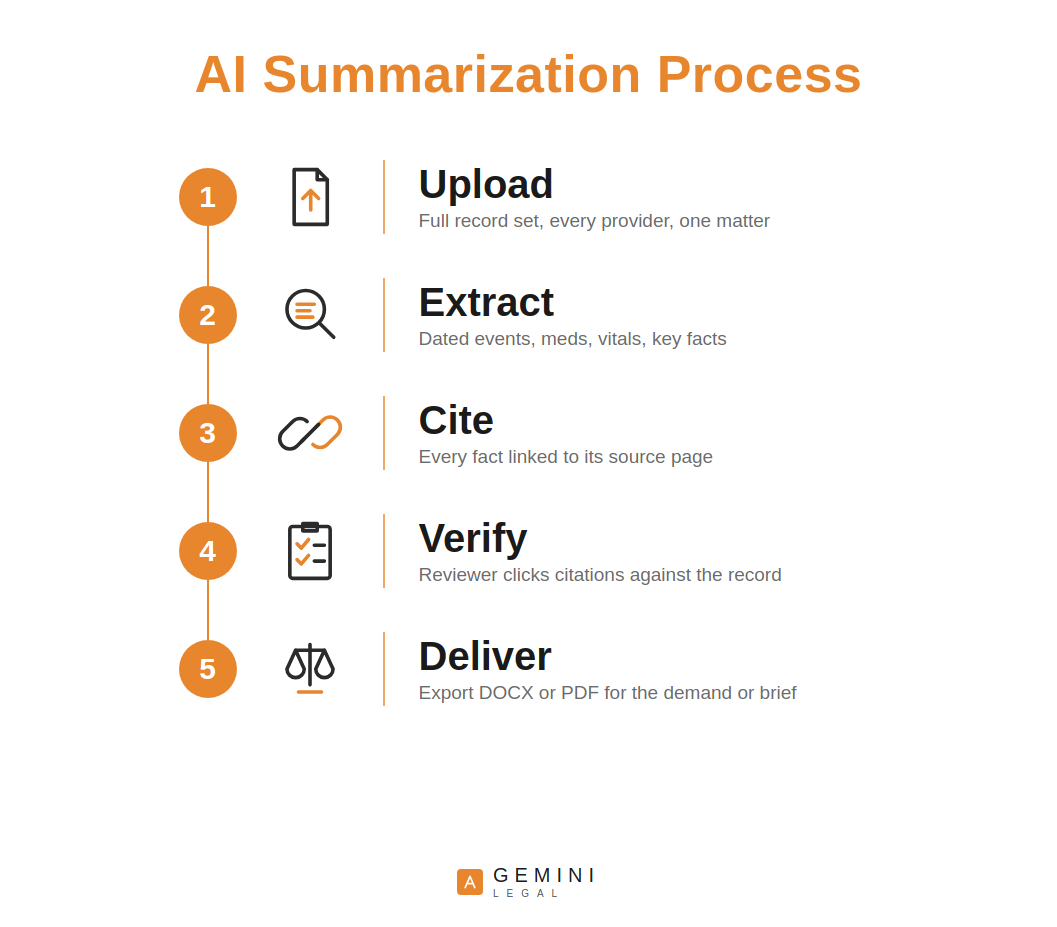
- Upload the full record set from every provider into one matter
- ChartInsight generates the chronology, narrative summary, vitals, and medications table
- Cited output items link to their source pages; clicking opens the PDF inside the app
- The research assistant on every record answers follow-up questions with cited answers
- Outputs export to editable DOCX or PDF with supported page references preserved
Pro Tip: Before sending a demand, click through every citation in the ChartInsight output. The live PDF viewer makes this fast. Any fact you cannot verify to a source page should not appear in the demand letter.
ChartInsight's page citation system directly addresses the confabulation risk that creates sanctions exposure. The original record is never altered, which matters when opposing counsel requests the source documents.
Comparing AI tool categories for personal injury medical summarization
Not every AI tool in this space solves the same problem. Understanding the categories helps you evaluate what your firm actually needs.
| Tool category | Core strength | Key limitation |
|---|---|---|
| General-purpose LLMs | Fast narrative drafting | No source citations; confabulation risk |
| Single-document chat tools | Quick Q&A on one PDF | Cannot query across multiple provider records |
| Cross-record extraction platforms | Multi-record extraction and gap-finding prompts | Require structured intake workflow |
| Full-pipeline platforms | Intake through demand in one workspace | Higher learning curve; overkill for single-purpose needs |
| Human-reviewed AI services | High accuracy with expert verification layer | Slower turnaround than pure AI |
The accuracy benchmark matters most when the output feeds into litigation. A tool that produces a clean-looking summary with no source links is a general-purpose LLM dressed up for legal use. A tool that links facts to their source pages and lets you verify in the same window is built for the work.
For firms handling high-volume personal injury caseloads, cross-record extraction paired with a chronology builder does the work that single-document chat cannot: querying the same details across 30 provider records, then assembling the timeline automatically.
ChartInsight cuts medical record review from days to hours
Personal injury attorneys and paralegals who spend days buried in medical records before drafting a demand are not just losing time. They are leaving case value on the table when treatment gaps and billing inconsistencies go undetected. ChartInsight produces an AI-generated narrative summary, a navigable chronology, and a medications table from the full record set, with cited facts linked to their source pages in a live PDF viewer.
The AI accuracy studies show what that looks like in practice: details that manual review misses, surfaced and cited, ready for the demand or mediation brief. Templates and a Prompt Library let your team run consistent extractions across every case type, from motor vehicle accidents to complex med-mal files. Outputs export to DOCX or PDF with supported page references preserved.
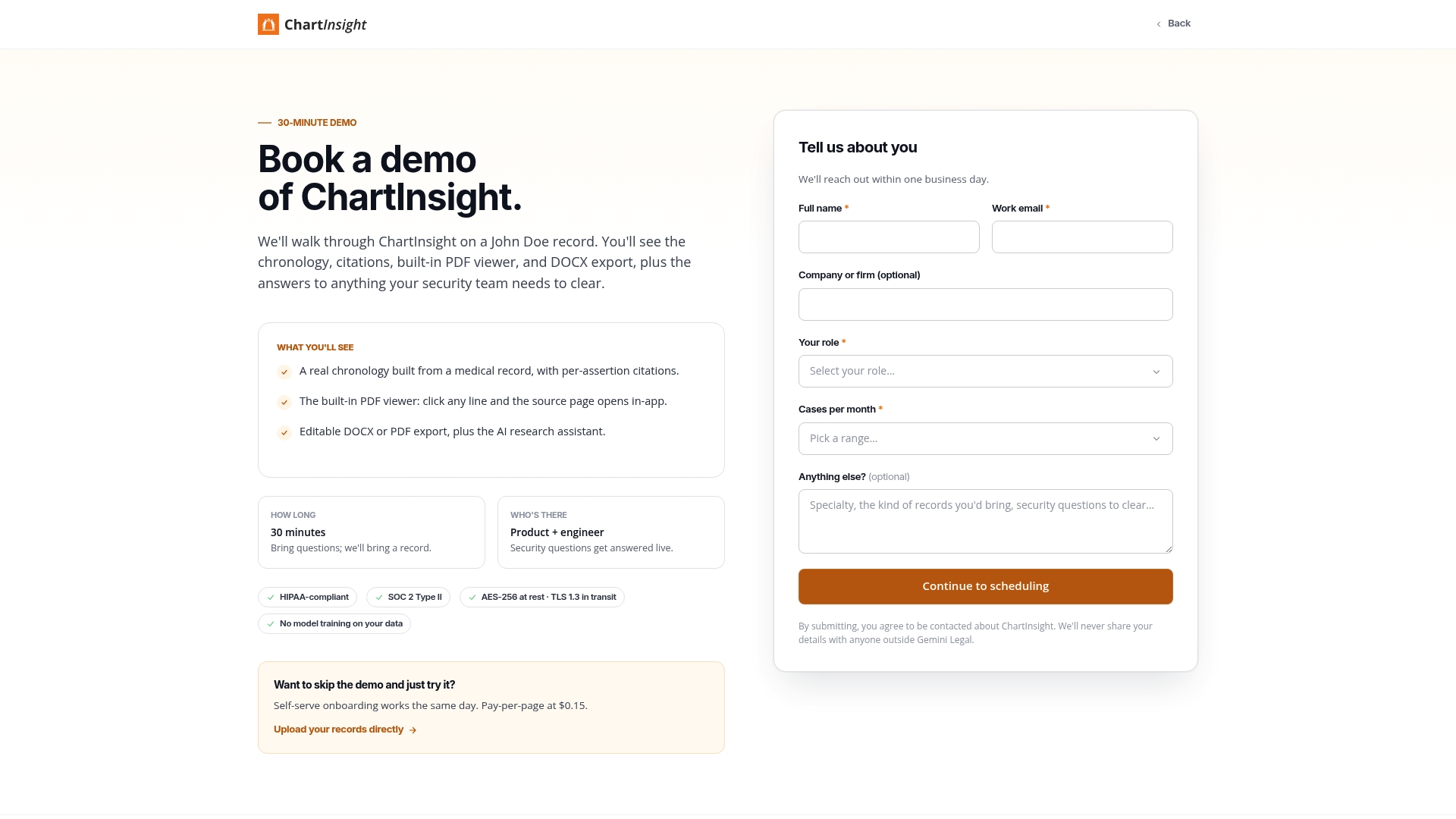
Book a demo to see how ChartInsight handles a real record set from your practice area.
FAQ
How much time does AI medical summarization save in personal injury cases?
Manually organizing a 2,000-page record set takes roughly 6 to 10 hours. AI tools compress that assembly and citation work into hours instead of days, because the reviewer verifies structured output rather than building it from scratch.
Does AI output require human review before use in litigation?
Yes. Clinical language models require human expert review for legal accuracy, and attorneys remain ethically responsible for every factual claim in a filing regardless of how it was generated.
What makes ChartInsight defensible for personal injury use?
ChartInsight links cited facts to their source pages, and clicking a citation opens the original PDF inside the app. The original record is never altered, and outputs export with supported page references preserved.
Can AI handle apportionment and AMA Guides analysis?
No. AI extracts and organizes clinical data, but apportionment determinations and AMA Guides interpretation require a QME or AME. That clinical judgment is outside what current AI tools reliably provide.
Is AI medical summarization HIPAA-compliant?
Reputable platforms are designed to meet HIPAA requirements for protected health information, but attorneys should verify a vendor's Business Associate Agreement and data handling practices before uploading client records.
Key Takeaways
AI medical summarization for personal injury cases is most defensible when extracted facts carry citations back to their source pages and human expert review validates the output before it enters litigation.
| Point | Details |
|---|---|
| Time savings are substantial | Manually organizing a 2,000-page file takes roughly 6 to 10 hours; AI compresses the assembly and citation work into hours instead of days. |
| Page citations are the defensibility standard | Facts that reach a demand or brief must link to their source pages; unlinked output creates sanctions exposure. |
| Human review is mandatory | AI cannot assess apportionment, AMA Guides criteria, or P&S status; QME or AME judgment is required. |
| Cross-record extraction beats single-document chat | Multi-record tools query all provider records at once, surfacing gaps and billing inconsistencies. |
| ChartInsight for cited outputs | ChartInsight produces page-cited summaries, chronologies, medications, and vitals with a live PDF viewer for one-click verification. |