

Generative AI can draft a coherent medico-legal narrative, and it can invent citations while doing it. A 10-case pilot study in the International Journal of Legal Medicine, run at the Institute of Legal Medicine of the University of Catania on Italian healthcare liability files, compared two custom GPT configurations simulating opposing medico-legal perspectives. Agreement between the two models was substantial for clinical synthesis (Cohen's κ = 0.804) but slight for permanent impairment estimates (κ = 0.167), and the patient-oriented model produced significantly more fabricated or non-verifiable references (OR = 3.74, p = 0.0065). That gap between fluent synthesis and unverifiable sourcing is the whole story.
Before you rely on any AI-generated summary in a claim file or expert report:
- Run a citation-verifiability check on a sample of extracted facts against the source PDF.
- Require page-level live citations, not just a bibliography at the end of the document.
Key Takeaways
Defensible AI-generated medical summaries require page-level citation verification and mandatory human sign-off, not blind trust in clinical synthesis scores alone.
| Point | Details |
|---|---|
| Synthesis and citations diverge | Two AI configurations agreed substantially on clinical synthesis (κ = 0.804) while differing significantly in how often they produced fabricated or non-verifiable references. |
| Fabrication risk is measurable | One configuration produced significantly more fabricated or non-verifiable references than the other (OR = 3.74, p = 0.0065). |
| Impairment ratings need human review | Inter-model concordance on impairment estimates was slight, so treat AI ratings as drafts only. |
| Procurement must demand traceability | Require live page-level citations, editable exports that preserve them, and a documented record of who reviewed what, from any vendor you evaluate. |
| ChartInsight™ builds verification in | Its page-level citations and integrated PDF viewer let reviewers confirm every fact without leaving the summary. |
Table of Contents
- What Does Artificial Intelligence Accuracy Mean in Medical-Legal Review?
- What Does the Research Say About AI Citation Reliability?
- What Are the Most Common AI Failure Modes in Chart Review?
- How Do You Validate AI-Generated Medical Summaries Before Trusting Them?
- How Should Reviewers Design a Defensible AI Accuracy Test?
- How Do You Keep AI-Assisted Review Defensible Day to Day?
- What Should You Require From an AI Vendor Before You Sign?
- How ChartInsight Applies Accuracy and Traceability to Medical Records
- Practical Perspective for Busy Reviewers
- See ChartInsight's Citation Accuracy in Action
- Sources
- FAQ
What Does Artificial Intelligence Accuracy Mean in Medical-Legal Review?
For a QME writing a P&S report or an attorney building a causation argument, artificial intelligence accuracy has nothing to do with F1 scores or model benchmarks. It means two things: did the AI extract the fact correctly, and can you verify, in seconds, exactly which page it came from.
That second piece is what separates a defensible summary from a liability. An AI tool can correctly summarize a lumbar MRI finding and still fail if it cannot point you to the exact page, or if the citation it generates doesn't correspond to a real document in the file. Accuracy, in this context, is inseparable from traceability. Apportionment findings under the AMA Guides, MMI determinations, and impairment ratings all rest on facts a reviewer must be able to trace back to a contemporaneous record, not a paraphrase generated weeks later.
- Extracted fact accuracy (was the value, date, or diagnosis stated correctly?)
- Citation verifiability (does the cited page actually contain that fact?)
- Bibliographic correctness (author, date, and document type match the source)
Pro Tip: When drafting procurement or vendor acceptance criteria, propose a testable threshold, for example "every cited fact must resolve to a matching page in the source PDF via live citation," rather than a vague requirement for "AI accuracy." Vague language is unenforceable. Vendor-side write-ups of structured AI vendor analysis are useful further reading on how buyers frame those criteria, though they are not a medico-legal standard.
What Does the Research Say About AI Citation Reliability?
The most useful data point for this audience comes from a 10-case retrospective pilot comparing two role-conditioned GPT models that generated simulated medico-legal reports from the same anonymized clinical documentation. Agreement between the models was substantial for clinical synthesis (Cohen's κ = 0.804) and slight for permanent impairment estimates (κ = 0.167). Ten Italian healthcare liability cases is a small, jurisdiction-specific sample, so read it as a signal about failure modes rather than a benchmark for any particular tool.
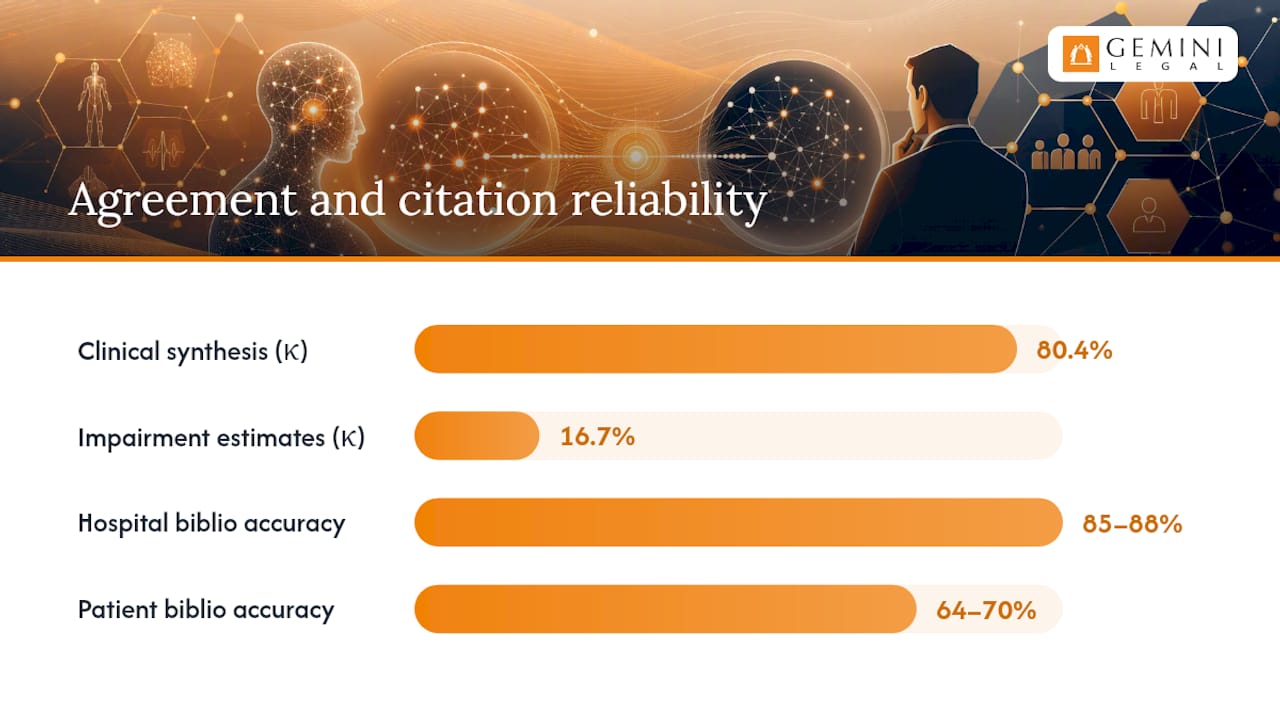
That split matters enormously for anyone drafting a P&S report. The models largely agreed on what happened clinically but diverged sharply on how to rate the resulting impairment, which is exactly the section most likely to get challenged in deposition.
The citation-fabrication finding is the real warning. The patient-oriented model produced significantly more fabricated or non-verifiable references than the hospital-oriented model (OR = 3.74, p = 0.0065), while the relevance of the citations the models did produce did not differ significantly (p = 0.195). In other words, a reference can be on-topic and still not exist. Confabulated references are a documented problem in the wider biomedical literature too, as this commentary on AI-generated references discusses.
- A citation can be topically relevant and still be formally wrong (wrong year, wrong journal, wrong page).
- Relevance without verifiability is a forensic hazard, not a convenience.
What Are the Most Common AI Failure Modes in Chart Review?
Four failure patterns show up repeatedly in AI-generated medical summaries, and each carries a distinct legal consequence.
- Fabricated or non-verifiable citations. The AI generates a reference that sounds plausible but doesn't correspond to any actual page or, in some cases, any actual document. Detect this by clicking every citation and confirming the underlying page exists and says what the summary claims.
- Incorrect page links or misattributed fields. A citation may point to page 340 when the fact actually appears on page 240, or attribute a finding to the wrong treating provider.
- Missed or altered facts affecting causation or apportionment. A dropped prior injury or an altered date can quietly change an apportionment calculation.
- Inaccurate impairment estimates. The two models in that pilot barely agreed with each other on permanent impairment (κ = 0.167), so treat any AI-suggested rating as a draft for the QME or AME to determine, never a final number.
Consider a single fabricated citation in a submitted report: opposing counsel finds the reference doesn't exist, and now every other citation in that report is suspect, even the accurate ones.
Pro Tip: Spot-check the citations most likely to be challenged first: dates that establish MMI, and any reference tied to a pre-existing condition relevant to apportionment.
How Do You Validate AI-Generated Medical Summaries Before Trusting Them?
Run these checks before any AI-generated summary reaches a report, deposition exhibit, or claim file.
- Citation verifiability. Confirm the reference exists, the authorship and year are correct, and any DOI or link resolves. Check that the cited page actually contains the quoted or paraphrased fact.
- Clinical-synthesis concordance. Run a blinded comparison against a human-generated gold-standard summary on a representative sample. Target substantial agreement, conventionally κ above roughly 0.6 to 0.8 on the Landis and Koch scale the study uses.
- Fabrication-rate threshold. Set a maximum acceptable rate for fabricated or non-verifiable citations, and measure it on your own sample rather than accepting a vendor's number. If any fabricated reference shows up in a sample, escalate to manual review of every citation until the cause is resolved.
- Traceability. Confirm live page-level citations exist in the interface, that exports (DOCX/PDF) preserve those citations, and that your own process records who reviewed what and when.
| Test | Acceptance Threshold | Action If Failed |
|---|---|---|
| Citation verifiability | Every cited fact resolves to the correct source page | Flag for manual citation rebuild |
| Clinical-synthesis concordance | κ roughly 0.6 to 0.8 vs. human reviewer | Escalate synthesis to full manual rewrite |
| Fabrication rate | No fabricated references in your own sample | Halt use pending vendor remediation |
| Impairment-rating reliance | Treat as draft only | Require QME/AME independent rating |
How Should Reviewers Design a Defensible AI Accuracy Test?
A useful benchmark doesn't need a research lab, but it does need structure.
- Sample selection. Pull a representative case mix: orthopedic, psychiatric, and multi-provider record stacks of at least 15 to 20 cases, mirroring your actual caseload.
- Blinding. Have a human reviewer produce gold-standard summaries independently, without seeing the AI output first, then compare.
- Scoring grid. Score each summary on a 1 to 3 scale for citation verifiability and a separate 1 to 3 scale for clinical-synthesis quality.
- Metrics. Report Cohen's κ for concordance and, where comparing two configurations or vendors, an odds ratio with a p-value for fabrication rates, the same approach used in the Springer forensic medicine pilot.
| Metric | What It Measures | Good Result |
|---|---|---|
| Cohen's κ (synthesis) | Agreement with human reviewer | roughly 0.6 to 0.8 or higher |
| Cohen's κ (impairment) | Agreement on ratings | No threshold makes an AI rating final; the published pilot saw κ = 0.167 between models |
| Odds ratio (fabrication) | Relative fabrication risk between configs | Closer to 1.0 is better; investigate any statistically significant difference |
Pro Tip: For a fast spot check between full benchmarking cycles, pull five citations at random from a completed summary and verify each one against the source PDF. If more than one fails, treat the whole document as unverified.
How Do You Keep AI-Assisted Review Defensible Day to Day?
Bench testing tells you whether a tool is trustworthy in principle. Daily workflow controls tell you whether it stays trustworthy in practice.
- Human-in-the-loop is mandatory, not optional. Every AI-drafted summary needs citation verification, a clinical-synthesis sign-off, and a second-level QA pass for high-value or contested cases.
- Templates and role controls keep output consistent. Custom report templates and prompt libraries mean a med-legal report and a peer review come back in a predictable structure every time, and role-based access limits who can edit versus review.
- Exports need to preserve citations, and every substantive change needs a record. An editable DOCX means nothing if the page citations disappear on export, and a review trail means nothing if it doesn't capture who confirmed what.
The practical flow looks like this: a record gets uploaded, the AI extracts chronology, vitals, and narrative sections with page citations attached, a reviewer verifies citations and signs off on synthesis, and the export retains those citations intact for the final report.
Pro Tip: Set triage rules so routine, low-dispute cases get a lighter verification pass while cases with apportionment disputes or contested MMI dates trigger full manual citation review every time.
What Should You Require From an AI Vendor Before You Sign?
Procurement is where most defensibility problems get prevented or created. Build these into the statement of work.
- Page-level live citations on every extracted fact, not a static bibliography.
- Editable exports (DOCX/PDF) that preserve those citations after formatting changes.
- Access to test datasets and review records, so your team or an expert witness can reproduce a given output.
- Role-based access management for QMEs, attorneys, paralegals, and adjusters working the same matter.
For SLA language, specify a maximum acceptable fabrication rate, a guarantee on citation verifiability, uptime commitments for the live PDF viewer, and a defined response time for investigating a flagged discrepancy. Include PHI handling and review-trail requirements in the same section your legal team reviews for data security. For a practitioner-side perspective on how fragmented charts slow a review down, this medical-record-review service write-up is useful background, though it is a vendor's own account rather than evidence about defensibility.
Pro Tip: Ask the vendor to show you how a completed review is documented before signing. If they can't show it on request, they likely can't produce it when opposing counsel asks either.
How ChartInsight Applies Accuracy and Traceability to Medical Records
ChartInsight™ was built around the assumption that a reviewer needs to verify, not just trust, every extracted fact. Every chronology entry, vitals reading, medication, and narrative statement carries a live citation back to its exact source page, opened inside the same integrated PDF viewer so you never leave the app to check a claim.
- Live page-level citations on chronologies, nine-section narrative summaries, vitals, and medications tables.
- Editable DOCX/PDF exports that keep citations intact after formatting.
- Custom templates and a prompt library, with role-based access for the QMEs, attorneys, and clinical reviewers working the same matter.
ChartInsight™ publishes its own indexing work: a 433-record study that read each AI-generated index against the expert human summary of the same record and found 1,318 clinician-documented findings the human summaries had missed, across 92% of cases, plus case detail such as one record whose human summary ran to 112,000 characters, roughly 56 pages of single-spaced text. In practice, the manual assembly and citation work drops away and the reviewer's time goes to confirming findings against the pages they came from, in the same screen as the summary.
Pro Tip: When evaluating any AI record-review tool, ask to see a citation resolve on a real multi-provider PDF before anything else.
Practical Perspective for Busy Reviewers
Efficiency and evidentiary caution aren't in conflict here. Use AI to draft synthesis, but verify every citation before it reaches a report. A weekly spot-check cadence is a reasonable starting point for routine files, and full manual citation review should be the rule whenever apportionment or MMI is contested.
See ChartInsight's Citation Accuracy in Action
You've just read what separates a defensible AI summary from a liability: page-level citation verifiability, not just plausible-sounding synthesis. ChartInsight™ was built around that distinction specifically for personal injury record review and workers' comp med-legal work, where every extracted fact needs a live link back to its source page.
The 433-record study and case detail like the 112,000-character human summary show what that traceability looks like on real, multi-provider charts. Instead of cross-referencing a chronology against a stack of separate PDFs, the citation check happens in the same viewer as the summary. If you handle QME reports, peer reviews, or personal injury chart review and need summaries that hold up under cross-examination, book a demo and bring your own record to test against.
Sources
- Generative artificial intelligence in forensic medicine: a pilot study on AI-simulated medico-legal reports in healthcare liability cases | International Journal of Legal Medicine
- Confabulated references in the age of AI, Exploration of Medicine
- AI Indexing Accuracy: the 433-record study (ChartInsight™)
This article is general information, not a substitute for advice from a qualified lawyer. Consult a qualified legal professional about your own circumstances before acting on anything here.
FAQ
Can AI-Generated Medical Summaries Be Used in Court?
They can support a report, but only after every citation is verified against the source page and a qualified human reviewer signs off on the clinical synthesis and any impairment findings.
What Is a Fabricated Citation in an AI Medical Summary?
It's a reference the AI generates that either doesn't correspond to any real document or misattributes authorship, date, or page. In the published pilot, one model configuration produced these at a significantly higher rate than the other (OR = 3.74, p = 0.0065).
How Accurate Are AI Impairment Ratings?
Not reliable enough to use unverified. In the pilot, agreement between two AI configurations on permanent impairment estimates was slight (κ = 0.167) even where synthesis agreement was substantial, so QMEs and AMEs should treat AI-suggested ratings as a starting draft only.
What Should I Look for in an AI Medical Record Review Tool?
Live page-level citations that open directly to the source PDF, editable exports that preserve those citations, and a review process that records who confirmed each high-value finding. ChartInsight™ provides the citations, the integrated viewer, and the citation-preserving exports.

How Often Should Reviewers Spot-Check AI Citations?
A weekly cadence is a workable baseline for routine files, and every citation should be checked on cases involving contested apportionment or MMI dates, where a single fabricated reference can undermine the entire report.