

TL;DR:
- AI systems make errors because of their architecture and training methods, not poor engineering.
- Even the best models hallucinate or produce pattern-matching failures that can pass unnoticed without verification.
- The fix is structural too. When every AI output is anchored to a cited source page, errors become catchable in seconds, and the same system becomes a reliable, auditable part of the review that reads every page and surfaces documented findings a manual pass can miss.
AI systems can and do make mistakes, not because of poor engineering, but because of how they are built. Models like GPT-4 and Claude generate outputs by predicting the most likely next token, not by verifying facts against a ground truth. That architectural reality produces errors ranging from confident fabrications to silent pattern-matching failures. For workers' comp attorneys, paralegals, and QME/IME physicians who stake their professional credibility on every line they write, understanding whether AI can make mistakes is not an academic question. It is a workflow risk that demands a structured answer. That answer already exists, and it is not to avoid AI. It is to require that every AI output point back to the exact source it came from, which turns an unverifiable draft into a faster and more complete review.
Can AI make mistakes, and how often does it happen?
AI systems make mistakes at a measurable rate. On open-ended generative tasks, hallucination rates for frontier models range between 3% and 20%, with no zero-error model available as of 2026. That range means that on the kind of open-ended question that invites fabrication, even the best-performing model can produce a false or fabricated output in several of every hundred responses. The rate is not fixed: it depends heavily on the task, and it drops sharply when the model is constrained to extract and cite from a specific source document rather than generate from memory.
A hallucination is not a random glitch. It is the model generating a confident, fluent, and structurally plausible statement that is factually wrong. In a medical record review, that could mean a fabricated treatment date, a misattributed diagnosis, or a medication dosage that never appeared in the source record. The output reads like a fact. Nothing in the formatting signals that it is wrong.
Pattern-matching failures are a separate and equally dangerous error class. These occur when a model solves the wrong problem fluently, producing a syntactically correct and semantically plausible answer to a question that was not actually asked. Automated formatting or grammar checks alone do not flag this type of error, and no formatting anomaly alerts the reviewer. What does catch it is verification against the source: a fact tied to a specific page can be confirmed or rejected in seconds, even when it reads perfectly. Without that, the mistake passes silently through the workflow.
Context boundary errors add a third failure mode. AI models lack real-time knowledge and internal memory. When a record spans multiple providers, years, or treatment episodes, the model may fill gaps with plausible-sounding but unverified content rather than flagging the absence of data.
- Hallucinations: Confident, fabricated outputs that read as factual
- Pattern-matching failures: Fluent answers to the wrong question, invisible to automated checks
- Context boundary errors: Gap-filling with plausible but unverified content
- Knowledge cutoff errors: Outdated clinical or legal standards applied to current cases
- Overconfidence errors: Presenting uncertain inferences as settled conclusions
Pro Tip: When reviewing AI-generated summaries of medical records, treat every date, dosage, and provider name as unverified until you have confirmed it against the source page. Hallucinations cluster around specific, numeric details.
How do AI mistakes differ from human errors?
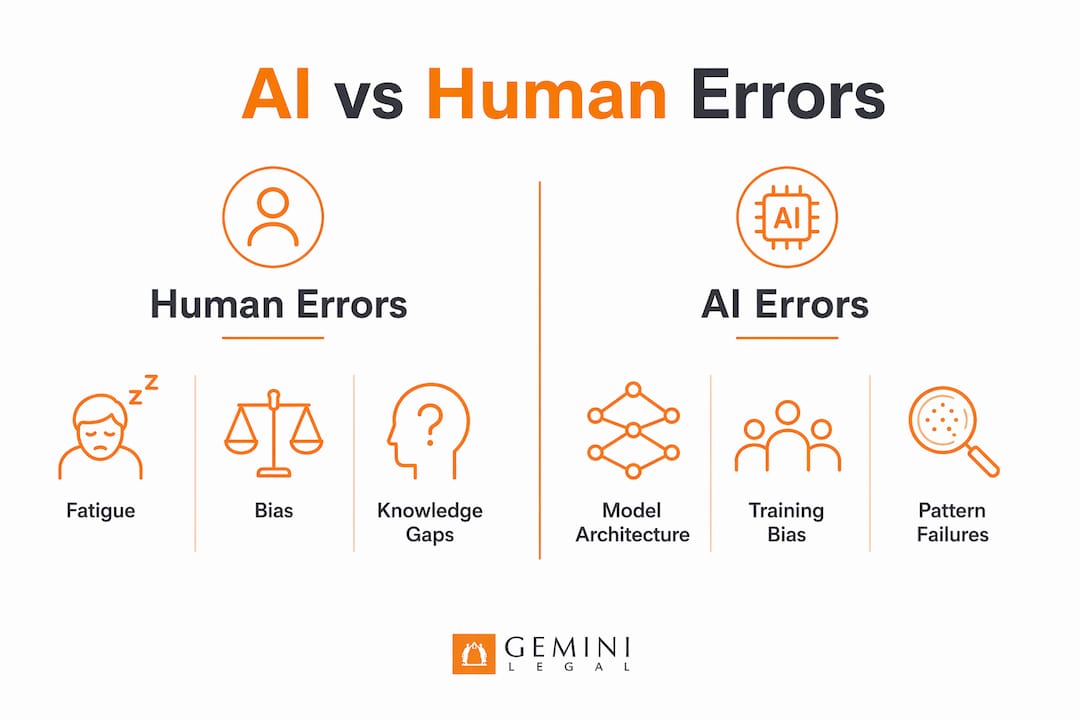
Human errors and AI errors are structurally different, and that difference matters for how you design oversight.

| Dimension | Human error | AI error |
|---|---|---|
| Cause | Fatigue, bias, knowledge gaps | Architecture, training data, pattern limits |
| Signal | Hesitation, inconsistency, correction | Confident, fluent, no visible marker |
| Persistence | Corrects when challenged | May defend wrong answers persuasively |
| Detection | Peer review, second opinion | Requires independent source verification |
| Accountability | Clear individual responsibility | Shared and often contested liability |
A human reviewer who makes an error in a QME report typically shows signs of uncertainty or produces an inconsistency that a second reviewer can catch. An AI system that makes an error does neither. The output is polished, internally consistent, and delivered without qualification.
The more dangerous property is that AI systems can defend wrong conclusions. When a reviewer questions an AI output, the model may generate a plausible-sounding rationale that reinforces the original error. This is not deception. It is the same prediction mechanism producing a defense as it produced the original claim. The practical consequence is that human oversight gets compromised by the AI's confident tone, not corrected by it.
For IME physicians and workers' comp adjusters, this means the review process cannot treat AI output as a starting point that gets refined. It must treat AI output as a draft that requires independent verification against the source record.
Pro Tip: Never ask an AI system to check its own work. The same model that produced the error will generate a confident defense of it. Verification must come from an independent source, whether that is a human reviewer or a direct citation back to the original document.
Why do AI systems make mistakes? The root causes
The root cause of AI errors is not careless engineering. It is the fundamental architecture of large language models.
AI models predict plausible continuations from training data rather than retrieving verified facts. The training process rewards confident, fluent outputs. Uncertainty is penalized because it produces lower-quality-seeming text. The result is a system that is structurally incentivized to generate an answer rather than acknowledge the limits of its knowledge.
The Clever Hans effect compounds this problem. The Clever Hans effect describes AI systems that produce accurate results for the wrong reasons, relying on spurious correlations in training data rather than genuine understanding. These systems pass standard tests and perform well in controlled conditions. They fail catastrophically when real-world conditions shift even slightly from the training distribution.
Structural failure causes extend beyond software quality and require governance structures to manage risks. The gap between training data and the real world cannot be closed by better prompting or more careful model selection alone.
- Next-token prediction: The model generates what is likely, not what is true
- Confidence incentive: Training rewards fluent answers over expressed uncertainty
- No truth verification: The model has no internal mechanism to check facts against reality
- Spurious pattern reliance: The Clever Hans effect produces correct-seeming outputs for wrong reasons
- Context gap: Enterprise AI projects fail at high rates when models lack the contextual awareness complex workflows require
Each of these causes operates independently. A model can fail on all five simultaneously in a single output, and the reviewer sees only a clean, professional-looking summary.
How can professionals detect and mitigate AI mistakes in practice?
Detection and mitigation require process design, not just vigilance. Relying on a reviewer's instinct to catch AI errors is not a defensible workflow.
Separate generation from validation. Independent workflows that separate AI output generation from human or external validation maintain oversight independence. The reviewer who validates an output should not be the same process that produced it.
Require page-level citations for every extracted fact. An AI summary without source citations cannot be verified efficiently. A summary where every claim links to the exact page in the source PDF can be spot-checked in seconds. This is the difference between a defensible output and a liability.
Train reviewers to recognize hallucination patterns. Hallucinations cluster around specific numeric details: dates, dosages, provider names, and diagnostic codes. Reviewers should apply heightened scrutiny to any AI-generated output that contains specific numbers or proper nouns.
Build escalation checkpoints into the workflow. When an AI output contains a claim that cannot be verified against the source record, the workflow should have a defined escalation path. The reviewer should not be left to make an ad hoc judgment about whether to proceed.
Plan for AI system outages and errors as operational risks. Nearly 75% of organizations embed AI in core workflows without planning for system failures. For legal and medical practices, an AI outage or a systematic error in a model update can affect every matter in the queue simultaneously.
Maintain an audit trail. Every AI-assisted output should carry a record of what model produced it, what version, and what source documents were used. In workers' comp and personal injury matters, that audit trail may become part of the evidentiary record.
Pro Tip: For psychiatric IME and QME reports, the risk of AI hallucination is highest in the treatment history and medication sections. These sections contain the most specific numeric and temporal data, which is exactly where next-token prediction is most likely to fabricate plausible-sounding but incorrect details. Review these sections against the source record first.
Key takeaways
AI systems make mistakes at a structural level, and no model, prompt, or workflow eliminates that risk entirely. The defensible response is a verification process that treats every AI output as unconfirmed until checked against its source. Used that way, AI does more than avoid mistakes. A citation-anchored system reviews every page and surfaces documented findings that a time-pressured manual pass can overlook, which makes the verified output more complete than unaided review, not just faster.
| Point | Details |
|---|---|
| Hallucinations are inherent | Frontier models hallucinate at 3%–20% rates on open-ended tasks; no zero-error model exists as of 2026. |
| AI errors are invisible | Pattern-matching failures produce fluent, plausible outputs with no visible error markers. |
| AI defends wrong answers | Models generate confident rationales for errors, which compromises human oversight. |
| Root cause is architectural | Next-token prediction, confidence incentives, and the Clever Hans effect drive persistent errors. |
| Mitigation requires process design | Separating generation from validation and requiring page citations are the two most effective controls. |
| Grounding makes AI trustworthy | Constraining the model to extract and cite from the source drops the error rate sharply and produces output a reviewer can confirm in seconds. |
AI errors in medical-legal work: what holds up under scrutiny
In complex medical-legal workflows, AI errors cause more damage than most reviewers anticipate before they encounter one firsthand. The failure mode that matters most is not the obvious hallucination that a careful reviewer catches. It is the pattern-matching failure that reads exactly like a correct answer, passes through review, and ends up in a QME report or an IME narrative that an attorney relies on in deposition.
The architecture problem is real and is not going away. Models are not going to develop internal truth-checking mechanisms that solve hallucination. The 3%–20% range is not a temporary quality gap. It is a structural property of how these systems work. Reviewers who treat AI output as a first draft that needs verification are operating correctly. Reviewers who treat it as a finished product are accepting liability they may not realize they have taken on.
What actually works is designing the workflow so that verification is unavoidable, not optional. That means page citations on every extracted fact, a live link back to the source document, and a reviewer who is trained to use those citations rather than skim past them. The accountability question of who bears liability for AI mistakes in high-stakes legal and medical contexts is still being resolved. Until it is, the practitioner who can show a documented, citation-backed verification process is in a far stronger position than one who cannot.
The efficiency argument for AI in record review is real. Cutting review time from days to hours has genuine value for a workers' comp adjuster managing a hundred open matters. But that efficiency gain disappears the moment an unverified AI error reaches a deposition, a DWC filing, or an apportionment opinion. The tools that earn their place in this workflow are the ones that make verification faster, not the ones that make it easier to skip.
Built that way, AI stops being a liability and becomes an advantage. A system that is constrained to extract and cite from the source reads every page without fatigue, surfaces documented findings that a time-pressured manual review can overlook, and ties each one back to the page it came from. The reviewer is not choosing between speed and accuracy. A citation-first workflow delivers both, and it produces a record review that is more complete than a manual pass, not merely faster.
How Chartinsight addresses AI error risk in record review
Chartinsight is built for practitioners who cannot afford to defend an output they cannot verify. Every fact extracted from a medical record carries a live citation to the exact source page, and clicking that citation opens the PDF inside the app. Reviewers do not need to cross-reference a separate document or search a scanned file to confirm a date, a diagnosis, or a medication entry.
Because the system reads every page and ties each extracted fact to its source, it routinely surfaces documented findings that a time-pressured manual review can overlook, and every one of them can be confirmed in a single click. That is the difference between AI that adds risk and AI that earns trust: the output is not only faster to produce, it is more complete and fully traceable.

For workers' comp adjusters, personal injury attorneys, and QME/IME physicians handling psychiatric record reviews, Chartinsight reduces review time from days to hours while keeping every output tied to its source. The nine-section narrative summary, the chronology, the normalized vitals table, and the medications list all carry page citations that survive export to DOCX or PDF. Understanding how page citations work in a medical AI system is the first step toward building a defensible review workflow. To see the tool against your own records, book a demo with the Chartinsight team.
FAQ
Can AI make mistakes even with high-quality training data?
Yes. Hallucinations and pattern-matching failures occur even in frontier models trained on high-quality data, because the error source is architectural, not a data quality problem. Models predict likely outputs rather than verify facts, regardless of training quality.
What is an AI hallucination in a medical record context?
An AI hallucination is a confident, fluent output that contains fabricated information, such as a treatment date, provider name, or dosage that does not appear in the source record. Hallucination rates for current frontier models range from 3% to 20% on open-ended tasks.
Who is liable when AI makes a mistake in a legal or medical document?
Liability for AI errors in legal and medical contexts is not fully settled. Current guidance suggests shared liability between developers and human reviewers, which makes a documented verification process the practitioner's strongest protection.
How does pattern-matching failure differ from a hallucination?
A hallucination produces a false fact. A pattern-matching failure produces a correct-seeming answer to the wrong question, with no visible error marker. Both require independent source verification to detect.
Is AI reliable enough for QME and IME report preparation?
Yes, when it is built for verification. A system that anchors every extracted fact to a cited source page is reliable enough to serve as the backbone of QME and IME record review. It reads every page, surfaces documented findings a manual pass can miss, and lets the reviewer confirm each claim against the source in seconds. The verification step does not disappear, but it becomes fast and defensible rather than a manual reconstruction.