

TL;DR:
- Thorough claim investigation begins immediately with evidence preservation and early site visits to strengthen the case.
- Implementing disciplined processes, including clear documentation, expert involvement, and organized files, enhances settlement leverage.
Claim investigation best practices for attorneys are defined as the structured, early, and evidence-focused methods that determine whether a case settles favorably or collapses under adjuster scrutiny. Litigating a case through trial is expensive, so every evidentiary gap left unaddressed before filing costs real money. Attorneys who investigate thoroughly before filing preserve leverage, close factual gaps, and produce demand packages that adjusters cannot easily discount. Process often separates a strong claim from a weak one as much as the facts do.
1. Start the investigation immediately upon claim knowledge
Preservation duties can arise before a lawsuit is filed. In federal court, Rule 37(e) of the Federal Rules of Civil Procedure addresses electronically stored information that should have been preserved in the anticipation or conduct of litigation, and state courts apply their own standards, so confirm the trigger that governs your forum. A forensic investigation guide on subrogation recovery notes that outcomes may depend on whether physical evidence was preserved and properly collected, and poor preservation can invite a spoliation motion. Issue a litigation hold letter to your client and a preservation notice to any third party holding relevant records, photos, or electronic data as early as possible. Delay makes preservation harder to prove and easier to attack.
Scene visits conducted early can reveal physical context that police reports do not capture. As one personal injury litigation checklist puts it, some cases look obvious until you inspect the scene. Photographs, measurements, and witness interviews taken soon after an incident capture conditions before they change.
2. Define clear investigation objectives and timelines
Every investigation needs a written scope before the first call is made. List the specific facts in dispute, the evidence needed to resolve each one, and the deadline for obtaining it. Without a written scope, investigations drift and critical questions go unanswered until discovery forces the issue.

One personal injury lawsuit guide suggests setting a response window of 30 to 60 days in the demand, so your investigation timeline should work backward from your intended send date. Build in time for medical record retrieval, employer verification, and expert review. Internal deadlines for each evidence category make critical items harder to miss.
Pro Tip: Create a one-page investigation checklist for each case type, personal injury, workers' comp, employment, and update it after every matter closes. Patterns in missed evidence become obvious fast.
3. Engage licensed investigators before filing
Police reports and initial records alone are often not enough to build a defensible case. A private investigation firm's pre-suit guide describes using investigators before filing to test claims, pressure-check witnesses, and verify timelines. A licensed investigator can locate witnesses, conduct background checks, and perform surveillance before the defense knows you are looking.
Experienced attorneys know that pressure-testing client testimony before filing builds settlement leverage. An investigator who finds a contradiction in your client's account gives you the chance to address it. An adjuster who finds the same contradiction uses it to deny or reduce the claim.
4. Assess and verify witness credibility
Locating primary and secondary witnesses is an often undervalued step in claims handling. Witnesses who are not formally identified early often become unavailable or change their accounts. Contact every potential witness before opposing counsel does, and document each conversation in writing.
Evaluate each witness for consistency, partiality, and potential bias. A witness with a prior relationship to the defendant, a financial interest in the outcome, or a history of inconsistent statements requires careful handling. Courts and adjusters weigh witness credibility heavily, and a single unreliable witness can undermine an otherwise strong file.
Pro Tip: Ask each witness to describe the incident in their own words before showing them any documents. Contaminated recollections are harder to rehabilitate than honest gaps in memory.
5. Analyze digital evidence and social media thoroughly
Digital evidence plays a growing role in personal injury, employment, and fraud claims. Social media posts, phone records, GPS data, and public filings can corroborate or directly contradict a client's account of events. Attorneys who skip this step hand the defense a free impeachment tool.
Key digital evidence sources to review include:
- Social media platforms: Facebook, Instagram, X (formerly Twitter), and LinkedIn for posts, check-ins, and photos inconsistent with claimed injuries
- Phone records and GPS data to verify location and activity at the time of the incident
- Public court filings and prior claim histories to identify patterns of litigation
- Employment records and payroll data to verify lost wage claims
- Surveillance footage from nearby businesses, traffic cameras, and residential systems
Surveillance conducted by a licensed investigator must comply with applicable state law, including recording, privacy, and investigator licensing rules. The consequences of getting it wrong vary by state. In California, for example, Penal Code section 632(d) makes evidence from recording a confidential communication in violation of that section inadmissible in judicial proceedings. Confirm your jurisdiction's rules before authorizing any field surveillance.
6. Build demand packages that withstand adjuster scrutiny
Internal inconsistencies, especially dates and totals that do not reconcile, can reduce a demand's leverage even when liability is strong. Adjusters look for contradictory dates, mismatched totals, and summaries that do not reconcile with attached records. A single arithmetic error signals a disorganized file and invites a low offer.
A defensible demand package requires:
- Liability documentation: Police reports, photographs, surveillance footage, and witness statements that establish fault clearly
- Medical chronology: A complete, date-ordered treatment history with verified records from every provider
- Lost wage verification: Employer letters, pay stubs, and vocational expert opinions where applicable
- Damages summary: A total that reconciles precisely with every line-item attachment
Demand amounts should be supported by comparable verdicts and settlements in your jurisdiction. Incomplete medical chronologies and unverified wage claims can undercut a demand even when the liability facts are strong. Document everything specifically.
| Demand package element | Common failure point |
|---|---|
| Medical chronology | Gaps between treatment dates or missing provider records |
| Lost wages | Unverified employer statements or missing pay documentation |
| Liability summary | Contradicts attached police report or photos |
| Damages total | Does not reconcile with individual line items |
| Comparable verdicts | Absent or from dissimilar jurisdictions |
7. Select and prepare expert witnesses strategically
Expert selection must align with the core issues in the case, not with name recognition alone. A biomechanical engineer who cannot explain low-speed impact mechanics clearly under cross-examination can damage credibility more than no expert at all. Match the expert's specialty to the specific disputed facts.
Provide every expert with a complete, well-organized file before requesting an opinion. Experts who receive disorganized records produce opinions with gaps that defense counsel will exploit. Site work and scene visits should be completed before expert retention so the expert has full physical context.
Test expert opinions internally before disclosure. Run the opinion through the likely cross-examination questions and identify weaknesses. An opinion that cannot survive your own challenge will not survive a deposition.
For complex corporate claims or suspected fraud, engage a special investigations unit or a forensic accountant early. These specialists can identify evidentiary gaps that general investigators miss.
8. Organize and present investigation outcomes clearly
A clear, consistent, and chronological claim file that an outsider can follow is vital to avoid adjuster discounts and prepare for trial. Timeline gaps are a frequently exploited weakness in a claim file, and adjusters and defense counsel look for them.
Structure every file so that the narrative, the evidence, and the chronology align without requiring the reader to cross-reference multiple documents. Use section tabs or digital folders organized by category: liability, medical, damages, experts, and correspondence. Every document in the file should have a clear label and a date.
Pro Tip: Before sending a demand package, have a colleague who has not worked the file read it cold. If they cannot follow the liability narrative and damages calculation without asking questions, the file needs more work.
Medical record review is often among the most time-consuming elements of this process. AI-powered medical record tools with page-level citations help attorneys build chronologies faster and produce entries that are directly verifiable. Every cited fact pointing back to a source page is a defensible fact.
Key takeaways
Thorough claim investigation requires early evidence preservation, disciplined documentation, and expert involvement to produce files that adjusters cannot discount and courts can follow.
| Point | Details |
|---|---|
| Preserve evidence immediately | Issue preservation notices as soon as a claim is anticipated to reduce spoliation risk and protect claim integrity. |
| Verify every demand figure | Reconcile all dates, totals, and summaries before sending to avoid adjuster discounts. |
| Pressure-test client accounts | Use licensed investigators early to find contradictions before the defense does. |
| Match experts to core issues | Select specialists whose opinions align with disputed facts and can survive cross-examination. |
| Organize files for outsiders | Structure chronologies and evidence so any reader can follow the narrative without assistance. |
Patterns that separate strong claim files from weak ones
The attorneys who get the best outcomes are not always the ones with the strongest facts. They are often the ones with the most organized files.
A frequent error is delayed evidence preservation. Waiting for records to arrive before issuing preservation notices risks losing video footage, which many recording systems overwrite on a rolling basis, and witnesses who move on. Another is sending demand packages with internal inconsistencies that a short reconciliation check would have caught.
What shifts case dynamics most reliably is disciplined process applied early: investigators engaged before filing, experts retained with complete files, and chronologies built from verified records rather than client summaries. Technology that produces page-cited outputs does not replace attorney judgment. It reduces the time spent locating facts so attorneys can apply judgment where it matters.
The standard worth applying is simple: treat the claim file as a document that needs to hold up in front of a skeptical stranger.
How ChartInsight™ supports defensible claim file preparation
Attorneys handling personal injury, workers' comp, and med-legal matters spend significant time reviewing medical records that can run to thousands of pages across multiple providers. ChartInsight™ converts those records into structured, page-cited outputs: a chronology, a narrative summary, extracted vitals, and a medications table.
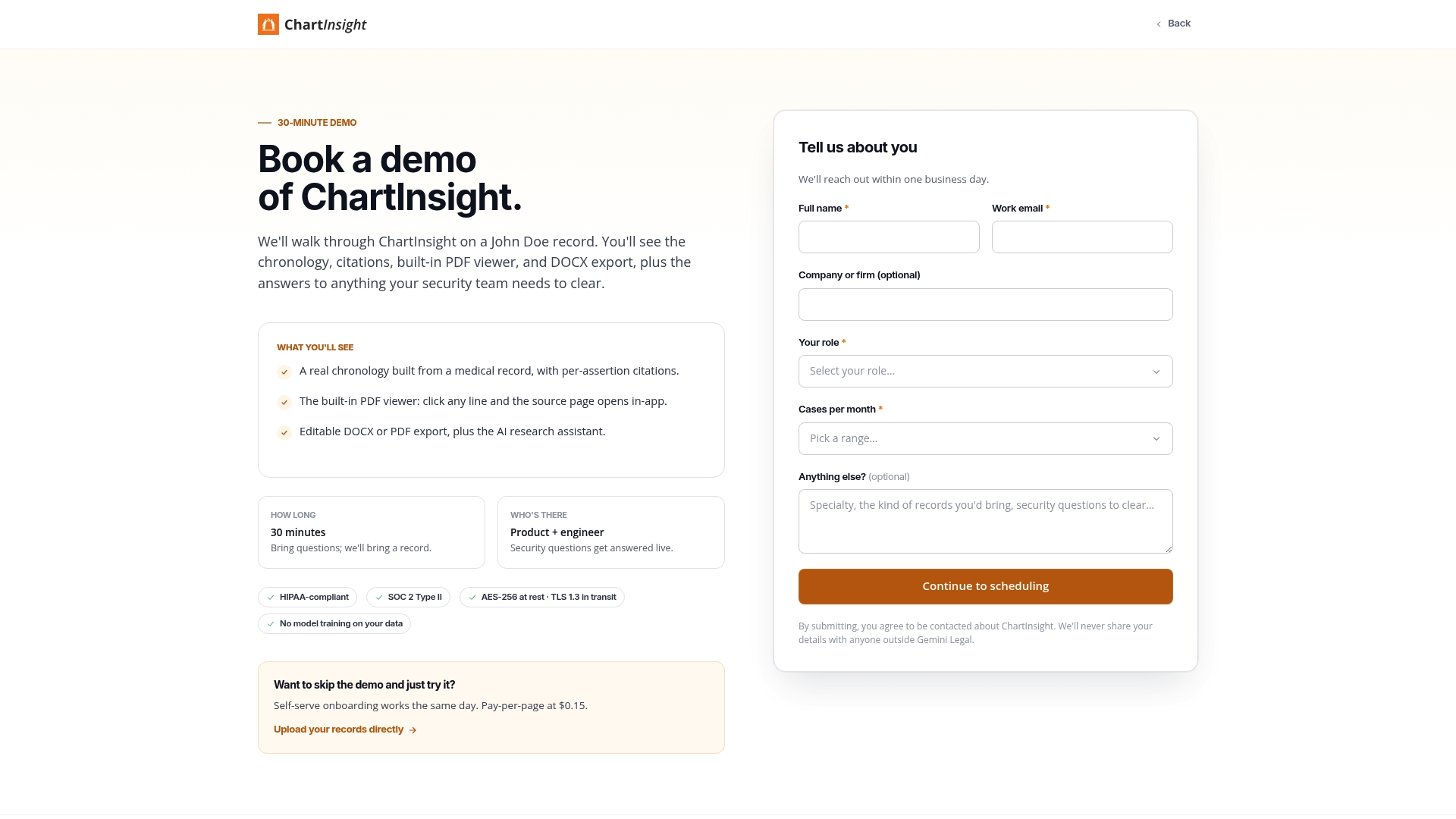
Every extracted fact in a ChartInsight™ output carries a live citation to the exact source page. Clicking that citation opens the source page in the built-in PDF viewer, so you can verify each fact against the record. For attorneys preparing demand packages or expert files, that means medical record summaries that are defensible line by line. ChartInsight™ also supports psychiatric record review for QME and IME matters where mental health records require specialized analysis. Book a demo to see how it fits your practice.
FAQ
What is the first step in a claim investigation?
Issue preservation notices as soon as a claim is anticipated. Preservation duties can arise before suit is filed, the exact trigger depends on the court and jurisdiction, and delayed action risks spoliation disputes.
How long should a demand package give the insurer to respond?
Many practitioners set a 30 to 60 day response window, subject to any statutory or policy-limits deadlines that apply. The window sets a clear deadline and signals readiness to proceed if negotiations stall.
Why do demand letters fall short?
Common reasons include internal inconsistencies, incomplete medical chronologies, and unverified lost wage documentation. Specific, documented evidence is the strongest pre-litigation negotiation tool.
When should an attorney retain an expert witness?
Retain experts after completing scene visits and evidence collection so the expert has full physical context. Test the opinion internally before disclosure to anticipate defense challenges.
How does digital evidence affect claim investigations?
Social media posts, GPS data, and phone records can directly contradict a claimant's account or corroborate it. Attorneys who skip digital review hand opposing counsel a free impeachment tool.