

TL;DR:
- A medical exam checklist guides physicians to ensure clinical thoroughness and legal compliance during independent evaluations. Proper adherence to administrative, conduct, and reporting protocols results in legally defensible reports that withstand disputes. Using structured workflows and record review tools improves report clarity and reduces downstream legal challenges.
An independent medical exam (IME) checklist is a structured protocol physicians use to ensure every evaluation meets clinical, legal, and jurisdictional standards before, during, and after the exam. Without a formal checklist, IME physicians risk procedural gaps that undermine report defensibility, trigger claim disputes, or violate state administrative rules. This guide covers the full independent medical exam checklist physicians need in 2026, from appointment notice compliance through final report structure. The steps are written to apply in any state. Where requirements differ by jurisdiction, the guide says so and points you to your own state's rules rather than assuming one state's framework.
A note on terminology before the checklist: the rules, the title of the evaluator, and even whether a state-administered certification exists all vary by jurisdiction. The conduct, documentation, and report-structure practices below are common to defensible medical-legal exams regardless of what your state calls the role. See the section on what the IME is called in your state for the role-specific differences.
1. What belongs on an IME physician checklist?

An independent medical assessment requires two parallel tracks: clinical thoroughness and legal compliance. Physicians who treat the IME as only a clinical exam miss the jurisdictional obligations that determine whether their report survives a legal challenge. The checklist framework below addresses both tracks in sequence, from pre-exam administration through report delivery.
2. Administrative preparation before the exam
Administrative compliance is the first line of defense in any IME dispute. Appointment notice timing and content are regulated in most jurisdictions, and a single procedural error can invalidate the entire evaluation.
- Confirm the appointment notice complied with your jurisdiction's notice rule. Notice requirements vary by state, but the common elements are advance written notice of the date, time, and place; a statement of the examinee's responsibility to attend; disclosure of the consequences of nonattendance; and, in many states, a defined window for the examinee to show good cause if they miss the exam. Confirm the specific timing and content your state requires, because some jurisdictions enforce these rules on strict-compliance grounds.
- Confirm that all medical records, diagnostic imaging, and prior IME reports have been received and organized before the exam day. Reviewing incomplete records after the fact weakens opinion credibility.
- Verify IME authorization status with the referring insurer or defense attorney. Confirm the specific referral questions in writing before the exam.
- Prepare procedural documents, including the examinee's rights notice and a copy-of-report disclosure. Inform the examinee in writing that they are entitled to a copy of the final report where your jurisdiction provides that right.
- Audit appointment notices regularly to catch formatting or timing errors before they become grounds for dispute.
Pro Tip: Keep a jurisdiction-specific notice template and re-verify it against your state's current rules at least quarterly. In states that enforce notice rules on strict-compliance grounds, partial adherence can be treated the same as no compliance.
3. How to conduct the IME exam itself
The exam opening sets the legal and clinical tone for everything that follows. Identity verification and clear communication about the exam's purpose are not formalities. They are widely recognized IME conduct steps, and they are directly tied to report defensibility. Physician examiners can pursue formal IME training and certification through bodies such as the American Board of Independent Medical Examiners, and many state workers' compensation agencies publish their own examiner conduct standards.
- Introduce yourself and verify identity. State your name, specialty, and the insurer or party that requested the exam. Confirm the examinee's full legal name and date of birth against the referral documents.
- State the nature of the exam. Explicitly tell the examinee that this is an independent evaluation, not a treatment visit. No treating relationship exists, and you will not be providing ongoing care or sharing opinions during the exam.
- Explain report sharing. Inform the examinee that your report will be shared with the requesting party and that they are entitled to a copy where applicable. Ask if they have questions before proceeding.
- Obtain a detailed history. Cover the mechanism of injury, symptom onset and progression, prior treatment, current functional limitations, and any prior relevant conditions. Document the examinee's own words where clinically significant.
- Perform a systematic physical exam. Use accepted clinical tests with standardized grading. Document range of motion, strength, sensation, reflexes, and any provocative test results using recognized clinical terminology. Note effort and consistency of effort.
- Address pain and functional limits. Document reported pain levels, functional restrictions, and any procedures terminated early due to examinee limitation or safety concerns.
- Document communications verbatim when possible. If the examinee makes a statement that directly affects your clinical opinion, record the exact language in your notes.
Pro Tip: Script your opening remarks and keep them consistent across every IME. Scripted introductory protocols reduce the risk of examinee confusion and protect against later claims that the exam's independent nature was not disclosed.
4. Key components of a structured IME report
The IME report is the product that attorneys, judges, and claims adjusters act on. Opinions supported by clinical evidence and organized by referral questions reduce challenges in claim disputes. A report that buries its conclusions or fails to cite reviewed records is far more vulnerable to attack.
Report structure checklist:
- Records reviewed: List every medical record, imaging study, and prior report reviewed, with dates, provider names, and sources. Do not summarize records as a group. Cite each one individually.
- History summary: Document the history obtained directly from the examinee during the exam, separate from the records review. Note any discrepancies between reported history and documented records.
- Physical exam findings: Report findings using standardized clinical grading and terminology. Include all relevant systems examined, not only the primary complaint area.
- Diagnostic imaging review: Interpret all imaging studies reviewed, including MRI, X-ray, and CT reports. Note the date of each study and the interpreting radiologist where available.
- Medical discussion: Analyze the clinical evidence in relation to the referral questions. Reference the AMA Guides edition required by your jurisdiction where impairment ratings are involved.
- Opinions and conclusions: Organize opinions explicitly by referral question. Each opinion must be supported by the history, exam findings, and records reviewed.
- Compliance statements: Include a statement confirming report ownership, distribution rights, and any applicable jurisdictional disclosure requirements.
Comparison: reports that survive disputes vs. reports that don't
| Element | Defensible report | Vulnerable report |
|---|---|---|
| Records cited | Each record listed with date and source | "Records reviewed" listed as a group |
| Opinions | Linked to specific findings and referral questions | Stated as conclusions without supporting evidence |
| Exam findings | Standardized grading with clinical terminology | Narrative only, no objective measures |
| Lay readability | Logic clear to non-clinician reviewers | Requires clinical background to follow |
| Compliance | Jurisdictional disclosures included | No disclosure statements |
Writing for non-clinician reviewers is not a concession to simplicity. It is a deliberate strategy that reduces the number of successful challenges to your opinions.
5. What the IME is called in your state
Terminology, evaluator titles, and certification requirements vary widely by state, so treat this as a general map rather than a precise crosswalk. Always confirm the specifics with your own state's workers' compensation agency.
- The generic IME. In most states, the Independent Medical Examination is the default model: a physician examines the injured worker and issues a medical-legal opinion on disputed issues. There is generally no state-administered certification, and any qualified physician can perform the exam.
- California: QME and AME. California uses state-certified Qualified Medical Evaluators (QMEs) and Agreed Medical Evaluators (AMEs). A QME is certified by the state and assigned from a panel; an AME is a physician both parties agree on. This is a more formalized, gatekept model than a pure open IME.
- Texas: Designated Doctor. Texas uses the Designated Doctor system, a physician selected from a state-maintained list to resolve disputes about impairment, maximum medical improvement, and return to work. Of the formalized roles, this is the closest functional analog to California's QME: state-certified, list-based selection, and a neutral dispute-resolution function.
- Florida: Expert Medical Advisor. Florida pairs the IME with a judge-appointed Expert Medical Advisor (EMA). When there is a genuine conflict between medical opinions, the EMA's opinion carries a strong statutory presumption of correctness.
- Other formalized roles. New York requires IME examiners to be registered or authorized by its Workers' Compensation Board. Massachusetts uses impartial examiners appointed from a state roster. Several states also recognize agreed examiners chosen jointly by both parties, mirroring California's AME.
For physicians, the practical takeaway is that the conduct, documentation, and report-structure standards in this guide apply across these models. What changes is the evaluator's title, how you are selected, the certification you must hold, and the procedural rules that attach to your specific role. Confirm those role-specific requirements with your state agency before each engagement.
6. How to verify jurisdictional compliance and AMA Guides alignment
Compliance with local IME standards is not optional, and it runs parallel to clinical thoroughness. Treat provider obligations as dual compliance: medical standards and jurisdictional legal standards. Physicians who satisfy only one track produce reports that are clinically sound but legally exposed.
- Review your state's applicable administrative rules before each exam. Workers' compensation rules differ by state, and the same topic (examiner conduct, notice, report deadlines) may sit in different rule sections depending on the jurisdiction. Identify the rules that govern your evaluator role in your state and check for updates at least annually.
- Verify AMA Guides edition requirements. The applicable edition (for example, Fifth or Sixth) varies by jurisdiction. Confirming the required edition and completing aligned training is the physician's responsibility; the AMA publishes AMA Guides training resources and CME. Verify that any continuing education you complete satisfies your state's requirements.
- Check report deadline requirements. Many jurisdictions impose strict timelines between the exam date and report delivery. Missing a deadline can affect the report's admissibility.
- Confirm data privacy compliance. Medical records obtained for IME purposes are subject to HIPAA and state privacy rules. Confirm your document handling and storage practices meet current requirements.
- Maintain continuing education records. Document all AMA Guides training, IME-specific certifications, and jurisdictional compliance courses. These records support your qualifications if challenged in a deposition or hearing.
Jurisdictional compliance reference table
| Compliance area | Key requirement | Verification step |
|---|---|---|
| Appointment notice | Advance written notice with content and timing set by your state | Audit notice template quarterly against current state rules |
| AMA Guides edition | Jurisdiction-specific (for example, 5th or 6th) | Confirm with your state workers' compensation agency |
| Report deadline | Varies by state | Check your state's applicable rule |
| Data privacy | HIPAA plus state rules | Review storage and transmission protocols |
| Training credentials | State-aligned AMA Guides training | Confirm CE satisfies state requirements |
Physicians who serve as a panel QME, Agreed Medical Evaluator, or Designated Doctor face additional requirements beyond a standard IME. The QME selection process, for example, adds reporting and format obligations, and those requirements should be incorporated into a separate checklist variant for your role.
Key takeaways
A defensible IME requires equal attention to administrative compliance, structured exam conduct, and evidence-anchored report writing. No single element substitutes for the others.
| Point | Details |
|---|---|
| Administrative compliance first | Verify appointment notice timing, content, and authorization before the exam date. |
| Know your role | Confirm whether your state uses a generic IME, a QME/AME, a Designated Doctor, or another formalized evaluator role, and follow its specific rules. |
| Script the exam opening | Identity verification and no-treating-relationship disclosure are required steps, not formalities. |
| Cite every record individually | List each reviewed document with date and source; grouped citations weaken report defensibility. |
| Organize opinions by referral question | Each conclusion must link directly to history, exam findings, and reviewed records. |
| Verify AMA Guides alignment | Confirm the applicable edition and that your training satisfies state-specific requirements. |
What building tools for IME physicians reveals
ChartInsight's team has spent years working with the workflows that IME physicians, QMEs, and med-legal reviewers actually use. One pattern recurs: physicians who are clinically excellent still produce vulnerable reports because the administrative and compliance layer gets treated as an afterthought.
The checklist items that cause the most downstream problems are rarely the clinical ones. They are the appointment notice that went out a day short of the required window, or the report that lists "records reviewed" as a block without individual citations. These are not clinical failures. They are process failures, and a checklist fixes them.
A second pattern: physicians who review records thoroughly before the in-person exam write better reports. When the imaging findings and treatment timeline are already known before the examinee walks in, history-taking is sharper and the physical exam is more targeted. An evidence-first workflow, where the records review is complete before the exam, produces opinions that are harder to challenge because the reasoning is visibly grounded in the full record.
The third pattern is readability. Attorneys and judges are not clinicians. A report that requires a medical degree to follow generates more questions, more depositions, and more challenges than one that walks a non-clinician through the logic clearly. Writing for the actual audience is not dumbing down an opinion. It is making the opinion stick.
ChartInsight and the IME record review problem
Physicians preparing for an IME often receive records that run into thousands of pages across multiple providers. Reviewing that volume manually before the exam takes days.
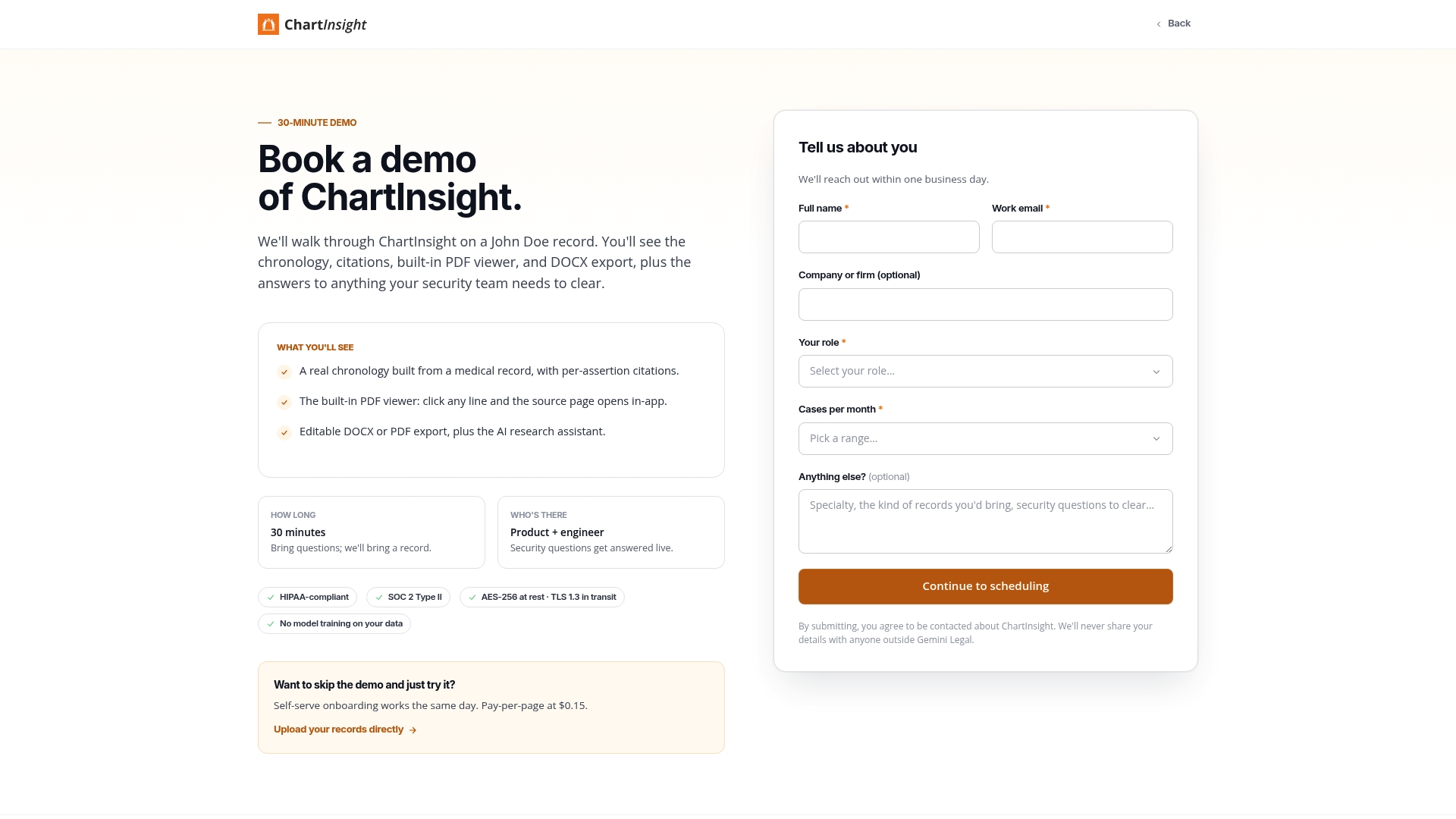
ChartInsight takes the full medical record PDF and produces a structured output: a chronology of events, a nine-section narrative summary, normalized vitals, a medications table, and any custom analyses your team has configured. Every extracted fact carries a live citation back to the exact source page. Clicking that citation opens the PDF inside the app, so you verify a claim without losing your place or downloading a separate file. For physicians who need to defend every line of their IME report, ChartInsight helps cut record review from days to hours. Book a demo to see how it fits your IME workflow.
FAQ
What is an independent medical exam checklist for physicians?
An IME checklist is a structured protocol covering administrative preparation, exam conduct, and report writing steps that physicians follow to produce thorough, legally defensible evaluations. It addresses both clinical requirements and jurisdictional compliance obligations.
How far in advance must an IME appointment notice be sent?
It depends on your state. Notice timing and content are set by each jurisdiction's workers' compensation rules, and some states enforce them on strict-compliance grounds. The common elements across states are advance written notice of the date, time, and place, disclosure of the consequences of nonattendance, and often a defined window for the examinee to show good cause. Confirm the exact requirement with your state agency.
Is an IME the same as a QME, AME, or Designated Doctor?
They are related but not identical. The IME is the generic model used in most states. California uses state-certified QMEs and party-agreed AMEs, Texas uses Designated Doctors selected from a state list, and Florida uses judge-appointed Expert Medical Advisors. The conduct and report-structure standards are largely shared; what differs is the evaluator's title, certification, and the procedural rules for that role.
Which edition of the AMA Guides applies to IME impairment ratings?
The applicable edition varies by jurisdiction. Physicians must confirm whether their state requires the Fifth or Sixth Edition and verify that their AMA Guides training satisfies their jurisdiction's requirements.
What makes an IME report legally defensible?
A defensible IME report cites each reviewed record individually with dates and sources, links every opinion directly to a referral question, uses standardized clinical grading, and is written clearly enough for non-clinician reviewers such as attorneys and judges to follow the reasoning.
Should physicians use a different checklist for QME or Designated Doctor evaluations?
Yes. Formalized evaluator roles such as a panel QME, an AME, or a Designated Doctor carry additional format and reporting requirements beyond a standard IME. Physicians conducting psychiatric or orthopedic evaluations in these roles should maintain a separate checklist variant that incorporates their role-specific obligations alongside the core IME framework.