

The defensible medical narrative summary format is a concise, chronologically ordered account of a claimant's treatment, organized into distinct sections and citing the exact record page behind every clinical fact. Use it when you need a document an adjuster, a QME, or a jury can trust on sight. For any record over a few hundred pages, pair it with a separate chronology, keep the originals available to the other side (in federal court, FRE 1006 governs when a summary of voluminous records may be admitted), and let tools like ChartInsight™ generate both with citations already attached.
TL;DR:
- A narrative summary should be paired with a detailed chronology for cases exceeding a few hundred pages to ensure accuracy and ease of review.
- All clinical facts within the summary must include inline citations to source pages, enabling quick verification during cross-examination.
- A nine-section template captures key case details, including injury mechanism, prior history, diagnostics, procedures, medications, current status, and the documented medicolegal opinions of the evaluating physician.
- Before finalizing, verify the ten most important facts against source pages to maintain credibility and avoid damaging inaccuracies.
- Tools like ChartInsight™ generate page-cited summaries so every sentence can be checked against the record.
Table of Contents
- Choosing the Right Narrative Summary Format
- A Copy-Ready Section-by-Section Template
- Sample Paragraphs You Can Adapt Right Now
- Narrative Summary or Chronology: What's the Difference?
- A Quality Check Before You Send It Out
- How ChartInsight™ Builds a Citable Narrative Every Time
- What ChartInsight™ Users Should Do First
- Get Page-Cited Summaries Without the Manual Review Marathon
- Sources
- FAQ
Choosing the Right Narrative Summary Format
Not every case calls for the same shape. A one-paragraph blurb, a full nine-section narrative, and a SOAP-derived summary each solve a different problem, and picking the wrong one wastes review time or undersells your case.
The one-paragraph blurb works for a demand letter cover sheet or a quick status update to a claims adjuster who already has the file. It states the injury, current treatment status, and prognosis in five or six sentences, nothing more. A full narrative summary is the workhorse for expert reports, mediation binders, and deposition prep. It runs several pages, follows a fixed section order, and cites every material fact back to a page number. SOAP-derived summaries (Subjective, Objective, Assessment, Plan) borrow the clinician's own charting logic and read well to a QME or treating physician, but they tend to confuse a jury unfamiliar with the format.
Three things should drive the choice:
- Audience. A jury needs plain narrative; a QME or AME reads SOAP-style structure faster.
- Record length. As a rule of thumb, under a few hundred pages a narrative alone may suffice. Beyond that, attach a chronology.
- Central issues. Cases turning on causation or apportionment need a longer medicolegal impressions section; routine soft-tissue claims often don't.
When the record spans multiple providers or exceeds a few thousand pages, produce a companion chronology regardless of which narrative format you pick. It becomes your fact-check tool during deposition.
A Copy-Ready Section-by-Section Template
Below is a nine-section structure paralegals and attorneys can drop into a template and fill directly from the record. Start every summary with a header block: claimant name, case number, records reviewed (by provider and date range), total pages reviewed, and the date the summary was prepared. That header alone answers the first challenge any opposing counsel raises: what exactly did you review?
- Presenting problem. The injury or condition as first documented, in the treating provider's own words where possible.
- Mechanism of injury. How the injury occurred, sourced to the earliest consistent account in the record.
- Relevant prior history. Pre-existing conditions or prior treatment bearing on causation or apportionment.
- Chronological narrative of care. The backbone section: each meaningful visit or intervention, in date order, collapsed to avoid repeating routine follow-ups.
- Diagnostics and objective findings. Imaging, lab results, and exam findings, each tied to its report date.
- Procedures and surgeries. Dates, providers, and stated outcomes for any invasive intervention.
- Medications and vitals summary. Current regimen and any notable vitals trends over the treatment period.
- Current status and prognosis. Where the claimant stands now, including P&S or MMI determination if one exists.
- Medicolegal impressions. The evaluating or treating physician's documented causation analysis, apportionment discussion, and opinions, each cited to the report page. The summary reports these opinions; it does not author them.
For inline citations, use a consistent short form: (Dr. Alvarez, 3/12/24, p. 47). When five visits say essentially the same thing, cite the range rather than each entry: (Dr. Alvarez, 1/8/24–4/2/24, pp. 12–19). This keeps the narrative readable without sacrificing traceability.
Pro Tip: Build the medicolegal impressions section last, after the chronological narrative is locked. Causation discussion drafted before the timeline is finalized is a common source of internal contradiction that opposing counsel will flag.
Sample Paragraphs You Can Adapt Right Now
Neutral, present-tense language keeps a summary from reading as argument rather than fact. Below are short adaptable examples across common case types, with citation placeholders you can swap for your own page numbers.
- Motor vehicle injury: "The claimant reports neck and lower back pain beginning immediately after the collision (Dr. Chen, [date], p. [X]). MRI of the cervical spine reveals a C5-C6 disc protrusion (Radiology report, [date], p. [X])."
- Orthopedic surgery: "Arthroscopic repair of the right rotator cuff is performed on [date] (Op report, p. [X]). Post-operative visits through [date range] document progressive improvement in range of motion (PT notes, pp. [X-X])."
- Psychiatric care: "The claimant is diagnosed with major depressive disorder secondary to the workplace incident (Dr. Patel, [date], p. [X]). Weekly therapy sessions from [date] through [date] show partial symptom improvement (Therapy notes, pp. [X-X])."
- Chronic condition: "Pain management records document ongoing lumbar radiculopathy managed with epidural injections at approximately six-week intervals (Dr. Osei, [date range], pp. [X-X])."
Notice the collapsing technique in the orthopedic and chronic-condition examples: instead of listing eight separate physical therapy visits, one sentence spans the date range and cites the supporting pages as a block. The same principle holds for narrative work generally: keep only the entries that change the diagnosis, treatment plan, or prognosis, and compress the rest.
Narrative Summary or Chronology: What's the Difference?
A chronology is a table: date, provider, event, page reference, nothing interpreted. A narrative summary is prose that connects those same events to causation, treatment response, and prognosis. Attorneys often need both, and confusing the two wastes review time.
Use the chronology when you or opposing counsel need to check a specific date fast, during a deposition, for instance, or when reconciling conflicting provider accounts. Use the narrative when you need to persuade: an adjuster reading a demand letter, a mediator, or a jury.
Cross-reference the two documents with matching page citations rather than duplicating content. If the narrative states "the claimant underwent lumbar fusion surgery (Dr. Osei, 6/14/24, p. 88)," the chronology row for that date should cite the same page. This lets a reviewer jump between the persuasive story and the raw timeline without hunting. The discipline is not unique to U.S. practice. For a practitioner's view from another jurisdiction, this Australian guide to serious injury claim timeline management makes the same point: consistent identifiers keep the chronology and the narrative from drifting apart as a case file grows.
A Quality Check Before You Send It Out
Run every draft through a short audit before it leaves your desk. Five checks, adapted from clinical documentation practice, catch most of the errors that get a summary challenged.
- Clear. Would a reader unfamiliar with the case understand the injury and treatment path from this alone?
- Concise. Have you collapsed routine, non-contributory visits rather than listing each one?
- Cited. Does every clinical fact carry a page reference back to the source record?
- Chronological. Does the narrative follow date order, with no unexplained jumps?
- Clinically neutral. Have you removed language that argues a position rather than states a fact?
Three specific pitfalls to scan for: unsupported prognosis statements with no citation, dates stated without a source page, and assertions ("the claimant fully recovered") that no record entry actually supports. CMS documentation guidance treats accurate, complete and contemporaneous entries as the baseline for a reliable record, and a summary that departs from that baseline invites challenge.
Before export, verify your top ten dates, medications, vitals readings, and imaging findings directly against the source pages. This ten-item spot check is a fast way to catch the transcription errors most likely to be challenged. When exporting to DOCX or PDF, confirm citations survive the format change; a summary that loses its page references in export is functionally useless to opposing counsel trying to verify it.

How ChartInsight™ Builds a Citable Narrative Every Time
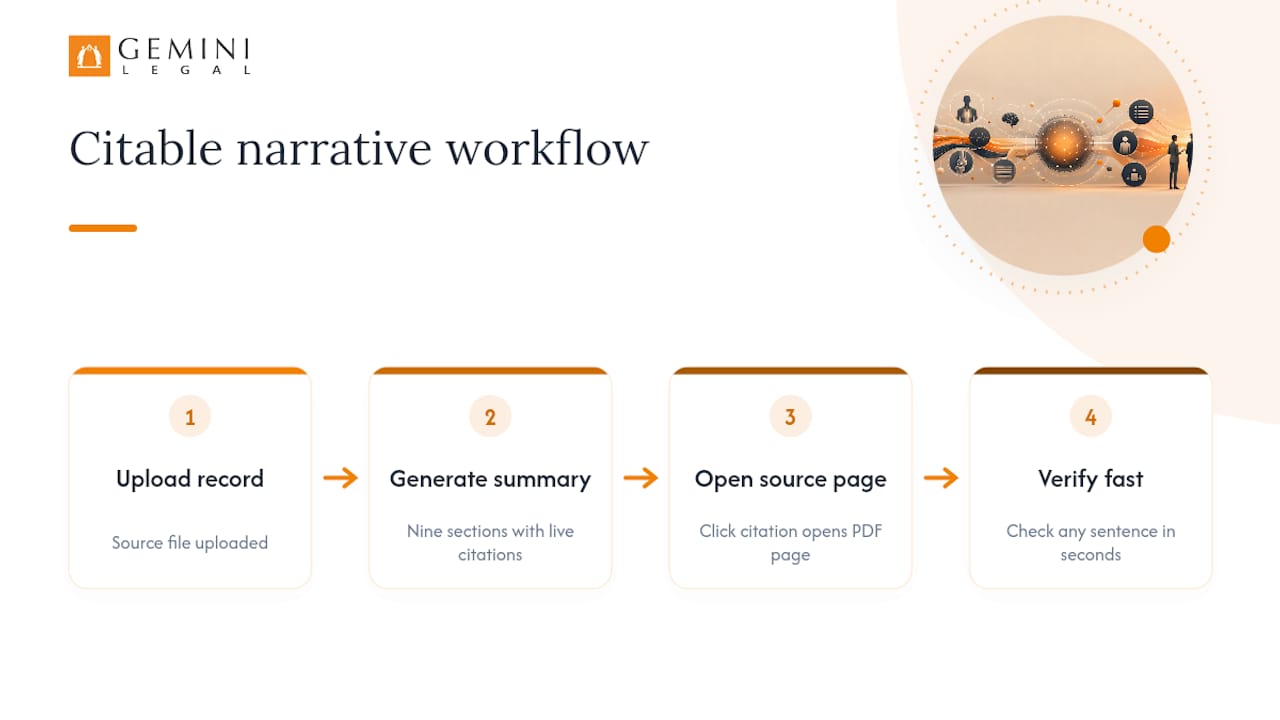
ChartInsight™ generates a nine-section narrative summary directly from the uploaded record (Overview, Key Diagnoses, Key Injuries, Key Test Results, Surgeries and Procedures, Medications, Current Health Status, Treatment Plan, and Return to Work), with every clinical fact carrying a live citation to its source page. Click the citation and the source PDF opens inside the app at that exact page, so verification never requires a separate file search.
The value of a page-cited workflow isn't speed alone. It's that an expert or opposing counsel can check any single sentence against the original record in seconds instead of paging through a stack of exhibits. That verification speed is what makes a summary defensible under cross-examination, not just readable.
The 112,000-character summary case study shows why this matters: a 56-page human-written summary of the same record still missed a stroke, a prior gastrectomy, and diabetes. Teams that need consistency across cases can build the template above as a reusable custom analysis and maintain a prompt library so a med-legal report and a peer review come back in the same format every time.
Pro Tip: When a QME or AME challenges a specific fact in your narrative, don't re-read the whole record to find it. Pull the citation, click through to the source page, and resolve the question in the room.
What ChartInsight™ Users Should Do First
Most guidance on narrative summaries focuses on structure and forgets the part that actually gets challenged in deposition: whether every sentence traces back to a page. Section headers and clean formatting matter, but they don't survive a cross-examination question like "where in the record does it say that?" A summary without inline citations fails that test regardless of how well organized it looks.
The overlooked mistake is treating the narrative and the chronology as competing formats instead of complementary ones. Attorneys who produce only a narrative lose the fast-reference table a deposition demands. Attorneys who produce only a chronology lose the causation story that actually persuades. Produce both, cross-referenced, every time the record justifies it.
If there's one thing to prioritize above template perfection, it's this: verify the ten most consequential facts in your summary against the source pages before it goes out the door. A beautifully structured summary with one uncited, wrong date does more damage than a plainer document that holds up under scrutiny. Defensibility comes from what survives the challenge, not from what looks polished on first read.
Get Page-Cited Summaries Without the Manual Review Marathon
Building a defensible narrative summary by hand, cross-referencing every fact back to a page number across a multi-provider record, is the part of case prep that eats entire weekends. ChartInsight™ generates the nine-section narrative, a companion chronology, normalized vitals, and a medications table directly from the uploaded PDF, with every fact carrying a live citation back to its exact source page.
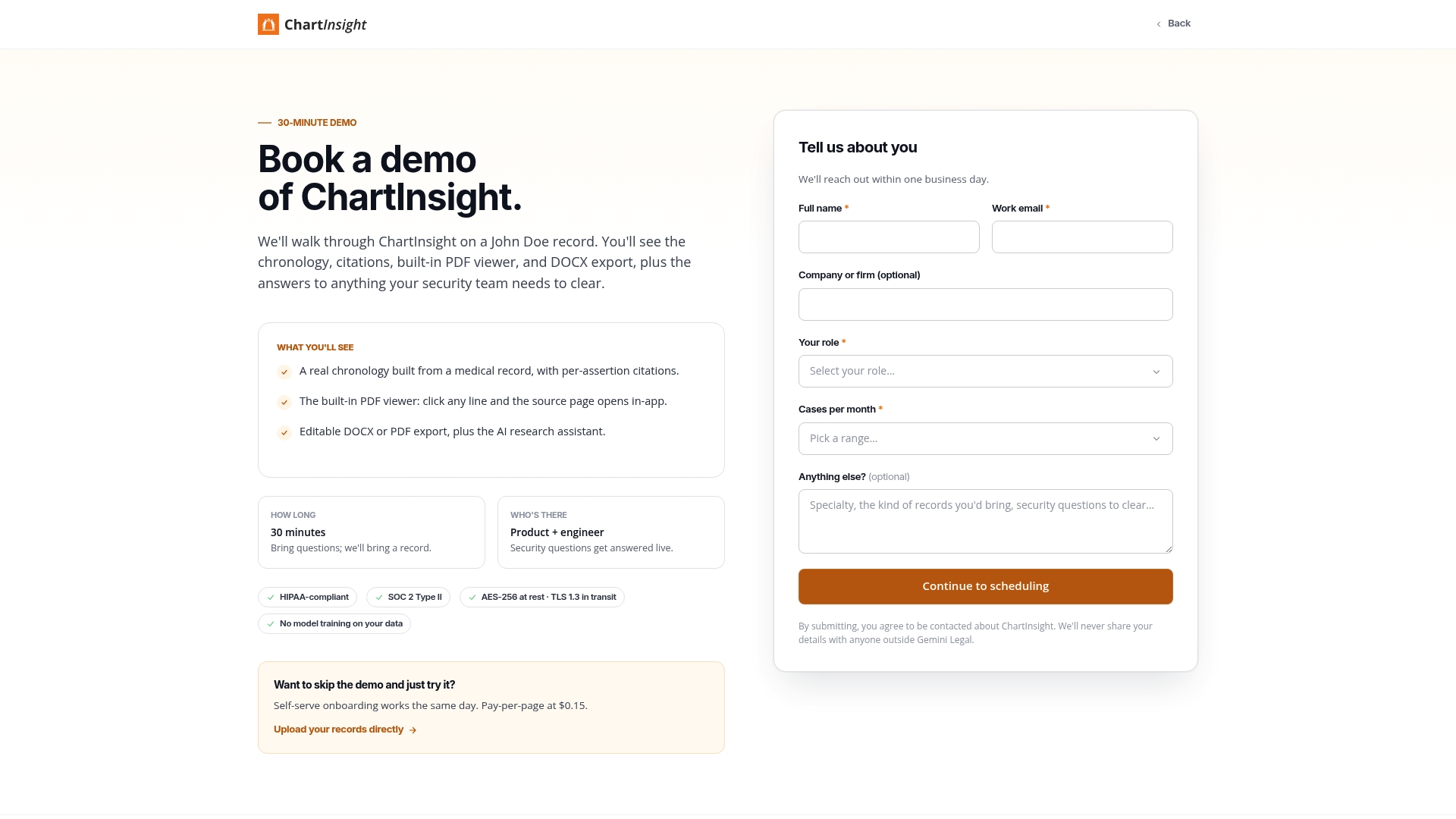
That citation isn't a footnote you have to double-check later. Click it, and the source PDF opens inside the app at that page, so you or a reviewing QME can verify any claim without downloading a separate file or losing your place in the record. Teams also set up reusable templates so a personal injury summary or a psychiatric expert review comes back in a consistent format case after case, and exports to DOCX or PDF preserve every citation intact.
If your caseload includes orthopedic QME reviews or personal injury files running into the thousands of pages, see what a citation-preserving workflow looks like on your own records by booking a demo.
Sources
- Federal Rules of Evidence, Rule 1006
- Complying With Medical Record Documentation Requirements, CMS MLN
FAQ
What Are the 5 C's of Medical Record Documentation?
A practical adaptation for narrative summaries is clear, concise, cited, chronological, and clinically neutral, meaning every fact traces to a source page and the language avoids arguing a position rather than stating one.
Can You Provide an Example of a Narrative Summary?
A short example: "The claimant reports lower back pain following a motor vehicle collision on [date] (Dr. Chen, [date], p. [X]). Lumbar MRI performed [date] reveals a disc protrusion at L4-L5 (Radiology report, p. [X]). Physical therapy from [date range] shows gradual improvement in range of motion (PT notes, pp. [X-X])."
What Is a Medical Narrative Report?
A medical narrative report is a chronologically ordered, prose account of a patient's diagnosis, treatment, and prognosis, typically organized into sections covering history, findings, treatment course, and clinical impressions, with each fact cited to its source page.
Can You Provide an Example of a Medical History Summary?
A medical history section might read: "The claimant reports no prior lower back injuries or treatment (Intake form, [date], p. [X]). A remote history of hypertension, managed with medication, is noted but not identified as contributing to the current injury (PCP records, [date], p. [X])."
Is a Narrative Summary Admissible in Court?
In federal court, FRE 1006 lets a judge admit a summary of voluminous admissible records when the originals are made available to the other parties; state rules vary, and admission is never automatic. That is why pairing a narrative with an accessible, page-cited source record matters for defensibility.