

A defensible medications table is not a summary. It is an extraction of every drug named in the record, mapped to RxNorm where possible, with each entry pointing back to a source document and exact PDF page. That page-level citation trail is what turns a medication history into evidence that a QME, adjuster, or opposing counsel cannot easily dismiss. This article covers the required fields, the extraction workflow, formatting rules for exhibits, and the specific errors that undermine a table's weight in deposition.
TL;DR:
- A defensible medication table requires page-level citations linking each drug to the exact source document and PDF page to establish evidentiary weight.
- Extraction must include core fields such as standardized drug name, RxNorm identifier, dosage, route, frequency, dates, and exact source location, with manual validation of high-risk entries.
- Medication data comes from multiple provider systems, often with discrepancies, so reconciliation and cross-referencing with secondary sources are crucial for accuracy.
- Automated extraction handles high-volume tasks efficiently but still needs human judgment for conflicts, ambiguous entries, and validation, supported by precise page citations.
- The ChartInsight™ platform automates source linking, preserves citations in exports, and speeds up the creation of defensible, court-ready medication records for legal reviews.
Table of Contents
- Why a Medication List in Records Needs Page-Level Citations
- Where Medication Data Comes From, and What Breaks During Extraction
- How to Extract and Verify a Medication List From the Record
- Formatting and Citation Rules That Hold Up in Discovery
- Quality Checks and Red Flags Before You Trust the Table
- Handling Over-the-Counter Drugs, Supplements, and Herbal Products
- Why Patient-Reported Information Still Matters in the Chart
- Reconciling Medication Lists Across Multiple Providers
- What Automation Gets Right, and Where It Still Needs a Human
- How ChartInsight™ Builds Page-Cited Medication Tables
- Sources
- FAQ
Why a Medication List in Records Needs Page-Level Citations
A medications table earns its place as substantial medical evidence only when every row can be traced back to a specific document and page. Under the substantial medical evidence standard, a report that gets its facts wrong loses weight even when it is formally compliant with reporting rules. That standard is why "the patient takes gabapentin" is not enough. The row needs to say which document, which page, and ideally the exact phrase the record used.
The required columns for a legal-grade table are not negotiable if the output is going into a QME report, a peer review, or a deposition exhibit:
- Standardized medication name (short name used consistently across the table)
- Generic name and brand name, when the record supplies both
- RxNorm ingredient name or RxNorm CUI (concept unique identifier)
- Strength and dose (with units, since "5" without "mg" or "mL" is meaningless)
- Route (oral, IV, topical, and so on)
- Frequency, plus start date, stop date, or "active as of [date]" when no stop date exists
- Source document name and PDF page number or page range
- A short quoted excerpt from the record when the entry is ambiguous or contested
Prescriber name and pharmacy fill data matter most when apportionment or causation is in dispute, such as when a claims' adjuster needs to know whether a controlled substance was continued past a reasonable treatment window. RxNorm is the right normalization layer here because it lets a reviewer compare "Norco" against "hydrocodone/acetaminophen" as the same clinical entity, and NLM's RxNav API is the standard tool for resolving ingredient identifiers across records pulled from different EHR systems. Deliverables should always come in two forms: an editable DOCX or PDF with citations preserved for the report or exhibit, and a plain CSV or Excel file for internal tracking and cross-referencing.
Where Medication Data Comes From, and What Breaks During Extraction
Medication entries in a multi-provider record come from at least five distinct document types: admission medication lists, discharge summaries, medication administration records (MARs), outpatient active medication lists, and pharmacy fill records. Each one was generated by a different system, at a different point in the treatment timeline, often by a different provider group entirely.
That fragmentation shows up in the data. Research on medication reconciliation across transitions of care found that medication lists compared within the same EHR system agreed closely, with a median intersection between 94.1% and 100%, while active medication lists compared across different EHR systems agreed far less (RxNorm drugs: 6.1% to 7.1%; RxNorm ingredients: 29.4% to 35.0%). If a claimant's record includes an orthopedic surgeon's EHR, a pain clinic's EHR, and a hospital discharge summary, expect the three medication lists to look nothing alike on paper, even when the underlying regimen barely changed.
Watch for these failure patterns when reviewing an extracted table:
- Missing RxNorm CUI on an entry that should have one (a strong signal of an OCR or parsing failure)
- Unit mismatches between two documents describing what should be the same prescription
- Free-text instructions too vague to code ("take as directed")
- Routes that don't make clinical sense for the drug listed
- Orderable supplies (test strips, lancets, syringes) mixed into the medication rows
How to Extract and Verify a Medication List From the Record
Turning a stack of provider PDFs into a table you'd defend under oath takes five steps, and skipping any one of them is where reviewers get caught flat-footed in deposition.
- Inventory every source document. List each PDF by file name, note the page range where medication information appears, and flag document type (MAR, discharge summary, active med list, and so on). You cannot cite a page you never logged.
- Run automated extraction with RxNorm mapping. Every entry should resolve to an RxNorm ingredient or CUI. Flag anything that doesn't resolve, along with any entry pulled from ambiguous free text, for manual review rather than accepting it silently.
- Validate manually using a mix of random and targeted sampling. Pull a random sample across the full table, then add a targeted review of every high-risk drug class: opioids, benzodiazepines, and anticoagulants. Reconcile conflicts using best possible medication history (BPMH) principles, which call for confirming an active medication from at least two independent sources rather than trusting a single list.
- Reconcile against secondary sources where legally permissible. Pharmacy fill records, e-prescribing logs, and PDMP data can confirm or contradict what the chart says. Document each reconciliation with its own page citation rather than folding it silently into the primary table.
- Lock the table and export with citations preserved. Record who extracted it, when, and what percentage was manually validated before it goes into a report or exhibit packet.
Pro Tip: Sample size matters more than reviewers assume. A validation pass on 5 records tells you almost nothing about systemic error rates.
Formatting and Citation Rules That Hold Up in Discovery
A citation format that looks fine in a draft can fall apart the moment opposing counsel asks "which page, exactly?" Every entry needs the source file name and a specific page or page range, not just "per the record." For ambiguous entries, a two- or three-word quoted excerpt from the original text settles disputes faster than any paraphrase.
Digital deliverables should preserve that citation trail end to end:
- Live links to the exact source PDF page in any exported working document
- Citations that survive the export into DOCX or PDF, not just in the internal review tool
- A clean CSV or Excel version for internal cross-referencing and searching
- Consistent formatting so a reviewer can scan hundreds of rows without re-learning the citation style each time
Distinguish between the exhibit table and the working table. The exhibit version is the full, fully cited table meant to stand on its own as a legal document. A condensed summary handed to a physician or adjuster for a quick read should reference the exhibit by number rather than duplicating (and potentially contradicting) the full table's data.
Every table should also carry its own extraction metadata: who extracted it, the extraction date, the validation sampling rate, and what percentage of sampled entries matched the source without correction. That metadata is what CMS and Joint Commission accreditation frameworks expect from reconciliation practices generally, and it is exactly the kind of documentation that supports a table under the substantial medical evidence standard when its accuracy gets challenged months later.
Quality Checks and Red Flags Before You Trust the Table
Red flags that should stop you before you cite the table in a report:
- Any medication entry with no page citation at all
- Conflicting dose or frequency for the same drug across two source documents
- Inpatient administration with no corresponding prescriber order
- Overlapping controlled-substance prescriptions from different providers with no documented taper or coordination
For adjacent context on how objective testing evidence is used to document controlled-substance compliance in legal proceedings, see this overview of court-ordered drug testing.
Pro Tip: When a red flag surfaces on an opioid or benzodiazepine entry, pause and request supplemental records or deposition testimony before finalizing the table. That single medication line can carry more weight in an apportionment argument than the rest of the table combined.
Handling Over-the-Counter Drugs, Supplements, and Herbal Products
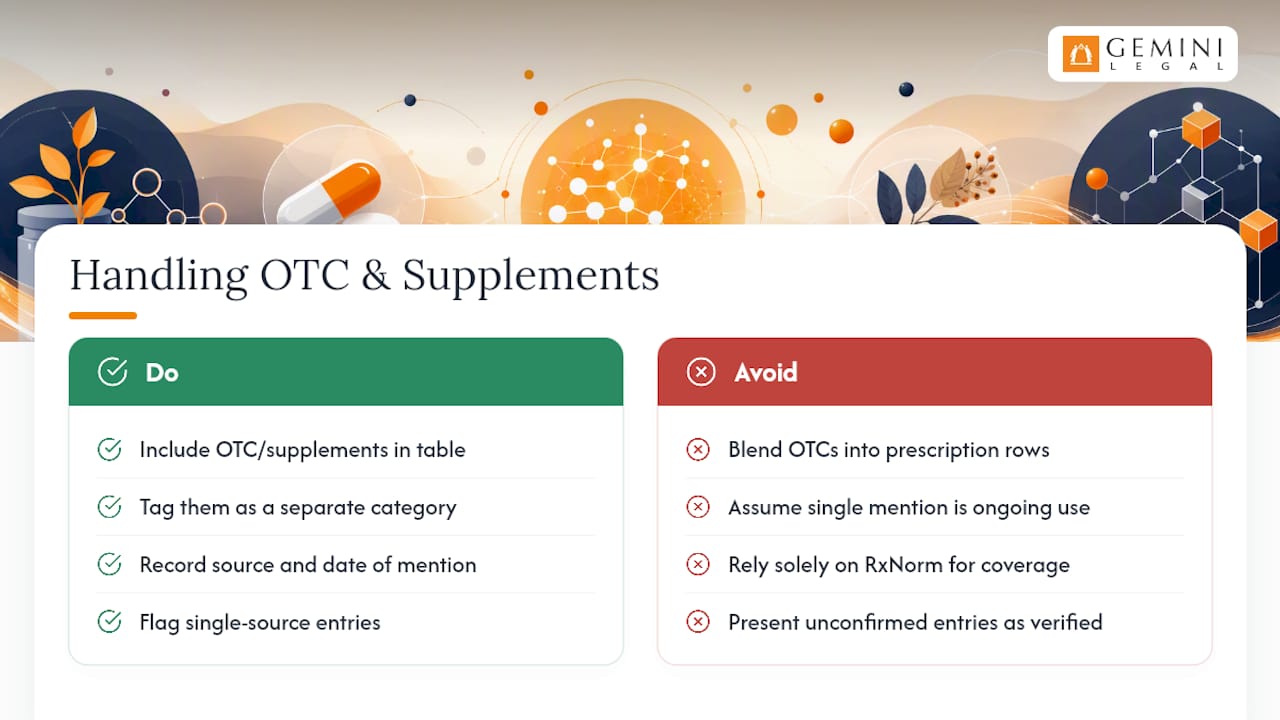
OTC medications, supplements, and herbal products get inconsistent treatment across provider documentation, and that inconsistency is itself a data point worth noting in the table rather than ignoring. Some providers log daily aspirin or a fish oil supplement with the same rigor as a prescription; others skip it entirely unless it interacts with a prescribed drug.
Include OTC and supplement entries in the medications table, but tag them clearly as a separate category rather than blending them into prescription rows. A claimant's daily ibuprofen use matters enormously in a case involving GI bleeding or renal function, and an herbal supplement with known drug interactions (St. John's Wort and SSRIs, for instance) can be directly relevant to a causation argument. RxNorm covers many common OTC products and supplements, though coverage is less complete than for prescription drugs, so expect more manual coding on this category than on prescription entries.
The bigger risk is documentation gaps. If a patient reports taking a supplement at intake but no provider ever re-confirms it at subsequent visits, the table should reflect that single-source status rather than implying ongoing verified use. Note the source and date of the OTC or supplement mention explicitly, the same way you would for a prescription entry, and flag entries that appear only once across a record spanning years. That single mention is a legitimate finding, but it should never be presented with the same confidence as a medication documented consistently across multiple visits.
Why Patient-Reported Information Still Matters in the Chart
Best possible medication history practices call for confirming an active medication list from at least two independent sources, and one of those sources is almost always the patient or a family member. That principle matters for record reviewers too, not just for clinicians building the original chart, because a patient's own account often surfaces medications that never made it into a formal EHR list.
Patient-reported medication information shows up scattered through a record: intake questionnaires, a psychiatric history section, a pain management consult's "current medications per patient" line. These entries carry a different evidentiary weight than a pharmacy-verified prescription. A reviewer should log them as patient-reported rather than provider-confirmed, and note when (or whether) a provider ever independently verified the claim.
Discrepancies between what a patient reported and what the chart otherwise shows are not automatically a red flag against the patient. Patients forget dosages, confuse drug names, or describe a medication a provider discontinued months earlier without updating every downstream document. But a pattern of contradictions between patient-reported and provider-documented medications, especially around controlled substances, is exactly the kind of finding that deserves a targeted note in the table and a flag for follow-up questioning in deposition. The table's job is to preserve that distinction, not paper over it.
Reconciling Medication Lists Across Multiple Providers
The core challenge in any multi-provider record is that different EHR systems barely agree with each other. Every med-legal reviewer working from a stitched-together record needs a strategy for that gap.
Start by treating each source document as a snapshot in time rather than a running total. An orthopedic surgeon's active medication list reflects what that surgeon's office knew on the date of that visit, not a live feed of everything the patient was taking. Build the master table chronologically, and let later entries from any provider supersede earlier ones for the same drug, while keeping every prior entry in the table rather than deleting it. A medication that appears, disappears, and reappears across three providers over eighteen months tells a story that a single flattened "current medications" list would erase.
When two sources conflict on an active date or dosage, resolve it with a documented reconciliation note, not a silent edit. Reference the ingredient-level RxNorm mapping to confirm you're comparing the same drug rather than two different formulations that happen to share a name. For multi-ingredient combination products, map each ingredient separately so a later comparison against a different provider's list, one that might document the ingredients individually, doesn't produce a false discrepancy. And where legally permissible, cross-check against a state PDMP or pharmacy fill history, which often resolves a conflict between two clinical documents faster than requesting supplemental records from either provider.

What Automation Gets Right, and Where It Still Needs a Human
Automated extraction earns its keep on the repetitive, high-volume work: pulling every medication mention out of a 2,000-page record, mapping each one to an RxNorm ingredient, and embedding a page-level citation on every row without a human retyping page numbers by hand. That's exactly the kind of task where consistency matters more than judgment, and machines are more consistent than a tired reviewer on their fourth chart of the day.
Manual review still has to own the judgment calls: reconciling a dosage conflict between two providers, deciding whether an ambiguous free-text instruction supports a specific coded entry, and flagging controlled-substance patterns that need a deposition question rather than a database lookup. Page-level citations don't replace that judgment. They make it faster to exercise, because a reviewer checking a contested entry can click straight to the source page instead of paging through a PDF stack looking for it.
Firms that get the most out of automated extraction are the ones that configure validation thresholds and report templates to match their own evidentiary standards up front, rather than accepting a generic default and hoping it holds up in deposition.
How ChartInsight™ Builds Page-Cited Medication Tables
There are other ways to build a medications table: a paralegal manually extracting entries page by page, or a general-purpose AI summarizer with no citation trail at all. Both cost time you don't have, and neither gives you a defensible audit trail when opposing counsel asks where a dosage figure came from.
ChartInsight™ builds the medications table directly from the source record, with RxNorm normalization applied automatically and a live citation on every row pointing back to the exact PDF page. Click that citation and the source page opens inside the app, so verifying a contested entry during report drafting or deposition prep takes seconds instead of a page-flipping search through a personal injury record review. Exports to DOCX or PDF preserve every citation, and teams can configure their own templates and validation thresholds to match their firm's evidentiary standards, whether that's a workers' comp file or a psychiatric med-legal review. The workflow is designed to take hours rather than the days a manual, page-by-page build requires, with the citation accuracy intact and the reviewer still verifying sampled rows against their cited pages. If you review large, multi-provider records for a living, book a demo and see how a page-cited medications table comes together on one of your own files.
Sources
This guide draws on medication reconciliation research on cross-system discrepancy rates, an integrative review of medicines management law, and accreditation-based reconciliation standards that inform documentation expectations.
This article is general information, not a substitute for advice from a qualified doctor. Consult a qualified healthcare professional about your own circumstances before acting on anything here.
- Medication reconciliation during transitions of care across institutions: a quantitative analysis of challenges and opportunities
- Integrative review of medicines management law (Medicina, MDPI)
- RxNav browser and API (U.S. National Library of Medicine)
FAQ
What Fields Must a Legal-Grade Medications Table Include?
At minimum: standardized drug name, RxNorm ingredient or CUI, dose, route, frequency, start/stop dates, source document name, and PDF page citation.
Why Does RxNorm Matter for a Medication List in Records?
RxNorm gives every drug a consistent identifier so a reviewer can compare medications across different EHR systems, which otherwise show ingredient-level agreement as low as 29.4% to 35.0% across different EHR systems.
How Much of a Medication List Should Be Manually Validated?
Validation should include a random sample along with targeted reviews of high-risk drug classes to detect systemic and clinically significant errors.
What's the Biggest Cause of False Positives in Automated Extraction?
Non-medication orderable supplies, like lancets and glucose test strips, account for 4.4% of discrepancies found in manual validation because they lack RxNorm identifiers but share order-entry workflows with real medications.
Does ChartInsight™ Preserve Page Citations in Exported Reports?
Yes. ChartInsight™ exports medication tables to DOCX or PDF with every page citation preserved, and each citation opens the source PDF page inside the app for direct verification.