

TL;DR:
- California workers' comp reviewers must tie every treatment request to MTUS/ACOEM evidence, or document the formal medical evidence search sequence when deviating. Defensible documentation means a source-linked chronology, citation-bound narrative sentences, and an evidence table mapping each recommendation to a guideline citation or a rebuttal. ChartInsight builds those outputs with a live citation on every fact, so the assembly and citation-tracking work stops being manual.
For California workers' comp reviewers, MTUS medical records means one thing: every treatment request, summary, and rebuttal must be supported by MTUS/ACOEM evidence, with citations and clinical documentation that a reviewing physician can check, or by the formal medical evidence search sequence when the guidelines are being rebutted. The California Division of Workers' Compensation (DWC) sets this baseline in title 8, California Code of Regulations sections 9792.20 through 9792.27.23. Miss it, and the dispute turns on documentation rather than on the merits.
Citing to the exact source page is not itself a regulatory mandate. It is the practice that makes the mandate survivable, because it is what lets a utilization review or independent medical review physician verify your claim instead of taking it on trust.
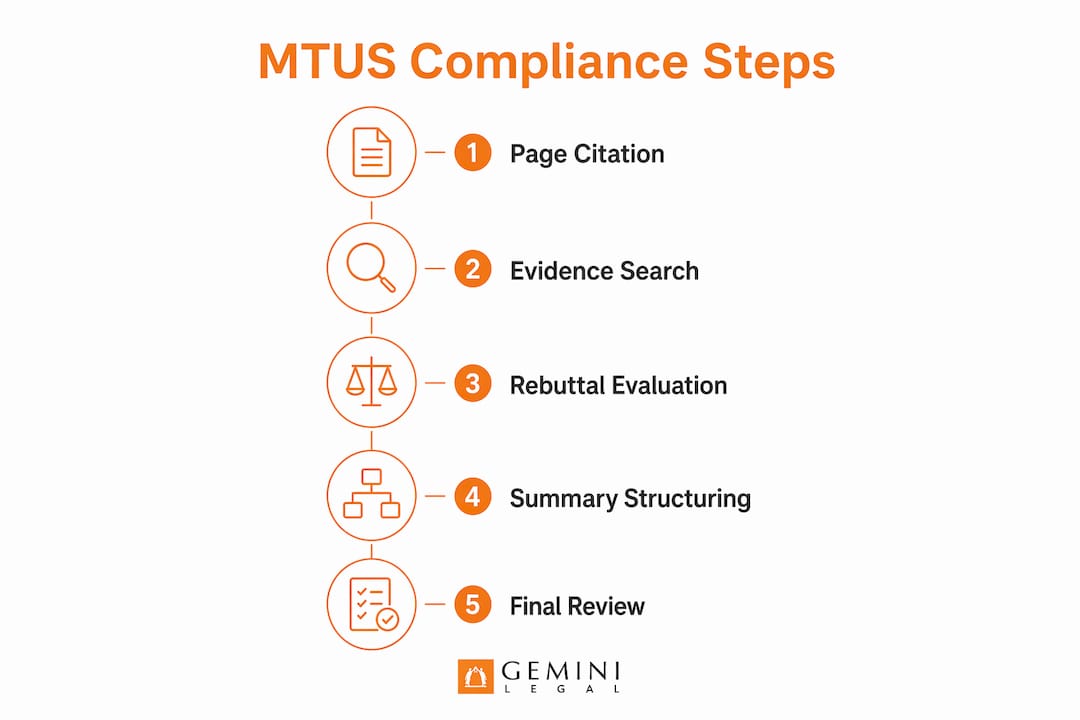
Three elements every reviewer should supply:
- A page-linked chronology tying each clinical event to the exact PDF page it came from
- Citation-bound narrative sentences connecting every treatment recommendation to the applicable MTUS/ACOEM guideline section
- An evidence table mapping each recommendation to either a guideline citation or a formal rebuttal with search-sequence documentation
The MTUS Drug Formulary and Independent Medical Review (IMR) procedural rules layer additional deadlines on top of this baseline. Getting the documentation right from intake is the only way to protect a claim through UR, IMR, and any subsequent appeal.
Table of Contents
- MTUS compliance checklist for medical record reviews
- How to prepare a defensible MTUS-aligned record review
- How to apply the MTUS medical evidence search sequence
- IMR and MTUS Drug Formulary timelines that matter
- How to structure summaries that hold up in appeals
- What to require from any tool used for MTUS record review
- Key Takeaways
- What the checklist misses, and why it matters
- How ChartInsight supports MTUS record review
- Authoritative sources and MTUS quick links
- FAQ
MTUS compliance checklist for medical record reviews
Before you open the first PDF, confirm you can check every item below.
- Verify California jurisdiction and confirm MTUS applicability to the body part(s) at issue
- Identify the specific ACOEM guideline chapters adopted into the MTUS that govern the claimed condition
- Assemble all provider PDFs with original pagination intact; never renumber or flatten pages
- Produce a one-line-per-event chronology with each entry linked to its exact source page
- Build a normalized medications table, then check each drug against the MTUS Drug List yourself
- Tag every non-MTUS recommendation with the step in the medical evidence search sequence it came from and the supporting citation
- Strip anything that does not belong in an outbound package, and keep an index of what was removed
- Confirm the filing deadline that applies to the dispute before assembling the package, because a drug-only denial runs on a 10-day clock
| Deliverable | Required source type | Document form |
|---|---|---|
| Page-cited chronology | Original provider records | Indexed PDF or DOCX with live page links |
| Narrative summary | MTUS/ACOEM guideline sections | Nine-section report, sentence-level citations |
| Medications table | MTUS Drug List plus provider records | Normalized table, page-referenced |
| Rebuttal evidence packet | Peer-reviewed literature, matched guidelines | Annotated citations naming the search-sequence step |
| Removed-content index | Originals | Separate index page with page numbers |
How to prepare a defensible MTUS-aligned record review
Intake and triage. Confirm California jurisdiction, identify injured body parts, and pull the MTUS/ACOEM guideline sections that apply. Note any conditions the guidelines do not address, because those require the full search-sequence path.
Normalize and paginate. Combine provider PDFs into a single indexed master file. Preserve original pagination throughout. Renumbering pages is one of the fastest ways to create citation drift that unravels under IMR scrutiny.
Extract a page-cited chronology. Build one line per clinical event, each linked to the exact source page. A chronology without page references is an assertion, not evidence.
Create evidence linkages. For every treatment request or recommendation, attach the MTUS/ACOEM guideline citation. Where the treating physician deviates, assemble the medical evidence search sequence rebuttal with live source links and page citations.
Build tables for meds, vitals, and procedures. Normalize each medication name, record the page reference, and check each drug against the MTUS Drug List. Vitals normalization, covering blood pressure, heart rate, BMI, and pain scores, matters for QME and AME reports.
Confirm the deadline and finish the package. Establish which filing window applies before you assemble, prepare the removed-content index, and leave enough room to file. Missing the window is a procedural denial, not a clinical one.
Pro Tip: Bind every narrative sentence to the original page number, not just the provider name or date of service. A reviewing physician working through an IMR package has to be able to land on the page that proves the claim without hunting for it. Page-level citations make that possible; provider-and-date citations do not.

How to apply the MTUS medical evidence search sequence
The presumption of correctness is the central rule: the guidelines set forth in the MTUS are presumptively correct on the issue of extent and scope of medical treatment, and rebutting them requires the formal search sequence plus condition-matched, citable evidence. General clinical opinion does not meet the standard.
Section 9792.21.1 sets the order:
- Search the recommended guidelines in the current MTUS for a recommendation applicable to the condition or injury
- If the condition is not addressed, or the presumption of correctness is being challenged, search the most current version of ACOEM or ODG
- If no applicable recommendation is found there, search other evidence-based treatment guidelines that are recognized by the national medical community and scientifically based
- Then search current studies that are scientifically based, peer-reviewed, and published in nationally recognized journals
- At every step, choose the recommendation supported by the best available evidence under the MTUS Methodology for Evaluating Medical Evidence in section 9792.25.1
What counts as an acceptable rebuttal: a specific published study matched to the claimant's condition, a comparably rigorous guideline section, or a recommendation supported by higher quality and strength of evidence as measured by the MTUS methodology. What does not count: a treating physician's general clinical experience or an unmatched literature reference.
The DWC publishes a free 90-minute MTUS course that covers the search sequence directly. It is written for physicians, open to the public, and eligible for MCLE credit, so attorneys and claims administrators can take it too. If your team has not completed it, that is the first gap to close.
Pro Tip: Every rebuttal citation should name the step in the search sequence it came from. A reviewer who writes "section 9792.21.1(a)(2)(C), condition-matched peer-reviewed study" alongside the citation gives the IMR physician a clear audit trail and reduces the chance of a summary denial.
IMR and MTUS Drug Formulary timelines that matter
Most UR denials carry a 30-day IMR filing window. Drug-list denials do not. Under 8 CCR section 9792.10.1, if the utilization review decision only denies or modifies a treatment request for a drug listed on the MTUS Drug List, the application for independent medical review must be filed within 10 days of service of the written UR decision, not 30. The clock runs from service of that written determination, not from the date the reviewer receives the file. Filing is by mail, facsimile, or electronic transmission on DWC Form IMR, with a copy of the written decision attached.
Key deadlines and triggers to track:
- UR response windows under California workers' comp regulations
- Service date of the written UR determination, which starts the IMR clock
- 10-day window when the denial is limited to a drug on the MTUS Drug List, against 30 days otherwise
- Package assembly and review of outbound content before anything leaves the office
A practical submission timeline for a drug-list denial:
- Day 1: Receive the written UR decision; confirm it is limited to a drug on the MTUS Drug List
- Days 1 to 3: Assemble the paginated record, extract the page-cited chronology, build the evidence table
- Days 4 to 6: Complete rebuttal citations, normalize the meds table, review outbound content
- Days 7 to 8: Final review, prepare the filing package
- Day 9 at the latest: File, leaving a day of margin
Delays almost always trace back to disorganized multi-provider PDFs and uncited narrative claims. Both are preventable at intake.
How to structure summaries that hold up in appeals
Defensible documentation is not about length. It is about structure that a UR physician, QME, or WCAB judge can verify in minutes.
- Chronology: one event per line, each with a page citation to the source record
- Narrative summary: sentence-level citations to the exact PDF page, not the provider or visit date
- Medications table: normalized drug names, page references, checked against the MTUS Drug List
- Exhibits: preserved original pages attached as numbered exhibits, never altered
- Citations index: a standalone list of every cited page and guideline section used in the summary
These elements reduce subjective reinterpretation during IMR and give appeals panels a single source of truth. ChartInsight's 433-record semantic review makes the case for why the underlying index has to be complete: in 92% of records, AI indexing surfaced clinician-documented findings that the expert human summary had missed, 1,318 AI-only findings in total. A summary can be well cited and still be missing the entry that decides the dispute.
Pro Tip: Maintain a version log: who edited the summary, what changed, and when. A challenged summary with a clean edit history is far harder to impeach than one without.
Worth knowing where these disputes can lead. A contested claim rarely stays contained to the medical record; practitioners on the employment side write about the adjacent exposure, including retaliatory termination after a workers' comp filing. Useful context for how much weight a clean documentation trail ends up carrying.
What to require from any tool used for MTUS record review
Not every platform built for medical record review is built for defensibility. These are the capabilities that materially affect whether your output survives scrutiny.
Citation and navigation:
- Live page-level citations in every narrative output, not just section-level references
- Integrated PDF viewer with one-click navigation from a cited sentence to the source page
- Automated pagination and indexing that preserves original page numbers
Output and export:
- Exportable DOCX and PDF reports with citations intact after export
- Medications table with normalized names, date ranges, and page references, so you can check each entry against the MTUS Drug List yourself
- Vitals normalization across at least the standard measures (blood pressure, heart rate, BMI, pain, blood glucose)
Access and audit:
- Record-level sharing controls, so a record can be kept private, shared team-wide, or shared with named individuals
- Visible provenance on the output: who uploaded the record, when it was processed, and which template or configuration produced it
- Exports that preserve original pagination and page labelling, so your index still matches after the file leaves the platform
Each feature maps to a specific risk. No integrated PDF viewer means the reviewer must toggle between the summary and a separate PDF application, which is where citation drift starts. No visible provenance means a challenged summary cannot be traced to what produced it. A meds table without page references means you cannot check a drug-list conflict without re-reading the record.
Cross-checking a medications list against the MTUS Drug List is still your call, not the platform's. What a platform can do is make sure every drug entry has a page citation behind it, so the check takes minutes.
For acceptance testing: take a 100-page sample file, run it through the platform, and verify page-to-sentence accuracy on a 1:1 sample of cited statements. If the tool cannot pass that test on 100 pages, it will not hold up on 10,000.
Key Takeaways
MTUS compliance requires evidence-supported treatment requests, formal rebuttal documentation following the search sequence, and an IMR filing window that shortens to 10 days for drug-list denials.
| Point | Details |
|---|---|
| Presumption of correctness | MTUS guidelines are presumptively correct on the extent and scope of medical treatment; rebutting them requires the formal search sequence and condition-matched citations. |
| Page citations carry the weight | Not a regulatory mandate, but the practice that lets a UR or IMR physician verify a claim. Cite the exact source page, not just the provider or date. |
| The 10-day IMR window | When a UR decision only denies or modifies a drug on the MTUS Drug List, the IMR application is due within 10 days of service of that written decision. Otherwise the window is 30 days. |
| Rebuttal evidence standard | General clinical opinion is insufficient; acceptable rebuttals require specific, condition-matched evidence chosen at the right step of the search sequence under the MTUS methodology. |
| ChartInsight for MTUS reviews | ChartInsight produces page-cited chronologies, normalized meds and vitals tables, and exportable reports with citations preserved, which removes the manual assembly and citation-tracking work. |
What the checklist misses, and why it matters
The practitioners who struggle most with MTUS compliance are not the ones who do not know the rules. They know the rules. The problem is applying them to a 4,000-page, 12-provider PDF assembled from three different EMR systems, two imaging centers, and a physical therapy clinic that still faxes its notes.
The checklist above is correct. But a checklist does not paginate your record or bind your citations to pages. Those are execution problems, and execution is where disputes are won or lost. A rebuttal that cites the right literature but references "page 47 of the orthopedic records" when the IMR physician is looking at a merged PDF with no consistent pagination is not a rebuttal. It is a rejected submission.
The habit that actually changes outcomes: treat every sentence you write as a citation waiting to be challenged. If you cannot point to the exact page immediately, the sentence is not ready. That standard sounds demanding until you realize it is exactly what reviewing physicians apply when they work through your package.
How ChartInsight supports MTUS record review
Reviewers using ChartInsight for California workers' comp record review get a structured output where every sentence in the narrative summary carries a live citation back to the exact source page. Click it, and the integrated PDF viewer opens to that page. No toggling, no searching, no citation drift.
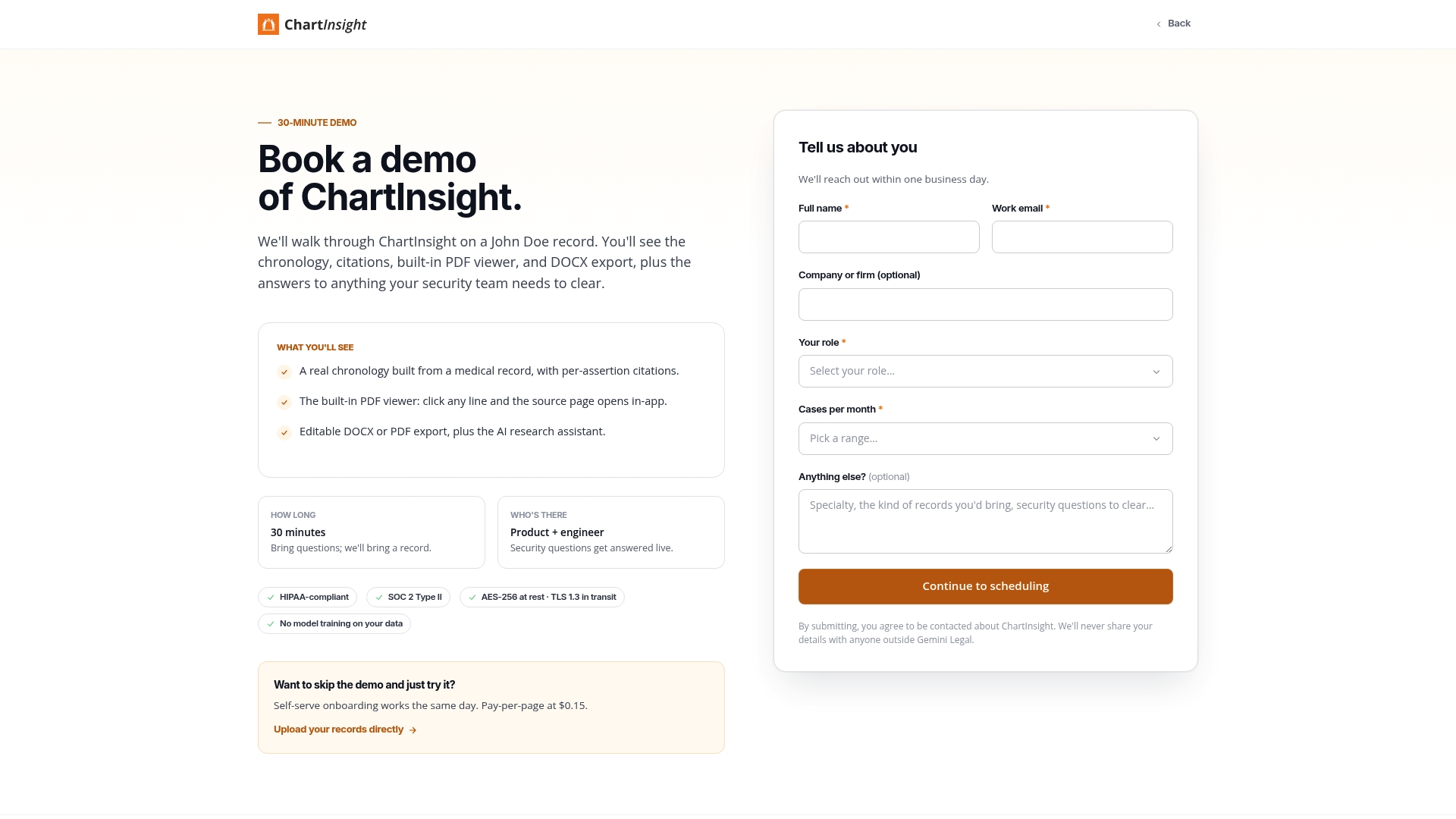
The platform produces a nine-section narrative summary, a source-linked chronology, normalized vitals across ten measures, and a medications table with date ranges, all exportable to DOCX or PDF with page citations preserved. Records of any size are supported, including sets exceeding 70,000 pages. What that changes is where the reviewer's time goes: not into assembling, paginating, and hand-tracking citations, but into the judgment calls the record actually requires. When a drug-list denial puts you on a 10-day clock, starting from a paginated, citation-complete package is what makes the deadline workable.
Book a demo to see how ChartInsight handles a real workers' comp file.
Authoritative sources and MTUS quick links
The sources below are the ones you will cite in rebuttal packets and reference when building your evidence hierarchy.
- DWC Medical Treatment Utilization Schedule is the primary regulatory landing page, covering the presumption of correctness and the Drug Formulary
- 8 CCR section 9792.21.1, Medical Evidence Search Sequence is the ordered search you must document when going outside the MTUS guidelines
- 8 CCR section 9792.25.1, Methodology for Evaluating Medical Evidence is how quality and strength of evidence are judged at each step
- 8 CCR section 9792.10.1, Utilization Review Dispute Resolution sets the IMR filing windows, including the 10-day rule for MTUS Drug List denials
- DWC Physician Education MTUS course is free 90-minute training on the search sequence, open to the public and MCLE eligible
- MDGuidelines MTUS access offers no-cost registration for healthcare providers treating, evaluating, or performing utilization review in the California workers' comp system; commercial use requires a license
- ChartInsight's 433-record semantic review is useful when documenting how complete your index has to be
When building a rebuttal evidence packet, always pull the canonical guideline text from MDGuidelines rather than a secondary summary. Reviewing physicians check sources, and a citation to a paraphrase rather than the original text is a vulnerability.
FAQ
What does MTUS presumption of correctness mean for reviewers?
The guidelines set forth in the MTUS are presumptively correct on the issue of extent and scope of medical treatment. A treating physician who disagrees must follow the formal medical evidence search sequence in section 9792.21.1 and supply condition-matched, citable evidence to rebut that presumption.
What is the 10-day rule for MTUS Drug List disputes?
Under 8 CCR section 9792.10.1(a)(2), if a utilization review decision only denies or modifies a treatment request for a drug listed on the MTUS Drug List, the application for independent medical review must be filed within 10 days of service of the written UR decision. All other UR denials carry the standard 30-day window.
How do I access MTUS/ACOEM guidelines for free?
Healthcare providers treating, evaluating, or performing utilization review in the California workers' compensation system can register for no-cost access to the MTUS (ACOEM) Guidelines and the MTUS Drug List at MDGuidelines. Any commercial use requires a separate license.
What makes a rebuttal evidence citation acceptable under MTUS?
An acceptable rebuttal requires a specific, condition-matched recommendation, whether from a current guideline or a peer-reviewed study, found at the correct step of the medical evidence search sequence and supported by the best available evidence under the MTUS methodology. General clinical opinion does not meet the standard.
How does ChartInsight support MTUS-compliant documentation?
ChartInsight produces page-cited chronologies, normalized medications and vitals tables, and exportable reports with citations preserved, covering the core deliverables behind a defensible MTUS medical record review.