

A Permanent and Stationary (P&S) report is the physician's formal declaration that an injured worker's condition has reached Maximum Medical Improvement (MMI), meaning no further material change is expected with or without treatment. Once the condition is P&S, temporary disability (TD) generally ends, permanent disability (PD) evaluation begins, and every party to the claim has a narrow window to act.
For reviewers, the immediate steps are:
- Request the full record. Obtain the complete medical file, prior disability disclosures, and the signed PR-4 or PR-3 form before anything else.
- Verify objective findings and apportionment language. A P&S report without measurable clinical data or a compliant apportionment statement is legally vulnerable from day one.
- Calendar your deadlines. The first PD payment is due within 14 days after the final TD payment; objections to the treating physician's findings under LC 4062 (20 days if the employee is represented, 30 days if not) and employer job-offer notices each carry their own windows.
Pro Tip: Flag the report date immediately. Under 8 CCR § 9785(h), the primary treating physician must report P&S findings within 20 days of the examination unless good cause is shown. A late report is a compliance issue that can affect claim timelines and should be documented in your file.
Table of Contents
- What "Permanent and Stationary" means in medical and legal terms
- What a P&S report should contain, and what's missing when it's weak
- How permanent disability ratings are calculated from a P&S report
- What happens to benefits and treatment after a P&S report
- How to challenge a P&S report or seek an independent evaluation
- The defensibility checklist every medical-legal reviewer needs
- Key Takeaways
- The hardest part of a P&S review isn't the medicine
- ChartInsight™ keeps P&S review tied to the record
- Useful sources for P&S reviewers
- FAQ
What "Permanent and Stationary" means in medical and legal terms
P&S and MMI describe the same clinical threshold from two different vantage points. MMI is the medical concept. P&S is the California workers' compensation term for the same moment: under 8 CCR § 10152, disability is permanent when the employee has reached maximal medical improvement, meaning the condition is well stabilized and unlikely to change substantially in the next year with or without medical treatment.
The distinction between the two qualifying phrases matters more than most reviewers realize:
"No expected improvement in the next year" is a temporal prediction about trajectory. "No reasonable expectation of improvement with available treatment" is a clinical judgment about the limits of medicine. A physician who conflates them may declare P&S prematurely, or fail to declare it when the condition has genuinely plateaued.
Who declares P&S and who evaluates it are different questions. The primary treating physician (PTP) makes the initial declaration, typically on the PR-4 (ratings under the 2005 schedule, using the AMA Guides 5th Edition) or the PR-3 (ratings under the pre-2005 schedule). The current form revisions apply to dates of service on or after October 1, 2015. That declaration is not final. A Qualified Medical Evaluator (QME) or Agreed Medical Evaluator (AME) may independently evaluate the same condition, and their findings can override or supplement the PTP's conclusions. An Independent Medical Examiner (IME) serves a similar function in other jurisdictions.
State variation is real and consequential. California's DWC uses the PR-4/PR-3 framework, with PR-4 impairment described under the AMA Guides, 5th Edition. Other states use their own terminology (some say "maximum medical improvement" exclusively), their own forms, and sometimes different editions of the AMA Guides or state-specific rating schedules. Reviewers working outside California should confirm the applicable form, edition, and reporting timeline before applying any California-specific rule.

Pro Tip: When reviewing a P&S report from a state other than California, identify the governing rating schedule and edition of the AMA Guides before you assess WPI percentages. Applying California's 5th Edition methodology to a state that uses the 6th Edition will produce a materially different rating.
What a P&S report should contain, and what's missing when it's weak
A defensible P&S report is not a narrative summary. It is a structured evidentiary document, and every element has a legal function. The PR-4 form and 8 CCR § 9785 set out the required contents; missing elements create grounds for challenge.
Contents checklist:
- Diagnoses with ICD-10 codes, linked to the industrial injury
- Objective clinical findings: range of motion (ROM) with bilateral comparison values, muscle strength grades, atrophy measurements, and sensory deficits
- AMA Guides citations: the specific table number and page from the 5th Edition used to derive each WPI percentage
- Whole Person Impairment (WPI%) per body region, with the math shown
- Pain assessment: additional WPI for excess pain (0%–3% cap per PR-4 instructions)
- Apportionment statement per Labor Code Sections 4663 and 4664, or a narrative explanation of why apportionment cannot be determined
- Functional capacity and work restrictions: specific physical limitations (lifting, standing, reaching) tied to the clinical findings
- Future medical care recommendations: curative versus palliative, with a medical rationale for each
A report that lists a WPI percentage without showing which AMA Guides table and method produced it is hard to verify. Reviewers should treat an uncited WPI as unsupported until the physician explains it.
Red flags that justify immediate challenge:
- ROM values without bilateral comparisons (unilateral measurements are uninterpretable)
- No imaging citations despite a structural diagnosis (e.g., disc herniation with no MRI reference)
- Apportionment stated as a percentage with no causation narrative
- Future care listed as "as needed" with no clinical basis
- Pain WPI added without documenting that the pain exceeds what the impairment rating already captures
On receipt, request these documents immediately: prior medical records predating the injury, all imaging reports with dates, EMG/NCS results, job description or Dictionary of Occupational Titles (DOT) classification, prior disability ratings or PD awards, and any prior QME/AME reports. These are the records the physician should have reviewed; if they are not cited in the P&S report, that is itself a finding.
How permanent disability ratings are calculated from a P&S report
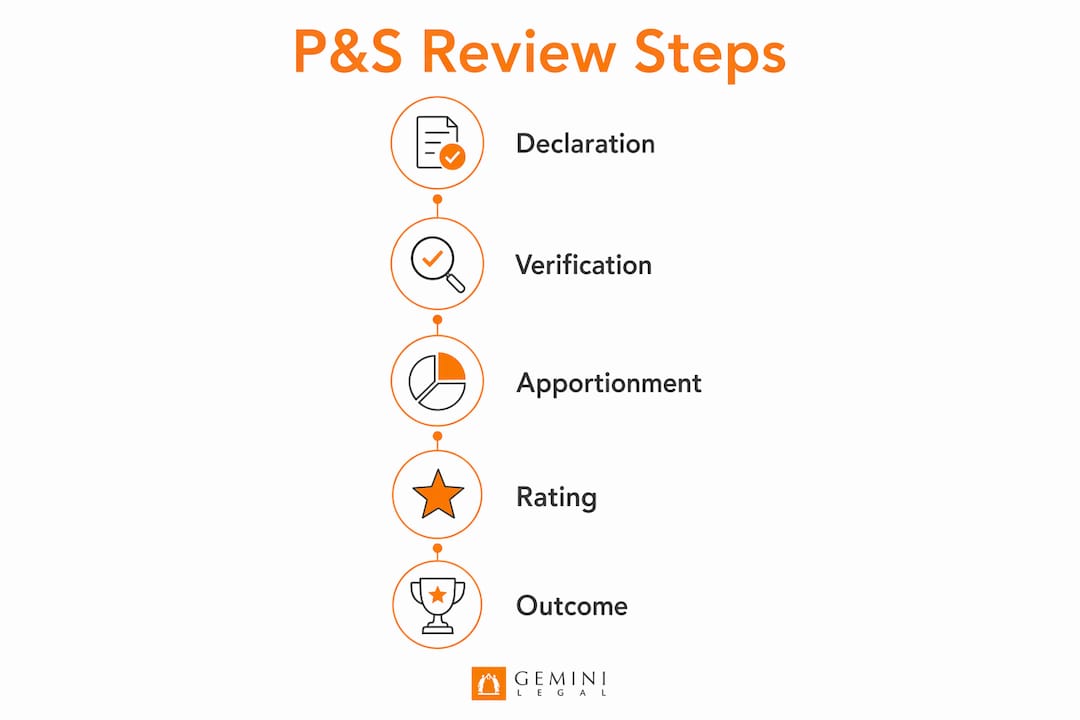
The path from a P&S declaration to a PD award follows a defined sequence. Reviewers who understand each step can identify exactly where a rating has been inflated, understated, or improperly derived.

Rating workflow:
| Step | What happens | What to verify |
|---|---|---|
| 1. P&S declaration | PTP declares MMI and completes PR-4 | Form version, exam date, 20-day reporting rule |
| 2. Impairment description | WPI% assigned per AMA Guides, 5th Ed. | Table and method shown; bilateral ROM values |
| 3. Pain add-on | 0% to 3% WPI for excess pain | Documented basis; cap not exceeded |
| 4. Rating adjustments | WPI adjusted under the PDRS (FEC for 2005 to 2012 injuries, the 1.4 multiplier for 2013+ injuries), then occupation and age | Correct date-of-injury rules applied |
| 5. Apportionment | Industrial vs. other-factor causation applied to each adjusted rating | Labor Code §§ 4663/4664 language; narrative basis |
| 6. Combined PD | Apportioned ratings combined into a final PD% | Math shown; combined values chart used |
| 7. PD payments | Weekly PD payments calculated from PD% | Payment timing under the Labor Code |
Apportionment is a step that is frequently done wrong. Labor Code Section 4663 requires the physician to identify the approximate percentage of disability attributable to the industrial injury versus all other causes, including prior injuries, degenerative conditions, and non-industrial factors. If the physician cannot make that determination, LC 4663 requires the physician to state the reasons and to consult with other physicians or refer the employee to another physician who can. A bare statement that "apportionment is not applicable" without further explanation does not satisfy the statute.
The pain add-on is a narrow exception, not a default. The PR-4 allows up to 3% additional WPI when the claimant's pain exceeds what the underlying impairment rating already accounts for. Reviewers should verify that the physician has documented the clinical basis for any pain WPI, not simply added the maximum.
For the date-of-injury schedule: injuries on or after January 1, 2005 generally use the 2005 PDRS (Permanent Disability Rating Schedule). The correct schedule must be selected before any WPI-to-PD conversion is valid.
What happens to benefits and treatment after a P&S report
The P&S declaration is an administrative trigger, not just a medical milestone. Several payment and notice obligations activate simultaneously, and missing any of them creates procedural exposure.
Post-P&S timeline:
- TD generally ends when the condition becomes P&S (or the worker returns to work), subject to the Labor Code's TD duration caps.
- First PD payment is due within 14 days after the final TD payment. If no TD was paid, the first PD payment is due within 14 days after the claims administrator learns of the PD. Subsequent payments follow every 14 days.
- Employer job offer: for injuries from 2005 through 2012, LC 4658(d) adjusts remaining PD payments by 15% (down if the employer offers regular, modified, or alternative work within 60 days of P&S, up if it does not, for employers with 50 or more employees). For injuries on or after January 1, 2013, that adjustment no longer applies (see the DIR Injured Worker Guidebook, Chapter 7).
- Supplemental job displacement benefit (SJDB) voucher eligibility for 2013+ injuries depends on whether the employer makes a qualifying offer of work within 60 days after the claims administrator receives the physician's Return-to-Work & Voucher Report (DWC-AD 10133.36), which the PTP attaches to the P&S report under LC 4658.7 and 8 CCR § 9785(i).
P&S does not end medical treatment. This is one of the most commonly misunderstood consequences of the declaration. Future medical care, including palliative care that manages symptoms without improving the underlying condition, can continue when it is reasonably required to cure or relieve the effects of the industrial injury. To support that entitlement, the treating physician must document the medical rationale for continued services explicitly. "Pain management" is not sufficient; the record needs to show what specific treatment is being provided, why it is medically necessary, and how it relates to the industrial injury.
Pro Tip: If the P&S report recommends future medical care without distinguishing curative from palliative, request a supplemental report clarifying the nature and basis of each recommendation. Ambiguous future-care language can be used to dispute ongoing treatment.
Forms and notices to calendar on receipt of a P&S report:
- Notice of offer of work: DWC-AD 10133.35 for 2013+ injuries; DWC-AD 10118 for the 15% adjustment on 2005 to 2012 injuries
- SJDB voucher issuance deadline
- LC 4062 objection deadline (20 days if represented, 30 days if unrepresented) before a QME panel request
- First PD payment due date
How to challenge a P&S report or seek an independent evaluation
The review path has three primary options: a QME (Qualified Medical Evaluator, selected from a DWC panel), an AME (Agreed Medical Evaluator, jointly selected by both parties), or an IME (Independent Medical Examiner, used in some contexts outside the QME/AME framework). Each carries different procedural requirements and strategic implications.
Stepwise challenge workflow:
- Request the complete record immediately. Obtain the signed PR-4, all underlying medical records cited in the report, imaging studies, and any prior QME/AME reports. Confirm the physician reported within the 20-day window (daisyBill's PR-3/PR-4 form guide summarizes the rule).
- Identify the specific deficiencies. Map each challenged impairment to the missing or contradicted evidence: absent ROM bilaterals, uncited AMA table, unsupported apportionment percentage, or missing pain basis.
- Calendar all deadlines. LC 4062 objections, QME panel requests, AME agreement windows, and employer job-offer notices each have deadlines. Missing one can forfeit or complicate the challenge.
- Notify opposing counsel or the claims administrator in writing. Document the specific objections; a vague "we dispute the rating" letter does not preserve the record.
- Request targeted supplemental testing. If ROM values are missing, ask for a supplemental report or a functional capacity evaluation (FCE). If imaging is uncited, request updated MRI or X-ray. Tie each request to the specific deficiency in the report.
- Prepare a rebuttal memo. For each challenged assertion in the P&S report, cite the exact record page that contradicts or fails to support it. This memo becomes the foundation of the QME/AME packet.
- Select the QME panel or negotiate an AME strategically. For QME panel selection, consider the evaluator's specialty, publication history, and known methodology. In represented cases, an AME lets both parties agree on an evaluator with relevant expertise.
Apportionment disputes deserve particular attention. If the PTP's apportionment is unsupported or the causation narrative is thin, a QME or AME with access to the full prior medical history can produce a materially different result. Vocational evidence is underused in this context: a vocational expert's opinion on actual work capacity can anchor the functional limitation findings and make the apportionment argument more concrete.
Pro Tip: When preparing the QME packet, organize exhibits by body region and impairment claim, not chronologically. An evaluator who can immediately locate the ROM measurements, imaging, and prior ratings for the lumbar spine without searching through 500 pages will produce a more thorough and defensible report.
The defensibility checklist every medical-legal reviewer needs
This is where a P&S review either holds up or falls apart. The checklist below maps each common impairment claim to the objective evidence that must exist in the record to support it.
Evidence standard by impairment type:
| Impairment claim | Required objective evidence | Common gap |
|---|---|---|
| Lumbar/cervical spine | ROM with bilateral values, MRI/X-ray with dates, AMA Guides Ch. 15 table citation | Unilateral ROM only; imaging cited without date |
| Upper extremity | Grip/pinch strength, ROM per joint, EMG/NCS if neuropathy claimed | Strength not measured; EMG absent for carpal tunnel |
| Lower extremity | ROM, gait analysis, imaging | No imaging for structural claims |
| Psychiatric/psychological | DSM diagnosis, GAF (used by the 2005 PDRS), validated scales (PHQ, PCL), ADL limitations | Diagnosis without GAF rationale; no ADL documentation |
| Pain (excess WPI) | Documentation that pain exceeds impairment rating; functional impact | Bare assertion; no clinical basis for add-on |
| Pulmonary | PFT results with predicted values, AMA Guides Ch. 5 citation | PFTs absent; no predicted-value comparison |
Cross-referencing each impairment to objective data and AMA Guides entries materially strengthens a report's defensibility. A report that cites only a WPI percentage without the underlying table is vulnerable to challenge as not substantial evidence.
Sample rebuttal outline (adapt per case):
- Claim: Lumbar spine WPI of 8% per PR-4.
- Report assertion: "Range of motion limited; AMA Guides applied."
- Missing evidence: No bilateral ROM values documented; AMA Guides table and page not cited on PR-4.
- Contrary record: Physical therapy notes from [date, page X] show full lumbar flexion.
- Requested remedy: Supplemental FCE with bilateral ROM; QME re-evaluation with complete AMA citation.
Reviewer workflow from intake to hearing:
- Intake: Receive and copy the PR-4; confirm form version and exam date; log the 20-day submission deadline.
- Rapid source mapping: For each impairment claim in the report, locate the supporting record page. Flag every assertion that has no page citation.
- Targeted discovery: Request missing tests, imaging, and prior records within the first week.
- QME/AME selection: Use the rebuttal memo to brief the evaluator; provide organized exhibits by body region.
- Disability rater packet: Compile the final WPI, apportionment, and adjustment factors into a clean packet with page citations for each input.
Practitioners who can show a citation path between a physician's P&S assertions and the underlying record are better prepared for cross-examination. ChartInsight™ supports this workflow: every entry in its chronology, narrative summary, and medications table carries a live citation back to the exact source page, and clicking it opens the PDF in the built-in viewer. For a psychiatric record review or a complex orthopedic case with thousands of pages, that gives the rebuttal memo a page-cited starting point the reviewer can verify.
Pro Tip: Build your rebuttal memo in the same order as the PR-4 sections. Evaluators and judges read the PR-4 sequentially; a rebuttal that mirrors that structure is easier to follow and harder to dismiss.
Key Takeaways
A defensible P&S review comes down to three things: objective evidence that is measurable and cited, apportionment language that satisfies Labor Code Sections 4663 and 4664, and deadlines that are calendared the day the report arrives.
| Point | Details |
|---|---|
| Verify objective findings first | Each impairment claim should be supported by measured findings, imaging where relevant, and the AMA Guides table or method used. |
| Apportionment must be explicit | Labor Code §§ 4663/4664 require a causation narrative; a bare percentage without explanation is legally incomplete. |
| Calendar deadlines immediately | First PD payment is due within 14 days of final TD; LC 4062 objection and job-offer windows also run from the report. |
| P&S does not end all treatment | Future medical care, including palliative care, can continue post-P&S when reasonably required and documented. |
| ChartInsight™ supports source mapping | Page-level citations and a built-in PDF viewer help reviewers trace each assertion to its source page. |
The hardest part of a P&S review isn't the medicine
Most P&S disputes are not won or lost on the clinical question of whether the condition has stabilized. They are won or lost on whether the reviewer can tie every assertion in the report to a specific page in the underlying record, and whether they can do it fast enough to matter.
Defensible P&S reviews share one habit: they treat the report as a legal instrument from the moment it arrives, not a medical narrative to read once and file. That means checking the AMA Guides citations before reading the diagnosis, verifying the apportionment language before accepting the WPI, and building the rebuttal memo before the QME is even selected.
The conventional wisdom is that a thorough review takes time. That is true, but the time is mostly spent on the wrong task: manually cross-referencing a physician's assertions against hundreds or thousands of record pages without a reliable index. The defensibility problem is not analytical; it is organizational. A reviewer who can instantly locate the page behind every claim in a P&S report is not doing better medicine. They are doing better evidence management.
P&S reports are the pivot point for benefits, future care, and vocational options. Treat them accordingly.
ChartInsight™ keeps P&S review tied to the record
Reviewers who handle P&S disputes know the bottleneck: the medical record is a PDF, sometimes thousands of pages from a dozen providers, and the physician's assertions in the PR-4 need to be traced back to specific pages before a rebuttal memo or QME packet can be built. That source-mapping step is where most of the time goes.
ChartInsight™ takes the full medical record and produces a structured, page-cited output: a chronology, a narrative summary, extracted vitals, and a medications table. Entries in the chronology, summary, and medications table link to the exact source page. Clicking a citation opens the source page in the built-in PDF viewer. For personal injury and workers' comp reviews, that gives the rebuttal memo a page-cited foundation the reviewer can verify line by line.
Teams can configure custom templates for consistent PR-4 review outputs, maintain a prompt library for recurring analysis types, and export to editable DOCX or PDF with citations preserved. The original record is never altered.
If your practice handles P&S disputes, QME packet preparation, or peer review, book a demo to see how ChartInsight™ handles a real record.
Useful sources for P&S reviewers
The sources below are the primary references for California P&S procedure. Reviewers in other states should identify the equivalent DWC or workers' compensation board resources for their jurisdiction.
Key references:
- 8 CCR § 9785: PTP reporting duties, including the 20-day P&S reporting rule in subdivision (h) and PR-3/PR-4 form use.
- PR-3 / daisyBill KB: A billing-software knowledge-base summary of form selection and the 20-day reporting requirement.
- LC 4062 and LC 4658: Objection deadlines and PD payment rules, including the 2005 to 2012 return-to-work adjustment.
- DIR Injured Worker Guidebook: Plain-language overview of TD, PD payment timing, return-to-work, and QME/AME rights.
- AMA Guides to the Evaluation of Permanent Impairment, 5th Edition: Required for impairment ratings under California's 2005 PDRS. Reviewers should verify that PR-4 citations reference specific chapter, table, and page numbers.
| Source | What it provides | When to use it |
|---|---|---|
| 8 CCR § 9785 | PTP reporting duties, 20-day rule, PR-3/PR-4 use | Checking reporting compliance; citing the rule in objection letters |
| PR-3 / daisyBill KB | Form selection summary | Quick reference on form versions |
| LC 4062 / LC 4658 | Objection deadlines, PD payment rules | Setting deadlines |
| DIR Guidebook | Benefits overview, QME/AME rights | Advising claimants on benefits |
| AMA Guides 5th Ed. | Impairment methodology, table references | Verifying WPI citations in any PR-4 |
For opioid-related evidence in P&S reports, LienScripts' MME guide for PI attorneys explains how morphine milligram equivalents can help quantify medication burden in the record.
FAQ
What happens after a worker is declared permanent and stationary?
Temporary disability generally ends, and the claims administrator must issue the first permanent disability payment within 14 days of the final TD payment. The employer's job offer (or lack of one) within 60 days affects SJDB eligibility for 2013+ injuries and, for 2005 to 2012 injuries, a 15% PD adjustment.
Can a claimant challenge a P&S report?
Yes. A party that disagrees with the treating physician's findings must object in writing under LC 4062 (within 20 days if the employee is represented, 30 days if not), and the dispute then goes to a QME or, in represented cases, an AME. Missing the deadline can complicate the challenge.
How is the permanent disability payout calculated?
The PD payout is based on the WPI percentage derived from the P&S report, converted to a PD percentage using the applicable state rating schedule, then converted to a number of weeks and a weekly PD rate under LC 4658 and 4453. The exact dollar amount depends on the date of injury, the PD percentage, and the worker's pre-injury wages.
What is the 20-day rule for P&S reports?
Under 8 CCR § 9785(h), the primary treating physician must report P&S findings within 20 days of the examination, unless good cause is shown. A late report is a compliance issue that reviewers should document, as it can affect claim timelines.
Does P&S mean all medical treatment ends?
No. Future medical care, including palliative care, can continue after a P&S declaration when it is reasonably required to cure or relieve the effects of the industrial injury. Treatment requests remain subject to utilization review, so document the medical rationale for each ongoing service.