
TL;DR: A provider contradiction in medical records is any place where two clinicians document conflicting information about the same patient, encounter, or episode of care: opposing diagnoses, incompatible work-status opinions, different MMI or P&S determinations, or objective data recorded differently in two notes. A systematic review of 48 documentation studies found incompleteness in 47 of them and inconsistency in 8. In a workers' comp or medical-legal review, these conflicts are the substance of the disputed medical question, not clerical noise, and an unaddressed contradiction in the underlying record is the first thing opposing counsel will find. Locating them reliably means putting every provider's statement in date order with a page citation attached, so the conflict is visible on the face of the record rather than buried across thousands of pages.

A provider contradiction in medical records occurs when two or more clinicians document conflicting information for the same patient encounter or episode of care. For workers' comp attorneys, paralegals, and QME/IME physicians, these contradictions are not minor clerical issues. They drive claim disputes, delay P&S determinations, and complicate apportionment analyses under the AMA Guides.
Key types of contradictions that appear in medical-legal review:
- Conflicting diagnoses: One treating physician documents a lumbar sprain; an IME physician documents degenerative disc disease with no industrial causation.
- Temporary vs. permanent condition designations: A treating orthopedist notes ongoing temporary total disability; a QME finds MMI has been reached.
- Functional capacity discrepancies: A claimant reports severe limitations to one provider while describing greater ability to another.
- Objective data conflicts: Vital signs, clinical risk scores, or lab values recorded differently across notes for the same encounter.
- Treatment recommendation gaps: A treating doctor recommends conservative care; an AME recommends surgical intervention.
Research confirms these conflicts are not rare edge cases. A systematic review of 48 studies on medical record documentation published between 2009 and 2019 found incompleteness reported in 47 of them, inaccuracy in 14, and inconsistency in 8. The review attributed these errors largely to occupational stressors, manual documentation, and the absence of local, national, or international documentation standards. Emergency medicine researchers have since begun studying the narrower case directly, asking what happens when two clinicians document on the same patient within a single encounter.
What types of contradictions appear most often in provider records?
Contradictions in medical records fall into a few predictable categories, and recognizing them early shapes how you build or defend a claim.

Diagnostic disagreements are the most consequential. When a treating physician and an IME or QME physician reach different diagnostic conclusions, the claims professional must weigh clinical context, specialty, and proximity of care. In California workers' compensation, the QME or AME opinion typically carries substantial weight on disputed medical questions, but the WCAB judge decides which medical evidence is substantial, and a well-documented treating physician narrative can still influence the outcome.
Work status and functional capacity conflicts create the most day-to-day friction. A claimant might report severe restrictions to a treating provider and describe greater capacity to an independent evaluator. These discrepancies raise questions about credibility and complicate return-to-work timelines. They also tend to be the hardest conflicts to spot, because the two statements sit hundreds of pages apart in the file.
Symptom progression inconsistencies emerge over time. Earlier records may indicate MMI has been reached, while later notes document new or worsening complaints. These shifts require careful chronological analysis to determine whether the change reflects genuine deterioration or documentation drift.
Patient self-report versus documented history adds another layer, and the gap runs in both directions. A study of 525 hospitalized acute coronary syndrome patients found that patients reported more comorbidities in interview (mean 1.78) than their medical records documented (mean 1.27), with fair-to-poor agreement on most individual conditions. A separate study of 270 inpatients found 80.9% agreement between EHR-documented and verbally reported medication allergies, with 6.7% of reported reactions absent from the record entirely and 12.4% documented incorrectly. For a reviewer, neither source is automatically authoritative. The conflict itself is the finding, and it belongs in the chronology with citations to both entries.
Why do these discrepancies matter for claims and legal outcomes?
Unresolved contradictions between providers directly affect claim validity, cost, and timeline. When one physician classifies a condition as temporary and another calls it permanent, the claims professional has no clean path to resolution without additional medical development. That ambiguity extends claim duration, increases costs, and creates exposure to disputes with treating providers, employers, and legal representatives.

The legal stakes are equally concrete. Conflicting clinical notes give opposing counsel a straightforward line of impeachment. A defense attorney who finds that two clinicians recorded different objective findings for the same encounter has a ready argument against the reliability of either note. For a QME or AME preparing a report, an unacknowledged contradiction in the underlying record is a vulnerability that opposing counsel will find.
Patient care suffers too. When providers downstream rely on contradictory records, treatment decisions can be based on incomplete or inaccurate histories. In the acute coronary syndrome study above, kappa agreement between record and self-report was fair to poor for every condition except prior myocardial infarction, and congestive heart failure showed the weakest agreement of all at 0.09 with 67% overall agreement. The authors noted that in the absence of a gold standard, the hospital records may simply not have captured all pre-admission comorbidities. Gaps of that kind feed directly into risk scoring and treatment protocols.
How should you approach intelligent analysis of contradictory records?
Manual review of multi-provider records across thousands of pages is where contradictions get missed. A reviewer working through a 4,000-page workers' comp file, stitched together from a treating orthopedist, a pain management specialist, a QME, and an AME, cannot reliably hold every prior statement in working memory while reading a new note.
Effective analysis requires:
- Chronological structuring: Building a timeline that places each provider's statement in sequence makes conflicts visible that would otherwise hide across volume.
- Source traceability: Every extracted claim needs a page citation. Without it, a reviewer cannot verify the finding or defend it under cross-examination.
- Normalized data comparison: Vitals, pain scores, and functional assessments recorded across providers need to be pulled into a common format before comparison is meaningful.
- Discrepancy flagging: AI-enabled analysis tools can consolidate narratives, surface contradictory statements, and trace data back to source documents, reducing the time spent cross-referencing provider opinions by hand.
Clinical notes were written for care and billing, not legal scrutiny. Reviewers must interpret terminology within clinical context. A note that reads "patient reports improvement" may reflect a billing-driven documentation habit rather than a genuine clinical finding. That distinction matters when you are evaluating apportionment or drafting a peer review under MTUS guidelines.
How ChartInsight handles provider contradictions in medical records
ChartInsight was built for exactly this problem. When a record arrives as a multi-provider PDF, sometimes tens of thousands of pages, ChartInsight produces a structured output: a navigable chronology, a nine-section narrative summary, normalized vitals across ten measures, and a medications table. Every extracted fact carries a live page citation that opens the source PDF at the exact page inside the app. No downloading, no tab-switching, no losing your place.
For QME and IME physicians, that citation architecture means every statement in a report can be traced back to its source in seconds. For workers' comp attorneys and paralegals, it means every line of the summary is traceable to a page before the first draft goes out. ChartInsight's 433-record accuracy study compared AI indexes against expert human summaries of the same records and recovered 1,318 clinician-documented findings across 92% of cases.
Practical benefits for contradiction-heavy cases:
- Chronologies surface conflicting diagnoses and MMI determinations side by side, in date order.
- Normalized vitals and pain scores make cross-provider comparison direct rather than inferential.
- The research assistant on every record lets a reviewer ask a specific question and receive a cited answer pointing to the source pages.
- Templates structure outputs for medical-legal reports, workers' comp summaries, and peer review, so the format is consistent across matters.
Pro Tip: When reviewing a record with conflicting P&S dates from a treating physician and a QME, use ChartInsight's chronology to place both determinations in sequence with all preceding treatment notes. The surrounding context often resolves the apparent conflict before you need additional medical development.
ChartInsight removes the manual assembly, cross-referencing, and citation work that consumes most of a multi-provider review. For psychiatric med-legal cases, where contradictions between treating psychiatrists and forensic evaluators are common and consequential, that is the difference between a report that engages the whole record and one that misses half of it.
Legal implications of provider contradictions
Courts and administrative bodies treat conflicting medical records as credibility questions, not just factual disputes. In workers' comp proceedings, a QME report that fails to address a contradictory treating physician opinion is vulnerable to challenge. A medical-legal report that does not engage the conflicting evidence in the record is easier to attack as non-substantial medical evidence.
In personal injury litigation, retained experts are often asked to evaluate whether contradictions in the record reflect genuine clinical disagreement or documentation inconsistency. Juries and administrative law judges weigh the coherence of the medical narrative, and a record with unaddressed contradictions weakens whichever side relies on it.
Best practices for documenting and communicating corrections
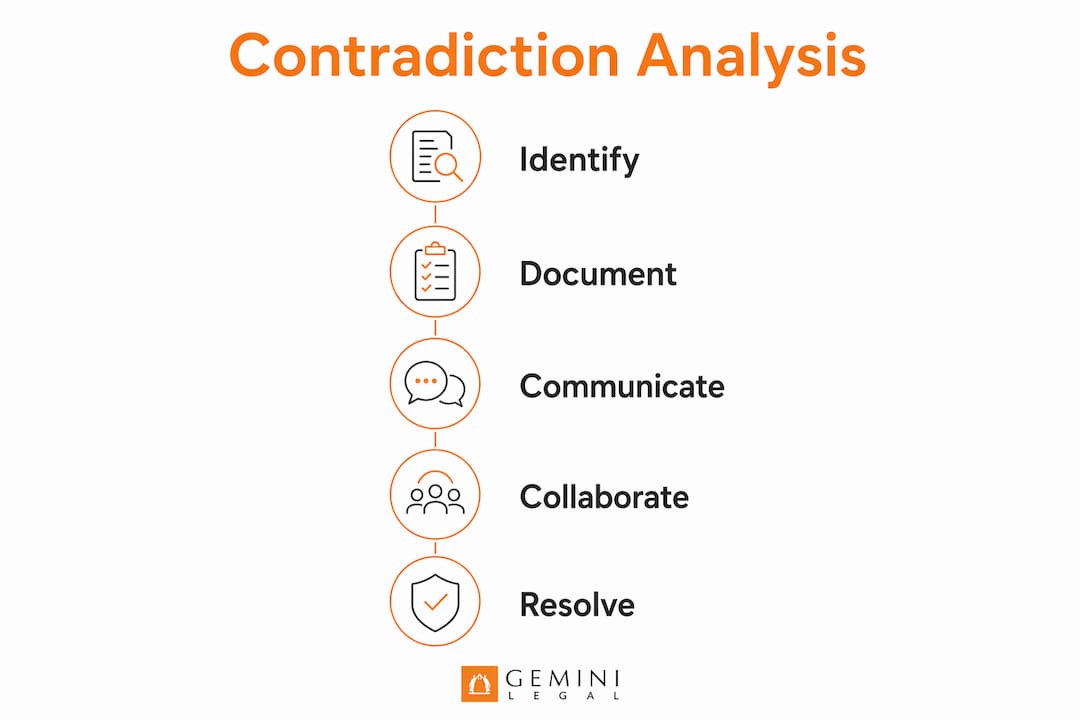
When a contradiction is identified, the correction process must be documented as carefully as the original entry. Altering a medical record without a proper amendment trail creates legal exposure. The accepted practice is an addendum, dated and signed, that references the original entry and explains the correction without obscuring what was previously written.
For cross-provider contradictions, direct communication between clinicians is the most reliable resolution path. When a treating physician and a QME reach different conclusions, a supplemental report that explicitly addresses the opposing opinion carries more weight than one that ignores it. Attorneys preparing clients for IME evaluations routinely flag these contradictions in advance so the evaluating physician can address them on the record.
When the record and the claimant's account conflict, the conflict should be documented rather than silently resolved in favor of either source. The comorbidity and allergy studies cited above found errors running in both directions, including conditions the patient reported that the record never captured. For a reviewer, the defensible move is to note both entries with page citations and let the discrepancy be visible on the face of the report.
How providers can reduce contradictions through better collaboration
The most durable fix is structural. When care teams share a single documentation platform and review each other's notes before finalizing their own, discrepancy rates drop. The systematic review above identified manual documentation and absent standards among the leading contributors to documentation error, which points at process rather than individual carelessness.
Structured handoff protocols, shared problem lists, and templated assessment formats reduce the variation that produces contradictions. For IME and QME contexts, providing the evaluating physician with a complete, organized record before the examination reduces the likelihood that the report will conflict with treating provider notes on basic factual matters.
Key Takeaways
Provider contradictions in medical records are a systemic documentation problem that directly affects claim outcomes, legal defensibility, and patient care quality.
| Point | Details |
|---|---|
| Documentation errors are pervasive | A systematic review of 48 studies found incompleteness in 47 of them and inconsistency in 8, driven by occupational stressors, manual documentation, and absent standards. |
| Legal exposure is real | Conflicting notes give opposing counsel a line of impeachment and weaken QME/AME reports that fail to address them. |
| Chronological analysis is essential | Placing contradictory statements in date order reveals context that resolves many apparent conflicts. |
| Self-report conflicts run both ways | Records under-documented comorbidities relative to patient interview in a 525-patient ACS study, so neither source is automatically authoritative. |
| Source citations are non-negotiable | Every extracted claim needs a page citation to be defensible under cross-examination or peer review. |
| ChartInsight removes the manual work | Page-cited summaries with an in-app PDF viewer eliminate the assembly and cross-referencing that consume most of a multi-provider review. |
Book a demo to see how a multi-provider record looks as a cited chronology.
FAQ
What happens if a medical record is incorrect?
An incorrect medical record can affect treatment decisions, claim outcomes, and legal proceedings. The accepted correction method is a dated, signed addendum that references the original entry without altering it.
What is the operating principle in medical record documentation?
Document contemporaneously, accurately, and completely. Every entry should reflect what was observed or done, not what was assumed or anticipated.
What happens when a doctor's notes contradict another provider's records?
The contradiction becomes a disputed medical question. In workers' comp, a QME or AME is typically asked to address the conflict directly. In litigation, the coherence of each provider's narrative is weighed against the full record.
What should a reviewer do when patient self-report conflicts with the documented history?
Treat the conflict as a finding rather than deciding which source wins. Research on acute coronary syndrome patients found that records under-documented comorbidities relative to patient interview, and an inpatient allergy study found reported reactions missing from the EHR entirely, so errors run in both directions. A medical-legal reviewer should surface both entries with page citations so the discrepancy is visible in the report.