

The deliverable is simple to state and hard to execute: a medication table plus a page-cited chronology, where every date, dose, and prescriber traces back to a specific document and page. That's what psychiatric medications tracking means in a medical-legal context, and it's what separates a summary that survives cross-examination from one that gets picked apart in a deposition.
The minimum bar for defensibility is one rule: no asserted fact without a named source. A start date needs a page. A dose change needs a page. A prescriber's name needs a page. If you can't point to it, it goes in as "reported" or "unconfirmed," not as fact.
- Medication table with generic/brand name, dose, prescriber, and source page for each row
- Cited chronology showing start/stop dates and dose changes in sequence
- Citation floor: every claim maps to a specific page, not a general "per records reviewed"
This deliverable feeds QME and IME reports, apportionment analysis, and counsel briefs where the psychiatric history determines causation or the extent of a work-related psychiatric injury.
TL;DR:
- Each medication entry must be linked to an exact source page, including dose, prescriber, and date, to ensure defensibility in legal review.
- Pharmacy fill data should be prioritized, but cash-pay and sample medications require separate verification, as they may not appear in PBM claims.
- Mark inferred exposure periods explicitly, avoiding confusion between documented facts and assumptions based on fill patterns.
- Consistent citation and preservation of original source documents, including custodian and retrieval details, are essential for admissibility.
- Tools that embed page-level citations let a reviewer confirm a fact where it sits, which removes the manual cross-referencing pass between a summary and the underlying PDFs.
Table of Contents
- Step-By-Step Workflow For Tracking Psychiatric Prescriptions
- How Do You Structure A Defensible Medication Table?
- Verification Checks And Common Discrepancy Patterns
- Documenting Chain-Of-Evidence For HIPAA and ROI Compliance
- How Evidence-First Tools Change The Extraction Workflow
- What Reviewers Consistently Get Wrong
- How To Evaluate A Record-Review Tool Before You Commit
- Key Takeaways
- Sources
- FAQ
Step-By-Step Workflow For Tracking Psychiatric Prescriptions
Reviewers lose time when they extract medication data in no fixed order. Working sequentially, from intake through export, cuts that waste and produces a cleaner audit trail.
- Intake. List every custodian: primary care, psychiatrist, ER, inpatient facility, pharmacy. Note which sources are electronic (PBM claims, e-prescribing records) versus scanned paper, since electronic sources often carry structured NDC codes and timestamps that paper records don't.
- Triage. Pull pharmacy fills, MARs, and hospital discharge medication lists first. Survey research on outpatient psychiatrists' record requests found the community standard of care is to request treatment records from clinicians seen in the past year. That is a treating-side floor, not a medical-legal rule: in a claim, the lookback is set by the alleged injury period and the questions posed to the evaluator, and it is frequently longer.
- Extraction. Search generic and brand names together (sertraline/Zoloft, quetiapine/Seroquel), plus NDC fragments, and phrases like "last taken," "discontinued," "refill," and "PRN." Clinic notes often use shorthand that a straight drug-name search misses.
- Normalization. Convert everything to a canonical drug name and standard units (mg, mL). Flag ambiguous entries, an illegible sig, a dose range instead of a fixed number, rather than guessing at a resolution.
- Citation and export. Every extracted fact needs a page anchor before it leaves your working file. When you export to DOCX or PDF, confirm the citations survive the conversion, not just the summary text.
Pro Tip: Build your search term list before you open the first PDF. A fixed list of generic/brand pairs and NDC fragments takes ten minutes to assemble and saves you from re-reading the same 400-page chart twice.
How Do You Structure A Defensible Medication Table?
The table itself is where most defensibility fights get won or lost, because a sloppy table invites opposing counsel to challenge every row individually.
Every row needs these fields: generic and brand name, NDC (when available), dose, route, sig (patient instructions), prescriber name, source document and page number, first-seen and last-seen dates, and refill pattern. Skipping the source-page column is the single most common defect reviewers introduce, and it's the one that gets a table thrown out.
| Field | What to Record | Common Pitfall |
|---|---|---|
| Drug name | Generic + brand, normalized spelling | Treating brand and generic as two separate drugs |
| Dose/route/sig | Numeric dose, route, PRN status | Averaging a dose range instead of flagging it |
| Source + page | File name and exact page number | Citing "records reviewed" instead of a page |
| First/last seen | Earliest and latest documented mention | Confusing prescribed date with fill date |
Normalize units consistently (mg not "one tablet"), and mark PRN medications separately from scheduled doses since they imply different exposure patterns. When a fact is unknown, write "not documented" rather than leaving the cell blank. Blanks read as oversights; explicit gaps read as thoroughness.
The chronology built on top of this table should annotate overlaps (two prescribers treating the same condition simultaneously), dose changes with the date they took effect, and any exposure window inferred from fill patterns rather than stated explicitly. Mark inferred dates clearly. Reviewers who blur the line between documented fact and inference are the ones who get impeached on cross.
Verification Checks And Common Discrepancy Patterns
Cross-checking is where a medication tracking exercise turns into an actual review. Compare pharmacy fill dates against prescriber notes and the patient's own reported history; the three rarely align perfectly, and where they diverge is often where the case turns.
- Duplicate fills across two pharmacies for the same drug class, worth flagging whenever more than one dispensing pharmacy appears in the file
- Inconsistent dosing between what's prescribed and what a MAR shows was actually administered
- Cash-pay gaps where a patient reports a medication with no matching PBM record
- Sample medications dispensed in-office that never appear in pharmacy claims
When you write up a discrepancy, separate documented fact from your own inference explicitly: "Pharmacy records show no fills for sertraline between March and July 2025; clinic notes from that period continue to list it as active" reads very differently from "patient was noncompliant." The first is defensible. The second is an opinion dressed as a finding.
Escalate to a pharmacy subpoena or a prescriber clarification request when a gap materially affects the causation or apportionment analysis, and note the escalation in your file even if the response never comes back.
Pro Tip: When a patient's self-report conflicts with the pharmacy record, cite both and let the discrepancy speak for itself. Resolving it yourself in the narrative is where reviewers overstep into advocacy.
Documenting Chain-Of-Evidence For HIPAA and ROI Compliance
Provenance metadata is not optional paperwork, it's what makes your findings survive a challenge to their admissibility. For each source document, record who produced it, the date you received it, the custodian of record, and the authorization type (patient release, subpoena, or court order).
- Log every ROI refusal or denied request, and note its effect on your conclusions rather than silently working around the gap
- Note court orders that expanded or limited scope, since that shapes what conclusions you can draw from an incomplete record
- Apply the HIPAA minimum necessary standard to your written notes, but never let "minimum necessary" become an excuse to omit provenance; those are separate concerns, and documentation guidance in Primary Care Companion for CNS Disorders treats objective, relevant documentation as the safer default
- Preserve original documents unaltered and cite page numbers directly rather than paraphrasing a fact away from its source
How Evidence-First Tools Change The Extraction Workflow
Page-level citation used to mean a reviewer manually flipping between a summary document and a stack of PDFs, confirming each fact by hand. That's still how most teams work, and it's still where hours disappear on a large multi-provider record.
Structured electronic health data, NDC codes, ICD-10 diagnoses, CPT procedure codes, gives litigation teams a time-stamped framework for anchoring exposure windows as the record is read. A tool built around that structure, rather than around freeform text extraction, changes what's testable in a demo.
Ask any record-review platform to show you these capabilities directly:
- Page-level citations on every extracted fact, not just a general "per records reviewed" footnote
- A standardized medication table template that populates consistently across cases
- DOCX/PDF export where citations remain clickable or at minimum page-referenced after conversion
- A cited research assistant you can query against the record itself, with answers pointing back to source pages
A single tool that preserves live page citations and exports them into an editable report removes the common, error-prone step of manually cross-referencing a summary against the underlying PDFs, the exact step that consumes the most reviewer hours on a large chart.
ChartInsight™ is built around that principle: clicking any citation opens the exact source page in the built-in PDF viewer, so verification happens without leaving the record for a separate file search.
What Reviewers Consistently Get Wrong
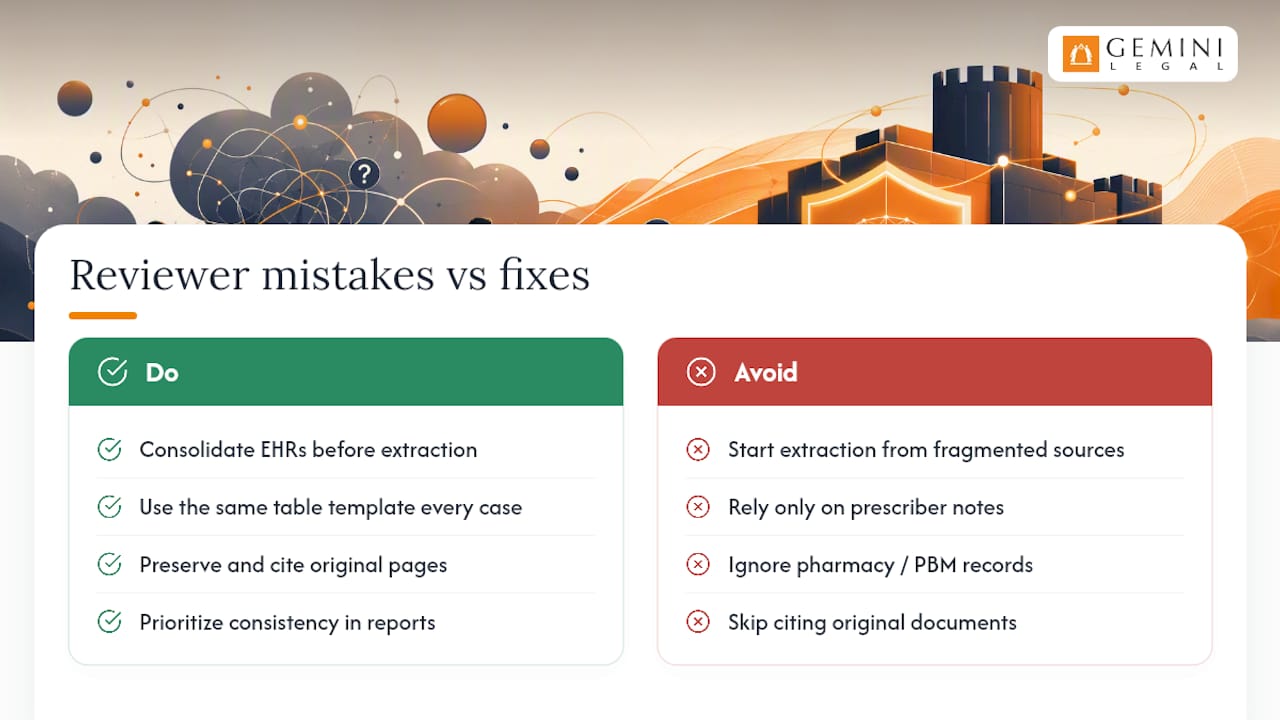
Fragmented EHRs across providers are the biggest time sink in this work, not because the data doesn't exist, but because it exists in five incompatible formats and nobody consolidates it before extraction starts. Missing pharmacy data compounds the problem: reviewers build a chronology entirely from prescriber notes, then discover months later that a subpoenaed PBM record contradicts half of it.
The fix isn't more effort, it's more discipline. Reuse the same table template across every case so nothing gets skipped. Preserve original pages and cite them directly, every time, even when a fact seems obvious. Consistency is what makes a report defensible under cross-examination, not thoroughness alone.
How To Evaluate A Record-Review Tool Before You Commit
Most platforms claim citation accuracy. Few survive a real demo test. Before you trust any tool with a multi-provider psychiatric record, run it through four tasks and watch what breaks.
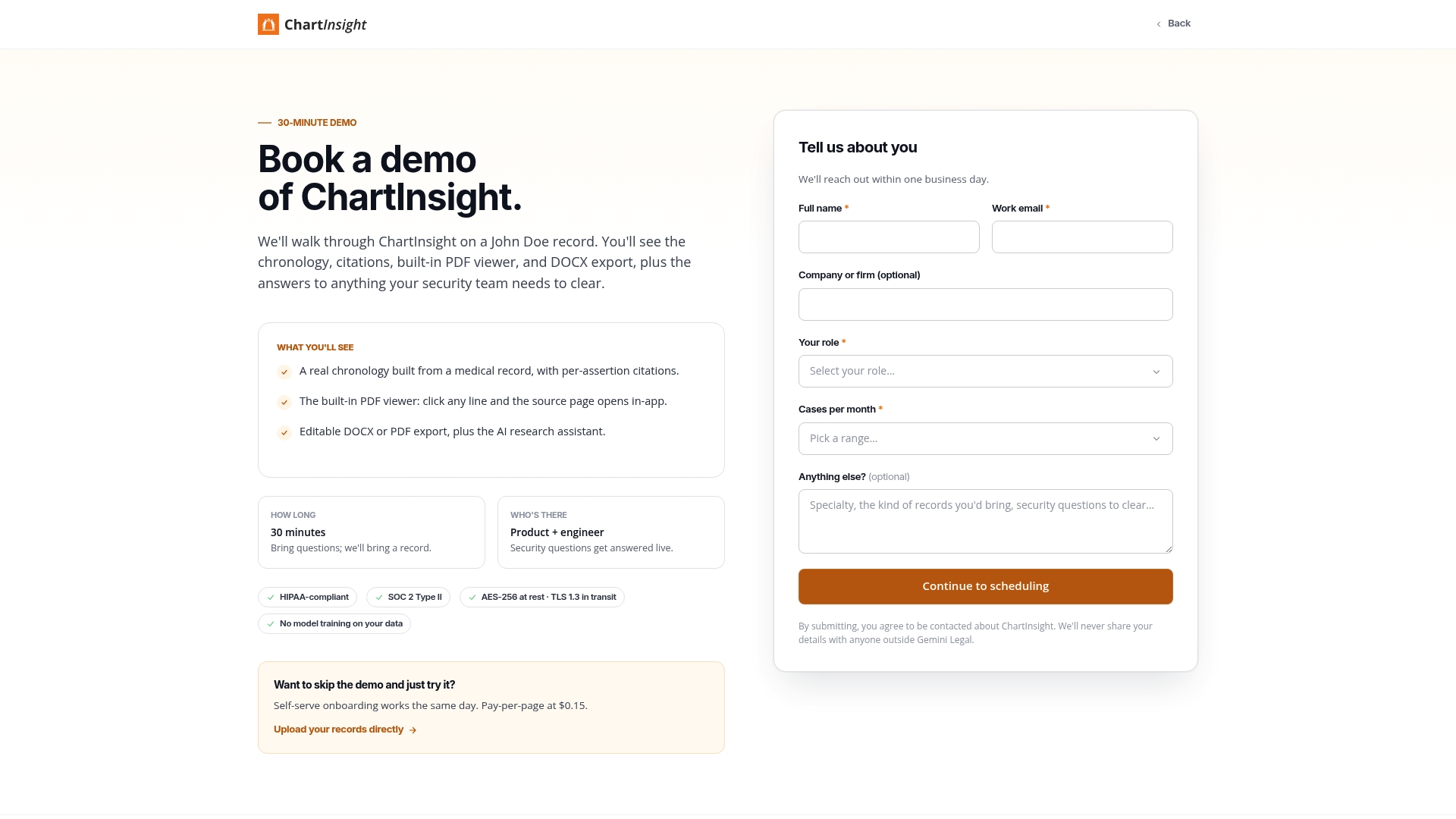
Load a genuinely large record, tens of thousands of pages if you have one on hand, and see how long extraction actually takes. Ask it to generate a medication table from that record and check whether the NDC, dose, and prescriber fields populate correctly or just approximate. Click a citation on any extracted fact and confirm it opens the exact source page inside a viewer, not a generic document link. Then export the result to DOCX and verify the citations survive the conversion instead of disappearing into plain text.
ChartInsight™ is the alternative to hand-built spreadsheets and manual page-flipping for psychiatric record review: every extracted fact is traced to its source page through the built-in viewer, and templates keep a personal injury or psychiatric report consistent across a caseload. If that caseload also includes Social Security disability work, the same medication-history discipline carries over; SSDI Lawyer is a practitioner-side view of how psychiatric impairment claims get built, offered as further reading rather than as authority on California workers' compensation. See how the extraction and citation workflow holds up on your own records by requesting a demo.

Key Takeaways
A defensible psychiatric medication history requires a cited table, a page-referenced chronology, and documented provenance for every source, with no asserted fact left unattributed.
| Point | Details |
|---|---|
| Cite every fact to a page | No date, dose, or prescriber name belongs in a report without a specific page reference. |
| Prioritize pharmacy and PBM data | Fill records offer the strongest proof of use but miss cash-pay and sample medications. |
| Flag inferred dates explicitly | Mark exposure windows inferred from fill patterns as inferred, not documented fact. |
| Preserve chain-of-evidence | Log custodian, retrieval date, and authorization type for every source document. |
| Use citation-first tools to verify faster | ChartInsight™ links every extracted medication fact to its source page inside a built-in PDF viewer, so cross-referencing happens in place instead of by hand. |
Sources
- Outpatient Psychiatrists' Practices for Requesting Prior Treatment Records (J Am Acad Psychiatry Law, 2015)
- Strategies for Documenting Information in the Medical Record (Primary Care Companion for CNS Disorders)
FAQ
What Counts As A Defensible Medication History?
A medication table with source-cited fields (dose, prescriber, dates) plus a chronology where every claim traces to a specific page in the record.
Which Source Is Most Reliable For Confirming Medication Use?
Pharmacy dispensing and PBM claims data, since NDC codes and fill dates are time-stamped, though they miss cash-pay prescriptions and physician samples.
How Far Back Should A Reviewer Request Records?
Survey research on treating psychiatrists points to the past year as the community default. In a medical-legal review the lookback is set by the alleged injury period and the questions posed to the evaluator, so it commonly runs further back, particularly with prior hospitalizations or long-term treatment.
How Do You Handle A Discrepancy Between Patient Report And Pharmacy Records?
Cite both sources directly in the report and note the conflict as an observed fact, rather than resolving it with an unsupported inference about compliance.
Can Software Speed Up Psychiatric Medication Tracking Without Losing Defensibility?
Yes, when the software links every extracted fact to its source page. ChartInsight™'s built-in PDF viewer lets reviewers click a citation and check it against the original page without leaving the record, which removes the manual cross-referencing pass rather than the reading itself.