

Asking AI about medical records means using a citation-first review platform that ingests full PDF files and returns structured, page-cited outputs: a chronology, a narrative summary, vitals and medications tables, and an index. The right approach is not a general chatbot query. It is a workflow where every AI-generated statement traces to a source page, and a human reviewer signs off before anything goes into a report or deposition binder.
TL;DR:
- AI tools should produce source-cited outputs such as chronologies and summaries, not just unstructured text, to ensure defensibility.
- Human validation is essential to verify AI extraction with a strict workflow including pagination, chronological ordering, and source comparison.
- Citations must be preserved and clickable, with export formats maintaining page-level links for quick source verification.
- Handling OCR errors requires manual spot checks on critical numeric and date fields, especially in scanned or handwritten records.
- The platform should support HIPAA compliance, leave original records unaltered, and support a documented chain of custody and access controls.
Table of Contents
- What Does "Ask AI About Medical Records" Actually Mean for Reviewers?
- What Is the Reviewer's Workflow From Intake to Export?
- What Makes an AI Medical Record Summary Defensible?
- How Do You Verify an AI Summary Quickly Under Time Pressure?
- What Security and Compliance Standards Should the Platform Meet?
- How Does a Citation-First Research Assistant Work in Practice?
- How Do You Handle OCR Errors in Scanned Medical Records?
- How Do You Manage Unstructured Formats Within Medical PDFs?
- What Are the Real Limits and Risks of AI Summarization Here?
- Should You Train or Fine-Tune AI Models on Medical Record Data?
- Which AI Platforms Are Built Specifically for Medical Record Review?
- Balancing Speed With Defensibility
- See How ChartInsight™ Handles Page-Cited Record Review
- Sources
- FAQ
What Does "Ask AI About Medical Records" Actually Mean for Reviewers?
For a QME, an adjuster, or a personal-injury attorney, this phrase covers a specific class of tool, not a novelty search-bar feature. It means an AI system built to process a multi-provider PDF record, often thousands of pages, and produce deliverables you can hand to a judge or opposing counsel without apologizing for them.
That is fundamentally different from typing a question into a consumer chatbot and getting an unsourced paragraph back. A defensible platform produces structured outputs such as a full chronology, a narrative summary, vitals, and a medications list, and every fact in those outputs carries a citation to the page it came from.
Those outputs have direct case value. A cited chronology gives the evaluator a traceable basis for the causation and apportionment analysis required under California Labor Code section 4663. Vitals and medication history give context for MMI and P&S findings. A list of referenced-but-missing records tells counsel what to request next. On the personal-injury side, medical treatment and expenses are the first factor in case valuation, as a Massachusetts firm's overview of how personal injury cases are evaluated explains, so record accuracy feeds directly into case value. None of it replaces the reviewer's judgment. Treat every AI output as a draft that a qualified human confirms against the source pages before it becomes a report.
What Is the Reviewer's Workflow From Intake to Export?
A defensible review follows a fixed sequence, and skipping steps is where cases get exposed on cross-examination. Here's the order that holds up:
- Intake and scoping. Confirm the authorizations cover the full requested record set, and flag any provider whose records have not yet arrived. Build the completeness checklist before extraction starts, not after.
- Pagination and chronological ordering. Every page gets a stable number, and the record gets organized chronologically with clear section headings, a best practice described in an ABA Law Technology Today article on records likely to become legal documents. Skip this and your citations will not survive a reorganized exhibit.
- AI extraction. The platform generates the chronology, pulls vitals and medications into structured lists, and links each entry to its source page. Structured, cited indexing helps bridge fragmented multi-provider files and surface referenced-but-missing documents.
- Human validation. A clinical or legal reviewer checks the extraction against the source pages, resolves ambiguous phrasing, and signs off. This is not optional and it is not fast if the AI output lacks citations to check against.
- Export. The final report goes out as an editable DOCX or PDF with every citation preserved, so opposing counsel or a hearing officer can click straight through to the source.
Turnaround varies widely. One practical guide to medical record review for law firms cites published medical record access statistics putting manual workflows at 60 to 90 days or longer and some AI-enabled workflows at about 10 to 12 days, and it cautions that those figures are context, not a promise for a particular case.
What Makes an AI Medical Record Summary Defensible?
A summary either survives cross-examination or it does not, and the difference usually comes down to five habits.
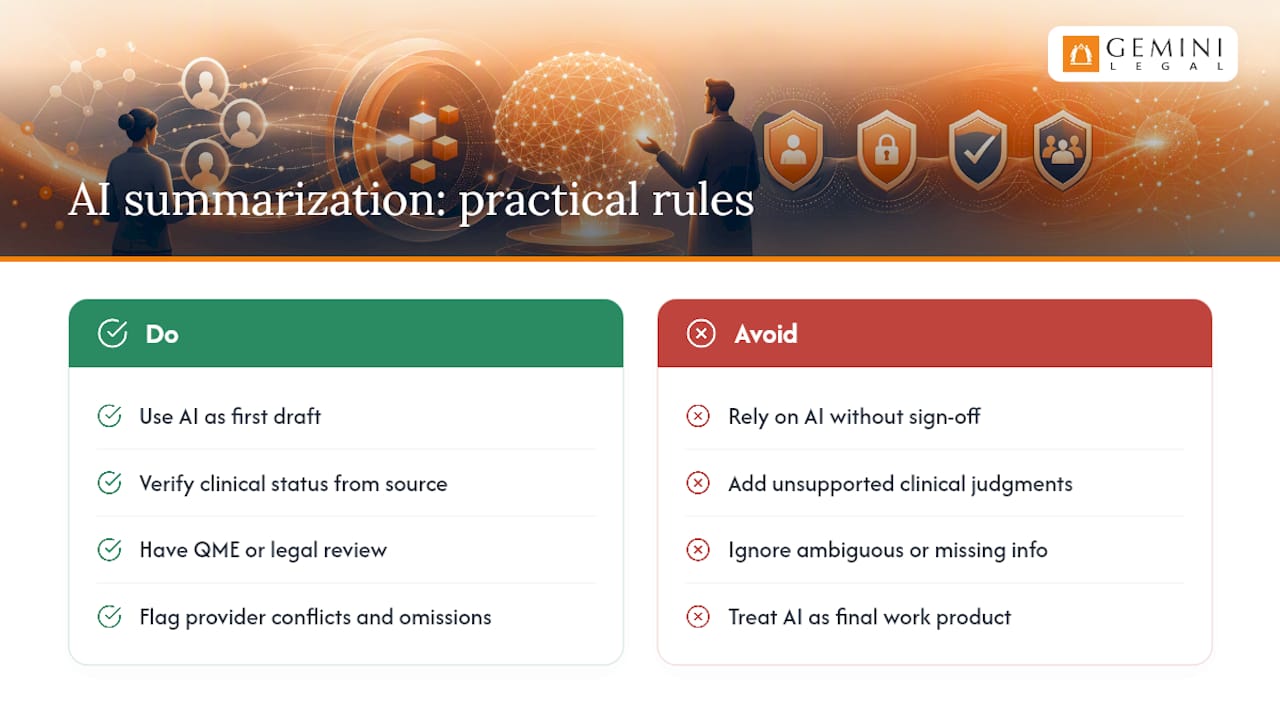
- Cite every material statement. If a sentence in the narrative summary states a diagnosis, a treatment date, or a work restriction, it needs a page number or Bates reference attached. No citation, no sentence.
- Stick to source language. Avoid adjectives and adverbs the record itself does not support. A summary that says a patient "improved dramatically" when the chart says "reported some improvement" has invented a fact.
- Document chain of custody. Note redactions, missing pages, and who reviewed what and when.
- Flag conflicts and gaps. A missing-records report and a documented conflict between two providers' notes are as valuable as the chronology itself.
- Run standard QC checks before sign-off. Date consistency across providers and a trace test on key claims should happen every time, not just on high-stakes files.
The pattern is predictable: summaries that stick to reported, citable language hold up better under deposition challenges, while summaries that add interpretive flourishes invite line-by-line attack.
Pro Tip: If a narrative summary reads too smoothly, with no hedges, no "per the record" qualifiers, and no citations, treat that as a warning sign rather than a compliment. Fluent, unsourced prose is exactly what an AI model produces when nobody checked its work.
How Do You Verify an AI Summary Quickly Under Time Pressure?
Once the full record has been reviewed, re-reading all 4,000 pages before every hearing is rarely practical, so pre-hearing verification of the summary needs to be fast and targeted.
- Start with the strongest claims. Verify the statements the case actually turns on first, apportionment percentages, MMI dates, causation language, before touching minor details.
- Run the three-sentence trace test. Pick three sentences from the summary at random, click their citations, and confirm the source page says what the summary claims. This single habit, applied before any summary gets signed off, turns an AI draft into an auditable product.
- Watch for red flags. A sentence with no citation, an adjective that sounds interpretive rather than clinical, or a date that does not match the surrounding entries all mean stop and pull the source page manually.
- Log the check. Note in the case file which sentences you traced and when. If the summary gets challenged later, that log is your answer.
What Security and Compliance Standards Should the Platform Meet?
Any platform handling protected health information for litigation or claims work needs HIPAA-compliant handling and encryption in transit and at rest. Records move between providers, counsel, and reviewers constantly, and every hop is a point of exposure if the transfer is not encrypted end to end.
The original record should never be altered. A defensible platform keeps the source PDF untouched and layers citations on top of it, supporting the documented chain of custody that shows the underlying file was not altered. Role-based access control and multi-factor authentication limit who can view or export a given matter, which matters when multiple staff roles touch the same file across a firm or claims team. Automated audit logs that record every read, edit, and export give you a second line of defense if access to a record is ever questioned in a motion or deposition.
How Does a Citation-First Research Assistant Work in Practice?
The theory of page-level citations only matters if the tool actually delivers them on demand, not just in a static report. ChartInsight™ builds its workflow around that expectation: it ingests multi-provider PDF records, produces a chronology, extracts vitals and medications, and generates a nine-section narrative summary, with chronology entries, summary statements, and medications each citing their source page.
- Templates and a prompt library keep output consistent across a team, so every med-legal report, or every peer review, comes back structured the same way.
- A built-in research assistant answers specific questions on demand, "what were the pain scores in Q3," "list every provider who noted lumbar tenderness," and returns a cited answer linking straight back to the PDF page.
- Clicking any citation opens the source page inside the built-in PDF viewer, so a reviewer never downloads a separate file or loses their place mid-review.
Because citations are preserved through export, an expert or opposing counsel can go straight to the cited page to verify a claim.
How Do You Handle OCR Errors in Scanned Medical Records?
Scanned records, especially older workers' comp files and handwritten provider notes, generate OCR errors that a naive extraction tool will happily present as fact. A misread "5mg" as "50mg" in a medications table is not a cosmetic error. It is a defensibility problem waiting to surface in cross-examination.
The fix starts with treating OCR confidence as a QC input, not background noise. A platform worth using should flag low-confidence text rather than silently smoothing it into clean-looking prose. Handwritten entries, faxed records with degraded contrast, and multi-generation photocopies are the highest-risk categories, and they deserve a manual spot-check regardless of how clean the rest of the extraction looks.
Practically, that means checking any numeric field, dosages, vitals, lab values, against the source image whenever the original document was scanned rather than born-digital. A reviewer who traces a sample of numeric extractions per record, the same instinct behind the three-sentence trace test for narrative claims, is more likely to catch OCR-driven errors before they reach a report. Date fields deserve the same scrutiny, since a misread "1" as "7" can shift an entire treatment timeline by years. When a platform's citation links back to the actual scanned page image rather than a re-typed transcript, verifying an OCR-suspect field means opening the page rather than requesting the record again.
How Do You Manage Unstructured Formats Within Medical PDFs?
A single workers' comp or personal-injury file rarely comes in one clean format. It is faxed intake forms, typed physician letters, handwritten nursing notes, scanned lab reports with tables, and sometimes screenshots of an EHR portal, all stitched into one PDF by whichever paralegal assembled the record.
Tables are the hardest part. A lab panel or medication list formatted as a table in the source document needs extraction logic that recognizes rows and columns, not just raw text that gets ordered scanning left to right. A tool that flattens a two-column vitals table into a single garbled line of numbers has quietly corrupted the data before a reviewer even sees it.
Mixed document types within a single file require the extraction to recognize context shifts. A progress note followed immediately by a billing summary followed by a radiology report needs different handling for each, and a platform that treats the whole PDF as one undifferentiated text blob will misattribute vitals or medications to the wrong encounter. Document classification on intake, tagging each section by type before extraction runs, is what keeps a discharge summary from getting merged with an unrelated consult note that happens to sit on an adjacent page. This is also where an index and hyperlinked chronology earn their keep: when the structure is unclear in the source, a clean navigable index lets a reviewer confirm which section a given fact actually came from.
What Are the Real Limits and Risks of AI Summarization Here?
AI summarization speeds extraction, but it does not replace clinical or legal judgment, and pretending otherwise is how defensible cases become indefensible ones. A known failure pattern is fluent, well-organized prose that quietly omits clinically meaningful absences or glosses over contradictions across providers without flagging the conflict.
The most consequential risk involves what AI tends to miss rather than what it gets wrong. Models trained to summarize tend to smooth over ambiguity. The distinction between "history of depression" and an "active diagnosis" matters enormously in an apportionment analysis, and an AI system without clinical guardrails can flatten that distinction into a single confident sentence. That is a job for a legal nurse consultant or a QME, not an algorithm running unsupervised.
There is also a liability risk in overreach. A summary that adds interpretive language the source record does not support, describing pain as "severe" when the chart says "reported as 6 out of 10," creates a document that misrepresents the record even though every individual fact traces back to a real page. That kind of overreach is exactly what fails under cross-examination, because opposing counsel only needs to find one unsupported adjective to cast doubt on the whole summary.
The practical takeaway: treat every AI output as a first draft requiring sign-off, never as a finished work product, regardless of how polished it reads.
Should You Train or Fine-Tune AI Models on Medical Record Data?
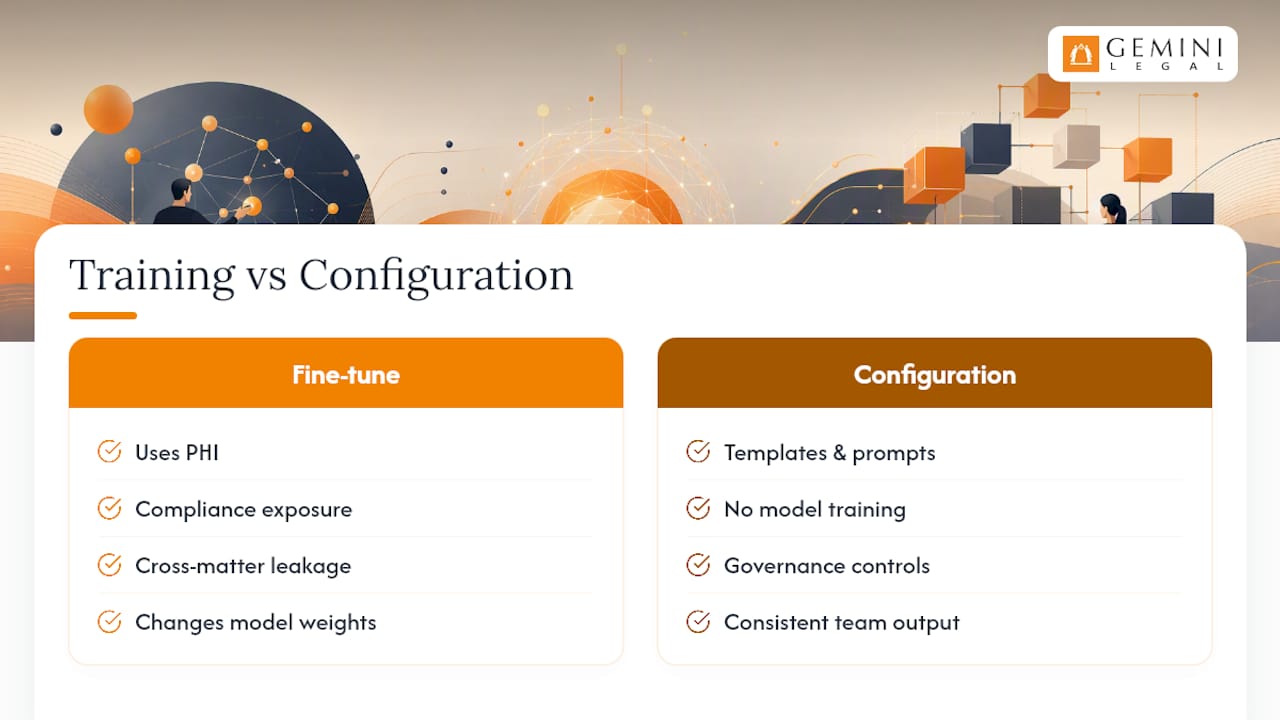
Most legal and clinical review teams should not attempt to fine-tune a general-purpose model on their own record data, and the reasons are practical, not just theoretical. Protected health information used for training creates a compliance exposure that most firms and claims departments are not equipped to manage, especially around data retention, consent scope, and cross-matter contamination.
The more relevant question for a reviewer evaluating a vendor is what that vendor does with your records once you upload them. A platform that trains its underlying model on customer data risks one client's confidential record data influencing outputs for a different client's matter. Ask any vendor directly whether your firm's or claims department's uploaded records are used to train shared models, and get that answer in writing before you rely on the platform for privileged material.
What does matter, and what teams can reasonably control, is configuration rather than training: templates that define how a med-legal report should be structured, a prompt library that standardizes how specific analyses (apportionment summaries, medication timelines, psychiatric symptom tracking) get requested, and document classification rules that determine how incoming files get sorted. Those are governance tools, not model training, and they are what actually produce consistent output across a team without touching the underlying model weights or raising data-use questions.
Which AI Platforms Are Built Specifically for Medical Record Review?
The tools worth evaluating for this work share a specific profile: citation-first output, page-level traceability, and export formats that preserve those citations. That is a narrower category than general legal AI or general-purpose document summarizers, and it is worth asking any vendor to demonstrate the citation click-through before signing a contract.
ChartInsight™ is built specifically around outputs useful to medico-legal reviewers: a chronology, a nine-section narrative summary, vitals, medications, and custom analyses configured through templates and a prompt library. The distinguishing feature is architectural, not cosmetic. Chronology entries, summary statements, and medications carry live citations, and clicking one opens the source PDF inside the platform rather than requiring the reviewer to search for a separate file. For psychiatric and personal-injury records specifically, where narrative nuance and symptom tracking carry outsized weight, that page-level traceability is what makes the output usable in a deposition rather than just a helpful first read.
When evaluating any platform in this category, the questions that matter are consistent: Does every fact cite a page? Can you click through to the original document without leaving the app? Does the export preserve those citations? Answer no to any of those and the tool is producing a research aid, not a legal work product.
Balancing Speed With Defensibility
AI drafts can shorten the time between intake and a usable chronology, but that speed is only worth something if every claim still traces to a page. Require citations and an audit trail on every output, no exceptions, and build record readiness into case planning from day one rather than treating it as a bottleneck to solve later. Outsource retrieval when your team's bandwidth runs short, but never outsource the sign-off.
See How ChartInsight™ Handles Page-Cited Record Review
ChartInsight™ is built around the workflow this article describes: a chronology, a nine-section narrative summary, vitals, and medications, with chronology entries, summary statements, and medications each carrying a live citation back to the source page.
Reviewers keep the page-level traceability a QME report or claims file demands while spending less time hunting for pages. Templates and a prompt library keep output consistent whether the task is a personal-injury record review or a peer review report, and exports preserve every citation in editable DOCX or PDF format so nothing gets lost between the platform and the final filing. Every citation points back to a page in the original record, which matters for anyone who has to answer for a summary's accuracy later.
If your team is still reconciling an AI summary against a stack of PDFs by hand, that gap is worth closing. Book a demo with ChartInsight™ and see the citation click-through on one of your own case files.
Sources
The ABA Law Technology Today article on medical records as legal documents covers pagination, chronological organization, authentication, and chain-of-custody practices. Texas Autopsy Services' practical guide to medical record review for law firms discusses turnaround ranges and their limits.
This article is general information, not legal or medical advice.
- When a medical record becomes a legal document
- Medical Record Review for Law Firms: A Practical Guide
- California Labor Code section 4663
FAQ
What does "ask AI about medical records" mean for legal reviewers?
It refers to using a citation-first platform that ingests full PDF records and returns structured outputs, chronologies, narrative summaries, vitals, and medications tables, where every fact links to its source page. It does not mean typing informal questions into a general-purpose chatbot.
Is an AI-generated medical record summary admissible on its own?
No. An AI summary is a draft that requires human clinical or legal validation before it becomes a work product, and it should always retain page-level citations to source pages or Bates numbers so every statement can be checked.
How much faster is AI-assisted record review than manual review?
It varies by record volume and complexity. Figures cited in one industry guide put manual workflows at 60 to 90 days or longer and some AI-enabled workflows at about 10 to 12 days, but those figures are context, not a promise for any particular case.
What is the three-sentence trace test?
It is a quick QC check where a reviewer picks three sentences from an AI summary at random, clicks their citations, and confirms the source page supports the claim. It's a fast way to catch overreach before a summary is signed off.
Does ChartInsight™ train its AI models on customer records?
No. ChartInsight™ does not use customer records, prompts, or outputs to train AI models; details are on its security and compliance page. Ask any vendor directly, in writing, whether uploaded records are used to train shared models before relying on the platform for privileged material.
What security features should a medical record AI platform have?
At minimum, HIPAA-compliant handling with a BAA, encryption in transit and at rest, role-based access control, and audit logging. The platform should also preserve the original record without alteration to support a documented chain of custody.