

An audit trail for medical records, in the sense that matters to a reviewer, is a page-level provenance trail: every extracted fact, chronology entry, or summary sentence links back to the exact page in the source PDF where it appears. It is not an EHR access log. For workers' comp adjusters, PI attorneys, QMEs, and legal nurse consultants, the practical payoff is simple: a summary you can defend, because anyone can click a citation and confirm the fact in seconds.
TL;DR:
- Provenance links each fact to an exact page or document, but authentication still requires proper chain-of-custody evidence to confirm legality.
- Reviewers must verify continuous pagination, proper citations for all facts, functioning hyperlinks, and attached authentication before finalizing a summary.
- Building an index and page-level citations before extraction ensures efficiency and verifiability in handling large or complex medical record files.
- Office workflows should include QC steps like sample verification and version logs to maintain the integrity of the citation trail.
- Automation aids in organizing volume and generating citations but does not replace the critical judgment of trained reviewers.
Table of Contents
- What Does "Audit Trail" Mean in a Medical Record Review?
- Why Does Provenance Determine Whether a Summary Is Defensible?
- How Do You Build a Defensible, Citation-Backed Summary?
- What Should You Check Before You Sign Off on a Summary?
- What Features Preserve the Audit Trail in a Review Tool?
- The Case for Pairing Automation With Human Judgment
- Turning a Multi-Provider Record Into a Citable Summary in Hours
- Sources
- FAQ
What Does "Audit Trail" Mean in a Medical Record Review?
Most search results on this phrase point toward EHR or EMR audit logs, the system metadata that shows who viewed or edited a chart, when, and from what device. That's a real compliance concept, but it's not what a claims adjuster or QME needs when producing a record summary. The audit trail that matters for legal and clinical review is a document-level provenance trail: a citation chain proving that the sentence "patient reported 8/10 low back pain on March 3, 2024" traces to a specific page in a specific document.
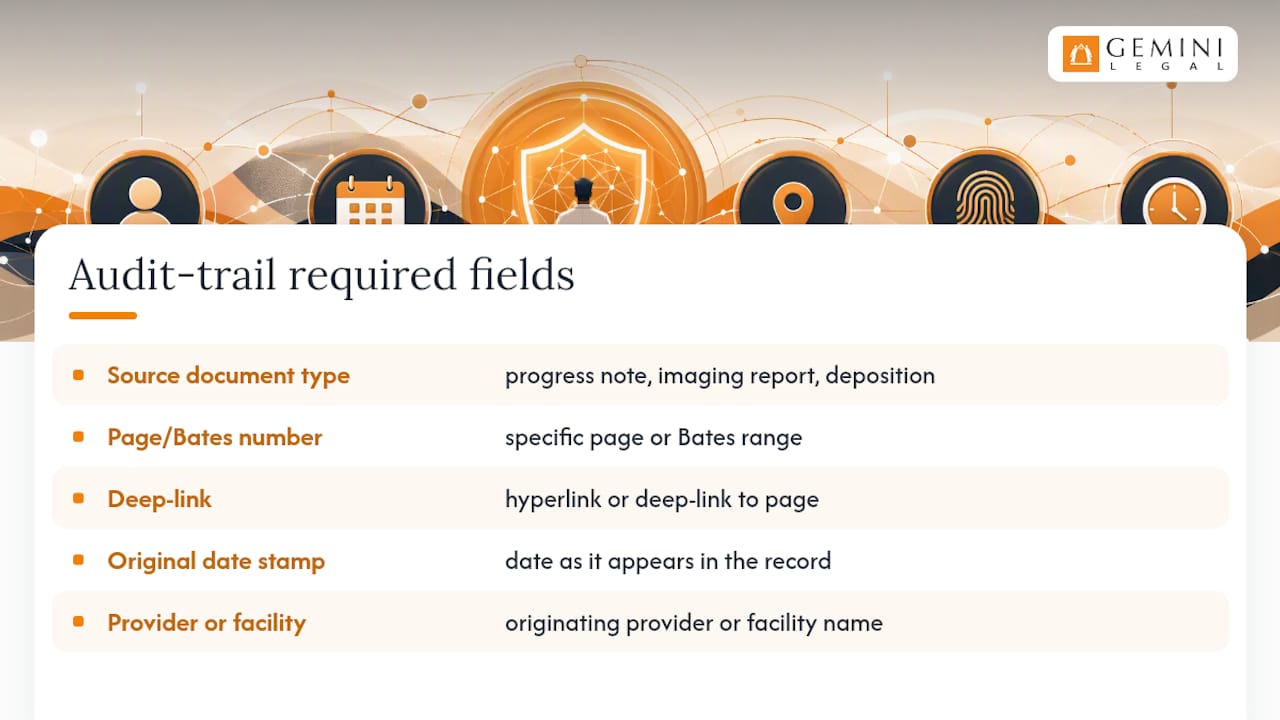
For each extracted fact, a reviewer should be able to capture five things: the source document type (progress note, imaging report, deposition), the page number or Bates number, a hyperlink or deep-link to that page, the original date stamp as it appears in the record, and the provider or facility of origin. That's the atomic unit of a citable summary.
Provenance has a limit worth stating plainly: linking a fact to a page doesn't authenticate the underlying document. A page can be mislabeled, duplicated, or altered before it ever reaches your review. Authentication still requires a custodian affidavit or independent chain-of-custody evidence, as courts and practice guides on evidentiary standards for medical records as legal documents make clear. Provenance and authentication are two different jobs, and confusing them is where weak summaries fall apart under cross-examination.
Why Does Provenance Determine Whether a Summary Is Defensible?
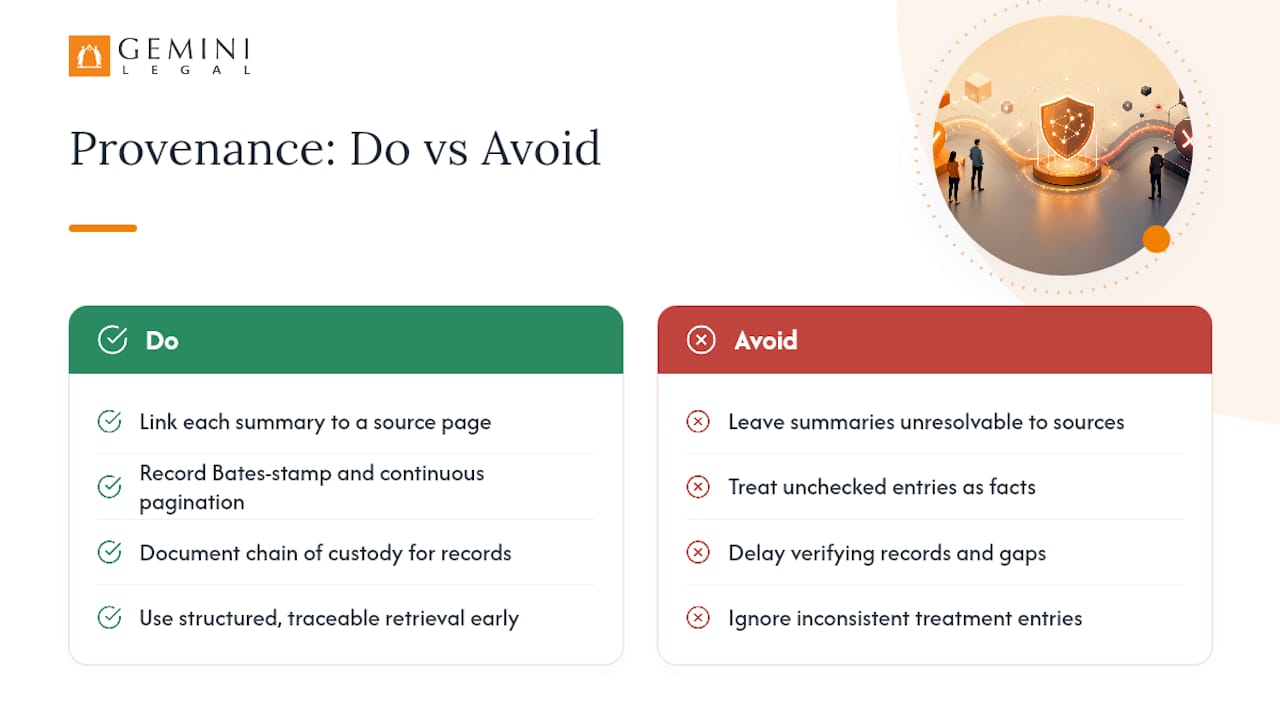
A summary that can't resolve to a source page is, functionally, an opinion. In mass tort and MDL-scale reviews, that distinction gets tested constantly: reviewers working through thousands of pages across multiple providers need every entry in a chronology to check against a Bates-stamped source in seconds, not minutes. Litigation-scale record review guidance treats unresolvable summary entries as effectively indefensible, and that standard doesn't loosen just because a matter is a single workers' comp claim instead of a consolidated proceeding.
The same logic applies directly to admissibility. Courts routinely accept custodian affidavits and business-records certifications when a chain of custody is documented and the pagination is continuous, according to guidance on when a medical record becomes a legal document. A QME defending a report at deposition, or an attorney responding to a motion to strike an expert summary, needs that same paper trail behind every factual claim.
There's a throughput benefit too. Structured, traceable retrieval surfaces missing records, gaps in treatment, and inconsistent entries earlier in the review cycle, which shortens the runway experts need before they can form an opinion, . Fewer discovery disputes, less time spent re-verifying facts that should have been nailed down the first time.
How Do You Build a Defensible, Citation-Backed Summary?
The workflow doesn't change much whether you're handling a 300-page workers' comp file or a 40,000-page multi-provider production. What changes is the discipline you apply at each step.
- Inventory the production. Confirm what you actually received against what was requested. Flag missing providers, gaps in date ranges, and any facility referenced in one record but absent from the file.
- Stabilize the record. Apply continuous pagination or Bates numbers across the entire set, and build an index or table of contents by provider and date range. This is the step most reviewers rush, and it's the one that breaks the audit trail downstream if skipped.
- Extract with live citations. Generate the chronology, the narrative summary, vitals, and medications, with every fact tied to its exact source page or hyperlink rather than a vague "per records reviewed" footnote.
- QC the output. Have a human verify a sample of citations, test that hyperlinks actually resolve to the cited page, and reconcile duplicate or copied-forward entries (a chronic problem in EHR exports where a note gets pulled into five subsequent visits verbatim).
- Deliver with the trail intact. Export in a format that preserves citations, attach a version log, and note how supplemental records will be incorporated if they arrive later.
Standard procedural guidance on summarizing medical records follows this same sequence: scope, stabilize, extract with references, verify, deliver with version control.
Pro Tip: Build your index before you extract a single fact. A summary built on an unindexed, unpaginated stack of records will need to be rebuilt the moment opposing counsel asks "what page is that on?"
What Should You Check Before You Sign Off on a Summary?
Run this before any report leaves your desk:
- Does pagination resolve cleanly, with no gaps, duplicate numbers, or overlapping Bates ranges?
- Does every material fact in the summary carry a page citation, not just a general reference to "the records"?
- Do the hyperlinks actually open to the cited page, not just to the document's first page?
- Are custodian affidavits or authentication documents attached, or at least noted as pending?
- Is there a redaction log and a version history showing what changed between drafts?
Automated logging that tracks reads, edits, and exports gives reviewers a defensible administrative record on top of the citation trail itself, a practice reviewers on high-volume caseloads increasingly treat as standard.
When something can't be resolved, don't quietly drop it. Note the gap explicitly in the final report: "Progress notes for March through May 2023 not included in production." That single sentence often does more for your credibility than a perfectly clean summary would.
Pro Tip: If you expect the summary to go in front of opposing counsel or a judge, package the citation trail as a standalone appendix. A reviewer who can hand over "here's exactly where every fact came from" without being asked wins credibility before the substantive argument even starts.
What Features Preserve the Audit Trail in a Review Tool?
Whether you're evaluating software or building an internal workflow, the same feature categories map directly to the checklist above:
- A review tool with deep-link citations, so clicking a fact opens the exact source page instead of dumping you at page one of a large file.
- A chronology generator that timestamps each event against its original source date, not the date it was scanned or uploaded.
- Sentence-level citation in narrative summaries, not just document-level attribution.
- Normalized vitals and medications tables, so a blood pressure trend or medication change is traceable across dozens of visit notes without manual re-entry.
- Export that preserves citations, so the DOCX or PDF you hand to a QME or attorney still carries the page references.
- Templates, role-based access, and redaction or version logs, which support consistency across reviewers and give you an administrative record of who touched what.
Missing any one of these categories creates a gap somewhere on the verification checklist. A tool with a chronology generator but no citation preservation on export, for instance, hands you a clean summary that becomes unverifiable the moment it leaves the platform.
The Case for Pairing Automation With Human Judgment
Automation is good at one thing above all: organizing volume so a trained eye can get to the substance faster. It should extract, timestamp, and cite. It should not decide what a discrepancy means, whether a gap in treatment is significant, or how apportionment should be allocated under the AMA Guides. Those calls stay with the QME, the attorney, or the retained expert, full stop.
The QA routine that works in practice is unremarkable: sample a percentage of extracted facts against source pages, require senior sign-off before a summary goes final, and keep version control so you can show exactly what changed between drafts.
Turning a Multi-Provider Record Into a Citable Summary in Hours
ChartInsight™ builds the provenance trail directly into the output instead of leaving you to reconstruct it. Every fact in a chronology, narrative summary, vitals table, or medications list carries a live citation to its source page, and clicking that citation opens the record right inside the app, no separate PDF, no lost place in a 10,000-page file.
That matters most on the records that take longest to summarize by hand: multi-provider workers' comp files, psychiatric IME records with years of treatment history, or orthopedic QME files stacked with imaging and operative notes. Reviewers using structured, citation-preserving workflows typically move from days of page-flipping to hours of verification, without losing the paper trail a QME or attorney needs to defend the report. Templates help maintain consistency across reports, and exports preserve page citations. For a closer look at how the same approach applies to psychiatric records, see ChartInsight's psychiatric record review workflow, or check the accuracy data behind the extraction engine if you want the validation detail before you commit.
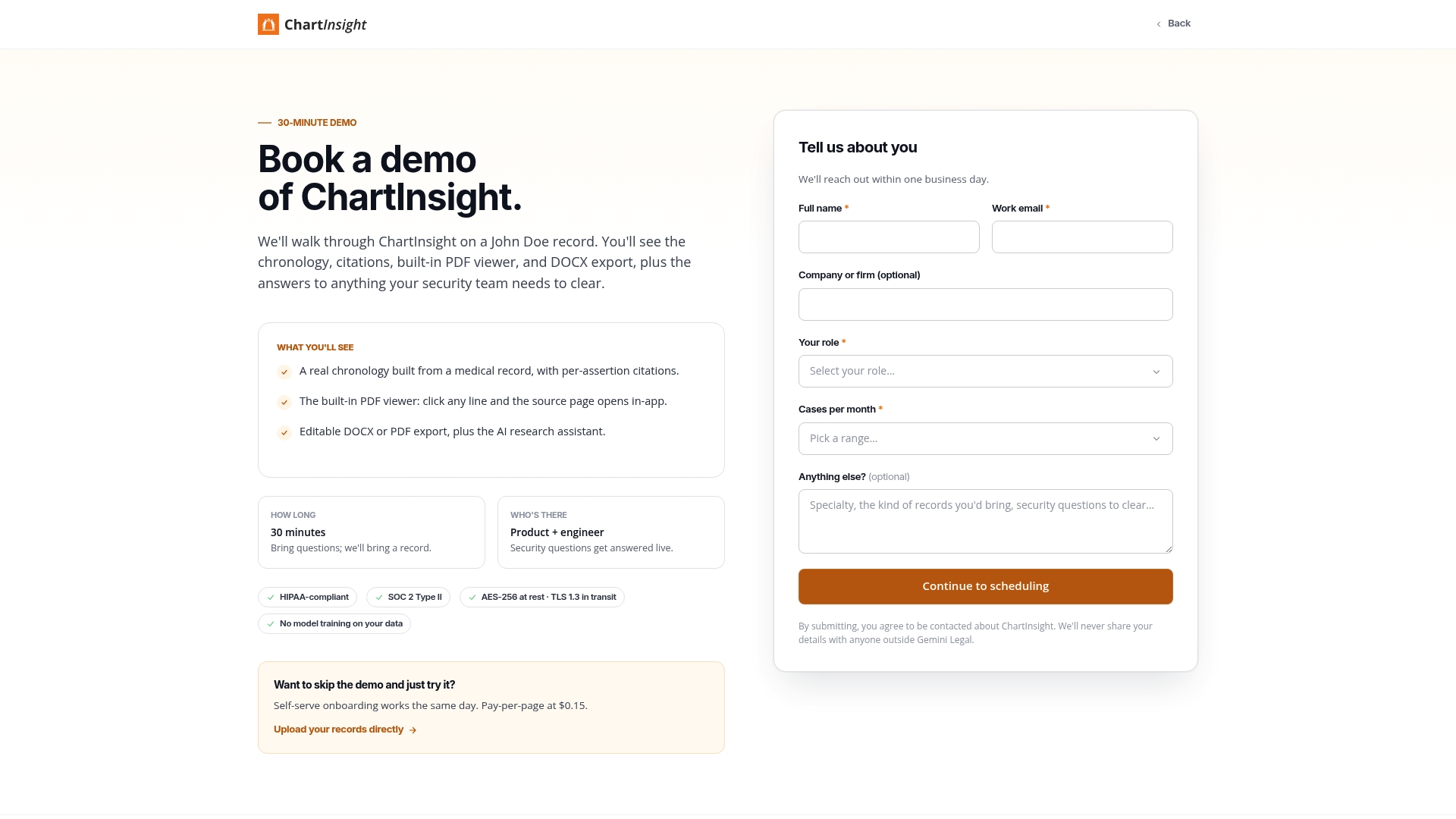
If you review records for a living, book a demo and bring a real file. The fastest way to judge a citation trail is to click one yourself.
Sources
FAQ
What Is an Audit Trail in a Medical Record Summary?
It's a citation chain linking each fact in a chronology or summary to the exact page in the source PDF where that fact appears, not a system log of who accessed the chart.
Is a Page-Level Citation the Same as Authentication?
No. A citation shows where a fact came from; authentication requires a custodian affidavit or chain-of-custody documentation proving the document itself is genuine.
How Does ChartInsight™ Handle Source Citations?
Every fact extracted by ChartInsight™, whether in a chronology, narrative summary, or vitals table, carries a live citation that opens the exact source page inside an integrated PDF viewer.
What Should a QME Check Before Relying on a Summary?
Confirm pagination is continuous with no gaps, every material fact cites a page, hyperlinks resolve correctly, and any authentication or redaction documentation is attached or noted.
Does Automated Extraction Replace Human Review?
No. Automation organizes and cites the record faster, but trained reviewers still verify context, resolve edge cases, and make judgment calls like apportionment under the AMA Guides.