

A defensible behavioral health record review is a page-cited chronology, a nine-section narrative, and supporting tables that anchor every clinical claim to an exact page in the original record. The single requirement that makes or breaks defensibility: every factual statement must trace back to a source page you can hand opposing counsel in discovery. If you're evaluating a vendor or building a report in-house, demand that traceability before anything else, because it's what separates an opinion that survives a Daubert challenge from one that unravels the first time opposing counsel asks which page a finding came from. Platforms like ChartInsight™ build their output structure around this single idea: live citations that open the source PDF at the exact page.
TL;DR:
- Every chronology entry, narrative sentence, and table value needs a source page a reviewer can produce in discovery, since an unsourced finding is the first thing opposing counsel attacks.
- Four deliverables form the baseline: a page-cited chronology, a narrative summary, a vitals table, and a medications table.
- Jurisdictional minimums are separate requirements: California sets a one-hour face-to-face floor for an uncomplicated psychiatric QME evaluation under 8 CCR §49.8, evaluation method under 8 CCR §43, and predominant causation under Labor Code §3208.3.
- Late-added addenda and modified timestamps are discoverable, so metadata deserves documented scrutiny before a reviewer relies on the record.
- Tools that page-cite their output let a reviewer confirm a finding where it sits, which removes the manual cross-referencing pass but does not replace reading the record.
Key Takeaways
A defensible behavioral health record review lives or dies on whether every factual claim traces to an exact, citable page in the original record.
| Point | Details |
|---|---|
| Page citations are non-negotiable | Every chronology entry, narrative sentence, and table value needs a source page a reviewer can produce in discovery. |
| Four deliverables, minimum | Chronology, narrative summary, vitals table, and medications table form the baseline structure. |
| Know your jurisdiction's minimums | California requires at least one hour of face-to-face time for an uncomplicated psychiatric QME evaluation, and the report must state the time actually spent. |
| Flag metadata risks early | Late-added addenda and modified timestamps are discoverable and deserve documented scrutiny before you rely on them. |
| ChartInsight™ removes the citation grind | Its page-cited chronology, narrative, and tables link directly to source PDF pages, so verification happens in place instead of through manual cross-referencing. |
Table of Contents
- What Makes a Behavioral Health Record Review Defensible?
- How Do You Extract and Cite Behavioral Health Records?
- What Legal Standards Apply to Psychiatric Record Reviews?
- Building a Repeatable Review Workflow
- Where Behavioral Health Reviews Actually Go Wrong
- See a Page-Cited Behavioral Health Record Review in Action
- Sources
- FAQ
What Makes a Behavioral Health Record Review Defensible?
Defensibility isn't a vibe. It's a set of structural requirements a report either has or doesn't, and most challenges to a psychiatric expert opinion target the gaps.
Four deliverables carry most of the weight in a behavioral health record review: a chronological event timeline, a narrative summary, a normalized vitals table, and a medications table, each with objective findings tied to page citations. ChartInsight™ structures its narrative in nine sections, but the section count matters less than whether every factual sentence carries a page reference. Leave one of the four out and the gap is usually where cross-examination starts.
Three principles hold the structure together. Transparency means every assertion carries a citation back to its source page, not a vague "per the record" gesture. Reproducibility means another reviewer, given the same PDF, could retrace your steps through an indexed document set. Relevance means you're not summarizing every progress note in a 40,000-page file. You're linking specific records to the specific legal questions at issue, whether that's causation, apportionment, or functional capacity.
Before you sign off on a report, or before you accept one from a vendor, check for:
- Diagnoses coded to DSM criteria, with the supporting record excerpt cited alongside
- Event dates that match the underlying documents, not paraphrased timeframes
- An explicit apportionment statement when the case calls for one
- Documented limits: what wasn't available, what couldn't be verified, and why
Unstructured clinical history alone can't carry a forensic opinion. The Federal Judicial Center and National Academies' Reference Manual on Scientific Evidence devotes its mental health guide to this problem, separating diagnosis from functional impairment and treating multiple documented sources of information, rather than patient self-report alone, as the basis for a forensic mental health opinion.
How Do You Extract and Cite Behavioral Health Records?
Extraction is where most reviews lose hours, and where most defensibility gaps get created. A reviewer skimming a stitched-together file from six providers over four years will miss things a systematic pass would catch, and a missed contradiction is exactly what a cross-examining attorney is hunting for.
Here's the sequence that produces an auditable result:
- Pull event timestamps first. Build your skeleton chronology before you write a word of narrative. Every visit, ER admission, and medication change gets a date and a page number.
- Capture treating-provider impressions verbatim where possible. Paraphrasing a psychiatrist's clinical impression risks distorting it. Quote it, cite it, move on.
- Log objective exam findings separately from subjective complaints. A mental status exam finding of flat affect is not the same evidentiary weight as a patient's self-reported mood, and your report should treat them differently.
- Record standardized test results with their instrument name and score. A PHQ-9 of 18 means something specific. Don't bury it in prose.
- Track medication timelines against symptom timelines. Gaps and restarts often carry more forensic weight than the medications themselves.
- Note every work-status or functional-limitation entry, with the treating provider's exact restriction language and the date it was issued.
- Establish the pre-incident baseline. Without it, causation and apportionment arguments have no anchor point.
On citation technique: page-level citations beat section or document-level citations every time, because a reviewer or an opposing expert should be able to click a claim and land on the exact page, not a 200-page exhibit. Preserve the PDF's original context and never alter the source document. Any redaction, annotation, or correction should live in your work product, not the record itself.
Your deliverables should include a one-line event chronology with inline citations, the nine-section narrative with citations woven into each factual sentence, a medications table, and what's often called a "what I relied on" exhibit: a short list of the key pages underlying your major opinions. That exhibit alone can save hours in deposition prep, because it answers the "show me where you got that" question before it's asked.
Pro Tip: Build the "what I relied on" exhibit as you go, not at the end. Retrofitting citations into a finished narrative is where most reviewers lose a full day.
What Legal Standards Apply to Psychiatric Record Reviews?
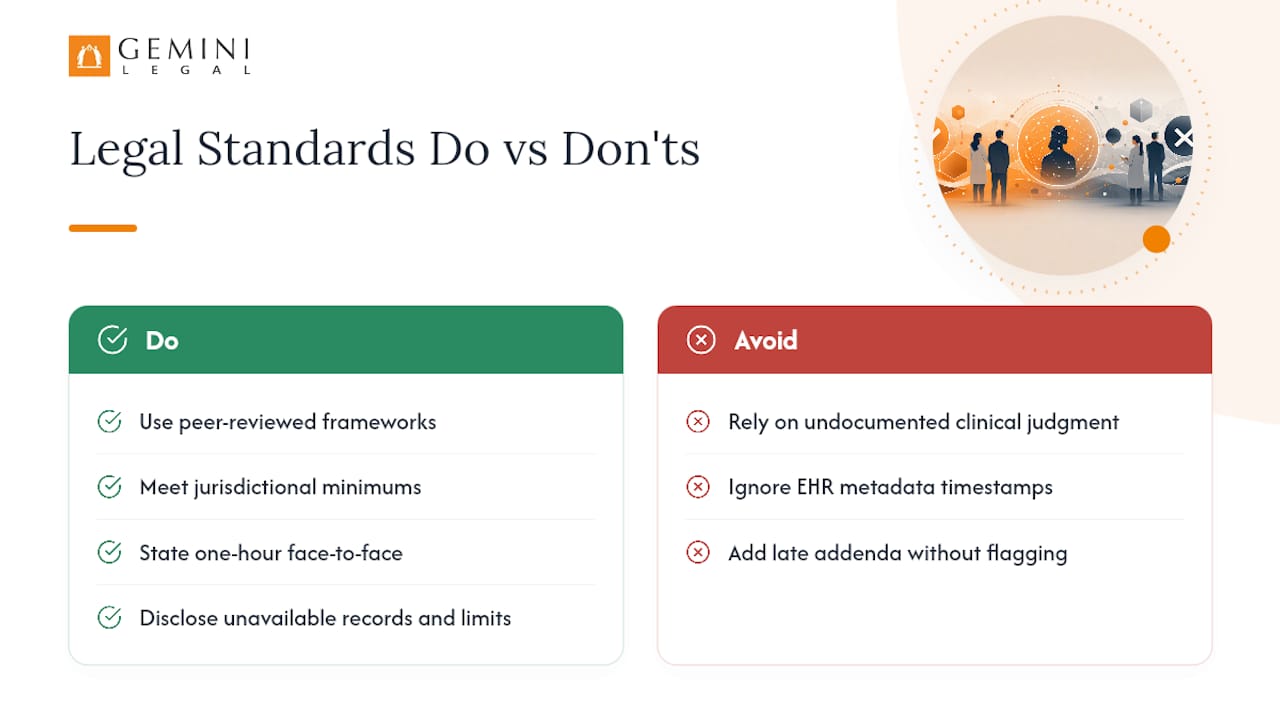
Admissibility challenges to forensic psychiatric opinions increasingly target the gap between a clinician's conclusion and the documented basis for it. Opinions grounded in peer-reviewed frameworks and exhaustive record review hold up better than opinions resting on clinical judgment alone; a peer-reviewed analysis of Daubert challenges to forensic evaluations conducted by telepsychiatry walks through the four reliability criteria courts apply, from testable methodology to known error rate. If your report can't show its work, it's exposed.
Jurisdictional minimums matter just as much as the science. California's QME regulations set a floor of one hour of face-to-face time for an uncomplicated psychiatric evaluation, and require the evaluator to state the face-to-face time actually spent and explain in detail any variance below that minimum. Method sits in a separate regulation: under 8 CCR §43, for claims on or after January 1, 2005, evaluating the psychiatric elements of impairment must include describing the employee's symptoms, social, occupational and where relevant school functioning, and the rationale for the impairment level assigned under the Permanent Disability Rating Schedule. Causation sits in the statute: Labor Code §3208.3 requires actual events of employment to be predominant as to all causes combined of the psychiatric injury. A report that skips any of those elements invites a supplemental request or a deposition ambush.
Metadata is the quieter risk. EHR systems log creation and modification timestamps, and those logs are routinely discoverable in malpractice litigation. A late-added addendum, especially one entered after a claim or lawsuit was filed, deserves scrutiny before you rely on it. Flag it, document when you noticed it, and consider whether it changes your chronology.
Every psychiatric QME report needs to state the face-to-face time actually spent, with a detailed explanation of any variance below the one-hour minimum. Beyond that regulatory floor, present uncertainty candidly. State what records were unavailable, what couldn't be corroborated, and how that shapes the confidence of your opinion. A report that acknowledges its limits is harder to attack than one that pretends to have none.
Building a Repeatable Review Workflow
A one-off review is fine for a single case. A repeatable workflow is what protects you across a caseload, and it's the difference between rebuilding your process every time and running a system that's already proven itself.
Start with intake: index every PDF, classify documents by type and source, and retain the originals untouched. Never work from a modified copy of the record.
From there, extraction and citation follow the same discipline described above, building toward a chronology, a nine-section narrative, and vitals and medications tables where every fact carries a page citation. Quality control comes next: standardized templates so a med-legal report and a peer review come back consistent every time, role-based review so a second set of eyes checks the work, and a metadata check on anything that looks like a late entry.
Export matters more than reviewers usually admit. An editable DOCX or PDF that carries the source page references through the conversion, so opposing counsel or a QME panel can land on the exact page behind a sentence, closes the loop between your narrative and your evidence.
- Intake: index, classify, preserve originals
- Extraction: chronology, narrative, vitals, and medications, all page-cited
- Quality control: templates, role-based review, audit trail, metadata checks
- Export: editable formats with source page references preserved
Indexed, page-linked platforms for psychiatric record review change where the time goes: verifying a clinical claim no longer means re-opening a 30,000-page PDF and searching by hand. That removes the manual cross-referencing pass, not the obligation to read the record.
Pro Tip: Ask any vendor how a citation actually works before you buy. "We cite our sources" and "click the citation, land on the exact page in a live PDF viewer" are very different products.
Where Behavioral Health Reviews Actually Go Wrong
Manual indexing is where most review time disappears. A paralegal or clinical reviewer flipping between a summary document and a 15,000-page PDF, trying to reconcile a claimed date with the actual chart entry, loses hours per file to work that a page-cited workflow removes.

Templates and citation discipline pay off hardest in deposition prep. When every sentence in your narrative already points to its source page, you're not scrambling the night before to rebuild your evidentiary trail. You're reading it off the report.
The accuracy of any indexed system still deserves scrutiny, and reviewers should ask vendors directly how citation placement is validated before trusting it on a contested case.
See a Page-Cited Behavioral Health Record Review in Action
ChartInsight™ turns a stitched-together, multi-provider psychiatric file into a chronology, a nine-section narrative, a normalized vitals table, and a medications table, with every extracted fact carrying a live citation back to its exact source page. Click a claim, and the original PDF opens right there in the app, at that page, so you're never downloading a file or losing your spot to double-check a clinical impression.
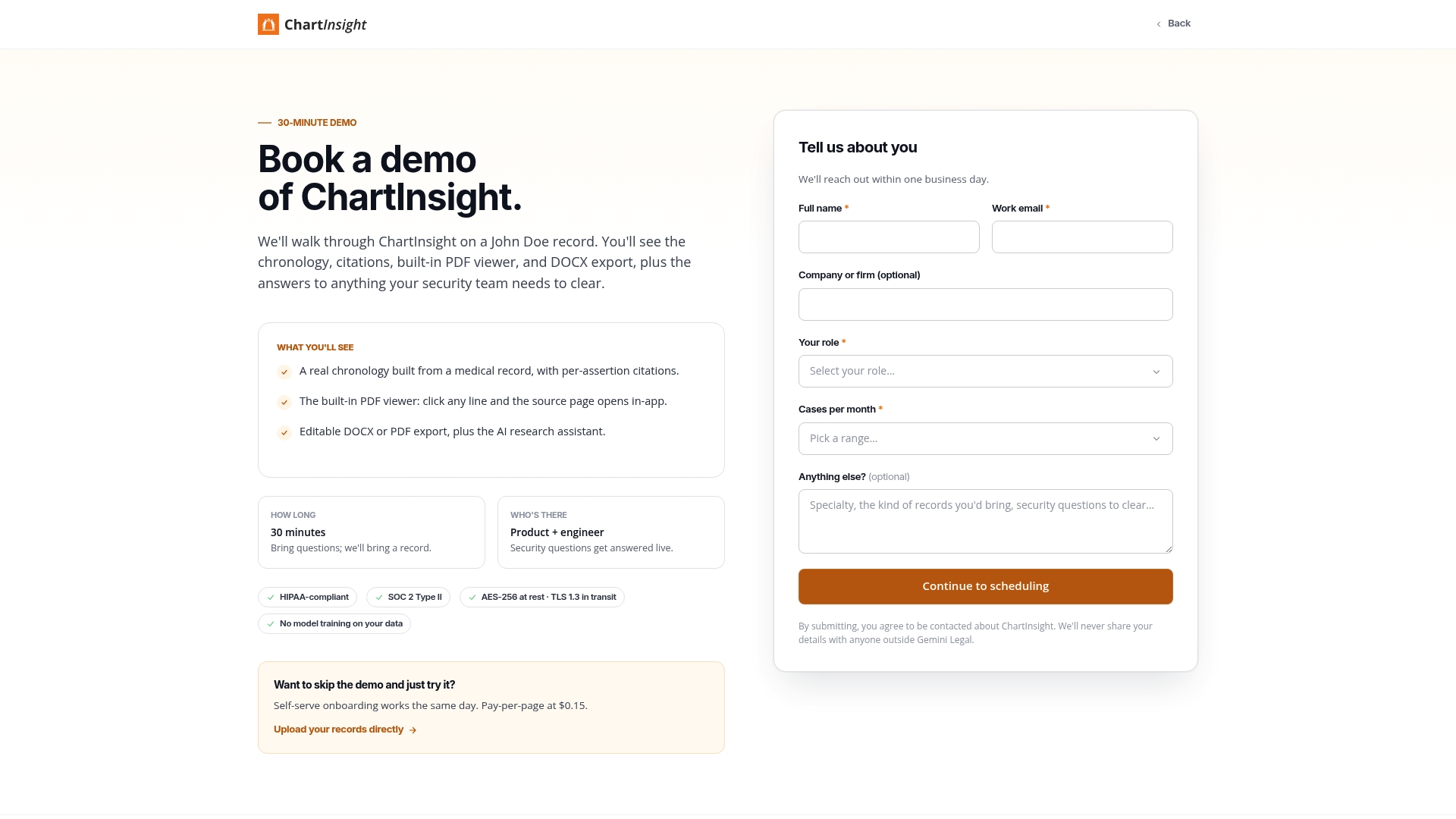
For attorneys handling personal injury record review or workers' comp psychiatric claims, the practical difference shows up in deposition prep time: instead of rebuilding your evidentiary trail from scratch, you're working from a report where the citations are already there. A demo walks through live PDF navigation to a cited page, a sample chronology, template options for med-legal versus peer review output, and an export sample with source page references intact. Book a demo to see how it handles a file like your current caseload.
If your case also touches broader mental-health legal exposure, a practice-side page such as Rubin Law's mental health practice offers practitioner context on how these evidentiary issues surface outside record review itself.
Sources
- 8 CCR §49.8, Psychiatric evaluation (California DIR)
- 8 CCR §43, Method of Measurement of Psychiatric Disability (California DIR)
- California Labor Code §3208.3, psychiatric injury
- Daubert Considerations in Forensic Evaluations by Telepsychiatry (PubMed)
- Reference Guide on Mental Health Evidence, Reference Manual on Scientific Evidence, 4th ed.
- Metadata, malpractice claims, and making changes to the EHR (Current Psychiatry, 2021)
This article is general information, not a substitute for advice from a qualified lawyer. Consult a qualified legal professional about your own circumstances before acting on anything here.
FAQ
What Is a Defensible Behavioral Health Record Review?
It's a page-cited chronology, nine-section narrative, and supporting tables where every clinical claim traces to an exact source page in the original record, allowing verification during discovery or deposition.
How Long Must a QME Spend Face-to-Face for a Psychiatric Evaluation?
California's QME regulations set a minimum of one hour face-to-face for an uncomplicated psychiatric evaluation, and require the report to state the face-to-face time actually spent and explain in detail any variance below that minimum.
Why Do Forensic Psychiatric Opinions Face Daubert Challenges?
Opinions unsupported by peer-reviewed frameworks or exhaustive record review are more vulnerable to Daubert-style admissibility challenges than opinions grounded in documented, citable evidence.
How Should Reviewers Handle Late-Added Record Entries?
Treat addenda or metadata showing late modifications as high-risk, document when you identified them, and consider whether they materially change your chronology or credibility assessment of the record.
Can Software Speed Up a Psychiatric Record Review?
Page-indexed platforms like ChartInsight™ generate citable chronologies, narratives, and tables with live links to source PDF pages, which removes the manual cross-referencing pass between a summary and the underlying record.