
Why Standardized Peer Review Templates Strengthen Clinical QA

Standardized peer review templates substantially increase consistency, objectivity, and legal defensibility in clinical peer review. If you are a QME, IME physician, or workers' comp attorney who needs reports that hold up under DWC scrutiny or cross-examination, the practical next step is to pilot a focused template on a single case type and track three metrics: percent-complete, inter-rater agreement, and time-per-review.
The benefits of standardized peer review templates are concrete and not theoretical:
- Consistency: Every reviewer addresses the same criteria, in the same order, every time.
- Objectivity: Fixed scoring anchors reduce unconscious bias and reviewer drift.
- Audit trail: Required evidence fields create a documented chain from finding to conclusion.
- Efficiency: Structured prompts cut time spent deciding what to address, not just how.
- Legal defensibility: Page-cited findings tied to the AMA Guides, MTUS, or DWC standards support cross-examination in ways narrative-only reports often cannot.
Key Takeaways
Standardized peer review templates improve consistency, reduce reviewer variability, and create the auditable evidence chain that makes clinical and medicolegal reports defensible under DWC, AMA Guides, and MTUS standards.
| Point | Details |
|---|---|
| Consistency and objectivity | Templates force all reviewers to address the same criteria, reducing variability and unconscious bias. |
| Pilot metrics to track | Measure percent-complete, inter-rater agreement, and time-per-review from the first pilot case type. |
| Defensibility chain | Page-cited findings tied to the AMA Guides or MTUS are harder to challenge than narrative-only opinions. |
| Design priority | Keep mandatory fields to the defensible minimum; require evidence pointers for every scored conclusion. |
| ChartInsight integration | ChartInsight produces page-cited, structured outputs that supply the evidence a template's fields require. |
Table of Contents
- What a standardized peer review template actually is
- Core fields every effective peer review template should include
- How templates improve consistency, objectivity, quality, and defensibility
- Design principles for an effective clinical peer review template
- How to implement templates: governance, training, and workflow integration
- Common pitfalls when adopting templates and how to avoid them
- A sample peer review template you can adapt today
- Medico-legal defensibility: why structured outputs amplify template value
- What reviewers actually experience when templates are introduced
- ChartInsight supports defensible, page-cited peer review outputs
- Sources
- FAQ
What a standardized peer review template actually is
A standardized peer review template is a structured form with required fields, objective scoring ranges, and open narrative areas that guide every reviewer to address the same clinical and methodological criteria. It is not a checklist that replaces judgment. It is a scaffold that prevents reviewers from skipping criteria they find inconvenient or simply forget under time pressure.
When to use one:
- Routine clinical QA: Mortality and morbidity reviews, utilization management, and quality committee evaluations.
- Medicolegal reports: QME, AME, and IME evaluations where findings must be traceable to specific record pages and aligned with recognized standards.
- Panel triage: Screening records across multiple reviewers to identify cases requiring deeper analysis.
- Structured journal-style reviews: Where inter-rater agreement and coverage breadth matter for editorial decisions.
Templates in clinical and medicolegal settings are typically aligned to the AMA Guides to the Evaluation of Permanent Impairment, MTUS clinical guidelines, and DWC procedural standards. Alignment to these frameworks is not optional when the output will be used in a California workers' comp proceeding or a personal injury dispute.
Core fields every effective peer review template should include
The fields below represent the minimum defensible set for a clinical or medicolegal peer review. Missing any one of them creates a gap an opposing attorney will find.
- Case ID and reviewer identity: Establishes chain of custody and reviewer role (QME, AME, IME, clinical peer reviewer).
- Review date and record date range: Confirms the reviewer saw the complete record through a specific cutoff.
- Concise clinical summary: A brief, factual statement of the claimant's condition, treatment history, and current status.
- Chronology pointer: A reference to the timeline of events, ideally with page citations to the source record.
- Standards invoked: Explicit notation of which guidelines govern the review (AMA Guides, MTUS, facility protocols).
- Objective criteria or scores: Numeric or categorical ratings with defined anchors (e.g., functional limitation on a 1 to 5 scale).
- Findings with page citations: Each clinical conclusion tied to the exact page in the medical record that supports it.
- Recommendation block: P&S status, MMI determination, apportionment notes, and any treatment recommendations.
- Evidence-to-conclusion mapping: A brief statement showing how the cited evidence leads to each conclusion.
| Field | Purpose | Example Entry |
|---|---|---|
| Case ID / Reviewer Role | Establishes identity and accountability | "Case #2024-0471 / QME, Orthopedic Surgery" |
| Standards Invoked | Anchors conclusions to recognized criteria | "AMA Guides 5th Ed., MTUS Low Back Chapter" |
| Findings + Page Citation | Creates auditable evidence chain | "L4-L5 disc herniation confirmed; MRI report p. 47" |
| Recommendation Block | Documents P&S, MMI, apportionment | "P&S reached 03/15/2025; 12% WPI; 40% industrial apportionment" |
| Evidence-to-Conclusion Map | Closes the logical gap for legal review | "Functional limitation rating of 3/5 based on FCE findings, p. 112" |
How templates improve consistency, objectivity, quality, and defensibility
The most direct benefit is reducing reviewer variability. When two QMEs evaluate the same record without a template, their reports often differ in structure, depth, and the criteria they choose to address. A template does not make them agree, but it forces them to address the same questions, which makes disagreements visible and traceable, rather than invisible.
Consistency is the foundation. In academic publishing, where structured review has been studied most closely, structured feedback forms make reviewer reports more consistent and produce comparable data points that help decision-makers reach clearer conclusions. The same logic applies in a DWC proceeding: a report that addresses causation, functional capacity, and apportionment in a predictable structure is easier to defend than one that buries those conclusions in unorganized prose.
Objectivity follows from anchored scoring. When a template defines what a "3 out of 5" functional limitation means, reviewers cannot silently apply different thresholds. That calibration is what reduces unconscious bias, not just reviewer goodwill.
Quality assurance improves because templates act as a coverage checklist. Reviewers who might otherwise skip a methodological criterion under time pressure are prompted to address it, and published implementation guidance turns a set of structured questions into a reusable checklist that review programs can adapt.
Legal defensibility is where templates earn their keep in medicolegal work. When a report's findings are tied to page-cited evidence and aligned to the AMA Guides or MTUS, an opposing attorney has a narrower surface to attack, because each conclusion points at a specific page of the record rather than at the reviewer's recollection of it. The dependence on documented evidence is not specific to California: practitioners working injury claims under Scottish procedure describe the same reliance on contemporaneous medical records and traceable evidence, under a completely different set of governing rules.
Key finding: In a structured peer review pilot, an analyzed sample of 107 manuscripts drawn from 23 Elsevier journals showed that 92% of reviewers answered every structured question, and absolute agreement on final recommendations reached 41% against a 31% historical baseline. The study was observational and not randomized, so it shows association rather than causation.
Design principles for an effective clinical peer review template
Getting the design right matters as much as adopting a template at all. A poorly designed template produces checkbox responses that satisfy the form but not the substance.
Prioritize high-value fields. Not every data point belongs in a mandatory field. Identify the five or six criteria that, if missed, would make a report indefensible, and make those required. Everything else can be optional.
Balance fixed-choice items with open narrative. Dropdown selections and numeric scales capture comparable data. But clinical reasoning that does not fit a scale needs space. A template without narrative fields produces reports that look consistent but say nothing a reviewer could not have generated by algorithm.
Anchor scoring labels to decision thresholds. A scale only works if reviewers interpret it the same way. For functional limitation, define what each point means:
- 1 = No limitation; full duty without restriction
- 2 = Mild limitation; modified duty, no heavy lifting
- 3 = Moderate limitation; sedentary work only
- 4 = Severe limitation; part-time capacity
- 5 = Total incapacity; no gainful employment
Tie those anchors to P&S and MMI thresholds so the score connects directly to the recommendation.
Map template fields to recognized standards. Each field should reference the AMA Guides chapter, MTUS guideline, or DWC rule it is designed to satisfy. That mapping is what allows a reviewer to say, in a deposition, exactly which standard governed each conclusion.
Pro Tip: Avoid "checkboxing" by requiring a one-sentence evidence pointer for every scored field. A reviewer who must cite a page number before submitting a score cannot simply click through the form. The narrative remains the primary source of clinical reasoning; the structured fields are its skeleton.
A Nature commentary argues that structured questions should direct reviewers to address methodological and analytical elements consistently while supporting, not replacing, expert judgment. That distinction is the difference between a template that produces defensible reports and one that produces defensible-looking forms.
How to implement templates: governance, training, and workflow integration
A template that sits in a shared drive and gets used inconsistently is not a template program. Implementation requires governance, not just a form.
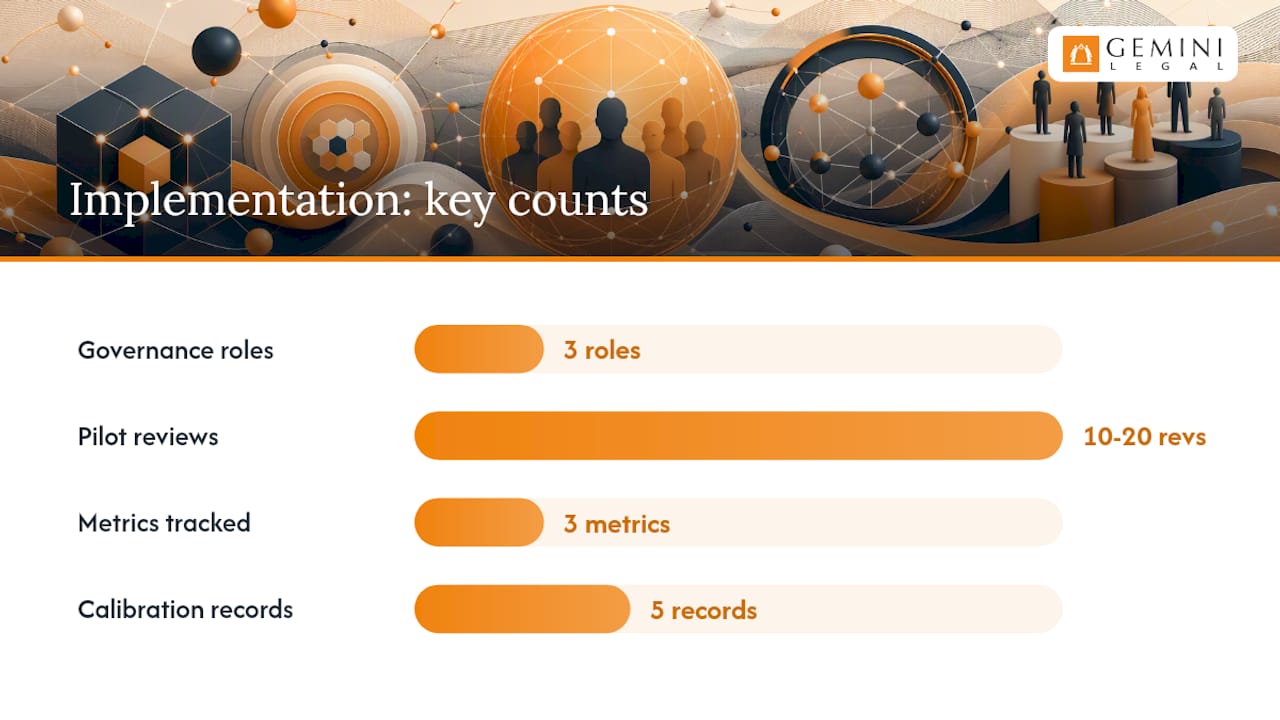
- Form a governance team. Include at least one QME or senior clinical reviewer, a legal or compliance representative, and an administrator who owns the workflow. This group approves template versions and owns the change log.
- Define objectives and scope. Decide which case types the template covers first. Workers' comp orthopedic QMEs are a natural starting point; psychiatric IMEs have different field requirements.
- Map existing workflows. Identify where the template fits: at intake, during review, or at report generation. Templates that interrupt a reviewer's natural process get abandoned.
- Pilot on a single case type. Run 10 to 20 reviews with the template before scaling. Collect three metrics: percent-complete (did reviewers fill every required field?), inter-rater agreement (do two reviewers score the same case similarly?), and time-per-review.
- Train reviewers with calibration exercises. Do not just distribute the template. Run side-by-side scoring sessions using five representative records. Reviewers who score the same record independently, then compare results, calibrate faster than those who read instructions alone.
- Collect metrics and iterate. After the pilot, adjust field labels, scoring anchors, or mandatory/optional designations based on what the data shows.
- Scale with version control. Every template version should carry a date stamp and a change log. When a report is challenged two years later, you need to know exactly which version of the template governed that review.
Pro Tip: Publish the structured questions to reviewers before they begin. Implementation guidance recommends informing reviewers early and placing structured questions prominently in the workflow to improve compliance and reduce ambiguity about expectations.
Digital templates and automated workflows let organizations centralize form management, automate reminders, and produce auditable records that feed directly into calibration sessions and compliance reporting.
Common pitfalls when adopting templates and how to avoid them
Most template programs fail at the same points. Knowing where they break is half the fix.
- Over-templating: Too many mandatory fields increase reviewer burden and produce superficial checkbox responses. Keep mandatory fields to the defensible minimum; make secondary fields optional but require an explanation when a key conclusion is reached.
- Reduced narrative richness: When reviewers focus on completing fields, they sometimes shorten or omit the clinical reasoning that makes a report credible. Mitigation: require a minimum-length narrative for any case where the recommendation differs from the treating physician's opinion.
- Reviewer resistance: Experienced QMEs and IMEs resist templates that feel like scripts. Present templates as navigational scaffolds, not substitutes for expertise. The framing matters. Reviewers who understand the template as a defensibility tool, not a constraint, adopt it faster.
- Inconsistent use: A template used by some reviewers but not others produces a mixed record that is harder to defend than no template at all. Governance and monitoring solve this; spot-check completion rates monthly.
- Unclear scoring anchors: Vague labels ("moderate," "significant") produce the same variability the template was designed to eliminate. Define every anchor with a concrete clinical or functional description.
A calibration-plus-audit workflow addresses most of these at once: run a quarterly calibration session where two reviewers score the same record independently, compare results, and document the reconciliation. That session also serves as a training record, which matters if the program is ever audited.
A sample peer review template you can adapt today
The outline below covers the essential fields for a clinical or medicolegal peer review. Adapt field types and scoring anchors to your case type before piloting.
| Field | Response Format | Example Entry |
|---|---|---|
| Case ID | Short text | "WC-2025-0847" |
| Reviewer Name / Role | Short text + dropdown | "Dr. J. Smith, QME, Orthopedic Surgery" |
| Review Date | Date | "April 10, 2026" |
| Record Date Range Reviewed | Date range | "January 2022 to March 2026" |
| Clinical Summary | Narrative (150 to 300 words) | "45-year-old male with L4-L5 disc herniation following industrial injury…" |
| Standards Invoked | Multi-select dropdown | "AMA Guides 5th Ed., MTUS Low Back, Lab. Code §4628" |
| Functional Limitation Score | Numeric scale (1 to 5 with anchors) | "3 (Moderate; sedentary work only, FCE p. 112)" |
| Causation Opinion | Dropdown + narrative | "Industrial causation: Yes. Basis: treating records pp. 14, 47, 89" |
| P&S / MMI Status | Dropdown | "P&S reached; MMI as of 03/15/2025" |
| Apportionment | Numeric + narrative | "40% industrial; 60% pre-existing DJD (AMA Guides 5th Ed., Ch. 15)" |
| Recommendation | Narrative | "No further treatment indicated; permanent restrictions apply" |
| Evidence Citation Block | Page-number list | "pp. 14, 47, 89, 112" |
California workers' comp reviewers should note two specifics in that table. Labor Code §4660 designates the AMA Guides 5th Edition for the injuries it governs, so a report invoking the 6th Edition invites an avoidable challenge. And §4628 is a Labor Code section, not a DWC regulation; it governs who may examine the injured employee and perform the nonclerical preparation of the report, and noncompliance carries admissibility consequences.
Optional extensions for specialty reviews:
- Psychiatric IME fields: DSM-5 diagnostic criteria checklist, GAF or WHODAS score, medication review table
- Personal injury fields: mechanism of injury narrative, prior condition comparison, future medical cost estimate
- Utilization management fields: MTUS/ODG guideline citation, requested vs. approved treatment comparison
Medico-legal defensibility: why structured outputs amplify template value
A well-designed template creates the conditions for a defensible report. But the template alone does not make a report defensible; the evidence behind each field does.
The mechanism is straightforward: when reviewers must answer the same questions and cite evidence for each answer, the resulting reports are more comparable and more auditable. That is what the structured peer review pilots observed, and it is the property that carries over into medicolegal work.
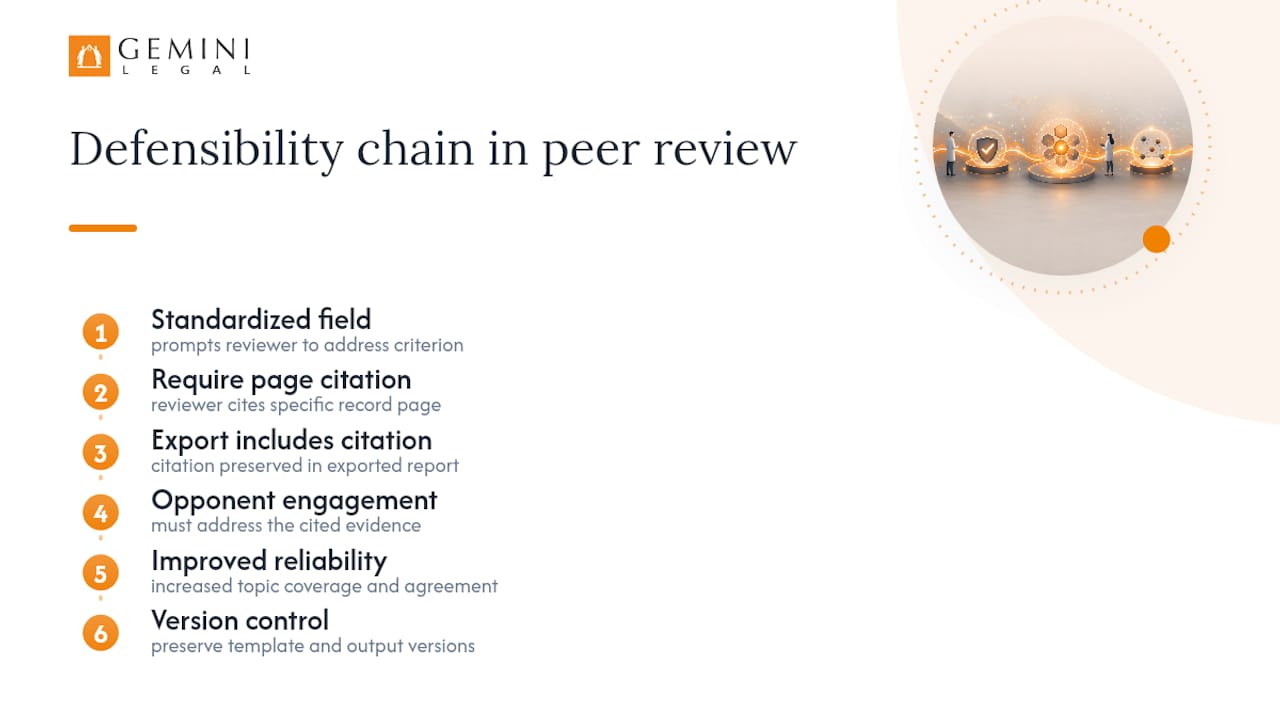
In DWC, AMA Guides, and MTUS contexts, the defensibility chain works like this: a standardized field prompts the reviewer to address a specific criterion, the reviewer cites the page in the record that supports their finding, and the report exports with that citation intact. An opposing attorney who challenges the finding must engage with the cited evidence, not just the reviewer's opinion. That is a materially different evidentiary position.
Key finding: The published evidence on structured review comes from academic publishing, not medicolegal practice. The mechanism transfers, but treat the reported figures as directional rather than as a benchmark for QME or IME work.
Consider a generic example: a QME report on lumbar impairment includes a standardized apportionment field requiring a page citation to the pre-existing condition evidence. The reviewer cites the treating physician's note on page 89 documenting degenerative joint disease predating the industrial injury. At deposition, the opposing attorney challenges the apportionment opinion. The reviewer points to page 89. The field and the citation are in the exported report. The challenge fails because the evidence chain is intact and documented.
Pro Tip: Preserve version control on every template and every output. When a report is challenged months or years later, you need to demonstrate that the template in use at the time of review was the approved version, and that the output reflects the record as it existed at review. Never alter the source record; document every revision to the template separately.
Workers' comp record review workflows that integrate page-cited extraction with standardized templates close the gap between what the template requires and what the record actually contains.
What reviewers actually experience when templates are introduced
Initial skepticism is nearly universal. QMEs and IMEs who have written reports the same way for fifteen years do not welcome a form that tells them what to address. The resistance is not irrational; experienced reviewers have internalized the criteria and resent the implication that they need a checklist.
What changes after calibration is the recognition that the template is not questioning their expertise. It is protecting their conclusions. A reviewer who has been cross-examined on a report that lacked an explicit apportionment citation understands immediately why the field exists.
The adoption strategy that works is presenting templates as navigational scaffolds and preserving open narrative sections for case-specific reasoning. Reviewers who feel the template constrains their clinical voice will find ways around it. Reviewers who see it as a defensibility tool adopt it and often improve it.
One actionable step: run a short calibration exercise with five representative records. Have two reviewers score each record independently using the template, then compare results in a structured discussion. Disagreements on scoring anchors surface immediately, and the discussion that follows is the most effective training you can provide. The goal is not perfect agreement; it is documented, reasoned disagreement that can be defended.
ChartInsight supports defensible, page-cited peer review outputs
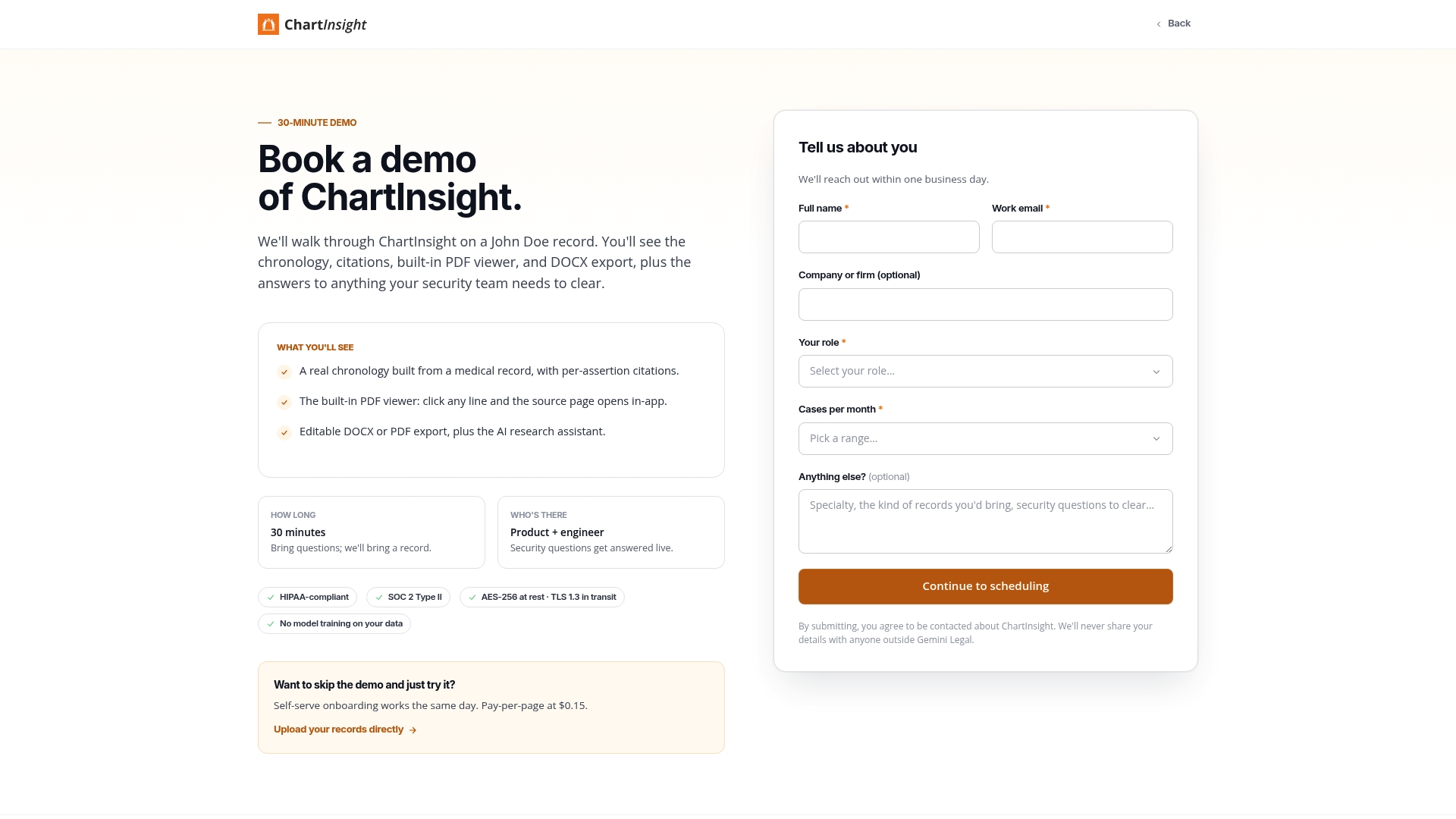
Peer review reports are only as defensible as the evidence behind them. ChartInsight processes full medical records, including sets running to tens of thousands of pages across multiple providers, and produces structured outputs: a chronology, a narrative summary (nine sections in the standard format, with different section sets for specialty formats such as orthopedic and psychiatric), a vitals timeline, a medications list, and any custom analyses your team has configured. Core outputs carry page-level citations, and clicking a citation opens the corresponding source page in the built-in viewer.
For peer reviewers and QMEs, that removes the mechanical work of assembling a chronology and hunting for the page behind each finding. It does not reduce the reviewer's obligation to review the record, and it is not meant to. It removes the assembly and citation labor that surrounds that review. Templates in ChartInsight let authorized team administrators configure reusable output presets for specific case types, so a workers' comp record review and a psychiatric expert review come back in consistent formats every time. Exports to DOCX or PDF keep the page citations intact, so the evidence chain survives the handoff to counsel or the hearing officer.
To see how ChartInsight fits your peer review workflow, book a demo.
Sources
- Structured peer review: pilot results from 23 Elsevier journals
- Structured peer review: implementation and checklist development
- Opinion: structure peer review to make it more robust
- How to implement structured peer review for better feedback
- California Labor Code §4628
- California Labor Code §4660
This article is general information, not a substitute for advice from a qualified doctor. Consult a qualified healthcare professional about your own circumstances before acting on anything here.
FAQ
What is a standardized peer review template?
A standardized peer review template is a structured form with required fields, objective scoring anchors, and open narrative sections that guide every reviewer to address the same clinical or methodological criteria. In medicolegal settings, fields are typically aligned to the AMA Guides, MTUS, or DWC standards.
What are the main benefits of standardized peer review templates?
The primary benefits are consistency across reviewers, reduced unconscious bias, improved coverage of required criteria, and a documented evidence chain that supports defensible conclusions in legal or regulatory proceedings.
What are the five key elements of an effective peer review template?
An effective template includes a case identification and reviewer role field, the standards invoked (AMA Guides, MTUS), objective scored criteria with defined anchors, findings tied to page citations in the source record, and a recommendation block covering P&S status, MMI, and apportionment.
How do peer review templates improve legal defensibility?
Templates require reviewers to cite the specific record pages supporting each conclusion and to align findings with recognized standards. That documented chain is what allows a reviewer to respond to cross-examination with evidence rather than opinion alone.
Which edition of the AMA Guides applies in California workers' compensation?
California Labor Code §4660 designates the AMA Guides to the Evaluation of Permanent Impairment, 5th Edition, for the injuries that section governs. A template built for California work comp should invoke the 5th Edition, not the 6th.
What is the golden rule of peer review?
The core principle is that structure should support expert judgment, not replace it. Templates direct reviewers to address required criteria consistently while preserving narrative space for case-specific clinical reasoning.