

TL;DR:
- AI medical record review platforms convert large, multi-provider record sets into structured chronologies and summaries. For workers' comp and med-legal work, the deciding feature is whether every output links back to the exact source page, so reviewers can verify each fact before relying on it.
AI medical record review uses natural language processing and large language models to turn unstructured medical records into structured, reviewable outputs: chronologies, summaries, medication lists, and flagged findings. Workers' comp attorneys, adjusters, QME and IME physicians, and personal injury attorneys all face the same bottleneck: records that run thousands of pages and must be summarized accurately before a claim, a report, or a deposition can move forward. This guide explains how these platforms work, where they fit, and how to evaluate them for legal and medical-legal use.
What is AI medical record review and how does it work?
AI medical record review applies language technology to unstructured clinical data. A platform reads raw clinical text, including physician notes, lab results, imaging reports, and operative summaries, and converts that content into structured outputs usable in claims, litigation, and med-legal workflows. Scanned and handwritten pages first go through optical character recognition (OCR), so OCR quality directly affects everything downstream.
Domain context matters. Workers' comp and med-legal records use vocabulary such as permanent and stationary (P&S) status, apportionment, and AMA Guides impairment ratings. A general-purpose summarizer may handle that vocabulary unevenly, so test any platform on records from your own practice area.
Core capabilities to expect include:
- Automated data extraction from multi-provider record sets, pulling diagnoses, treatment dates, medications, and functional limitations into a structured format
- Chronology building that orders encounters by date and provider
- Summarization that condenses records into narrative outputs aligned with legal and med-legal workflows
- Question answering over the record, ideally with answers tied to cited source pages
Pro Tip: AI can automate extraction and summarization, but QME and IME physicians still need to verify apportionment conclusions against the AMA Guides. No AI platform replaces the physician's independent medical judgment on causation.
How do AI medical record tools differ?
Platforms in this space generally fall into three functional tiers:
| Feature category | Entry-level tools | Mid-tier platforms | Enterprise platforms |
|---|---|---|---|
| Record ingestion | Single-provider PDFs | Multi-provider bundles | Large multi-provider record sets |
| Output format | Plain text summary | Structured sections | Citable, exportable reports |
| Citation tracking | None | Page references | Live source PDF linking |
| Customization | None | Template selection | Custom templates and prompts |
| Target user | General reviewer | Claims adjuster | Attorney, QME, IME physician |
The table shows where many tools fall short for legal and medical-legal work: citation tracking and customization. A summary without page citations is hard to rely on in a DWC proceeding or a deposition. Attorneys and QME physicians need to point to the exact page in the original record, not just a paragraph in an AI summary.
Pro Tip: When evaluating any AI medical record platform, ask specifically whether citations link back to the source PDF page. If they do not, every fact in the output has to be re-located by hand before it can be relied on.
What are the practical applications for legal and medical-legal professionals?
AI summarization can shorten the first pass through a large record considerably. That matters most in high-volume environments, where a team handling many claims per month cannot spend days on manual organization for every file. The full record still needs professional review; the AI output organizes it and points to where each fact lives.

For QME and IME physicians, a structured chronology surfaces the clinical timeline before the evaluation begins. A psychiatrist conducting an evaluation on a cumulative trauma claim needs to know every prior psychiatric diagnosis, every medication change, and every gap in treatment before writing the report. A page-cited chronology organizes that information rather than leaving the physician to reconstruct it from a disorganized PDF stack.
For workers' comp and personal injury attorneys, the value is different but equally concrete. Attorneys need to identify inconsistencies between treating physician notes and IME or QME conclusions. They need to flag dates when the claimant reported improvement versus dates when they sought additional treatment. Finding those inconsistencies by hand in a very large record takes a long time; automated extraction gives the reviewer a structured starting point.
Common professional tasks these platforms address:
- Identifying MMI and P&S dates across multiple treating providers
- Extracting medication histories
- Summarizing prior claims and pre-existing conditions
- Flagging apportionment-relevant diagnoses for QME and AME reports
- Producing structured chronologies for deposition preparation
- Supporting peer review workflows for utilization review decisions
The citation accuracy of any AI output is one of the most important factors for legal defensibility. A summary that cannot be traced to a specific page in the source record is a starting point, not evidence. Platforms that produce page-cited outputs give attorneys and physicians a document they can verify and use.
How should professionals evaluate an AI medical record platform?
Vendor size, funding, and awards say little about whether a platform will work on your records. Evaluate the output instead:
- Citations. Does every chronology entry, summary statement, and extracted value link to the exact source page?
- OCR quality. How does the platform handle scanned, photocopied, and handwritten pages?
- Domain fit. Does the output correctly capture P&S dates, work status, and apportionment-relevant history?
- Customization. Can your team configure templates for QME reports, peer reviews, or deposition summaries?
- Security. Will the vendor sign a HIPAA Business Associate Agreement, and does it hold an independent audit such as SOC 2 Type II?
- Data use. Does the vendor use your records, prompts, or outputs to train its models?
- Exports. Can outputs be exported in editable formats with citations preserved?
Key Takeaways
AI medical record platforms can shorten the first pass through a large record, but legal defensibility depends on whether outputs carry page-level citations back to the source record.
| Point | Details |
|---|---|
| Core function | NLP-based extraction and summarization of complex medical records for legal and med-legal use |
| Citation accuracy is non-negotiable | AI output used in legal proceedings should link to the exact source page in the original record |
| Test on your own records | A known closed file reveals more than a sales demo |
| Platform selection criteria | Prioritize citation tracking, OCR quality, customization, and security over general summarization |
Lessons from evaluating AI medical record tools
A common pattern is that a team adopts an AI summarization tool, is impressed by the speed, and then discovers that the output is hard to use in a deposition or a DWC hearing because nothing links back to the source.
Speed is a real benefit, but speed without defensibility is a liability. An attorney who relies on an AI-generated summary without page citations gives opposing counsel an easy line of attack.
The key test is whether the citation is live: not a page number typed into a summary, but a clickable reference that opens the exact page in the original PDF. That feature is the difference between a tool that helps a team work faster and one that also helps it defend what it wrote.
Before committing to any platform, run a test case on a record the team already knows well. Compare the AI output against the team's own conclusions. If the platform misses a P&S date or misclassifies a pre-existing condition, that says more than any sales demo.
ChartInsight™: page-cited medical record review for legal professionals
Medical-legal teams who need citation-backed AI outputs have an option in ChartInsight™, built by Gemini Legal for reviewers who defend every line they write.
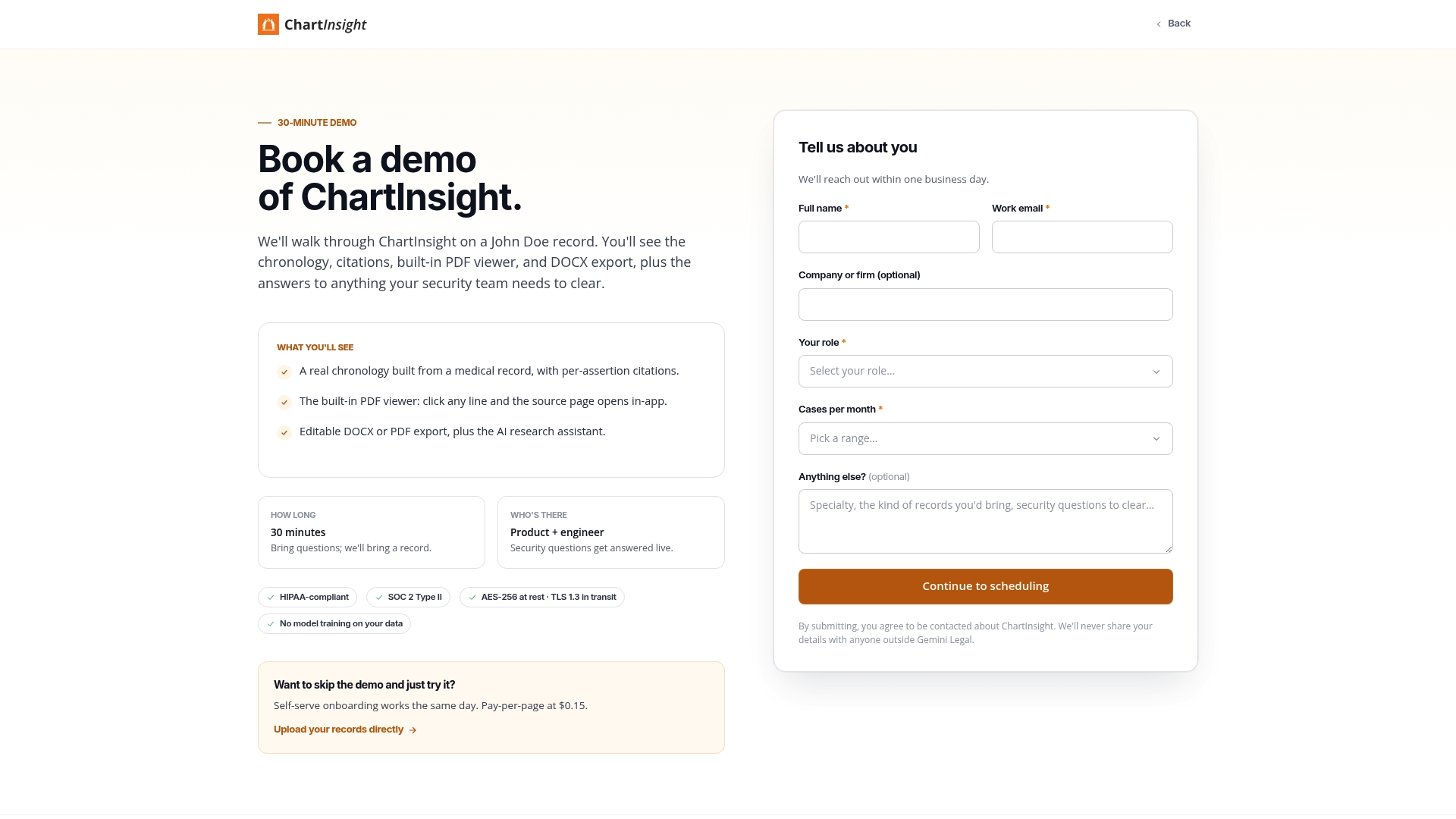
ChartInsight™ takes full medical records, often thousands of pages across multiple providers, and produces a structured chronology, a narrative summary, extracted vitals, and a medications table. Chronology entries, summary statements, and medication entries carry live page citations that open the source page in the built-in PDF viewer. The Research Assistant answers questions about the record with cited answers, custom templates keep outputs consistent across matters, and exports to editable DOCX or PDF keep the citations intact. ChartInsight™ operates under a HIPAA-compliant program with executed BAAs, holds SOC 2 Type II, and does not use customer records, prompts, or outputs to train AI models. Teams can also run psychiatric record reviews with the same citation-backed structure. To see how it handles a real record, book a demo.
FAQ
What does AI medical record review do?
It uses natural language processing to analyze, summarize, and extract structured data from complex medical records, producing chronologies and summaries that reviewers then verify.
Does AI medical record review replace physician or attorney judgment?
No. AI organizes the record and points to where each fact lives. Causation, apportionment, and legal strategy remain professional judgments.
Why do page citations matter in AI medical record summaries?
A summary without page citations forces reviewers to re-locate every fact before relying on it in DWC proceedings, depositions, or QME reports. Page citations allow attorneys and physicians to verify every claim against the original source record.
What should I ask a vendor before buying?
Ask whether every output is page-cited, how OCR handles handwritten and scanned pages, whether the vendor signs a BAA and holds SOC 2 Type II, whether customer data is used for model training, and whether you can test the platform on your own records.