

Duplicate medical records occur when a single patient ends up with two or more active records in the same system, splitting their history across files that never talk to each other. The consequence is not administrative housekeeping. Fragmented charts mean missed lab results, medication and allergy gaps, and, according to a 2026 multi-hospital cohort study, higher odds of adverse outcomes including ICU-level care and in-hospital death. This article covers why duplicates form, what they cost, and how to detect and fix them.
TL;DR:
- Duplication rates vary widely across institutions, from as low as 0.16% to over 15%, largely depending on registration discipline and system architecture.
- Duplicate records are associated with higher odds of adverse outcomes, including 4.7-fold higher odds of in-hospital mortality and 32% longer hospital stays in a 2026 propensity-matched cohort study.
- Effective detection combines exact (deterministic) matching at registration and probabilistic matching for retrospective review, with governance overseeing thresholds and adjudications.
- Preventing duplicates involves tightening registration controls, implementing prompts for near-matches, and conducting routine back-end audits to catch legacy cases.
- Proper consolidation requires maintaining an audit trail, citing original sources, and using specialized tools to generate unified, defensible records suitable for legal and clinical review.
Table of Contents
- What Are Duplicate Medical Records and How Common Are They?
- Why Duplicate Patient Files Keep Getting Created
- What Duplicate Charts Cost in Clinical Outcomes and Dollars
- How Health Systems Detect and Measure Duplicate Records
- A Prioritized Playbook for Preventing and Fixing Duplicates
- Rolling Out a De-Duplication Program: Checklist and KPIs
- Consolidating Duplicate Records for Defensible Medical-Legal Review
- The Real Lesson Buried in the Duplicate-Records Data
- See How ChartInsight™ Handles Consolidated, Cited Records
- Sources
- FAQ
What Are Duplicate Medical Records and How Common Are They?
Duplication rates vary widely by setting, but the number practitioners cite most often comes from a large urban academic medical center, where researchers found a duplication rate of 2.9% across the patient population. That figure sounds small until you multiply it across a hospital system processing hundreds of thousands of encounters a year.
Rates swing much wider once you look across institutions rather than within one. A BMJ Quality & Safety analysis of matching identifiers found that duplicate indicator rates ranged from 0.16% to 15.47% depending on the site, even after standardizing on first name, last name, and date of birth as the matching fields. That spread is not noise. It reflects real differences in registration discipline, system architecture, and how aggressively each organization hunts for duplicates in the first place.
Three forces drive most of that variability:
- EHR platform and configuration. Some systems enforce strict identity checks at registration; others let staff create a new record with a single click when a search returns no exact hit.
- Mergers and acquisitions. Every hospital merger, clinic acquisition, or health system consolidation imports a second (or third) master patient index that was never designed to reconcile with the one already in place.
- Population served. Transient populations, shared surnames, and patients who lack a stable address or phone number are harder to match reliably, which raises duplication odds regardless of how good the software is.
The same large-center study also found that duplicate records were more likely among patients with missing race or ethnicity data, Hispanic ethnicity, Black race, older age, more comorbidities, and more encounters. Duplication is not evenly distributed, and the study's authors note it concentrates in populations that already face barriers to consistent care.
Why Duplicate Patient Files Keep Getting Created
Most duplicate patient files trace back to one of four failure points, and identifying which one dominates in your system determines which fix actually works.
- Registration errors at intake. A misspelled last name, a transposed digit in a date of birth, or a nickname entered instead of a legal name is often enough for a matching algorithm to miss an existing record and create a new one. Self-registration kiosks and online portals make this worse, since patients themselves may enter inconsistent name variants or skip fields they consider optional.
- Legacy MRNs surviving a system merge. When two organizations combine, each brings its own medical record number scheme. Unless someone actively cross-references and merges those indexes, the same patient carries two live MRNs indefinitely, one from each legacy system.
- Missing or inconsistent demographic fields. Name variations (maiden name versus married name, middle initial present or absent), incomplete Social Security numbers, and typos in date of birth all weaken the fields that matching engines rely on. A record missing two of five key identifiers is far more likely to spawn a duplicate than one with a full demographic set.
- Weak matching logic across interoperability channels. Referrals, lab interfaces, and health information exchange feeds each push new patient data into a system. If the matching logic on that inbound channel uses looser criteria than front-desk registration does, it can silently create duplicates that no human ever sees at the point of entry.
Pro Tip: Run a quick audit of your last 100 newly created patient records and check how many share a date of birth and partial name match with an existing record. If more than a handful turn up, your front-end matching logic needs tightening before you invest in back-end cleanup tools.
Interoperability is the culprit that catches most administrators off guard. It is easy to lock down your own registration desk and still bleed duplicates through every external feed connected to your EHR, because each connection was configured by a different vendor at a different time, often with no shared standard for what counts as a match.
What Duplicate Charts Cost in Clinical Outcomes and Dollars
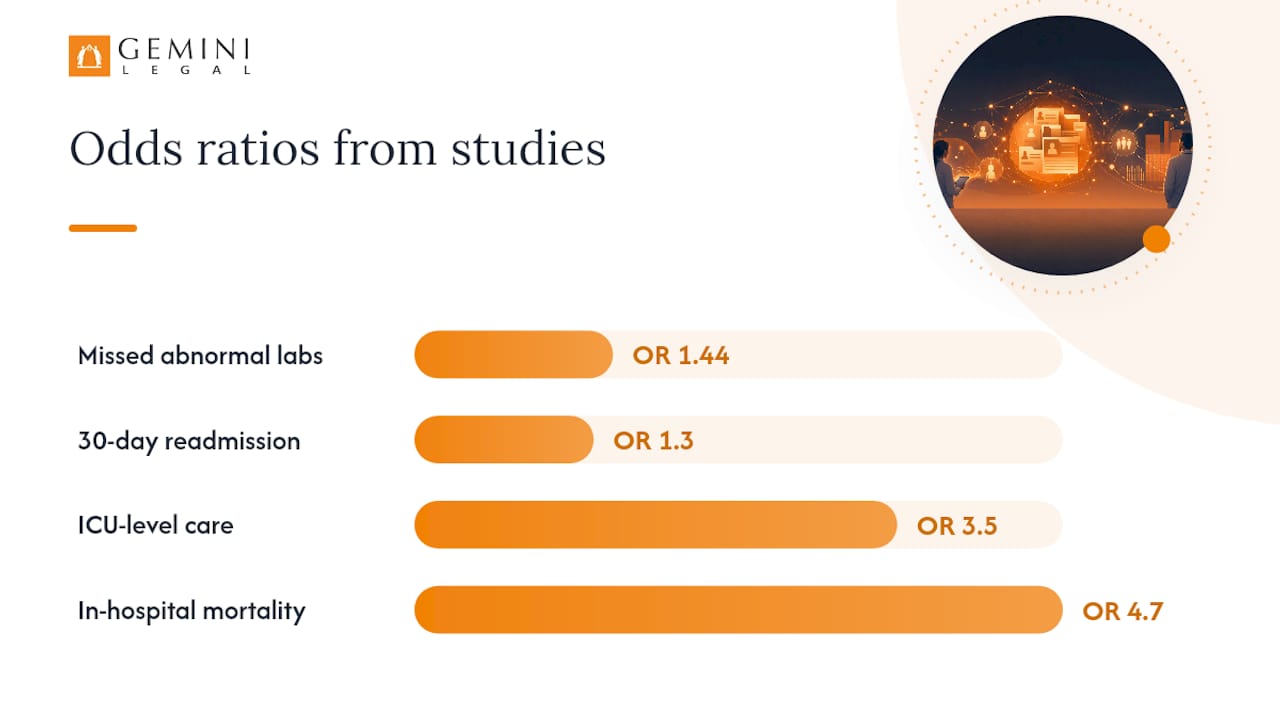
The clinical evidence on duplicate charts is no longer theoretical. A retrospective matched cohort study of outpatient laboratory results found that abnormal results were missed in 36% of duplicate-record cases versus 28% of matched non-duplicate cases, an odds ratio of 1.44 (95% CI 1.1 to 1.9). That gap exists because a critical value posted to the "wrong" copy of a patient's chart never reaches the clinician who is actively managing that patient's care.
A 2026 propensity-matched cohort study across 12 hospitals in one health system raised the stakes further. After matching 1,698 duplicate-chart inpatients to 4,388 comparable single-chart inpatients, researchers found duplicates associated with:
- 30-day readmission, odds ratio 1.3
- ICU-level care, odds ratio 3.5
- In-hospital mortality, odds ratio 4.7
- Length of stay, roughly 32% longer
Those numbers describe real inpatients, not a hypothetical worst case. The authors caution that an observational design cannot prove duplicates caused the outcomes, and the study comes from a single health system. Even so, an odds ratio of 4.7 for mortality is the kind of finding that should reframe duplicate records as a patient-safety metric tracked alongside falls and medication errors, not a data-quality footnote.
Operationally, the fallout is just as tangible. Duplicate charts drive redundant testing when a clinician cannot find a recent result and orders it again. They generate billing errors when claims split across two accounts under the same patient. They corrupt quality reporting, since a patient counted twice in a denominator skews every rate calculated from that population. And they slow care coordination at every handoff, because a specialist pulling "the chart" may be pulling only half the story.
The equity dimension compounds all of it. Because duplication odds run higher among patients with missing demographic data and among Black and Hispanic patients in the large-center study, the populations most exposed to a missed lab result or a fragmented medication list may also be the populations most likely to have a duplicate in the first place.
How Health Systems Detect and Measure Duplicate Records
Every serious de-duplication effort runs on a Master Person Index (MPI), the system of record that assigns one unique identifier per patient and tracks every alias, legacy MRN, and demographic variant tied to that identity. A well-maintained MPI is what lets a hospital merge two charts without losing the audit trail of how that merge happened and who approved it.
Detection itself splits into two approaches:
- Deterministic matching compares exact fields, typically first name, last name, and date of birth, and flags a match only when those fields align precisely. It is fast and easy to explain, but brittle: a single typo defeats it. The BMJ Quality & Safety study found that adding date of birth to name matching sharply reduced apparent duplicate rates, which shows how much a single well-chosen field can improve deterministic accuracy.
- Probabilistic matching assigns a weighted score across many fields (name, DOB, address, phone, partial SSN) and flags anything above a threshold as a likely match, even when no single field matches exactly. This catches more true duplicates but requires careful threshold-tuning to avoid false positives that merge two different patients into one record, a much more dangerous error than leaving a duplicate unresolved.
Systems built on FHIR-based data stores increasingly support explainable probability scoring alongside qualitative risk fields and "Do-Not-Match" lists, so a reviewer can see exactly why the algorithm flagged a pair as a possible match rather than trusting a black-box score.
The other key distinction is timing. Front-end matching happens at the moment of registration, before a duplicate is ever created, and is the cheapest place to prevent the problem. Back-end matching runs retrospectively against records that already exist, catching what front-end controls missed. Measurement programs need both, because front-end controls alone will never catch legacy duplicates already sitting in the database, and back-end audits alone will let the problem keep growing in real time.
A Prioritized Playbook for Preventing and Fixing Duplicates
Fixing duplicate records is not one project. It is four layers of control that reinforce each other, and skipping the front-end layer guarantees the back-end team never catches up.
- Tighten front-end registration controls first. Require a minimum demographic set (full legal name, date of birth, and at least one of SSN or phone) before a new record can be created, and standardize the search script every registration staffer follows before creating a new patient.
- Add match prompts and Do-Not-Match lists to the registration interface. When a search returns a near-match, the system should force a visible comparison screen rather than letting staff bypass it, and it should remember pairs that were already reviewed and confirmed as different people.
- Run batch detection on the back end on a fixed schedule. The CDC's de-duplication best-practices report, written for immunization information systems but applicable to any patient index, describes retrospective review as a distinct, ongoing process alongside real-time and incoming-record matching, because new duplicates accumulate continuously through every registration channel and every external data feed.
- Route every flagged pair through human adjudication with a documented audit trail. The CDC report recommends formally documenting all facets of the de-duplication process, including the business rules for each matching step, and every adjudication decision should log which fields were compared, the rationale for the decision, and the final disposition.
- Assign governance ownership and review KPIs on a cadence. Someone, typically a health information management director, needs formal authority over match thresholds, adjudication rules, and change control whenever the EHR vendor updates matching logic.
Pro Tip: Never let batch merges run unattended. Even a well-tuned probabilistic matching engine will occasionally propose a false match, and an unreviewed automatic merge is how two different patients end up sharing one chart, which is far more dangerous than the duplicate it was trying to fix.
Retaining original, unmerged records after adjudication (rather than deleting them outright) preserves the ability to reverse a bad merge decision and supports any later audit of how the consolidation happened.
Rolling Out a De-Duplication Program: Checklist and KPIs
Start with a baseline: run a one-time audit to establish your current duplication rate before changing anything, using the same matching fields you intend to use going forward. Pilot new front-end controls in one registration area before rolling out system-wide, and write a formal adjudication standard operating procedure before your back-end batch detection produces its first list of flagged pairs.
Four KPIs deserve a permanent spot on a health information management dashboard:
| KPI | What it tracks | Why it matters |
|---|---|---|
| Duplication rate | Percentage of active records identified as duplicates | Baseline for progress and cross-institution comparison |
| Adjudication backlog | Number of flagged pairs awaiting human review | Signals whether staffing matches detection volume |
| Duplicate-linked safety events | Missed labs or care gaps traced to a duplicate chart | Ties the program directly to patient-safety outcomes |
| Time-to-resolve | Days from flag to final adjudication decision | Measures whether the program is keeping pace with new duplicates |
Report these quarterly to a governance committee with real authority to fund fixes, and assign one accountable owner, not a shared responsibility that no one actually tracks.
Consolidating Duplicate Records for Defensible Medical-Legal Review
For QME and AME evaluators, workers' comp attorneys, and IME physicians, a duplicate chart is not just a data-quality problem. It is a risk to the defensibility of whatever report gets built from that record. The governing principle is logical consolidation, never deletion. A reviewer needs every source page preserved with its provenance intact, because a missing allergy entry or a contradicted medication date can become the basis of an apportionment dispute under the AMA Guides or a challenge during deposition.
A defensible review of a duplicated or merged record should produce:
- A unified chronology that reconciles conflicting dates across both source files
- Normalized vitals and medications pulled from every duplicate, not just the most recent one
- Page-level citations back to the exact source document for every extracted fact
- An audit trail showing which record each data point originated from
This is the gap ChartInsight™ is built to close for reviewers working large, multi-provider productions. It builds a citable chronology and a nine-section narrative summary across every PDF uploaded to the record, including files that arrived separately from different providers, and every fact carries a live citation back to the exact page, viewable inside the app without downloading a separate file. Reports export to editable DOCX or PDF with those citations preserved, so the cross-referencing work happens against cited source pages instead of side-by-side printouts.
The Real Lesson Buried in the Duplicate-Records Data
Most guidance on duplicate medical records treats it as an IT hygiene problem, something for the health information management department to quietly clean up in the background. The outcomes data does not support that framing. An odds ratio of 4.7 for in-hospital mortality is not a rounding error in a quality report. It belongs in the same conversation as medication reconciliation and fall prevention, reviewed by the same patient-safety committees that track those metrics.
The conventional advice also overweights technology and underweights governance. Probabilistic matching engines and MPI platforms matter, but the BMJ Quality & Safety finding that potential-duplicate rates swung from 0.16% to 15.47% across institutions using the same matching fields suggests that process discipline, rather than software sophistication, explains much of the gap. A hospital with mediocre matching software and a strict adjudication SOP will likely outperform one with excellent software and no one accountable for reviewing the flagged list.
For reviewers, the priority is different but related: stop assuming a "complete" record is complete. Duplicate charts hide evidence in plain sight, split across files that were never designed to be read together. Consolidate logically, cite everything, and never destroy the paper trail that lets someone check your work later.
See How ChartInsight™ Handles Consolidated, Cited Records
If your review workflow still means printing two duplicate charts side by side and manually reconciling which lab result belongs where, ChartInsight™ gives reviewers a faster, more defensible path through the same problem.
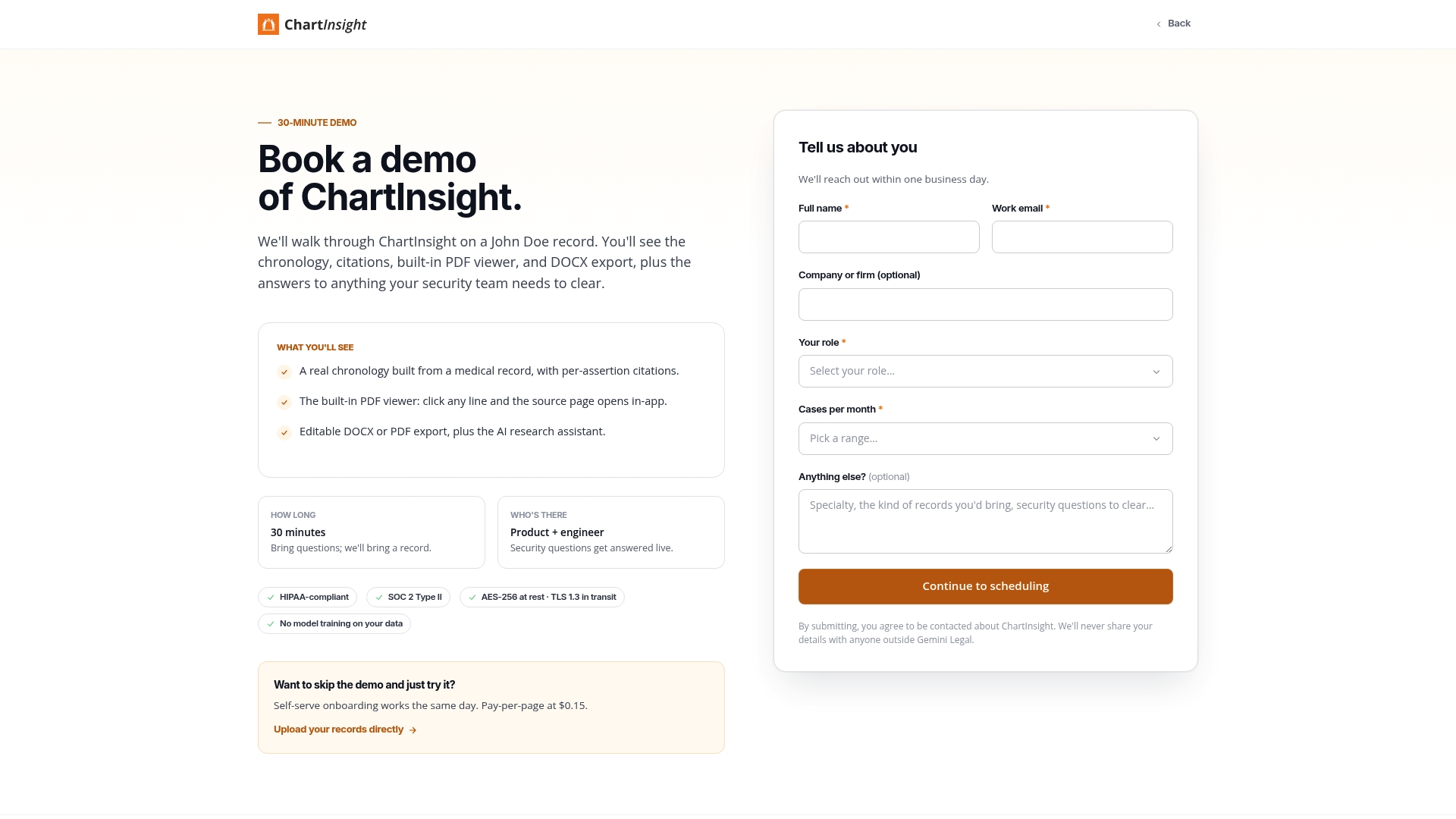
ChartInsight™ takes the full record, whether it arrives as one clean PDF or a stack of files from three different providers, and produces a unified chronology, a nine-section narrative summary, normalized vitals across ten measures, and a medications table. Every extracted fact carries a live citation back to its source page, and clicking that citation opens the underlying PDF inside the app, so nothing gets verified by memory alone. For workers' comp, personal injury, and QME record reviews of large, multi-provider productions, the goal is a faster path to a report that keeps the page-level citation trail intact. If your caseload includes psychiatric records with entries scattered across behavioral-health providers, the same citation-preserving workflow applies to those files too.
Book a demo to see how ChartInsight™ handles a record with known duplicate entries and how the citation trail holds up under review.
Sources
- Epidemiology of Patient Record Duplication (PMC)
- Matching identifiers in electronic health records: implications for duplicate records and patient safety (BMJ Quality & Safety, 2013)
- The effect of duplicate patient records on missed abnormal laboratory results (PMC)
- De-duplication best practices report (CDC, 2025)
- Double trouble: a propensity-matched cohort study evaluating the associations between duplicate medical records and patient outcomes (BMJ Quality & Safety, 2026)
- Individuals' Right under HIPAA to Access their Health Information (HHS)
FAQ
What Is a Duplicate Medical Record?
A duplicate medical record is a second (or third) active file created for a patient who already has an existing record in the same system, usually caused by a registration mismatch, a legacy MRN from a merged system, or a weak matching rule on an inbound data feed.
Can You Request Medical Records From 20 Years Ago?
Retention periods vary by state and provider type, but most healthcare organizations retain records well beyond typical statutory minimums, so a written request to the provider's health information management department is the right first step even for decades-old care.
Can a Doctor Refuse to Give Me a Copy of My Medical Records?
Under the HIPAA right of access, a provider generally cannot refuse a patient's request for their own records except in limited circumstances such as psychotherapy notes, though they can charge a reasonable, cost-based fee and may require the request in writing.
Can You Get Copies of Your Own Medical Records?
Yes. Patients have a legal right to obtain copies of their own medical records, and under HIPAA providers must generally respond within 30 days (with one 30-day extension permitted), though duplicate or fragmented records at multiple facilities may mean submitting more than one request to get a complete picture.
How Do You Fix Duplicate Records Once They Are Found?
Fixing duplicate records requires adjudicating the flagged pair against documented business rules, consolidating the data into one active record while preserving the original source files, and logging the merge decision in an audit trail; platforms like ChartInsight™ support this for reviewers by keeping every fact page-cited back to its original document throughout that process.