

A malpractice case is a lawsuit alleging that a professional, usually a physician or attorney, breached an accepted standard of care and caused compensable harm. The landmark cases below set the doctrines that govern every claim filed today: Canterbury v. Spence (informed consent), Helling v. Carey (standard of care), the Libby Zion case (resident supervision), the Dalkon Shield litigation (mass tort and product liability crossover), and the Johns Hopkins/Dr. Nikita Levy scandal (institutional liability). Newer cases like Sozomentou v. Arfaras and Estate of Fischel v. Mujic show how those doctrines play out today.
- Informed consent doctrine: Canterbury v. Spence
- Standard-of-care obligations: Helling v. Carey
- Supervision and systemic reform: the Libby Zion case
- Mass tort and product liability overlap: the Dalkon Shield litigation
- Institutional failure and vicarious liability: Johns Hopkins/Dr. Nikita Levy
- Modern consultation liability cases: Sozomentou v. Arfaras, Estate of Fischel v. Mujic, Anonymous N.P. v. Anonymous Physician
Nearly every one of these cases turned on the same gatekeeper: expert testimony. Courts require a "case-within-a-case" showing that the breach, not just a bad outcome, caused the harm. The National Practitioner Data Bank and the AMA Guides to the Evaluation of Permanent Impairment remain the reference points reviewers return to when building that causal chain.
Key Takeaways
Malpractice liability turns on four provable elements, duty, breach, causation, and damages, and nearly every landmark case above exists because a court clarified how one of those elements gets proven.
| Point | Details |
|---|---|
| Causation is the hardest element | Courts require a case-within-a-case showing the breach, not just a bad outcome, caused the harm. |
| Expert reports must avoid net opinions | Link the breach to a specific record entry and model the counterfactual outcome to survive summary judgment. |
| Coordination failures drive recent verdicts | The $15 million Oh v. Jeffries award turned on a care team's failure over 11 days to recognize a lymphatic fluid leak, not one isolated error. |
| Chain-of-custody matters in pathology claims | Mislabeled samples can shift liability across lab staff and treating clinicians alike. |
| ChartInsight supports defensible chart review | Page-cited chronologies and a live PDF viewer keep every extracted fact one click from its source page, with citations preserved on export. |
Table of Contents
- Landmark Malpractice Cases at a Glance
- What the Landmark Cases Actually Held
- The Legal Elements Every Case Above Illustrates
- How to Put These Cases to Work in Your Records
- Recent Verdicts and What Actually Drove the Payout
- How This List Was Built
- A Reviewer's Take on Prioritizing These Cases
- Where ChartInsight Fits Into Record Review
- Primary Sources for Further Research
- Sources
- FAQ
Landmark Malpractice Cases at a Glance
The table below groups the cases most frequently cited in litigation and law school casebooks by jurisdiction, doctrine, and outcome. Dollar figures are stated only where a public verdict or settlement record exists.
A few data points stand out against that backdrop. The 2026 Fulton County verdict in Oh v. Jeffries awarded a veteran's family $15 million after jurors found the treatment team failed to recognize and investigate a prolonged lymphatic fluid leak. The Dalkon Shield bankruptcy trust remains among the largest mass tort resolutions tied to a single medical device. The Johns Hopkins settlement, a $190 million payout, stands among the largest institutional malpractice settlements on record for patient privacy and psychological harm combined.
- Diagnostic delay and coordination failures dominate recent high-value verdicts, not single dramatic errors.
- Institutional cases increasingly settle on vicarious liability theories rather than individual negligence alone.
- Product liability and malpractice claims converge whenever a device, not just a clinician's judgment, is implicated.
What the Landmark Cases Actually Held
Each of these cases did more than resolve one dispute. They rewrote a rule that governs how attorneys plead claims and how reviewers build the medical record chronology behind them.
Canterbury v. Spence established that a physician's duty to disclose risk is measured by what a reasonable patient would want to know, not by what other physicians customarily disclose. The D.C. Circuit rejected the "professional standard" for consent and adopted a patient-centered test. In essence, the doctrine of informed consent arises from the patient's right to self-determination, and disclosure obligations flow from what a reasonable patient in the plaintiff's position would deem material to a treatment decision.
That single holding still shapes every informed consent claim filed today. For reviewers, it means chart review should flag not just whether consent was signed, but whether the documented conversation covered risks a reasonable patient would find material, not just the risks the treating physician personally considered significant.
Helling v. Carey did something rarer: it let a jury impose a standard of care stricter than customary medical practice. An ophthalmologist failed to test a 32-year-old patient for glaucoma because the standard practice at the time didn't recommend testing under age 40. The Washington Supreme Court held that compliance with custom doesn't automatically satisfy the legal duty of care when a cheap, simple test could have prevented blindness.
- Custom is evidence of the standard of care, not a ceiling on it.
- Courts can and do impose liability even when a defendant followed accepted protocol.
- Reviewers should document whether a low-cost, low-risk diagnostic step was skipped despite being clinically available.
The Libby Zion case never reached a jury verdict on the malpractice claim itself, but its aftermath changed graduate medical education nationwide. An 18-year-old died in a New York hospital after being treated by overworked, under-supervised residents. Her father's advocacy led directly to New York's Bell Commission regulations limiting resident work hours, a framework later adopted in modified form by the Accreditation Council for Graduate Medical Education. For litigators, Libby Zion remains the template for supervision and staffing negligence claims: was the treating team appropriately staffed and supervised for the acuity of the patient?
The Dalkon Shield litigation blurred the line between product liability and medical malpractice. A. H. Robins Company's intrauterine device caused pelvic infections, infertility, and deaths in thousands of patients, but the litigation also implicated prescribing physicians who failed to warn patients or monitor for complications. The case forced A. H. Robins into bankruptcy and created a claimants' trust that paid out billions. For reviewers, it's the clearest historical example of how a device defect and a clinician's failure to monitor can generate overlapping claims against multiple defendants.
The Johns Hopkins/Dr. Nikita Levy scandal tested how far institutional liability extends when an employee commits misconduct the institution didn't directly order or condone. Levy, a gynecologist, secretly photographed and recorded patients over years. Johns Hopkins settled with more than 8,000 patients for $190 million. The settlement carries a practical lesson: institutions face exposure for inadequate oversight of staff conduct even absent direct knowledge of wrongdoing.
Modern cases follow the same doctrinal skeleton with sharper factual detail. In Sozomentou v. Arfaras, a patient with a missed aortic dissection died the evening of admission; the jury awarded $6.4 million and apportioned fault across the emergency physician (80%), the inpatient provider (18%), and the radiologist (2%), a reminder that every provider who performs an affirmative act in the chain of care carries exposure. Estate of Fischel v. Mujic turned on a communication failure: a cardiologist's ECG read consistent with myocardial infarction never changed the emergency physician's discharge decision, and the emergency physician settled for $2 million while the consultant was not held liable. Anonymous N.P. v. Anonymous Physician addressed consultant liability, holding that an ENT physician who gave orders by phone (nothing by mouth, next-morning follow-up) performed an affirmative act that established a physician-patient relationship even though he never saw the child.
A related emergency medicine case series indexed on PubMed Central walks through three consultation-related malpractice scenarios that pair clinical facts with the legal reasoning courts applied, useful reading for anyone drafting an expert report involving ED handoffs. Reviewers building chart chronologies for similar claims should treat consultation timing and documented communication between providers as decisive evidence, not a formality.
The Legal Elements Every Case Above Illustrates
Every malpractice claim, medical or legal, rests on the same four elements, and each landmark case above maps to at least one of them cleanly.
- Duty: The professional owed the plaintiff a recognized standard of care (illustrated in Helling v. Carey).
- Breach: The professional's conduct fell below that standard (illustrated by the discharge decision in Estate of Fischel v. Mujic).
- Causation: The breach, not some other factor, proximately caused the harm (illustrated in Sozomentou v. Arfaras and Oh v. Jeffries).
- Damages: The plaintiff suffered actual, provable harm (illustrated in the Johns Hopkins settlement).
This four-element framework holds for legal malpractice claims as much as medical ones, and a breach must cause actual financial harm; an unfavorable outcome or frustrating conduct alone is not malpractice, according to Justia's overview of legal malpractice law. Causation is where most cases live or die, and it's where the "case-within-a-case" requirement comes in: a plaintiff suing a surgeon for a botched procedure must essentially prove the underlying medical facts as if trying that claim inside the malpractice trial itself. A legal malpractice plaintiff suing a former attorney for blowing a filing deadline must prove the underlying case they lost would have succeeded.
That's why expert testimony isn't optional in practice, it's structural. A 2026 New Jersey appellate opinion in a legal malpractice case reinforced that courts routinely grant summary judgment against plaintiffs whose expert reports offer conclusory "net opinions" rather than specific, record-tied explanations of how the breach caused the loss. An expert who writes "the standard of care was violated" without connecting that violation to a documented, counterfactual outcome gives a defense attorney an easy motion to dismiss.
Punitive damages sit apart from this four-element structure. They're governed by separate tort principles and generally require proof of willful or reckless conduct beyond ordinary negligence, a distinction worth checking against Cornell Law School's summary of punitive damages before assuming any negligence claim automatically opens the door to them.
Pro Tip: When drafting or reviewing an expert report, insist on language that names the specific record entry showing the departure from standard of care, then models what the patient's outcome would likely have been absent that departure. Reports that skip the counterfactual step read as net opinions, and net opinions get struck.
How to Put These Cases to Work in Your Records
Reading a landmark opinion is one thing. Turning it into usable litigation or review strategy is another. Here's a workflow that holds up whether you're a plaintiff's attorney, a defense paralegal, or a QME building a P&S report.
- Narrow the legal issue first. Identify whether the case turns on informed consent, standard of care, causation, or supervisory liability before searching for precedent, so you're not wading through irrelevant holdings.
- Confirm controlling jurisdiction. Canterbury v. Spence's patient-centered standard is not universal; some states follow it, while others still apply a professional-community standard.
- Extract the holding language precisely. Quote the operative rule, not the case's factual summary, when citing it in a pleading or expert report.
- Map record facts to each element. Walk the medical chronology against duty, breach, causation, and damages, flagging the specific page where each element finds support.
- Structure the expert report to bridge breach and outcome. Avoid conclusory statements; cite the exact chart entry and describe the counterfactual outcome explicitly.
- Primary opinions and dockets remain the authoritative source for holding language.
- PubMed and NCBI indexes supply clinical case literature for cross-referencing standards of care.
- The NPDB analysis tool helps surface a practitioner's disciplinary history relevant to pattern-of-negligence arguments.
- Firm-published verdict archives track settlement ranges for damages valuation.
Pro Tip: In pathology-related claims, chain-of-custody documentation, accession logs, and specimen transfer records are often the single most decisive evidence in the file. A mislabeled sample can shift liability from the treating physician onto lab personnel entirely, so pull those logs before you finalize your theory of the case.
Recent Verdicts and What Actually Drove the Payout
Large verdicts rarely come from a single dramatic mistake. They tend to come from a chain of missed follow-ups that a jury can see clearly in hindsight.
- Oh v. Jeffries ($15 million, 2026): A Fulton County jury apportioned 67.5% of fault to the attending physician and 32.5% to the radiologist who placed an abdominal catheter, after roughly 87 liters of lymphatic fluid drained over 11 days without the care team recognizing the leak that led to the veteran's death. The trial coverage emphasized coordination failure across the treatment team.
- Johns Hopkins/Dr. Nikita Levy ($190 million settlement): Institutional failure to supervise, paid as a class settlement across more than 8,000 patients.
- Pathology labeling error, unnecessary hysterectomy (suit filed 2026): A tissue sample allegedly mislabeled as belonging to a Georgia patient led to a 2025 cancer misdiagnosis and unneeded hysterectomy; the negligence suit, filed in 2026, names the health system and lab technicians, illustrating how lab chain-of-custody failures can generate exposure spanning both lab staff and treating clinicians.
Jury apportionment matters as much as the topline number. In states applying comparative fault, a jury can find a defendant 70% responsible and reduce the award accordingly, or bar recovery entirely under modified comparative fault rules if the plaintiff's own share of fault crosses a state threshold. Damage caps complicate this further. Several states cap noneconomic damages in medical malpractice cases, which shapes how malpractice liability insurance carriers price risk and how plaintiffs' attorneys value a case before trial.
How This List Was Built
Case selection prioritized doctrinal impact over sheer verdict size. A case earned a spot if it established or clarified a rule still cited in litigation today, appeared in a published court opinion or peer-reviewed clinical case series, or represented a recent high-profile verdict with public court records.
- Published court opinions and appellate decisions with citable holding language
- Peer-reviewed clinical case series indexed on PubMed or PubMed Central
- News reporting that links directly to court filings or verdict records
- Verdict and settlement archives maintained by litigation firms
- NPDB analytics for practitioner-level disciplinary context
Cases were excluded if no public opinion, settlement record, or credible court reporting existed, or if the jurisdictional relevance was too narrow to generalize into a usable doctrine for practitioners outside that state.
A Reviewer's Take on Prioritizing These Cases
Working through medical records for litigation, the pattern that jumps out isn't dramatic surgical error, it's the paper trail around coordination. The cases that hold up on appeal and the verdicts that survive post-trial motions almost always come down to whether someone can point to a specific chart entry showing the breach and connect it to the outcome without guessing. Chase causation before you chase drama, collect contemporaneous records early, and flag pathology or lab chain-of-custody entries the moment you see them, because those get lost fastest and matter most. Every citation in an expert report should point back to an exact page. Unsupported net opinions don't survive summary judgment, and they shouldn't survive your own internal review either.

Where ChartInsight Fits Into Record Review
Building the case-within-a-case timeline described above usually means paging through thousands of records from multiple providers, hunting for the one operative note or nursing flow sheet entry that proves causation. ChartInsight was built for exactly that grind.

It converts a full medical record, often tens of thousands of pages stitched together from multiple providers, into a structured chronology, a nine-section narrative summary, and normalized vitals, with every extracted fact carrying a live citation back to the exact source page. Reviewers open the cited PDF page inside the app instead of hunting through a separate file. Exports come back as editable DOCX or PDF with the citations preserved for the final report. A litigator preparing a personal injury record review or a QME building a P&S report can use the tool to map the medical timeline directly against the elements an expert opinion needs to satisfy, then verify each fact against the source page before it goes into a report anyone will cross-examine. If you review records for a living, book a demo and see how the citation trail holds up against your own chart review workflow.
Primary Sources for Further Research
- Legal Malpractice | Justia: the four-element framework and case-within-a-case causation standard.
- Malpractice | Cornell Law School WEX: concise doctrinal definitions for outlining claims.
- Punitive damages | Cornell Law School WEX: when punitive damages apply beyond ordinary negligence.
- PubMed Central emergency department case series: clinical facts paired with legal analysis.
- NPDB analysis tool: practitioner disciplinary history for background research.
- PubMed search index: clinical case literature for standard-of-care context.
For expert witness preparation specifically, the Florida guide to medical expert witness testimony and this overview of expert witness standards both walk through qualification requirements worth reviewing before you retain or challenge an expert.
This article is general information, not a substitute for advice from a qualified lawyer. Consult a qualified legal professional about your own circumstances before acting on anything here.
Sources
- New Jersey appellate opinion (2026) on expert testimony standards
- Three cases of emergency department medical malpractice involving consultations | PMC
- Malpractice | Cornell Law School WEX
- Georgia jury awards $15M in med mal trial over patient's death following lymphatic fluid leak | CVN
- Labeling mix-up led to unneeded hysterectomy, lawsuit says | AP News
FAQ
What are some famous malpractice cases?
Canterbury v. Spence, Helling v. Carey, the Libby Zion case, the Dalkon Shield litigation, and the Johns Hopkins/Dr. Nikita Levy scandal are the most widely cited landmark cases in American malpractice law.
Is it worth it to sue for medical malpractice?
It depends on whether you can prove all four elements, duty, breach, causation, and damages, with expert testimony connecting the breach to a specific harm; claims lacking a clear causal chain are routinely dismissed on summary judgment.
What are four examples of malpractice?
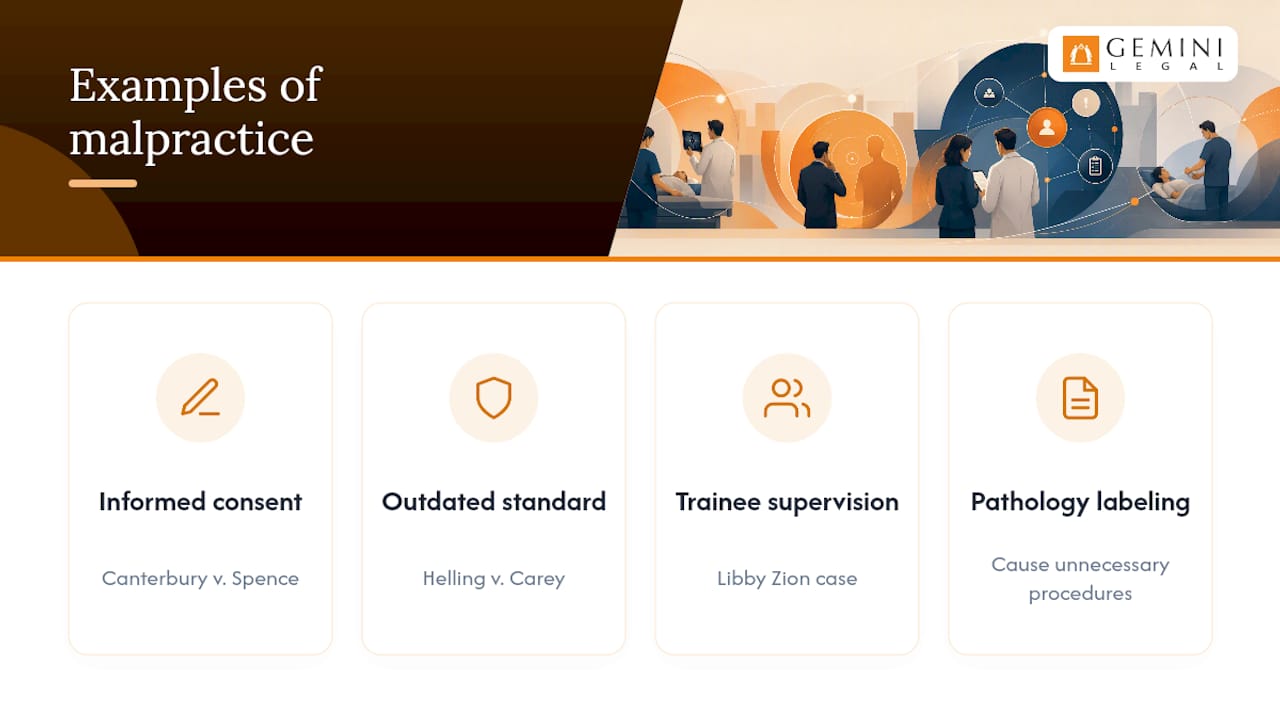
Failing to obtain informed consent (Canterbury v. Spence), applying an outdated standard of care (Helling v. Carey), inadequate supervision of trainees (the Libby Zion case), and pathology labeling errors that cause unnecessary procedures.
What happens when doctors make mistakes?
Consequences range from internal peer review and licensing board reports to civil malpractice lawsuits, and the National Practitioner Data Bank tracks reportable actions against a physician's record over their career.
How does ChartInsight help attorneys use case law in practice?
ChartInsight page-cites every extracted fact in a medical record chronology, so attorneys can map a case's holding directly to specific chart entries when building an expert report or pleading.