

Use a date-ordered table (ISO YYYY-MM-DD) with these columns: Date, Provider, Event Type, Description, Key Findings, Treatment, Citation, Exhibit. A defensible chronology also needs a cover page, a provider index, an exhibit list, and a page-level citation on every single row. Skip any of those four and the document reads as a summary, not evidence.
TL;DR:
- A strict chronological order is best for contested injury or causation cases, while provider-based grouping helps isolate specific treatment arcs.
- Every chronology row must use ISO date format, full provider names, fixed event types, factual descriptions, and precise citations to ensure defensibility.
- Building a comprehensive record involves collecting, indexing, normalizing data, extracting events, logging gaps, and final QA, which can be streamlined with AI tools.
- Conflicting findings should be documented neutrally, with missing records flagged separately, and rows marked pending to keep the timeline complete.
- The ChartInsight™ platform automates extraction with live citations, maintains consistency, and expedites production for complex, multi-provider medical records.
Table of Contents
- What Is a Medical Chronology, and When Should It Be Chronological vs. Provider-Based?
- What Fields Belong in Every Chronology Row?
- How Do You Build a Medical Chronology Step by Step?
- What Table Format and Export Options Work Best?
- How Should You Handle Conflicting Findings and Missing Records?
- What Should a Final Quality Check Cover Before Delivery?
- How ChartInsight™ Supports Defensible Chronology Workflows
- Rules of Thumb Every Reviewer Should Know
- Book a Demo: See ChartInsight™ on an Actual Chronology
- Sources
- FAQ
What Is a Medical Chronology, and When Should It Be Chronological vs. Provider-Based?
A medical chronology is a factual, date-ordered extraction of events from a medical record, built so a reviewer can trace every clinical fact back to its source page without re-reading the underlying chart. It is not a narrative medical summary. A narrative summary interprets: it groups findings by body system, draws conclusions about causation, and often carries clinical opinion. A chronology does neither. Blurring that line is one of the more common mistakes in legal chronology templates, and it undermines the neutrality that gives a chronology its evidentiary value in the first place.
Ordering depends on what the case needs:
- Strict chronological order works for the vast majority of personal injury and workers' comp files, especially where causation and injury progression are contested.
- Provider-based grouping (sub-chronologies nested inside a master timeline) helps when a claimant saw ten specialists and counsel needs to isolate one provider's treatment arc, such as an orthopedic surgeon's post-op course, separate from psychiatric treatment.
- Hybrid approach: build the master chronology strictly by date, then generate provider-filtered views as needed rather than maintaining two competing formats.
What Fields Belong in Every Chronology Row?
Every row needs the same fields, populated the same way, every time. Inconsistency here is exactly what turns a chronology into a liability during deposition. Inconsistent date formats, missing citations, and untracked missing records are the defensibility failures that surface most often when a chronology is challenged in litigation review.
- Date: ISO format (YYYY-MM-DD) only. Mixed formats (03/04/25 vs. 3-Apr-2025) sort incorrectly and create ambiguity between US and international date conventions.
- Provider: the treating clinician's full name plus credential, standardized once and used identically throughout (Dr. Maria Chen, MD, not "Chen" in one row and "Dr. M. Chen" in another).
- Event type: pick from a fixed taxonomy: office visit, ER visit, imaging, surgery, PT session, psych eval, QME exam, IME exam. Free-text event types make filtering unreliable.
- Description: one factual sentence describing what occurred, no adjectives, no inference.
- Key findings: objective results only (range of motion, imaging impression, lab value, GAF score).
- Treatment: medication, procedure, or referral ordered at that visit.
- Citation: document name or file ID, page number, and bundle reference, in that order.
Diagnoses deserve their own discipline. Transcribing "lumbar strain" when the chart says "lumbar radiculopathy" is a coding error, not a style choice, and the FY 2026 ICD-10-CM coding guidelines are the reference point for getting the diagnostic language right before it goes into a report a QME will read line by line.
Pro Tip: Build your event-type taxonomy before you start extracting, not while you're extracting. Retrofitting categories into 400 rows halfway through a 3,000-page record costs more time than it saves.
How Do You Build a Medical Chronology Step by Step?
A chronology is a five-step build, and skipping straight to extraction is the single fastest way to end up redoing work.
- Collect and index the record. Request records with a documented, compliant authorization for each disclosure, as required by the HIPAA Privacy Rule at 45 CFR 164.508. Name files consistently (Provider_DateRange_PageCount.pdf) before anyone opens them.
- Normalize dates and providers, then build a master index. Every provider gets one canonical name. Every date gets converted to ISO format at intake, not at export.
- Extract one event per row with a precise citation. Resist the urge to merge a two-day hospital stay into one row "for space." Each documented encounter gets its own line.
- Log gaps and conflicts as you go. Don't try to resolve a contradiction in the chart while you're still extracting. Flag it, cite it, keep moving.
- Finalize, QA, and export. Add the cover page, provider index, and exhibit list, then run the full defensibility check before delivery.
What this looks like in practice on a mid-size file:
- Intake and indexing: half a day for a 2,000-page record with reasonable organization.
- Extraction: the bulk of the time, and where AI-assisted tools cut days down to hours.
- Gap logging and QA: usually underestimated, budget real time for it.
- Final formatting and export: an hour or two once the data is clean.
What Table Format and Export Options Work Best?
The column order matters more than most reviewers assume, because it controls how fast a QME or opposing counsel can scan a 300-row table. The sequence used in most published chronology templates is Date, Provider, Event Type, Description, Key Findings, Citation, with Treatment and Exhibit added for litigation-heavy files. A sample row: 2024-11-03 | Dr. A. Rivera, MD | Imaging | Lumbar MRI ordered following continued radicular pain | L4-L5 disc herniation, mild central canal stenosis | Referral to neurosurgery | Bates 00412.
Format choice depends on record size:
- Word table: fine under roughly 50 rows, where formatting control matters more than sortability.
- Spreadsheet: better for anything larger, since sorting, filtering, and pivoting by provider or event type only works reliably in a spreadsheet or purpose-built chronology tool.
- Purpose-built chronology software: worth it once a record exceeds a few hundred pages or involves more than five providers, mainly because manual page-citation tracking breaks down at that scale.
Templates that embed bundle and page-level citation fields directly into each row save reviewer time during trial prep, because every citation maps to a location someone can actually reproduce months later. When exporting to DOCX or PDF, confirm citations survive the conversion, bookmarks still jump to the right section, and exhibit numbers match the bundle your opposing counsel received. Nothing kills credibility faster than a chronology that cites "Exhibit 14" when the produced bundle only goes to Exhibit 12.
How Should You Handle Conflicting Findings and Missing Records?
Conflicting entries in the chart are common, and the temptation to quietly resolve them in the chronology is exactly what a reviewer should resist. A neutral chronology documents the conflict, it doesn't adjudicate it.
- When two providers document different injury mechanisms on the same date, list both entries and mark the row "conflicting." Do not choose which one is "correct."
- Pre-existing conditions get their own entries, with explicit language distinguishing aggravation of a prior condition from a new injury, since apportionment analysis under the AMA Guides depends on that distinction being documented, not inferred.
- Missing records go into a deficiency log separate from the main table, listing the requested document, the date requested, the provider, and a follow-up date.
- Rows waiting on outstanding records get marked "pending" rather than left blank, so nobody mistakes an incomplete chronology for a finished one.
Following up on a deficiency log every 10 to 15 business days keeps outstanding requests from disappearing into the file indefinitely, which matters most when a deposition or QME deadline is already on the calendar.
What Should a Final Quality Check Cover Before Delivery?
Run this checklist before anything goes to opposing counsel, a QME, or an AME:
- Every date is in ISO format, no exceptions, no mixed formats slipping through from a rushed entry.
- Every provider name matches the master index exactly, character for character.
- Every row has a citation with a page number, not just a document name.
- A random sample of 10 to 15 rows gets manually spot-checked against the source PDF.
- The reviewer who ran QA signs and dates the sign-off, on the document itself.
- The exhibit list and provider index are complete and match the bundle actually produced.
Pro Tip: Spot-check the rows extracted late in a session, not just the first ten. Extraction accuracy tends to drift after several hours of manual review, and that's where citation errors cluster.
How ChartInsight™ Supports Defensible Chronology Workflows
Everything above describes what a reviewer has to enforce manually across a multi-thousand-page record: consistent dates, standardized provider names, a citation on every row, a clean export. ChartInsight™ builds those requirements into the extraction itself rather than leaving them to a post-hoc QA pass.
Every fact pulled into a chronology carries a live citation back to the exact page it came from. Clicking it opens the source PDF inside the live viewer, so a reviewer confirms a claim without downloading a file or losing their place in a 4,000-page record. Teams set up Templates and a Prompt Library so a personal injury chronology and a QME-facing summary come back in the same structure every time, regardless of which reviewer ran the extraction. That consistency is what a solo paralegal manually rebuilding column headers in Word cannot reliably match across dozens of files.
Outputs export to editable DOCX or PDF with citations preserved, which matters when the chronology has to go into a production bundle rather than stay in-house. The extraction step is designed to take hours rather than the days that manual page-flipping requires, and the reviewer still reads and verifies the record against the cited pages.

Rules of Thumb Every Reviewer Should Know
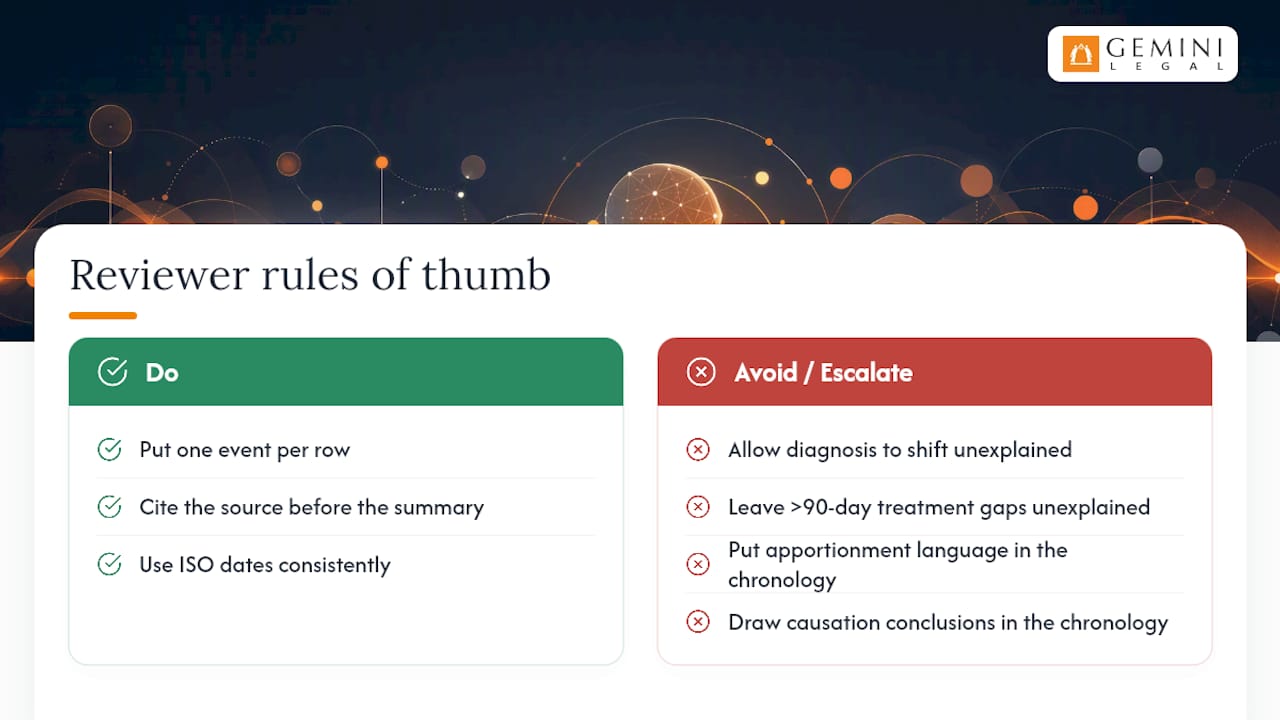
Three rules cut most formatting disputes before they start: one event per row, never several encounters merged for convenience; cite the source first, then summarize, never the reverse; and use ISO dates everywhere, with no exceptions carved out for "just this one record."
Red flags that warrant escalation to an IME, QME, or supervising attorney: a diagnosis that shifts between providers without documented explanation, a gap in treatment longer than 90 days with no deficiency-log entry explaining why, or apportionment language that appears in the chronology itself rather than in an expert's report. A chronology that starts drawing causation conclusions has stopped being a chronology.
Book a Demo: See ChartInsight™ on an Actual Chronology
If your team is still hand-building chronology tables in Word and manually tracking page numbers across a stack of PDFs, ChartInsight™ replaces that entire manual layer with structured, page-cited output from the record itself. Every extracted entry links back to its exact source page through the live PDF viewer, so verification happens inside the app instead of a second window juggling downloaded files.
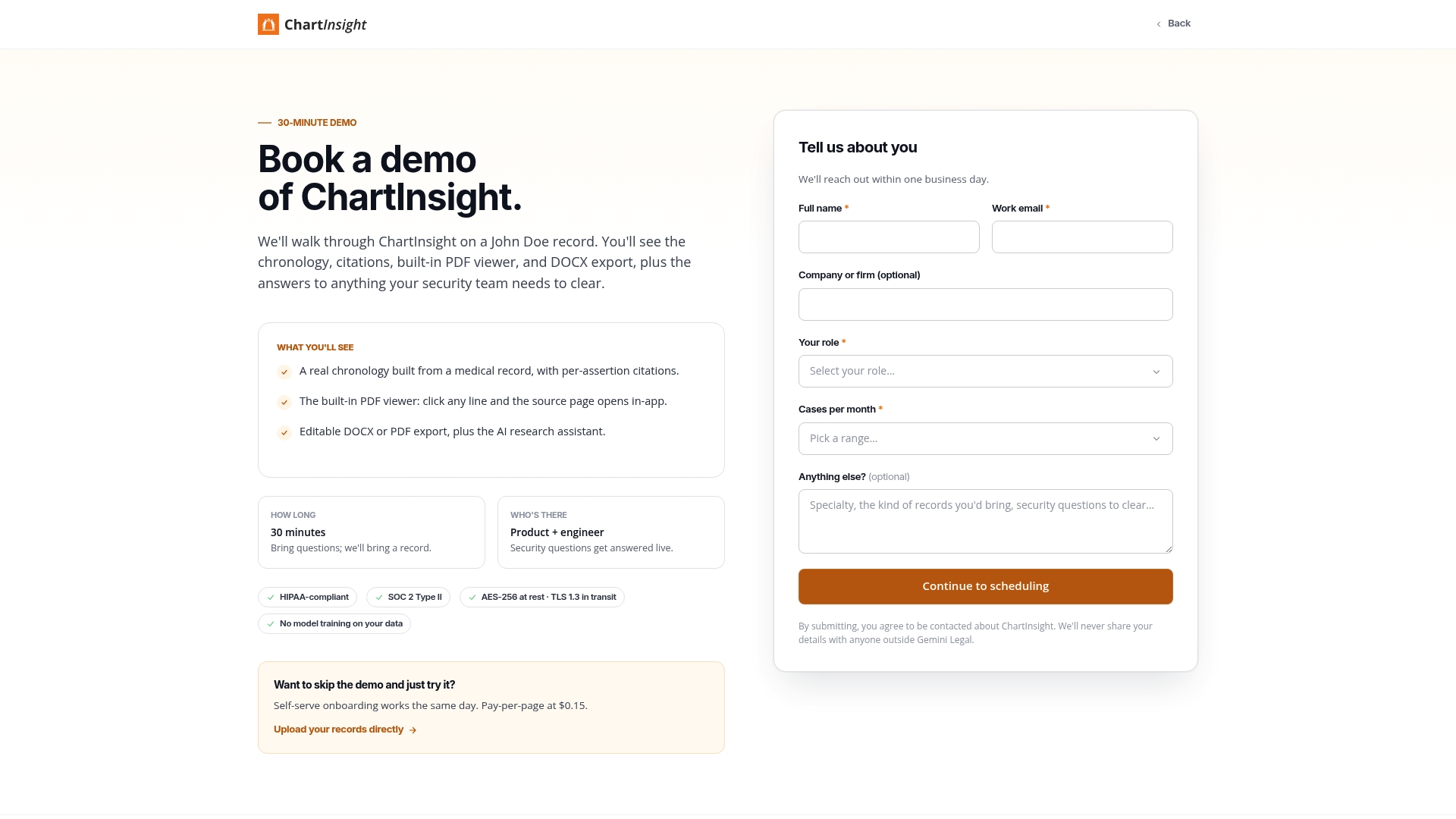
A demo walks through a real multi-provider record: how the chronology extracts, how templates keep a QME report and a peer review consistent across reviewers, and how exports preserve citations for production. It's worth attending for anyone who currently owns chronology prep on a matter: paralegals, legal nurse consultants, and the attorneys or claims reviewers who sign off on the final document. Book a demo to see how a record that would take days to chronicle manually gets structured in hours, with every page citation intact.
Sources
- 45 CFR 164.508, Uses and disclosures for which an authorization is required (eCFR)
- FY 2026 ICD-10-CM coding guidelines (CMS)
FAQ
How Do You Write a Medical Chronology?
Collect and index the full record, normalize dates and provider names, extract one event per row with a page-level citation, log any gaps or conflicts, then finalize with a cover page, provider index, and exhibit list before export.
What Are the Core Fields a Chronology Entry Needs?
At minimum: Date (ISO format), Provider, Event Type, Description, Key Findings, Treatment, and a Citation with document name and page number.
What Should a Chronology Table Look Like?
A date-ordered table with standardized columns, ISO dates, consistent provider names, and a page-level citation on every row, delivered with a cover page, provider index, and exhibit list.
What Is a Medical Chronology Used for in Litigation?
It's a neutral, fact-based timeline of medical events that lets attorneys, QMEs, AMEs, and IMEs verify treatment history and injury progression without re-reading the entire underlying record.
How Does ChartInsight™ Help With Chronology Formatting?
The platform extracts chronology entries with live citations to the exact source page, applies consistent templates across reviewers, and exports to editable DOCX or PDF with those citations preserved.