

TL;DR:
- Medical record review turnaround runs from about a day for urgent, limited-scope files to several weeks for large, complex ones. Scoping the clinical question before intake, supplying complete authorizations, and requiring page-level citations are what actually compress the cycle. Retrieval deadlines, vendor SLAs, and your own claims or discovery deadline are three separate clocks, and planning as if they are one is the most common scheduling error.
Expect medical record review turnaround to vary significantly depending on complexity, ranging from about a day for urgent, limited-scope files to several weeks for complex, multi-provider cases. Most standard legal reviews take a few business days, with timing driven by whether retrieval, clinical review, and report delivery run on one timeline or three. They are not the same. Retrieval is governed by whatever access rule applies to the request, vendor SLA tiers govern the clinical review, and your internal claims or discovery deadline governs everything.
Typical ranges by scenario:
- Urgent, limited-scope (single provider, under 100 pages): 24 to 48 hours with an AI-assisted plus human QC workflow
- Standard legal review (200 to 500 pages, 1 to 3 providers): 3 to 10 business days
- Complex multi-provider file (500 to 2,000 pages, IME/QME prep): 2 to 6 weeks
- Large hospital chart or psychiatric record (2,000+ pages): 4 to 8 weeks, sometimes longer when specialty reviewers are required
These ranges are planning heuristics drawn from how work of this kind is commonly scoped and quoted, not published industry benchmarks. Treat them as a starting point for your own SLA negotiation, then replace them with your vendor's measured performance on your files.
Quick rule of thumb: For a standard human review, budget on a per-page basis and expect a multi-hundred-page file to consume several business days. AI-assisted extraction with human QC compresses the abstraction step substantially, but only when the source PDFs are OCR-ready and the scope is defined before intake. Retrieval time is not compressible by tooling.
Insurance adjusters commonly work to 30 to 60 day internal windows for standard claims, with complex or high-value matters extending further. That outer limit is where retrieval delays, incomplete records, and vague vendor scopes do the most damage.
Table of Contents
- What does a medical record review actually deliver?
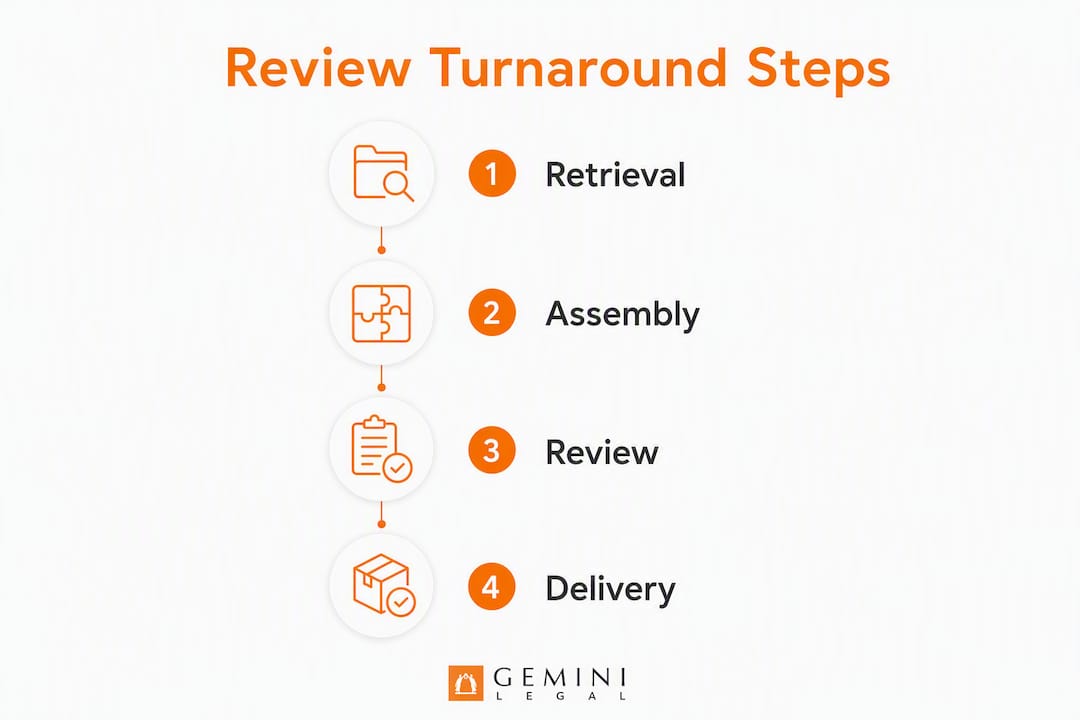
- How turnaround time breaks down: retrieval, assembly, review, and delivery
- What turnaround ranges and SLA tiers actually look like
- What actually lengthens or shortens your review time
- How to shorten turnaround without losing defensibility
- Rule-of-thumb timelines by page count and complexity
- Retrieval deadlines versus vendor review SLAs: why they differ
- What a defensible report must include
- When speed hurts defensibility
- How ChartInsight shortens turnaround while preserving defensibility
- Sample SLA clauses and ordering checklist
- Key Takeaways
- The real trade-off most legal teams get wrong
- See ChartInsight in a live review before your next file
- Useful sources
- FAQ
What does a medical record review actually deliver?
CMS describes medical review in the Medicare payment-integrity context as the collection and clinical review of medical records and related information to ensure payment is made only for services meeting Medicare coverage, coding, billing, and medical necessity requirements. In legal and claims contexts, the definition is narrower and more demanding: a medical record review is a structured clinical analysis of a patient's records, performed by a qualified reviewer, to answer a specific legal or medical question.

The questions vary. Is this injury causally related to the incident? Has the claimant reached P&S (permanent and stationary) or MMI (maximum medical improvement)? What is the appropriate apportionment under the AMA Guides? Does the record support the treating physician's opinion for the IME or QME report?
Standard deliverables from a defensible review include:
- Chronological index tied to exact PDF page numbers
- Nine-section narrative summary covering overview, key diagnoses, key test results, treatment plan, return to work, and related sections
- Normalized vitals table (blood pressure, heart rate, pain scores, BMI, blood glucose, and related measures)
- Medications table with dosage where documented, date range, and source page
- Editable DOCX or PDF export with page citations preserved throughout
The page-citation requirement is not a nice-to-have. When a QME or AME signs a report, or when a paralegal builds a demand package, every extracted finding needs to trace back to a specific page in the source record. Without that, the summary cannot be verified under oath, and opposing counsel will find the gap before you do.
How turnaround time breaks down: retrieval, assembly, review, and delivery
Understanding where time goes is the first step to compressing it. The workflow has eight discrete stages, and not all of them are under the vendor's control.
- Intake and authorization. The requesting party submits a signed HIPAA authorization, case details, and scope instructions. Incomplete intake is the most common cause of day-one delays.
- Record retrieval. The vendor or its business associate contacts the provider(s) and requests records. Timing here depends on the provider and on which access rule applies to the request, not on the vendor's SLA. Providers vary widely in response speed.
- OCR and indexing. Received files are processed for optical character recognition, page-numbered, and indexed by provider, date range, and record type. Native digital PDFs move through this in hours; scanned handwritten notes can take days.
- De-duplication and assembly. Duplicate pages are identified and flagged, records from multiple providers are merged into a single working file, and the assembled chart is quality-checked for completeness.
- Clinician assignment. The file is matched to a reviewer with the appropriate credentials. A workers' comp orthopedic file goes to an orthopedist or a trained clinical reviewer; a psychiatric record for a medico-legal case requires a psychiatrist or specialty reviewer.
- Clinical review and abstraction. The reviewer reads the record, extracts findings, builds the chronology, and drafts the narrative. This is the step most affected by volume, complexity, and record quality.
- QA and citation verification. A second reviewer or QA process checks extracted findings against source pages, confirms page citations are accurate, and flags any gaps or inconsistencies.
- Final delivery and export. The completed report is exported in the requested format (DOCX, PDF, or both) with citations intact and delivered to the requesting party.
Steps 3 and 4 are often parallelized with step 2 for large files. Steps 6 and 7 are always serial. The attorney or paralegal controls step 1 and can accelerate step 2 by supplying pre-signed releases and a provider contact list at intake. Everything else sits with the vendor.
Organized, OCR-ready digital files dramatically reduce manual prep time. A disorganized paper dump that requires manual sorting can add days before clinical review even begins.

What turnaround ranges and SLA tiers actually look like
AI-assisted vendors commonly quote tiers along the lines of Urgent (24 hours), High Priority (48 hours), and Standard (72 hours) for initial deliverables, with human QC layered on top. Those numbers apply to clean, limited-scope files. They do not apply to multi-provider retrieval or to records that arrive as scanned handwritten notes. Confirm the exact tier definitions in writing, because the labels are not standardized across vendors.
| SLA Tier | Typical Turnaround | Deliverables Included | Best Use Cases |
|---|---|---|---|
| Urgent | 24 to 48 hours | AI extraction plus human QC, chronology, page citations | Single-provider IME prep, deposition in 48 hours, urgent demand |
| High Priority | 2 to 5 business days | Chronology, narrative summary, vitals/meds tables, DOCX export | Workers' comp triage, QME prep, PI demand package |
| Standard | 5 to 10 business days | Full nine-section narrative, normalized vitals, medications, all exports | Complex PI, causation analysis, settlement evaluation |
| Complex/Extended | 2 to 8 weeks | Multi-provider assembly, specialty review, full apportionment analysis | Large hospital charts, psychiatric records, multi-defendant PI |
Rush fees for urgent SLAs are common. Before paying for one, confirm the file is actually eligible: many vendors exclude multi-provider retrieval, records over a certain page count, or files requiring specialty credentialing from their 24-hour guarantee.
To test a vendor's SLA reliability before committing a high-stakes file, send a trial file of moderate complexity and measure actual delivery against the promised window. Ask whether partial deliveries are available and whether the SLA carries a credit or penalty for late delivery. A vendor that cannot answer both questions clearly is telling you something.
What actually lengthens or shortens your review time
Most turnaround problems are predictable. The factors below are the ones claim teams can examine before placing an order.
Factors that lengthen turnaround:
- High page volume, especially when records span multiple providers and years
- Scanned handwritten notes, non-OCRable images, or EHR extracts that require manual indexing
- Retrieval delays caused by slow provider response, missing authorizations, or business associate handoffs
- Complex clinical content: ICU stays, multiple surgeries, overlapping treatment courses, or psychiatric records requiring specialty review
- Redacted pages that require legal review before clinical abstraction can proceed
- QME or AME credentialing requirements that limit reviewer pool availability
- Vague or undefined scope at intake, which forces the reviewer to read the entire record rather than prioritize
Factors that shorten turnaround:
- Native digital PDFs that are already OCR-ready
- Pre-scoped intake: specific date ranges, named providers, and defined clinical questions
- Pre-signed releases and a complete provider contact list supplied at intake
- Templates configured for the specific use case (workers' comp vs. PI vs. peer review)
- Rolling or partial deliveries that let the legal team begin work while the full record is still being assembled
Pro Tip: Scoping the clinical question before intake does more to compress turnaround than any per-page reviewer speed improvement. A reviewer who knows you need causation and MMI for a lumbar injury from a specific date will read differently than one handed a 1,200-page chart with no instructions.
How to shorten turnaround without losing defensibility
Speed and defensibility are not opposites, but they require deliberate process design. The following steps, applied in order, produce the largest time savings with the least risk.
- Scope the issue before intake. Define the clinical question (causation, MMI, apportionment, P&S), the relevant date range, and the named providers. A scoped order takes materially less time to review than an open-ended one.
- Prioritize documents by relevance. Flag the treating physician's records, operative reports, and imaging studies as first-priority. Billing records and administrative correspondence can follow in a second pass.
- Supply pre-signed releases and provider contacts at intake. Retrieval delays are the single most common cause of missed deadlines. Handing the vendor a complete authorization packet on day one eliminates the most common bottleneck.
- Request rolling or partial deliveries. HHS guidance encourages covered entities to provide requested information in pieces as it becomes available when a request may take close to the outer time limit, if the requester indicates a desire to receive it that way. Apply the same logic to vendor orders: ask for the treating physician's records first, then the hospital records, then ancillary providers.
- Require live page-citations and an editable DOCX export. These two requirements, written into the order, prevent the vendor from delivering a summary that cannot be verified. They also eliminate the back-and-forth that adds days to a review cycle.
- Use templates for recurring case types. A workers' comp template configured for your jurisdiction produces consistent output every time and eliminates the formatting review cycle. If the matter is a California comp file, build the template around the DWC medical record requirements you will be held to.
- Designate a single escalation contact. Retrieval stalls are common. Having a named person at the vendor who can escalate directly to the provider's medical records department cuts response time from days to hours.
- For AI-assisted workflows, require human QC and a page-level audit trail. AI extraction is fast. The accuracy of that extraction depends on the QC layer behind it. Require reviewer attestation and a versioned audit trail in the contract, not as an add-on.
Rule-of-thumb timelines by page count and complexity
These estimates assume OCR-ready PDFs, a defined scope, and a vendor with an AI-assisted plus human QC workflow. Retrieval time is excluded. They are triage heuristics for planning, not vendor benchmarks and not contractual guarantees.
| Page Range | Complexity | Standard Human Review | AI-Assisted + Human QC |
|---|---|---|---|
| Under 100 pages | Simple, single provider | 1 to 2 business days | 24 to 48 hours |
| 100 to 300 pages | Moderate, 1 to 2 providers | 3 to 5 business days | 1 to 3 business days |
| 300 to 500 pages | Complex, multi-provider | 5 to 15 business days | 3 to 7 business days |
| 500 to 2,000 pages | Complex, hospital/surgical | 2 to 5 weeks | 1 to 3 weeks |
| 2,000+ pages | Large, multi-defendant or psychiatric | 4 to 8 weeks | 2 to 5 weeks |
Redaction, specialty reviewer requirements, and retrieval delays each add time independently of page count. A 300-page psychiatric record reviewed by a QME psychiatrist will take longer than a 500-page orthopedic chart reviewed by a trained clinical reviewer.
For internal SLA planning, add a buffer to the AI-assisted column to account for retrieval and QA cycles. For complex multi-provider files, plan for partial deliveries and structure your downstream work around the treating physician's records arriving first.
Adjuster decision-making windows for standard claims commonly run 30 to 60 days, with complex matters extending further. The review timeline above feeds into that window, not the other way around.
Retrieval deadlines versus vendor review SLAs: why they differ
These are separate clocks, and conflating them is one of the most common planning errors in claims and litigation.
Start with what the retrieval clock actually is, because it is widely misstated. HIPAA's 45 C.F.R. §164.524 is the individual's right of access: a covered entity must act on an individual's request for access no later than 30 calendar days after receipt, with one 30-day extension available if it gives written notice of the reason and the completion date. That rule reaches a request the individual directs to a third party, but it is not a general deadline for every records request. A defense firm or claims office requesting records under a signed HIPAA authorization is proceeding under a different provision, and the Privacy Rule imposes no comparable turnaround requirement on that path. Do not plan a retrieval schedule on the assumption that a 30-day federal clock applies to your request; confirm which rule your request actually falls under.
Once records are in hand, the vendor's SLA clock starts. A provider who delivers records on day 28 of a 30-day access window has complied. Your vendor's 5-day SLA starts on day 29.
State law adds another layer, and it is often the binding constraint. California's Health and Safety Code §123110 entitles a patient or the patient's personal representative to inspect records within five working days of a written request, and requires copies to be transmitted within 15 days of a request specifying the records to be copied. Note that this is 15 days, not 15 business days, and that it runs to the patient or personal representative rather than to any requester. Other states have their own access rules with their own timelines. When a state rule applies to your matter, check it first, because it may be shorter than the federal 30-day standard.
Practical implications for claim teams:
- Document the timestamp of every retrieval request and every partial delivery received.
- Treat the applicable access deadline as an outer limit for retrieval planning, not the expected delivery date.
- When a matter has a discovery cutoff, a DWC hearing date, or a scheduled mediation, work backward from that date to set retrieval request deadlines rather than forward from the order date. Firms handling these matters routinely treat employment-law mediation as a fixed scheduling anchor for exactly this reason, and a records package that arrives after the session is worth considerably less than one that arrives before it.
- Request partial deliveries explicitly in the vendor order so that usable records arrive before the full production is complete.
Ordering patterns differ across the table, too. A defense-side claims office measuring against a 60-day internal window and a plaintiff's firm handling personal injury and workers' compensation matters are working to different pressures, and it is worth knowing which one you are negotiating an SLA against.
What a defensible report must include
A report that cannot be verified under oath is not a report. Before accepting any deliverable, check it against this list.
Required elements:
- Chronological index with every entry tied to a specific PDF page number
- Narrative summary with inline page citations on every extracted finding
- Normalized vitals table (blood pressure, heart rate, pain scores, BMI, blood glucose) with source page references
- Medications table with drug name, dosage, prescriber, date range, and source page
- Reviewer signature, credentials, and license number
- Versioned audit trail showing when the report was generated and by whom
- Editable DOCX export with citations preserved (not stripped on export)
- Original source PDFs retained unchanged
Red flags that justify withholding payment or requesting a redo:
- Summary text with no page citations
- No access to the source PDF viewer or inability to verify a finding against the original record
- Reviewer credentials not disclosed or not verifiable
- No audit trail for edits or version history
- Citations that point to the wrong page or to a page that does not contain the referenced finding
On reviewer credentials: a trained RN or clinical reviewer is appropriate for factual chronologies and treatment summaries. When the report will be used for IME/QME prep, apportionment under the AMA Guides, or expert testimony, require a physician reviewer with the relevant specialty credential. For psychiatric medico-legal cases, that means a board-certified psychiatrist, not a general MD.
For discovery purposes, treat the export file and the original source PDFs as a chain-of-custody document set. Both should be retained in their original form from the date of delivery.
When speed hurts defensibility
The failure modes are predictable and almost always avoidable.
Common shortcuts that undermine defensibility:
- AI-only summaries with no live citations: fast to produce, impossible to verify under oath
- Altered or deleted source PDFs: breaks chain of custody and creates discovery exposure
- No reviewer sign-off: a summary without a credentialed attestation is an anonymous document
- Page-level citations that point to the wrong page or to a section heading rather than the specific finding
- Summaries delivered as locked PDFs with no editable version: prevents the attorney from annotating or correcting the record
Mitigations to require in every order:
- Page-level live citations that open the source PDF at the exact page when clicked
- Human QC reviewer attestation on every deliverable, not just the final report
- Original PDFs preserved unchanged and delivered alongside the report
- Editable DOCX export with citations intact
- A versioned audit trail showing extraction date, reviewer identity, and any post-delivery edits
The risk of AI extraction errors is real. The mitigation is not to avoid AI-assisted review; it is to require the QC layer and the citation architecture that make errors visible before they reach a deposition.
One practical test: if a summary cannot be defended under oath by pointing to the exact source page for each finding, it is not sufficient for IME prep, demand packages, or expert reports. Apply that standard before accepting delivery, not after opposing counsel does.
How ChartInsight shortens turnaround while preserving defensibility
ChartInsight, built by Gemini Legal, is designed for the specific problem this article describes: compressing the abstraction and citation-verification work without sacrificing the citation architecture that makes a report defensible. One distinction matters before going further. ChartInsight is the software layer, not a review service. The credentialed reviewer, the QC pass, and the signed attestation remain yours; what changes is how much of the reviewer's time goes into assembling and verifying rather than analyzing.
The core workflow processes the full record as a PDF and produces:
- Source-linked chronology with every entry linked to its source page in the original PDF
- Nine-section narrative summary with inline page citations on every extracted finding, covering overview, key diagnoses, key test results, treatment plan, return to work, and related sections
- Normalized vitals table covering ten measures (blood pressure, heart rate, temperature, respiratory rate, oxygen saturation, pain, height, weight, BMI, and blood glucose), each cited to its source page
- Medications table with every drug across the record, date ranges, and page citations
- Editable DOCX and PDF exports with all citations preserved on export
- AI Research Assistant that answers questions about the record and cites the source pages behind each answer
The live PDF viewer is built into the same interface as the summary. Clicking a citation opens the source record at the exact page, so the reviewer never leaves the application to verify a finding. For a QME preparing a report or a paralegal building a demand package, that eliminates the back-and-forth that typically consumes hours of a review cycle.
Teams configure Templates for each use case, so a workers' comp review and a personal injury causation analysis come back in consistent formats every time. The Prompt Library holds reusable custom analysis sections that Templates pull in, so recurring clinical questions are answered the same way on every record. Records can be kept private, shared team-wide, or shared with named individuals, and organization permissions control who can manage files and configuration.
Large files are the point rather than the exception: sets exceeding 70,000 pages have been processed. The 112,000-character summary case study is the useful reference here, because it compares AI indexing against a human summary of roughly 56 pages and identifies the clinician-documented items that summary left out. Volume alone is not the test; whether the index catches what a reader would need is.
Sample SLA clauses and ordering checklist
Copy and adapt these clauses into vendor orders, RFPs, or retention agreements.
Sample SLA clauses:
- Turnaround tiers: "Vendor shall deliver an initial chronology and narrative summary within [24/48/72] hours of receiving a complete, OCR-ready record set for files under [X] pages. Files exceeding [X] pages or requiring multi-provider retrieval shall be delivered within [5/10/15] business days, with partial deliveries at [48-hour/72-hour] intervals."
- Citation requirement: "All extracted findings shall include a page citation referencing the specific page number in the source PDF. Citations shall be live links where the delivery format supports them, and shall be preserved in all DOCX and PDF exports."
- Reviewer credentials: "Vendor shall disclose the name, credentials, and license number of the reviewing clinician for each deliverable. Physician review shall be required for all IME/QME prep, apportionment analysis, and expert report support."
- Escalation and remedy: "If Vendor fails to deliver within the agreed SLA window, Client shall receive a [X]% credit on the affected order. Vendor shall designate a named escalation contact available by phone and email during business hours."
- Audit trail: "Vendor shall provide a versioned audit trail for each deliverable, including extraction date, reviewer identity, and any post-delivery edits. Original source PDFs shall be retained unchanged and delivered alongside the report."
Pre-order checklist:
- Signed HIPAA authorization and any state-specific release forms
- Complete provider list with contact information and fax numbers
- Defined scope: clinical question, relevant date range, priority providers
- Requested deliverables and export formats (DOCX, PDF, or both)
- Named escalation contact at the requesting firm or claims office
- Acceptance criteria: page-citation requirement, reviewer credential disclosure, audit trail
For discovery planning, retain proof-of-delivery records, the original source PDFs, and the versioned audit trail as a single document set. Partial deliveries with documented timestamps materially reduce the risk of missing a discovery cutoff or claims deadline.
Key Takeaways
Defensible medical record review requires page-level citations, credentialed reviewers, and SLA tiers matched to your deadline, not just the fastest available turnaround.
| Point | Details |
|---|---|
| Standard turnaround range | Most legal reviews land between 3 and 10 business days; urgent limited-scope files can be delivered in 24 to 48 hours. These are planning heuristics, not published benchmarks. |
| Page-citations are non-negotiable | Every extracted finding must link to a specific source page; summaries without citations cannot be defended under oath. |
| Three clocks, not one | The applicable retrieval deadline, the vendor SLA, and your claims or discovery deadline run independently. HIPAA's 30-day rule is the individual's right of access, not a universal retrieval deadline. |
| Scope intake to compress time | Defining the clinical question, date range, and priority providers before intake reduces review cycles more than reviewer speed. |
| ChartInsight for defensible speed | ChartInsight delivers page-cited chronologies, nine-section narratives, and vitals and medications tables with a live PDF viewer, so reviewer time goes to analysis instead of assembly. |
The real trade-off most legal teams get wrong
Speed and defensibility are not competing values. They become competing values when a team treats them as a dial to turn rather than a process to design.
The pattern that causes the most downstream damage is not choosing a slow vendor or a fast one. It is accepting a deliverable that looks complete but cannot be verified. A 24-hour summary with no page citations is not a fast review. It is an unverifiable document that will cost more time to fix than a 5-day review would have taken in the first place.
The practical standard is simple: require that every finding in the report can be located in the source record immediately by anyone who reads the report. If the vendor's output cannot meet that standard, the speed of delivery is irrelevant.
Legal teams that measure vendor performance on partial delivery timing and citation accuracy, rather than on final report delivery alone, catch problems early enough to fix them. That is the operational posture that actually compresses turnaround over time, because it forces vendors to build the QC layer into their process rather than treating it as optional.
See ChartInsight in a live review before your next file
If your team is spending days cross-referencing AI summaries against source PDFs, the problem is not the AI. It is the absence of a live citation layer that keeps the summary and the evidence in the same view.
ChartInsight gives workers' comp attorneys, paralegals, and adjusters a single interface where every extracted finding, every vitals entry, and every medication links directly to the source page in the original PDF. No tab-switching, no manual verification, no wondering whether the summary matches the record. The DOCX export preserves every citation. The original record is never altered.
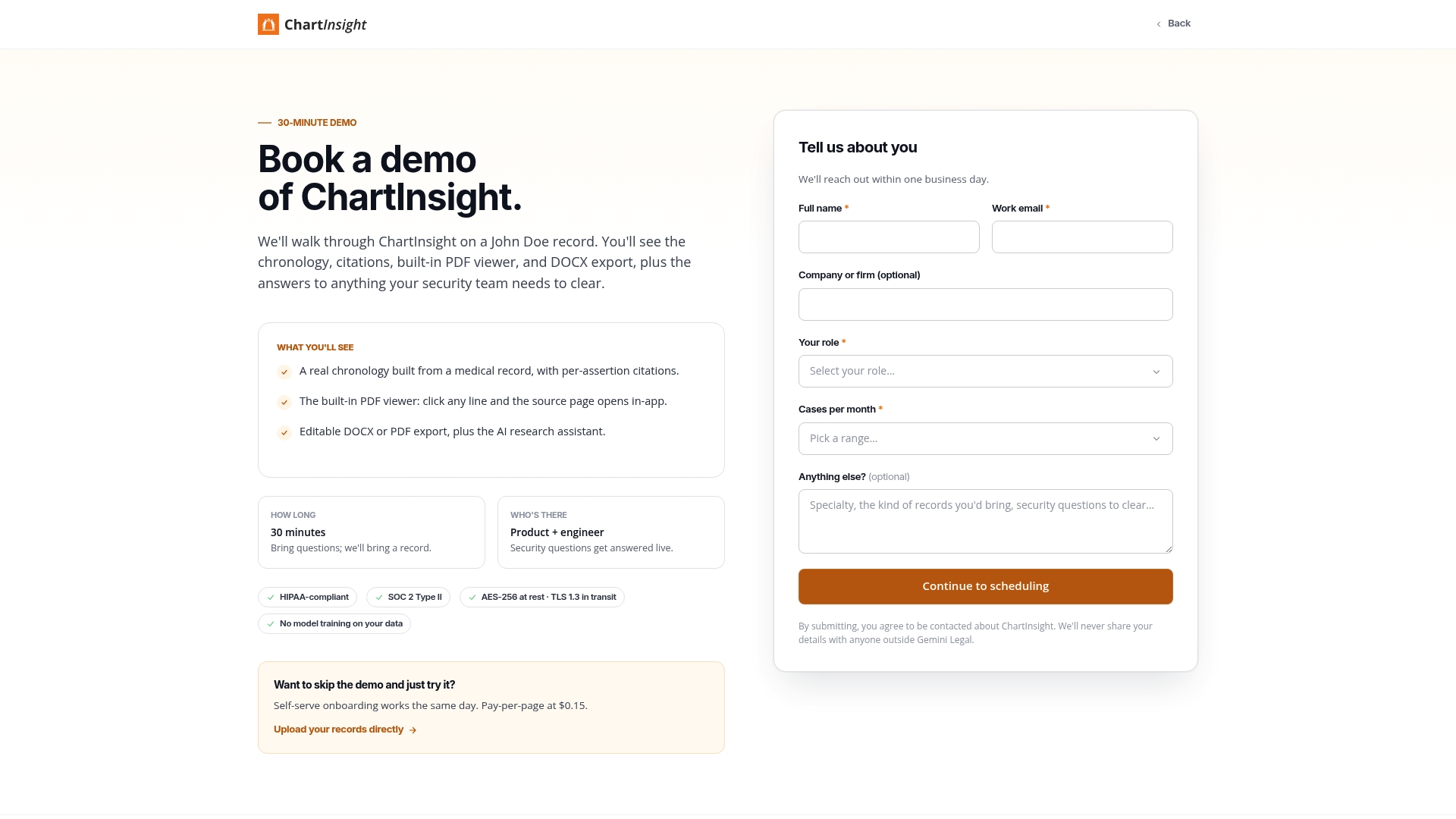
Book a demo at chartinsight.ai/book-a-demo and bring a real file. The fastest way to evaluate whether ChartInsight fits your workflow is to run a trial file against your current process and compare the time from intake to a citation-verified deliverable.
Useful sources
These are the primary regulatory and authoritative references for retrieval deadlines, review definitions, and requirements.
- Individuals' Right under HIPAA to Access their Health Information, 45 C.F.R. §164.524 (HHS.gov) is the governing regulation for the individual right of access; read this before setting any retrieval SLA, and note what it does and does not cover.
- HHS FAQ: How timely must a covered entity respond to access requests? is plain-language guidance on the 30-day outer limit, the single 30-day extension, and partial production.
- 45 C.F.R. §164.524 (Cornell LII) is the full regulatory text with all subsections, useful for vendor contract language.
- California Health and Safety Code §123110 (leginfo.legislature.ca.gov) sets California's five-working-day inspection and 15-day copy rules; check this for any California matter.
- CMS: Medical Review and Education is the Medicare payment-integrity definition of medical review, useful for distinguishing it from a legal record review.
Save these links before your next vendor negotiation. The regulatory text is the authoritative reference when a provider disputes a retrieval deadline or a vendor disputes SLA scope.
FAQ
What does "medical record review" mean in a legal context?
A medical record review is a structured clinical analysis of a patient's records, performed by a qualified reviewer, to answer a specific legal or medical question such as causation, MMI, apportionment, or P&S status. The output is a defensible report with a chronology, narrative summary, and page citations tied to the source record.
What is the typical turnaround time for a medical record review?
Standard legal reviews most commonly run 3 to 10 business days for moderate-volume files; urgent limited-scope reviews can be delivered in 24 to 48 hours with an AI-assisted and human QC workflow. Complex multi-provider files or large hospital charts may take 2 to 6 weeks or longer depending on retrieval, specialty reviewer availability, and record quality. These are planning ranges rather than published industry benchmarks.
How long does a provider have to respond to a medical records request?
It depends on who is asking. Under HIPAA 45 C.F.R. §164.524, a covered entity must act on an individual's access request within 30 calendar days, with one 30-day extension permitted if written notice is provided. That federal deadline does not automatically apply to a third-party request made under a signed authorization. Some state rules are shorter and apply on their own terms: California requires records to be available for inspection within five working days and copies to be transmitted within 15 days of the request.
How long does it take to review 100 pages of medical records?
A single-provider, OCR-ready 100-page file typically takes 1 to 2 business days for a standard human review, or 24 to 48 hours with an AI-assisted and human QC workflow. Handwritten notes, redactions, or specialty content can extend either estimate.
How do insurance adjusters' review timelines differ from vendor SLAs?
Adjusters commonly work to 30 to 60 day internal windows for standard claims decisions, with complex matters extending further. Vendor SLAs govern the clinical review and report delivery, which feeds into the adjuster's window but runs on a separate clock from both retrieval deadlines and internal claims timelines.
This article provides general information about medical record review processes and timelines. It is not legal advice. Confirm applicable deadlines and regulatory requirements with qualified legal counsel or the relevant primary source for your jurisdiction and matter type.