

Produce one page-cited medication table and one supporting timeline where every row cites the exact PDF page that proves it. That is the deliverable, full stop. Build it from at least three source types (dispense history, treating and pharmacy records, and the claimant's own account), and reject any row you cannot trace back to a specific page. If a reviewer, attorney, or QME can't click through to the source page, the entry doesn't belong in the report.
TL;DR:
- Dispense history is the most reliable source for medication reconciliation and should be prioritized over provider notes or discharge summaries.
- Normalizing medications to their RxNorm ingredient identifiers significantly increases matching accuracy across different EHR systems.
- Every medication entry in the final table must be backed by a specific page citation, source, and snippet to withstand legal review.
- Over-the-counter drugs and herbal supplements should be flagged as self-reported, since they rarely appear in pharmacy dispense records.
- Automated tools can streamline the process, but human verification remains essential for ensuring traceability and legal defensibility.
Table of Contents
- What You Need Before You Start Reconciling Medication Lists
- The Six-Step Workflow for Reconciling Records Into One Table
- How Do You Attach Citations Reviewers Can Actually Verify?
- Which Discrepancies Actually Change a Medico-Legal Opinion?
- The Evidence Behind Citation-First Reconciliation
- Handling Over-the-Counter Drugs and Herbal Supplements
- Managing Patient-Reported Adherence and Self-Report Gaps
- How to Verify Medication Details With Patients or Caregivers
- What Most Reconciliation Guides Get Backwards
- Reconcile Medication Lists in Hours, Not Days, With ChartInsight™
- Sources
- FAQ
What You Need Before You Start Reconciling Medication Lists
A reconciled medication list is only as strong as what went into it. Before opening a single PDF, confirm you have the full set of source documents and know what the final table needs to contain.
Sources to collect:
- Lawfully obtained dispense history from pharmacy benefit managers or state prescription monitoring programs
- Pharmacy fill records showing dates, quantities, and days' supply
- Prescriptions and treating physician progress notes
- Hospital discharge summaries and surgical records
- The claimant's or patient's own statement of what they're currently taking
- The original stitched PDF files, unaltered, for citation purposes
Required columns for the medication table:
- Medication name (both ingredient and brand)
- RxNorm or ingredient-level identifier
- Strength and route
- Frequency (as prescribed vs. as dispensed, if different)
- Prescriber name
- Last fill date
- Source file and exact page citation
- Comment field for discrepancy type (omission, duplication, escalation, etc.)
Red flags to flag on first pass: overlapping prescribers writing for the same drug class, duplicate therapy within a class (two different SSRIs, two different opioids), refills filled earlier than the days' supply should allow, an abrupt stop with no taper or discontinuation note, and medical supplies (test strips, syringes, wound care items) that got mis-tagged as medications during extraction. Catching these early saves you from rebuilding the table halfway through.
The Six-Step Workflow for Reconciling Records Into One Table
Reconciling a medication history across a stitched, multi-provider PDF is not a single task. It's six discrete steps, and skipping one is usually where defensibility breaks down.
Intake and cataloging. Before extraction, label every source file with a consistent naming convention and log its origin, date range, and page count. Never mark up or annotate the original PDF. Keep it pristine so it can be produced as-is if challenged.
Extraction. Search each file for medication mentions in both structured fields (medication lists, orders, MAR entries) and free text (progress notes, discharge narratives). Run an OCR quality check first. Scanned records from smaller clinics frequently have OCR errors that silently drop a drug name or strength. For every mention, capture the exact snippet and the page number, not just the drug name.
Normalization. Map every extracted medication to its RxNorm ingredient identifier using NLM's RxNav or an equivalent terminology service. This step matters more than it sounds. Medication lists pulled from different EHR systems typically show only 6.1% to 7.1% intersection when compared at the exact drug level, but 29.4% to 35.0% intersection once normalized to ingredient level, according to a cross-EHR medication reconciliation study. Skip normalization and you'll flag "different" drugs that are actually the same ingredient under a different brand or formulation. Treat combination products (a single pill with two active ingredients) as separate ingredient entries when comparing across sources.
Line-by-line comparison. Match at the ingredient level first for cross-source comparison, then narrow to dose and route once you've confirmed the ingredient matches. Use last fill dates to build the chronology; a prescriber's note saying a patient is "on lisinopril" is far less useful than a pharmacy fill date showing exactly when that prescription was last picked up.
Resolving conflicts. Treat lawfully obtained dispense history as your ground truth. It's the one document type that reliably captures prescriber, pharmacy, and fill date across a long timeline, according to claims-review practice. When dispense history conflicts with a treating note, or a medication appears in neither source but the claimant reports taking it, escalate: query the prescriber or pharmacy, or flag for pharmacist review rather than guessing.
Output preparation. Assemble the final table, export it with citations intact, and build a short timeline showing last fills and any dose changes over the review period.
Pro Tip: The single most common reviewer error is treating a discharge summary or progress note as the definitive medication list. Those documents reflect what a provider believed the patient was taking at one moment, not what was actually dispensed. Dispense history is the record that holds up under cross-examination.
How Do You Attach Citations Reviewers Can Actually Verify?
A medication entry without a page citation is an assertion, not a finding. Every row in your reconciled table needs a citation format that lets a QME, opposing counsel, or hearing officer trace it back in seconds.
Use a consistent template for every entry: file name, document date, exact page number(s), a short quoted snippet, and the export timestamp. When the source text is ambiguous, blurry scan, handwritten note, cut-off table, attach a screenshot of the page alongside the citation rather than relying on the quoted text alone.
Best practices for citation-preserving exports:
- Export tables to DOCX or PDF with hyperlinked page citations that jump directly to the source page
- Keep a discrepancy register separate from the main table, logging each unresolved item, its current status, and any query sent
- Log the date and content of any pharmacy or prescriber query, and summarize the reply in the register rather than burying it in an email thread
- Never edit the source PDF; annotate only in your working table
One reason this level of rigor matters: manual chart review consistently turns up discrepancies that automated extraction alone misses. Automated tools can extract and cross-reference at scale, but they still need a human check on ambiguous entries and page-level provenance for anything that ends up in a report. Medico-legal guidance on report construction makes a similar point: sections built from claimant recall alone, without dispense history, are the parts of a report most likely to get challenged.
Which Discrepancies Actually Change a Medico-Legal Opinion?
Not every mismatch matters equally. Five categories account for most of the discrepancies that affect causation, apportionment, or work-capacity findings.
- Omission. A medication appears in dispense history but never shows up in treating notes, or vice versa. Relevant to whether a condition was actually being managed as claimed.
- Duplication. Two prescribers writing for the same drug class (commonly opioids or benzodiazepines) without apparent coordination, a pattern claims teams specifically flag as a risk indicator.
- Dose escalation. A steady increase in strength or frequency that isn't explained in the visible treating notes, relevant to causation and progression arguments.
- Abrupt cessation. A medication stops appearing with no taper or discontinuation note, which can bear on work-capacity or driving-restriction questions.
- Mis-tagged supplies. Glucose test strips, syringes, or wound-care items pulled into a "medications" field by mistake, inflating an apparent drug count.
For each finding, the report language should stay neutral and evidence-linked: state the snippet and its citation, describe the discrepancy without editorializing, note the possible clinical implication, and suggest a concrete next step (pharmacist review, a written IME question, or a prescriber query).
The Evidence Behind Citation-First Reconciliation
The case for normalization and page-level citation isn't just workflow preference. It holds up against the clinical and claims literature. A separate quasi-experimental study on inpatient care found that reconciliation programs with pharmacist involvement cut 90-day readmission odds significantly (OR = 0.41, P = 0.002), according to a quasi-experimental study on medication reconciliation and readmission in CKD patients, reinforcing why escalation to pharmacist review belongs in your workflow when dispense history and treating notes genuinely conflict.
ChartInsight™'s own Prescribing Hazard accuracy case study documents how citation retention holds up across large stitched records, and its psychiatric and orthopedic record review examples show the same method applied to specialty caseloads. Reference these in an internal methodology memo or an expert's report the same way you'd cite any evidence source: name the artifact, state what it demonstrates, and link to it.
Handling Over-the-Counter Drugs and Herbal Supplements
Over-the-counter drugs and herbal supplements rarely appear in dispense history, since most are cash purchases with no pharmacy claim trail. That makes them the category most likely to fall out of a reconciliation entirely.
Capture them anyway, but flag them differently than prescription entries. Source them from claimant interviews, intake forms, and any treating note that lists "current medications" broadly rather than just prescriptions. Common offenders worth watching for: NSAIDs (ibuprofen, naproxen) taken alongside prescribed anticoagulants or anti-inflammatories, St. John's Wort interacting with prescribed antidepressants, and high-dose vitamin E or fish oil affecting bleeding risk before a surgical claim.
In the medication table, mark these rows with a source type of "self-reported" or "intake form" rather than "dispensed," and cite whatever document captured the claim. If no document captures it, the comment field should say so explicitly rather than leaving the citation blank. A reviewer who notes "claimant reports daily ibuprofen use, not independently verified" has produced a defensible, honest entry. A reviewer who lists ibuprofen with no source note at all has created a gap opposing counsel will find first.
Managing Patient-Reported Adherence and Self-Report Gaps
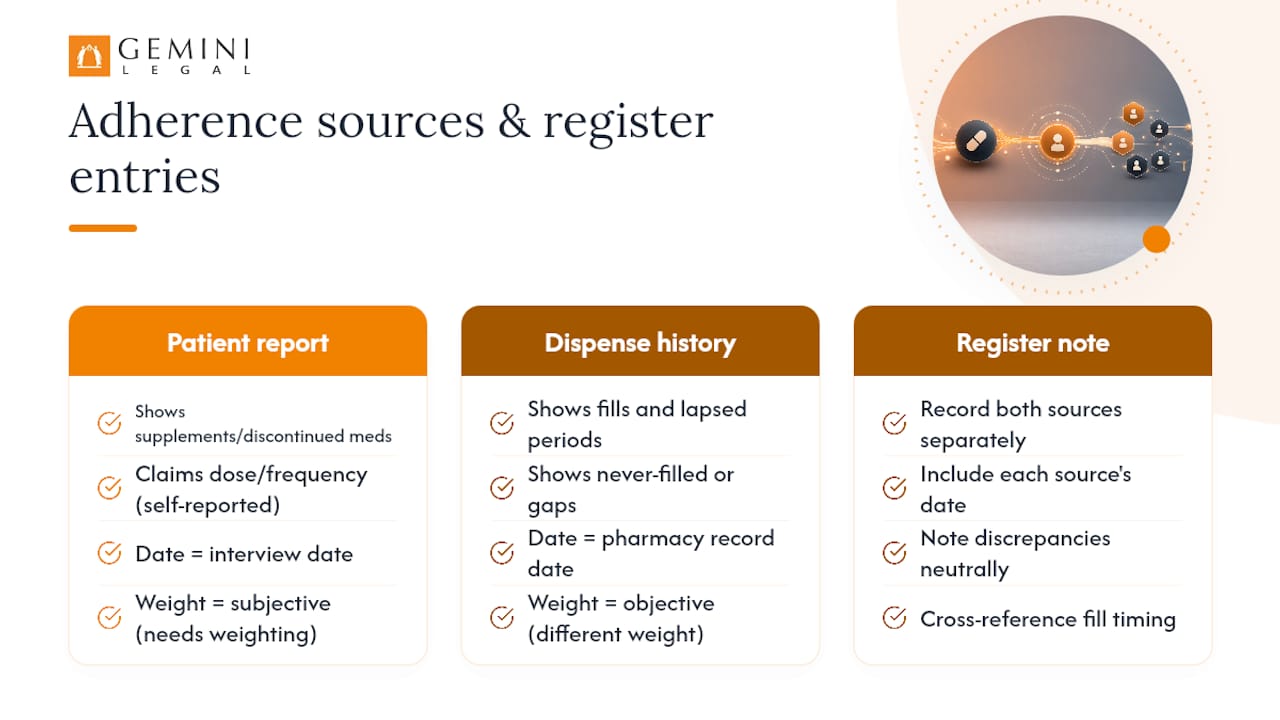
Claimant and patient self-report is a necessary source, not an optional one. It's often the only place that surfaces supplements, discontinued medications, or dose changes that never made it into a chart. But self-reported adherence needs to be weighted differently than a pharmacy fill record, and your table should show that difference.
When a claimant reports taking a medication that dispense history shows was never filled, or shows lapsed for months, don't quietly average the two accounts into one entry. Document both: what the dispense history shows, what the claimant reported, and the date each source was generated. That gap itself is often clinically or legally relevant. A large lapse between "prescribed" and "actually filled" can bear directly on causation arguments or on whether a claimed symptom is consistent with treatment compliance.
Cross-reference adherence claims against fill timing wherever possible. If a claimant reports taking a maintenance medication "every day for the past year" but the fill history shows gaps of sixty or ninety days, note the discrepancy neutrally in the register rather than resolving it yourself. That's a finding for the QME or treating physician to weigh, not a conclusion for the reviewer to reach in the table itself.
How to Verify Medication Details With Patients or Caregivers
When dispense history and treating notes leave a gap, a direct conversation with the patient or a caregiver is often the fastest way to close it. But that conversation needs structure, or it introduces more uncertainty than it resolves.
Clinical reconciliation practice offers a useful model here: the Best Possible Medication History (BPMH) approach used at hospital admission, which draws systematically on interviews, prescription bottles, and prior records rather than relying on any single source, as described in the CKD reconciliation study. Adapted for claims and med-legal review, that means asking specific, closed questions rather than an open "what are you taking": confirm each medication on your working list by name, ask about start and stop dates, and ask separately about anything not prescribed by a treating physician, since that's where supplements and over-the-counter use tends to surface.
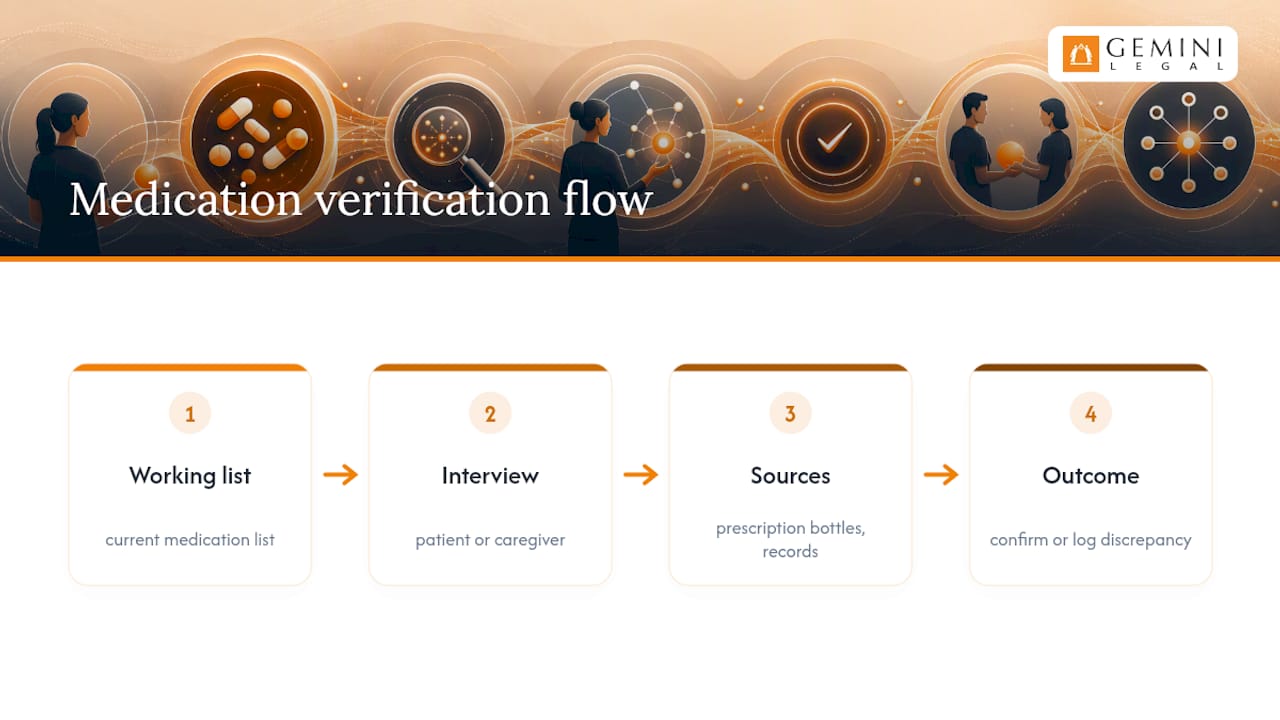
Document the interview itself as a source: date, who conducted it, and whether a caregiver was present and contributing information the patient couldn't provide alone. Where the interview confirms an entry already backed by dispense history, note it as corroboration. Where it contradicts dispense history, log it as a discrepancy with both accounts intact rather than picking a winner. The interview is evidence, not an override.
What Most Reconciliation Guides Get Backwards
Most guidance on this topic treats reconciliation as a matching exercise: line up two lists, flag what doesn't match, done. That framing misses what actually determines whether a medication table survives cross-examination, which is provenance, not accuracy alone. A table can be perfectly accurate and still be worthless in a hearing if no one can trace a single row back to its source page.
The bigger failure pattern isn't sloppy matching. It's reviewers treating a discharge summary or a progress note's medication list as ground truth, when dispense history almost always tells a more complete and more defensible story. Progress notes reflect a provider's belief at a single visit. Dispense history reflects what was actually picked up, when, and from whom, across the entire claim period.
If you take one thing from this workflow, prioritize sourcing over speed. Get the dispense history first, normalize before you compare, and never let a row into your final table without a page number attached to it. Everything else, formatting, table design, timeline visuals, is secondary to that discipline.
Reconcile Medication Lists in Hours, Not Days, With ChartInsight™
Some software platforms turn the workflow described above into something you don't have to build by hand every time. Feeding a stitched, multi-provider PDF into some software can produce a structured medication table with each entry citing the source page it came from. Clicking citations in these platforms often opens the source PDF within the app, helping avoid downloading files or losing your place hunting for the page that proves a fill date.
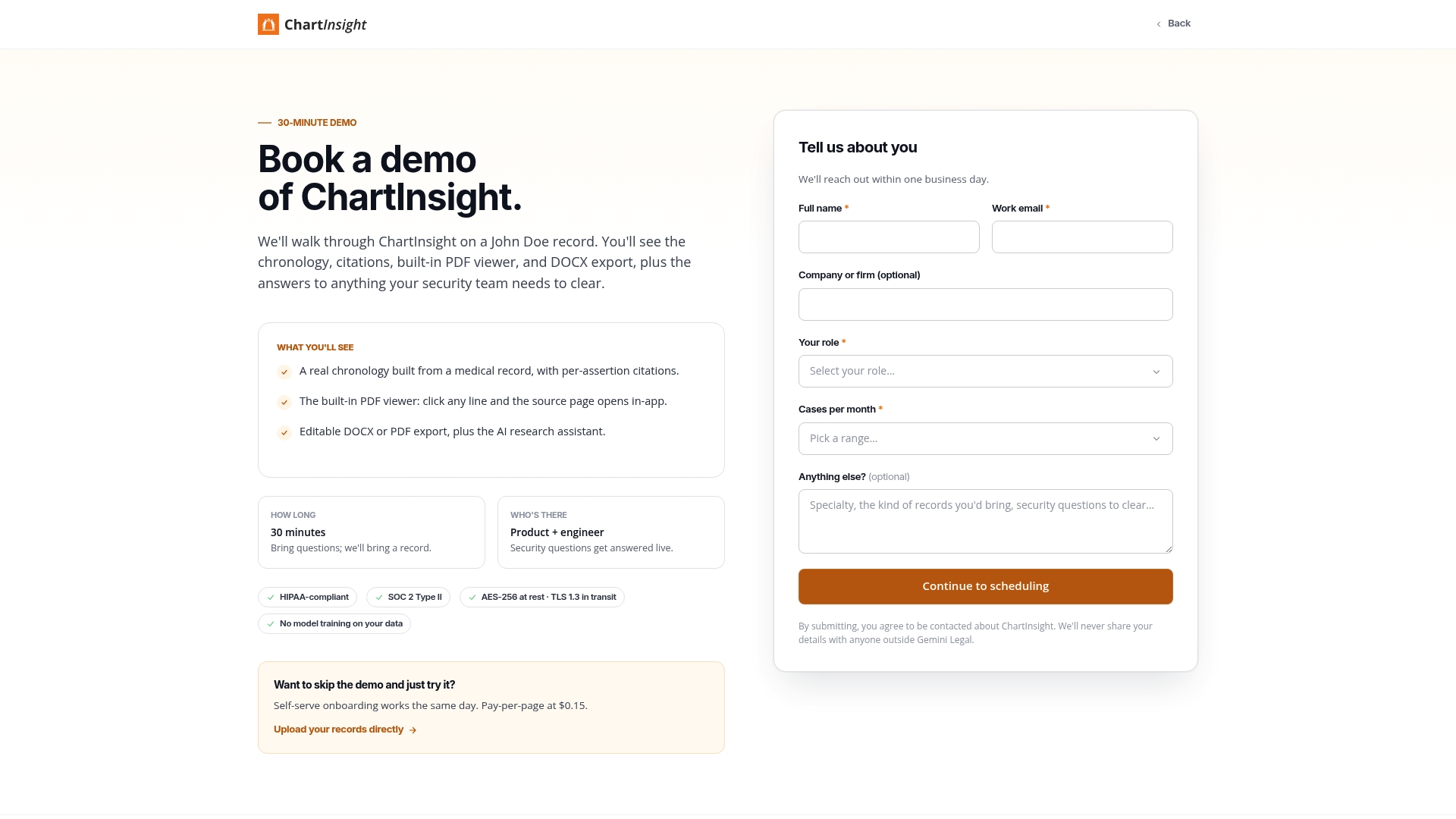
The table can be paired with a chronology and timeline export, both built on live citations, helping discrepancies flagged in the medication table appear consistently across the narrative summary. Teams can set up templates so med-legal reports or peer reviews come back in consistent structures, and exports to DOCX or PDF preserve page citations intact. Reviewers working stitched records that previously took days of manual cross-referencing can reduce the time needed to a matter of hours. If you want to see how it handles a record like the ones sitting in your queue right now, book a demo and bring a real file.
This article is general information, not a substitute for advice from a qualified lawyer. Consult a qualified legal professional about your own circumstances before acting on anything here.
Sources
- Medication reconciliation across EHR systems: discrepancies and RxNorm normalization (peer-reviewed, PMC)
- Medication reconciliation and 90-day readmission in CKD patients, quasi-experimental study (Journal of Pharmaceutical Policy and Practice)
- RxNav browser and API (U.S. National Library of Medicine)
FAQ
What Is the Best Way to Reconcile Medication Lists Across Multiple Providers?
Normalize every medication to its RxNorm ingredient identifier before comparing sources, then treat lawfully obtained dispense history as the ground truth when treating notes and claimant statements conflict.
Why Does RxNorm Normalization Matter for Medication Reconciliation?
Medication lists pulled from different EHR systems match only a very small percentage of the time at the exact drug level but a substantially higher percentage once normalized to ingredient level, according to a cross-EHR discrepancy study, so skipping normalization creates false mismatches.
How Should I Document a Medication Discrepancy in a Report?
State the evidence snippet with its exact citation, describe the discrepancy in neutral language, note the possible clinical implication, and suggest a concrete next step such as a pharmacist review or prescriber query.
Should I Trust Dispense History Over a Discharge Summary?
Generally, yes. Dispense history reliably shows prescriber, pharmacy, and fill dates across a long timeline, while discharge summaries and progress notes only reflect what a provider believed at one visit.
Can Software Speed Up Medication List Reconciliation?
Yes. Platforms like ChartInsight™ extract and normalize medication entries from large stitched PDFs and attach a page citation to every entry, cutting a process that takes days of manual review down to hours while keeping every finding traceable to its source page.