

Return-to-work restrictions are the treating clinician's task-level and schedule limits defining what an employee can safely do while recovering. If you've been handed a restriction note, the immediate move is simple: give a copy to HR or your supervisor in writing and ask for either a written accommodation offer or a written reason for denial. Expect the situation to intersect with OSHA recordkeeping rules, workers' comp procedures, and possibly the ADA or FMLA.
TL;DR:
- Return-to-work decisions are easiest to defend when they rest on specific, task-level restrictions with clear time frames rather than vague directives.
- Useful documentation includes task breakdowns, written offers or denials, the underlying medical records, and follow-up schedules.
- OSHA recordkeeping treats restricted work and days away from work differently, and the classification affects the figures an employer records on its OSHA 300 Log.
- Written communication and timely evaluations are essential for disputing return-to-work restrictions or denials, especially when legal or insurance claims are involved.
- A structured return-to-work program with consistent tracking and clear documentation reduces delays, re-injury risks, and legal vulnerabilities for employers.
Table of Contents
- What Are Return-to-Work Restrictions, Exactly?
- Light Duty vs. Modified Duty vs. Alternative Work
- The Legal Framework: ADA, FMLA, and Workers' Comp Together
- OSHA Recordkeeping: Restricted Work vs. Days Away
- How to Document Restrictions So They Hold Up
- When an Employer Refuses or Denies a Return
- Building an RTW Program: A Checklist for Employers
- Why Page-Cited Records Change the RTW Timeline
- Where RTW Documentation Usually Breaks Down (and How to Fix It)
- Get a Faster, Defensible Record Review With ChartInsight™
- Sources
- FAQ
What Are Return-to-Work Restrictions, Exactly?
Restrictions come from a treating physician, or in workers' comp cases, from an Agreed Medical Examiner (AME), Qualified Medical Evaluator (QME), or Independent Medical Examiner (IME). A restriction is only useful if it's written at the task level and tied to a time frame. "No heavy lifting" is not a restriction an employer can act on. "No lifting over 15 pounds, no overhead reaching, for four weeks" is.
Common restriction types include:
- Weight and lifting limits (often broken into occasional versus frequent lifting)
- Limits on repetitive bending, kneeling, or stooping
- No driving or operating machinery
- Reduced hours or no overtime
- No prolonged standing or a requirement for seated work
Duration matters as much as the task itself. A restriction might be temporary, pending a follow-up exam in two weeks, or it might run until the employee reaches Maximum Medical Improvement (MMI), called Permanent and Stationary (P&S) status in California workers' comp cases. Every follow-up visit is a checkpoint where restrictions get renewed, loosened, or lifted entirely, and each one should generate a new dated note.
Light Duty vs. Modified Duty vs. Alternative Work
These terms get used loosely, but they mean different things in practice, and the difference affects pay and duration.
- Light duty usually means the same job, temporarily reduced in intensity, such as a warehouse worker moved off pallet-jack duty but kept in the same department.
- Modified duty means the employer changes specific tasks within the existing role, like removing lifting requirements while keeping everything else the same.
- Alternative work means a different position altogether, sometimes in another department, when the original job can't be adjusted to fit the restrictions.
Pay and duration expectations vary by state and by claim type. California's injured worker guidebook is more specific: the claims administrator sends the offer within 60 days after learning the disability is permanent and stationary, qualifying modified or alternative work must last at least 12 months and pay at least 85% of the prior wages and benefits, and the worker has 30 days to accept. Remote work and part-time schedules increasingly show up as modified-duty options, particularly for office-based roles where the physical restriction doesn't touch the actual job function.
The Legal Framework: ADA, FMLA, and Workers' Comp Together
Three separate legal frameworks often apply at once, and confusing them causes most disputes.
The ADA requires reasonable accommodation for a qualifying disability, decided through an interactive process between employer and employee. Workers' comp law requires suitable work when the injury is job-related, and it's governed by state rules, not the ADA. FMLA protects job-guaranteed leave for a qualifying serious health condition, separate from whether the job itself gets modified.
An employer can lawfully delay a return when the restriction genuinely can't be accommodated safely, or when no suitable work exists, but that delay needs a documented, specific reason, not a vague "we'll get back to you."
Practical steps that protect both sides:
- Employees should submit every restriction note in writing and keep a personal copy, along with dated copies of every email exchange with HR.
- Employers should issue every accommodation or duty offer in writing, specifying the actual tasks and hours involved.
- Both sides should log follow-up appointment dates so restriction expirations don't get missed.
The DOL's Stay at Work/Return to Work initiative describes early return-to-work strategies as succeeding by returning injured workers to productivity as soon as is medically possible during recovery, which is why the documentation trail around those early weeks is worth keeping carefully.
OSHA Recordkeeping: Restricted Work vs. Days Away
This is where a lot of employers get tripped up, and it has real consequences for the OSHA 300 log.
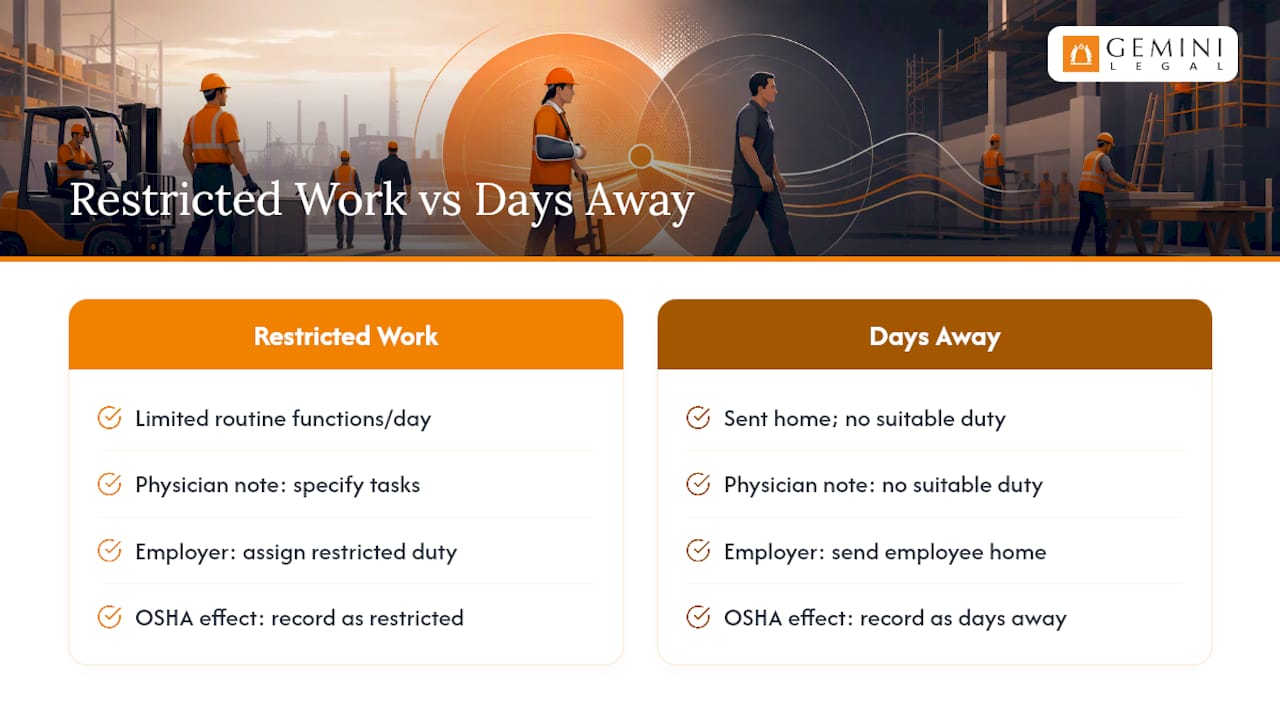
A case counts as restricted work when a clinician or the employer keeps an employee from performing one or more routine job functions, or from working a full scheduled day. 29 C.F.R. 1904.7 states that criterion directly, and an OSHA standard interpretation applies it to the "routine function" question, explaining that an activity performed only once or twice a month is not a routine function for recordkeeping purposes.
Pro Tip: If your restriction note doesn't specify which routine tasks are affected, ask the physician to revise it. A vague note makes it impossible for the employer's recordkeeper to classify the case correctly, and that ambiguity tends to work against the injured employee later.
If no suitable restricted-duty work exists and the employer sends the employee home, 29 C.F.R. 1904.7 treats the case as a days-away-from-work case rather than a restricted-work case. Both types are recorded on the OSHA 300 Log, but in different columns, so the classification changes what the employer's own injury and illness summary reports.
How to Document Restrictions So They Hold Up
A restriction note only protects you if it says enough. A strong physician note states the specific task limited, the numeric threshold (weight, hours, frequency), the expected duration, and the date of the next scheduled review.
Employers should meet that with a written job-task breakdown, not a job title. List the actual physical and time demands of the role, then compare each line against the restriction.
Keep these on file, on both sides of the table:
- Every restriction note and its revisions, in order
- Written job offers and any written denial with reasons stated
- All email or letter correspondence about the return
- Relevant state workers' comp forms (DWC-1 in California, OWCP forms for federal claims)
- A copy of the medical record excerpt the restriction is drawn from
That last item matters more than most people realize. A study of pain documentation in primary care found that while the presence of pain was documented in 95.4% of cases, documentation of the remaining quality indicators ranged from 56.9% down to 8.5%, with reassessment and functional detail among the thinnest. Restriction language drawn from notes like these is worth checking against the underlying record rather than quoting on faith.
When an Employer Refuses or Denies a Return
If you're told there's no work available, or the offer doesn't match your restrictions, don't let it stay verbal.
- Put the restriction in writing to HR immediately, and ask in writing for the specific reason behind any denial.
- Preserve every communication, including texts, emails and voicemail transcripts, because informal denials tend to get walked back once documented.
- File through the correct administrative channel: a workers' comp claim adjuster for injury-related restrictions, DWC or OWCP procedures depending on jurisdiction, or an OSHA complaint if the dispute involves recordkeeping or retaliation.
- Request a second-opinion or evaluating-physician examination through whichever system governs the claim, such as a QME or AME in California workers' comp or a second-opinion examination in a federal OWCP claim, if the employer disputes the treating physician's restriction.
- Bring every document above to an attorney the moment the employer's response stops being timely or specific. Waiting rarely helps; missed deadlines can forfeit rights under state comp statutes.
Building an RTW Program: A Checklist for Employers
A functional stay-at-work/return-to-work program isn't complicated, but it needs structure. The DOI's RTW handbook, written for a federal agency's workers' compensation program, states that "medical documentation is the key component for RTW" and assigns workers' compensation staff the job of contacting the injured worker at reasonable intervals for updated duty-status documentation. The same three ingredients transfer to a private employer: early contact, a person who owns the process, and offers grounded in documentation rather than guesswork.
- Maintain a written RTW policy that names who owns the process
- Contact the injured employee within days, not weeks, of the injury
- Keep a duty-description template ready for every role
- Use a written-offer template that states tasks, hours, and duration explicitly
- Track every case on a spreadsheet with restriction start and review dates
| Metric to monitor | Why it matters |
|---|---|
| Average time off before RTW offer | The DOL's early-intervention guidance is the reason to watch this number |
| Offer acceptance rate | Low acceptance often signals offers don't match real restrictions |
| Re-injury rate after RTW | Flags whether modified duty is actually being followed on the floor |
Review the policy annually, and after any claim that stalls past 90 days.
Why Page-Cited Records Change the RTW Timeline
Every RTW dispute eventually comes down to one question: what did the record actually say, and when? Reviewers who spend hours flipping between a summary and a PDF to answer that question are doing work that should take minutes.
ChartInsight™ builds outputs specifically for that moment:
- A cited chronology showing exactly when a restriction first appeared and which visit note introduced it
- A vitals table and medication list normalized across providers, so a reviewer isn't reconciling ten different formats
- A nine-section narrative summary, with a dedicated Return to Work section covering restrictions, disability status and return date, where every factual claim links to the exact page it came from
For an orthopedic record review, that means a claims adjuster or defense attorney can confirm a lifting restriction traces back to a specific exam note in seconds, not after an afternoon of scrolling.
Where RTW Documentation Usually Breaks Down (and How to Fix It)
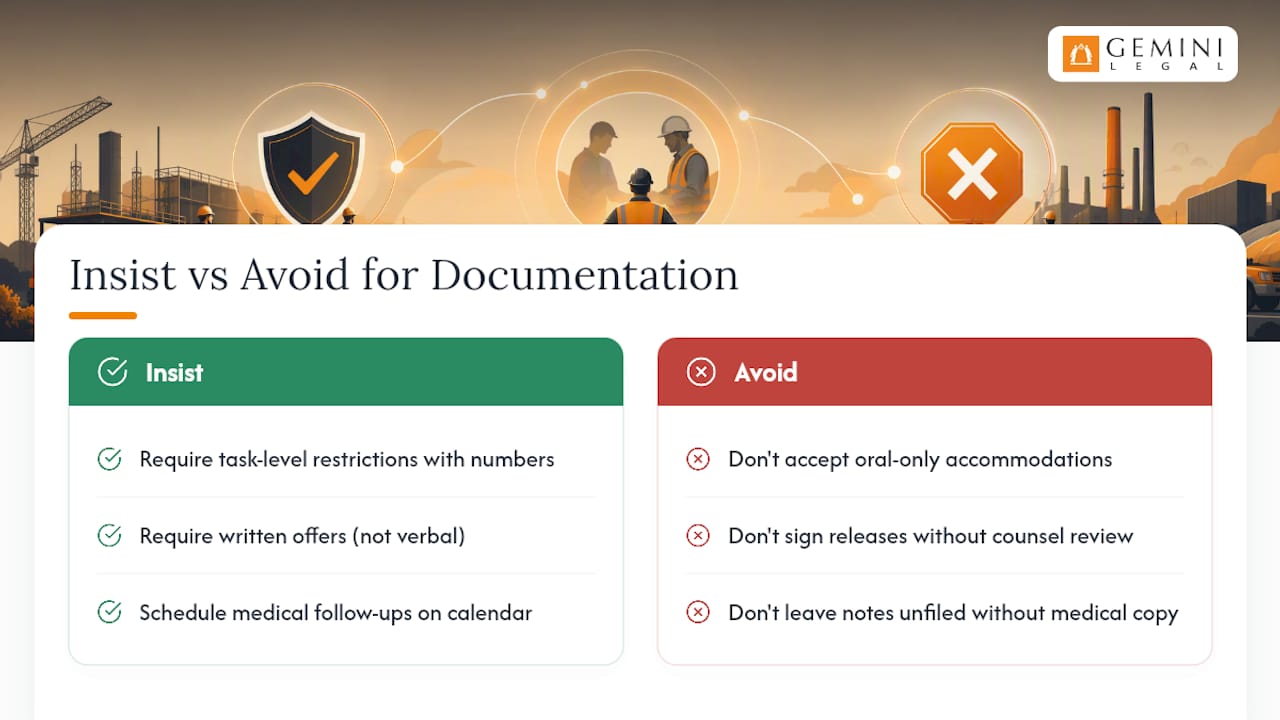
The most common documentation failure isn't fraud. It's vagueness: a restriction note that says "modified duty" without specifying what that means, or an employer offer with no written job-task breakdown behind it.
Three things to insist on: task-level restrictions with numbers attached, written offers instead of verbal ones, and scheduled medical follow-ups that actually happen on the calendar. Three things to avoid: accepting an oral-only accommodation, signing a release without counsel reviewing it first, and letting a restriction note go unfiled without a copy of the underlying medical excerpt behind it.
Get a Faster, Defensible Record Review With ChartInsight™
ChartInsight™ turns a multi-provider medical record, often thousands of pages, into a cited chronology and narrative summary, with every fact linked to its exact source page.

That matters most in exactly the disputes covered above: confirming when a restriction started, which note supports it, and whether an employer's offer actually matched the medical limits on file. The workers' comp record review workflow keeps the original PDF untouched, opens the source page directly inside the app when you click a citation, and exports to DOCX or PDF with those citations intact. If you're preparing a med-legal report or defending an RTW decision, book a demo to see how the chronology and vitals tables hold up against your own case file.
This article is general information, not a substitute for advice from a qualified lawyer. Consult a qualified legal professional about your own circumstances before acting on anything here.
Sources
- 29 C.F.R. 1904.7, General recording criteria (OSHA)
- Restrictions from restricted work activities, OSHA standard interpretation (2006)
- Stay at Work/Return to Work, U.S. Department of Labor
- Chapter 6, California Injured Worker Guidebook (DIR)
- DOI Return to Work Handbook
- Development and application of an electronic health record information extraction tool to assess quality of pain management in primary care (Translational Behavioral Medicine, 2014)
FAQ
What does return to work with restrictions mean?
It means a treating clinician, AME, QME, or IME has set specific, time-bounded limits on tasks, hours, or physical activity that the employee can safely perform while recovering, and the employer must evaluate whether it can accommodate those limits.
Can my employer refuse to let me return to work after surgery?
Whether an employer can decline depends on the governing framework, and the answer usually turns on whether suitable work matching your restrictions exists and whether the employer engaged with the question. A documented, specific reason is far easier to defend than a vague or verbal-only refusal, which is why getting the reason in writing matters.
What not to disclose to HR?
You're generally not required to disclose your full diagnosis, only the functional restrictions your physician has identified, so share the restriction note itself rather than detailed medical history.
Can my employer deny my return to work?
Sometimes, and the reason matters. A written, specific reason tied to actual job requirements or safety is the defensible form of a denial; a vague one is where disputes start. Either way, a denial is the point at which the administrative and legal routes covered above become relevant, including a workers' comp claim, an OSHA complaint if recordkeeping or retaliation is at issue, or a request for a second medical opinion.