

A medical chronology is a date-ordered, page-cited timeline that links every clinical event to its exact source page. The sample below gives you a working structure you can adapt instead of building from scratch.
The standard industry term is "medical chronology," though some firms call it a medical history timeline or medical documentation timeline. Whatever you call it, the format is the same: a table, not a narrative summary, that lets an attorney, adjuster, or QME trace a claim back to the page it came from. That page-level traceability is what separates a defensible chronology from a glorified table of contents. Chronological presentation of care is familiar outside litigation too: the AMA's patient-facing symptom and medical history timeline asks patients to lay out symptoms, clinicians seen, and treatments in date order, though it carries no page citations because a patient fills it in rather than building it from a record.
Here's a minimal one-page layout you can drop into a spreadsheet today:
| Date | Event/Finding | Provider | Intervention | Outcome | Page Cite |
|---|---|---|---|---|---|
| 03/14/2025 | ER visit, low back pain post-MVA | St. Mary's ER | X-ray, Toradol IM | Discharged, referred to ortho | ER_StMarys_p.4 |
| 03/21/2025 | Ortho consult, L4-5 disc bulge noted | Dr. Alvarez, Ortho | MRI ordered | Physical therapy referral | Ortho_Alvarez_p.4 |
| ~Apr 2025 | MRI results reviewed | Dr. Alvarez, Ortho | Epidural steroid injection scheduled | Pain, severity decreased | Radiology_p.2 |
- Keep entries to one line each; put nuance in a notes column, not the event field.
- Use month-year precision when exact dates are missing rather than guessing.
- Cite the source document name and original page number, never a rebuilt page number from your export.
Pro Tip: Build the chronology before you write the demand letter, not after. Attorneys who reverse this order end up quoting page numbers from memory, and that's exactly where citation errors creep in.
Platforms like ChartInsight™ generate this structure automatically from a full PDF record, with citations to source pages, which removes most of the manual assembly and citation work on multi-provider files.

Key Takeaways
A defensible medical chronology depends on consistent page citations, clear sequencing of events, and a workflow that preserves source traceability from intake through export.
| Point | Details |
|---|---|
| Use a page-cited table | Document name plus original page number for every entry, not a generic exhibit label. |
| Sequence before detail | List sentinel events first, then populate clinical detail. Order matters more than volume. |
| Flag approximations | Mark month-year or estimated dates clearly rather than presenting guesses as exact. |
| Match format to use case | Expand different fields for demand letters, depositions, P&S reports, or apportionment analysis. |
| Choose workflow by volume | Manual suits low-volume sensitive files; ChartInsight™'s page-cited AI extraction suits large, multi-provider records. |
Table of Contents
- Sample Medical Chronology Table and How to Read It
- How Do You Create a Medical Chronology?
- What Fields Make a Chronology Legally Defensible?
- How Do You Cite Source Pages Correctly?
- How Is a Chronology Used Differently for Each Litigation Task?
- Manual, Outsourced, or AI-Assisted: Which Workflow Fits?
- What Should You Expect for Turnaround Time and Cost?
- What Mistakes Undermine a Chronology's Defensibility?
- What Matters Most When You're Short on Time?
- Get a Faster, Fully Cited Chronology From Your Own Records
- Sources
- FAQ
Sample Medical Chronology Table and How to Read It
The table above is a skeleton. A real chronology for a rear-end collision case might run dozens to a couple hundred rows, but the columns rarely change: date, clinical finding, provider, intervention, outcome, and page citation. Add a billing reference column when CPT or ICD codes matter to the claim.
Here's how a paralegal turns three rows into a causation sentence for a demand letter: "Plaintiff presented to St. Mary's ER on 03/14/2025 with acute low back pain following the collision (ER_StMarys_p.4), was diagnosed with an L4-5 disc bulge one week later (Ortho_Alvarez_p.4), and began injection therapy within three weeks (Radiology_p.2)." That's the whole value of the format: a cluster of rows becomes one defensible sentence, with each clause traceable to a page.
- Place the page citation in its own column, never buried in the notes field.
- Keep billing references separate from clinical notes so a reviewer can't mistake a charge entry for a diagnosis.
- Sort by date first, then by provider, so gaps in treatment are visible at a glance.
How Do You Create a Medical Chronology?
Building a defensible chronology follows five steps, whether you're doing it manually or reviewing an AI-generated draft.
- Collect every record. Pull from patient portals, records requests, and billing departments, and assemble everything into a single PDF archive. Preserve original page numbering. The HHS HIPAA guidance for consumers explains an individual's right to obtain copies of their medical records, which is where a complete archive starts.
- Brain-dump sentinel events first. Before touching the table, list the five to ten events that actually matter: the ER visit, the surgery, the MMI determination. Use month-year precision where exact dates aren't available yet, and mark those entries clearly as approximations.
- Populate the table. Add date, provider, clinical detail, intervention, and page citation for each event. Prioritize sequence over exhaustive detail. A chronology that captures order and outcome beats one that transcribes every progress note.
- Flag gaps. Note pending test results, unresolved referrals, or unexplained treatment lapses for expert follow-up.
- Quality-check and export. Review the table against source pages, then export to DOCX or PDF with citations intact.
Pro Tip: Steps 1 and 2 take the longest if you skip them. Most delays come from chasing missing records mid-build, not from the table itself.
What Fields Make a Chronology Legally Defensible?
A chronology missing any of these fields invites challenge on cross-examination.
- Date or month-year, with approximations clearly marked.
- Event or finding, stated in plain clinical language.
- Provider or facility name, spelled consistently across every row.
- Intervention or procedure, including medication changes.
- Outcome or next step, so a reader can follow the arc of care.
- Page citation, document short-name plus original page number.
- Billing reference (CPT/ICD) when cost or causation is contested.
Beyond the columns, the document itself needs metadata: patient identifiers, a list of source documents, the page-numbering method used, and the preparer's name and date. Version control matters too. If a chronology gets revised after a new records production, the prior version needs to be retrievable, because opposing counsel will ask which version informed which expert opinion.
| Metadata Field | Why It Matters |
|---|---|
| Preparer name and date | Establishes who is accountable for accuracy |
| Source document list | Lets opposing counsel verify completeness |
| Page-numbering method | Prevents citation drift after re-scanning |
| Version number | Tracks which draft an expert reviewed |
How Do You Cite Source Pages Correctly?
Every entry needs a citation format that survives a records challenge. Use a short document name plus the original page number, something like "ER_StMarys_p.23" rather than a generic "Exhibit 4." That naming convention has to carry through every export, not just the working spreadsheet.
- Preserve the source's original page number, not a renumbered page from your combined PDF.
- Use exact dates when the record supports them; mark approximations with a tilde, like "~Mar 2024," rather than presenting a guess as fact.
- Add preparer initials, a preparation date, and a short notes field for any assumption you made when a record was ambiguous.
Pro Tip: If two source documents give conflicting dates for the same event, cite both and note the discrepancy. Silently picking one is how chronologies get impeached.
How Is a Chronology Used Differently for Each Litigation Task?
The same base table serves different purposes depending on where the case is headed.
- Demand letters: emphasize the timeline of care, total cost of treatment, and measurable functional outcomes.
- Deposition prep: expand the notes field on open questions and attach key document excerpts with their citations ready to hand to the witness.
- Expert reports (P&S, IME/QME): add clinical context, comparator baselines for similar injuries, and flag specific rows for the expert to address directly.
- Apportionment and workers' comp: document pre-existing conditions and prior comparable events with precise dating, since apportionment analysis depends on distinguishing new injury from prior impairment.
Manual, Outsourced, or AI-Assisted: Which Workflow Fits?
Three paths exist, and the right one depends on volume and turnaround pressure, not just budget.
Manual in-house review works best for low-volume or highly sensitive files where a paralegal's judgment on ambiguous entries matters more than speed. The tradeoff is reviewer variability and turnaround measured in days for anything over a few hundred pages.
Outsourcing to a specialist chronology vendor makes sense for firms with predictable volume. Confirm the vendor's page-citation practice and turnaround SLA before signing, since not every vendor preserves original pagination in its deliverables.
AI-assisted platforms, including ChartInsight™, handle large, multi-provider records fastest, producing structured chronologies with page citations preserved end to end. The ABA's overview of AI for legal document review describes the same pattern and the same condition: AI reduces manual review time on document-heavy work, and it requires human oversight, including verifying sources and citations. Standardized templates and prompt libraries help keep output consistent from reviewer to reviewer.
- Require a second-pass reviewer regardless of workflow.
- Spot-check citations against source PDFs before filing anything.
- Insist on version-controlled exports that preserve original page links.
Pro Tip: Ask any vendor or platform for a sample export before committing. If the citations don't survive the DOCX conversion, they won't survive discovery either.
What Should You Expect for Turnaround Time and Cost?
A single-provider, low-complexity case usually takes a few hours manually. More complex cases with many providers and large records take longer by hand, and AI-assisted workflows shift most of that time from assembly to verification.
- Cost structures vary by provider and by record complexity, so ask for the scope in writing before you commit.
- Before purchasing any service, require a sample deliverable and confirm page citations survive export.
What Mistakes Undermine a Chronology's Defensibility?
The most common errors are missing page citations, inconsistent page numbering after a re-scan, and dates presented as exact when they're really approximations.
- Watch for billing entries mislabeled as clinical notes.
- Spot-check 5 to 10 rows against the original PDF before relying on any chronology, including one your firm didn't build in-house.
- Confirm preparer initials and a version stamp appear on every draft.
Pro Tip: A chronology with zero flagged approximations is a red flag itself. Real records almost always have at least one ambiguous date.
What Matters Most When You're Short on Time?
Sequence and page-cited evidence answer causation questions faster than exhaustive verbatim notes ever will. If you're pressed for time, build a one-page timeline with clean citations and flag three to five entries for expert expansion rather than transcribing the entire file. Keep templates consistent across staff. Variability between reviewers, not the format itself, is usually what gets a chronology challenged.
Get a Faster, Fully Cited Chronology From Your Own Records
ChartInsight™ turns a stack of provider PDFs into a structured, page-cited chronology instead of a manual build. Every extracted event links back to its exact source page through an integrated PDF viewer, so a paralegal or QME can confirm a claim against the record without downloading a separate file or losing their place.
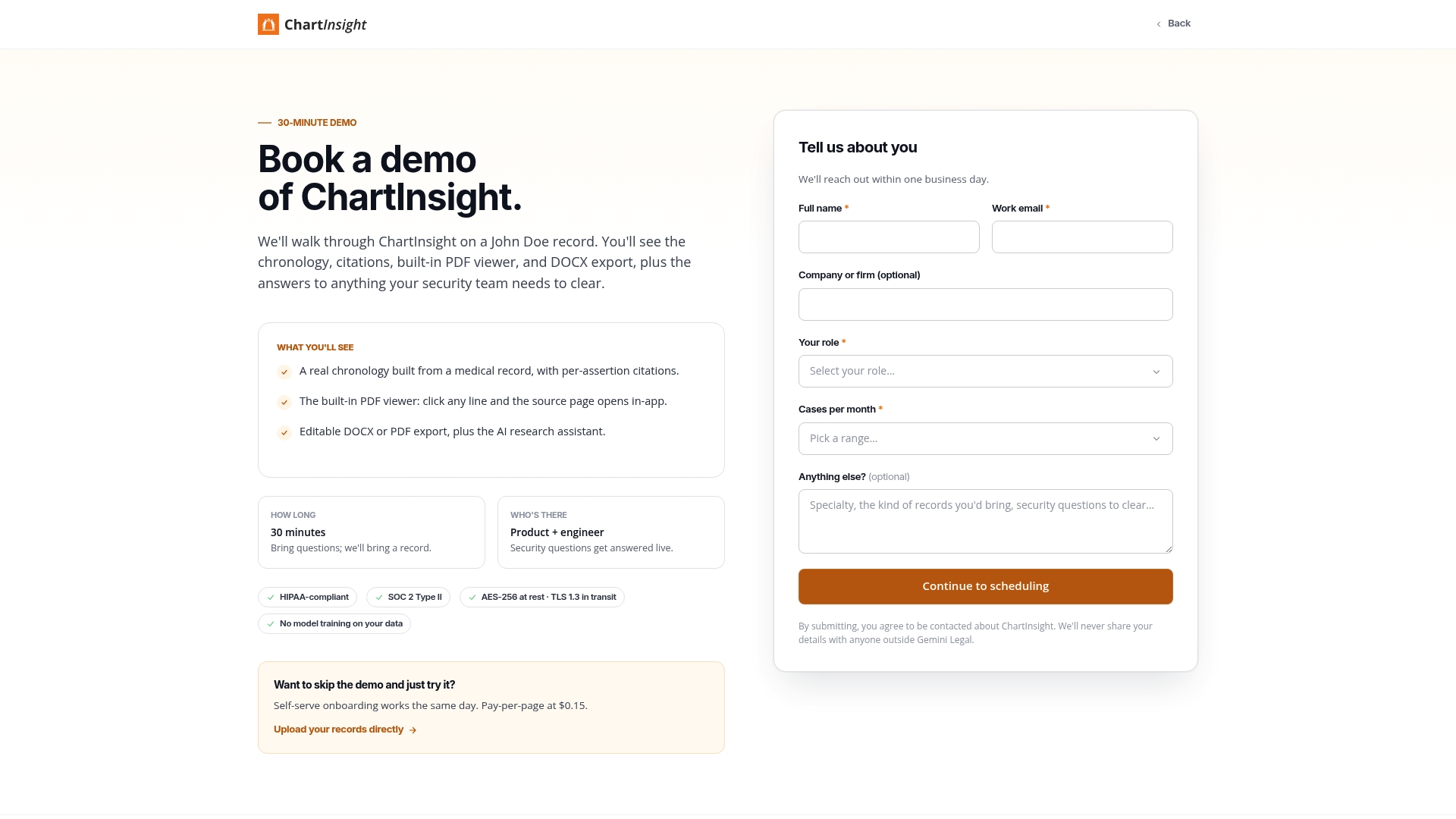
Teams set up templates and prompt libraries once, so a med-legal chronology or a peer review comes back in the same structure every time, regardless of who ran it. Outputs export to editable DOCX or PDF with citations intact, and a research assistant on the record lets a reviewer ask a direct question and get a cited answer that points back to the source pages. If your caseload includes complex, multi-provider files, book a demo and see how a real chronology export looks against your own records.
Sources
- AI for legal document review: a game changer for lawyers (American Bar Association, March–April 2025)
- Symptom and Medical History Timeline, patient-facing worksheet (AMA)
- HHS: Guidance materials for consumers (HIPAA)
This article is general information, not a substitute for advice from a qualified lawyer. Consult a qualified legal professional about your own circumstances before acting on anything here.
FAQ
What Is a Medical Chronology?
A medical chronology is a date-ordered, page-cited table that links each clinical event, from an ER visit to a follow-up procedure, back to its exact source page in the record. It differs from a medical summary because it prioritizes sequence and citation over narrative detail.
How Do You Create a Medical Chronology?
Collect every record into one archive, brain-dump sentinel events, populate a table with date, provider, intervention, and page citation, flag gaps, then quality-check and export. The full five-step process above walks through each stage.

Can You Give an Example of a Chronology Entry?
A typical row reads: "03/14/2025, ER visit for low back pain post-MVA, St. Mary's ER, X-ray and Toradol IM, discharged with ortho referral, ER_StMarys_p.4." Each field maps to a column in the sample table above.
What Are the Core Fields Every Chronology Needs?
At minimum: date, event or finding, provider, intervention, outcome, and page citation. Add a billing reference column when CPT or ICD codes affect the case.
How Long Does It Take to Build One?
A single-provider case takes one to three hours manually. Multi-provider cases take substantially longer by hand, and an AI-assisted platform like ChartInsight™ preserves page citations throughout extraction, so the work shifts from assembly to verification.