

Source-cited AI is a medical-record review system that produces structured outputs where every extracted fact links back to the exact page in the original PDF, ready to be verified by a licensed reviewer. That page-level traceability is what separates a defensible chronology from a liability. No AI output belongs in a QME report, deposition binder, or claims file until a human has confirmed it against the source record, and tools like ChartInsight™ are built around keeping that verification fast rather than optional.
TL;DR:
- Accurate verification involves spot-checking a sample of entries against source pages, focusing on dates, provider names, and clinical details.
- For large or poorly scanned records, stratified sampling is more effective than random checks to identify extraction drift.
- Vendors should provide transparency on dataset size, accuracy metrics, quality control processes, and citation preservation to prove reliability.
- Human review and correction are mandatory after initial AI extraction to ensure compliance with legal accountability standards.
- Exported reports must retain source citations in editable formats to support audit trails and defend the facts in court or claims processes.
Table of Contents
- What Does a Source-Cited AI System Actually Produce?
- How Do You Verify an AI-Generated Medical Summary?
- What Accuracy Evidence Should You Demand From a Vendor?
- How Do You Build Source-Cited AI Into a Review Workflow?
- Accountability First, Speed Second
- Get Page-Cited Chronologies and Summaries Without the Manual Cross-Check
- Sources
- FAQ
What Does a Source-Cited AI System Actually Produce?
The deliverables matter more than the underlying model. A source-cited AI system built for medical-legal work generally returns four things, each tied to a specific task in expert reports, discovery, or deposition prep.
- A chronology. Date-sorted, provider-attributed entries that support apportionment analysis and MMI/P&S determinations, where the sequence of treatment and findings often decides the outcome. Practitioner guidance on building medical chronologies for workers' comp stresses that entries need to be question-focused, not a flat transcript, so a reviewer can find the one visit that matters among hundreds.
- A nine-section narrative summary. Organized to mirror what an evaluator actually asks for: history, diagnostics, treatment course, current status, and so on, rather than a chronological dump.
- Normalized vitals and medication tables. Blood pressure, heart rate, pain scores, BMI, and blood glucose pulled into consistent units with dates attached, so a trend line (rising A1C over eighteen months, say) is visible instead of buried across forty progress notes.
- Editable exports. DOCX or PDF files that preserve the page citations and leave an audit trail, so the version that goes into a report is still checkable months later.
The common thread is traceability. A chronology entry that says "lumbar MRI positive for disc herniation, March 2024" is only useful if the reviewer can click through to page 214 of the record and confirm it says exactly that. How ChartInsight™ handles page citations is built around that one-click path, opening the source PDF inside the same window rather than forcing a separate download and search.
How Do You Verify an AI-Generated Medical Summary?
Verification isn't a courtesy step. Responsibility for AI output is non-waivable: courts have already sanctioned attorneys for filing unverified AI content, and the professional-responsibility rules land on the signer, not the software. Here's the sequence that holds up under scrutiny.
- Spot-check chronology entries against their cited pages. Pull a sample, confirm dates, provider names, and clinical notes match the source page exactly. Don't just skim the summary text.
- Check for omissions. Prior conditions, a provider who only appears once in 800 pages, an imaging report referenced but never summarized, supplemental records filed after the initial upload. Missing information is a bigger risk than wrong information, because nobody flags what isn't there.
- Confirm data integrity on vitals and medications. Units (mg vs. mcg), dosing frequency, and the date attached to each reading all need to trace back to a specific page. A blood pressure trend that looks alarming can turn out to be a unit transcription error.
- Log the verification. Reviewer name, date, what was checked, and any corrections made. Keep the original AI extract alongside the verified version, not overwritten by it.
QME reporting standards already require this level of rigor for the underlying record. The California Orthopaedic Association's QME report checklist requires physicians to document the number and dates of pages received and reviewed, and treats incomplete review as a reporting defect, not a technicality. AI-assisted summaries don't lower that bar. They just change where the reviewer's time goes.
Pro Tip: On records over a few thousand pages, don't spot-check randomly from the top. AI extraction quality can drift on documents that were scanned poorly or arrived as a stitched-together supplemental batch, and stratified sampling catches that drift faster than checking the same section twice.
What Accuracy Evidence Should You Demand From a Vendor?
Marketing claims about accuracy are worthless without a study behind them. Before trusting any source-cited AI tool with a case file, ask for three specific things.
- Sample size and dataset composition. A study run on 20 clean, single-provider records tells you almost nothing about how the tool handles a 2,000-page workers' comp file with five providers and inconsistent formatting.
- A defined indexing accuracy metric. Not a vague "highly accurate" claim, an actual measured rate against a defined test set.
- Operational quality control. Does a clinician audit layer sit on top of the raw extraction? How are supplemental records integrated, as a full re-run or a tracked revision? Is there any monitoring for hallucinated entries?
- Preserved citation exports. If the DOCX or PDF export drops the page links, the defensibility advantage disappears the moment the file leaves the platform.
ChartInsight™ publishes an AI Indexing Accuracy study covering 433 records, along with a case study on a 112,000-character summary that shows how the system holds up on genuinely large, multi-provider files rather than a clean test set. That's the level of specificity worth asking any vendor for, including this one.
How Do You Build Source-Cited AI Into a Review Workflow?
The tool works best as a first pass, not a final answer. Structuring the workflow around that one principle keeps speed and defensibility from fighting each other.
- Place AI extraction at intake, not at sign-off. Let it produce the chronology, narrative draft, vitals, and medication tables first. Human review, correction, and sign-off happen after, every time, with no exceptions for "obviously routine" files.
- Use templates and prompt libraries to standardize output. A med-legal report and a peer review need different structures. Setting up per-use-case templates means the AI output arrives in the right shape instead of getting reformatted by hand every time.
- Assign staff roles by matter access. Whoever touches a file, from paralegal to reviewing physician, should have defined permissions, which matters when a case gets audited later.
- Track supplemental records as revisions, not overwrites. When new records arrive mid-case, the system should show what changed and when, so opposing counsel or an auditor can trace the update instead of wondering why a chronology entry moved.
What actually gets faster: the first-pass extraction of a 3,000-page record, the initial vitals trend pull, and formatting a narrative into report-ready sections. What doesn't get faster, and shouldn't: clinical judgment calls, apportionment reasoning under the AMA Guides and MTUS, and the final read-through before a report goes to the DWC or opposing counsel. AI-assisted review can meaningfully cut turnaround time on record-heavy cases, but only once a clinician has actually checked the work.
Accountability First, Speed Second
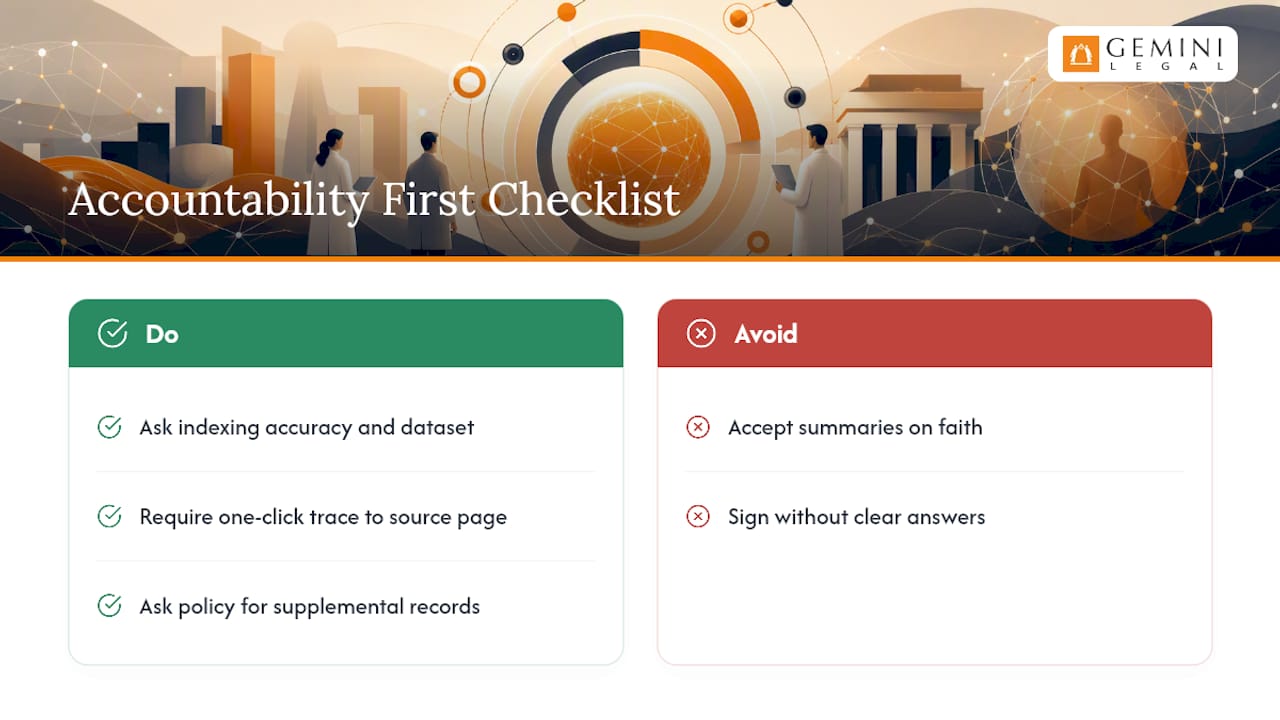
Every vendor selling AI for medical records will tell you it saves time. Fewer will tell you, plainly, that the professional signing the report is fully accountable for every fact in it, and that no software changes that. ChartInsight™ publishes its accuracy work, the 433-record indexing study and the 112,000-character summary case study, specifically to give reviewers something concrete to check the tool against, not something to take on faith.
Before accepting any outsourced AI summary, ask three questions: What's the measured indexing accuracy, and on what dataset? Can every fact be traced to a specific source page in one click? What happens when a supplemental record arrives after the first pass? If a vendor can't answer all three clearly, the summary isn't ready for your signature.
Get Page-Cited Chronologies and Summaries Without the Manual Cross-Check
ChartInsight™ turns a full medical record, chronology, structured narrative summary, vitals, medications, and any custom analysis your team runs, into outputs where every fact carries a live citation to its exact page. The integrated PDF viewer opens the source page in the same window, so confirming a fact takes a click instead of a search through a separate file. Exports to DOCX or PDF keep those citations intact.
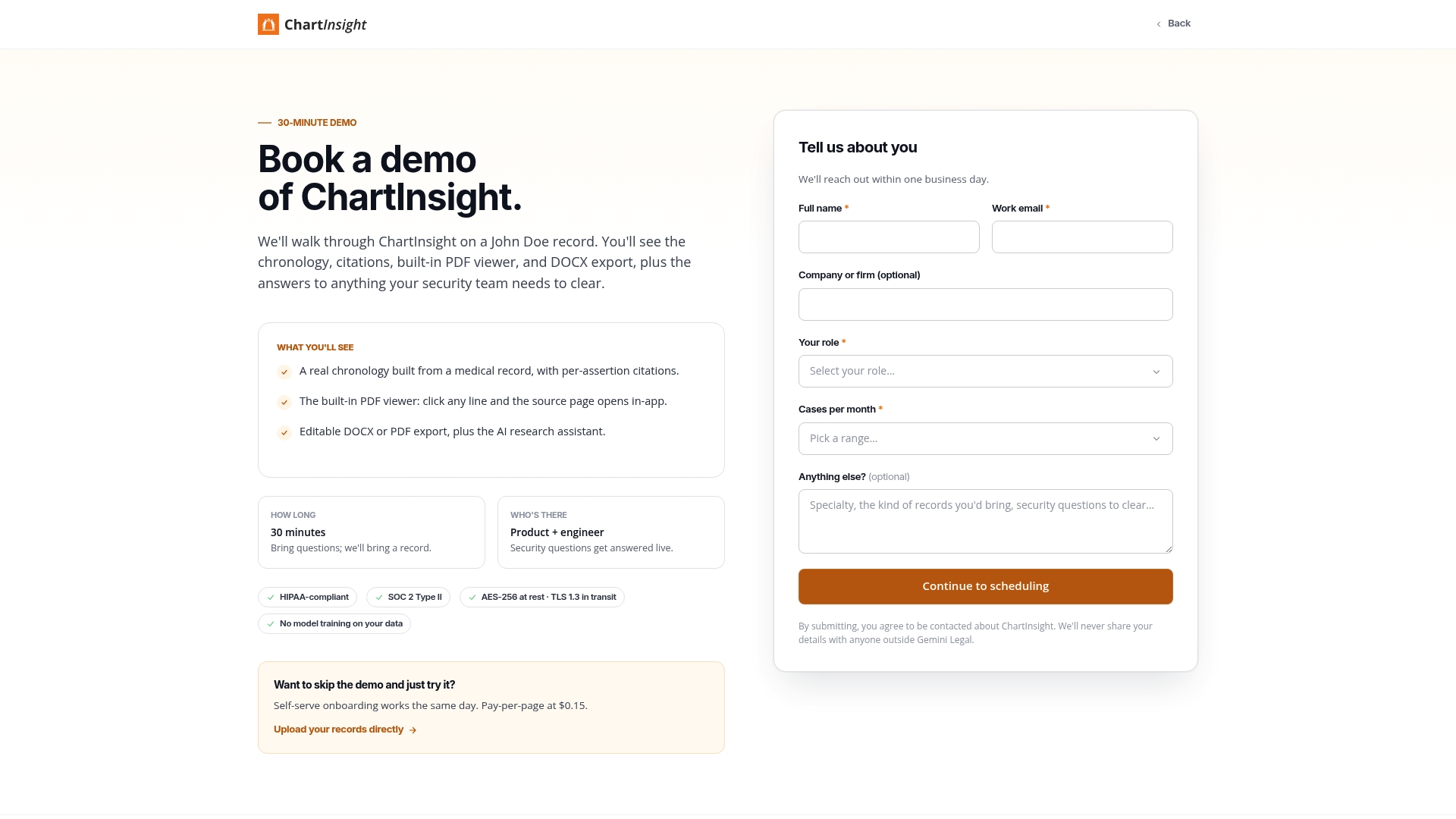
Reviewers working from records that used to take days typically get a first-pass extraction in hours, with the accuracy work available to check before you trust it on a real case. For attorneys handling personal injury files or clinicians reviewing psychiatric records for med-legal cases, the same page-citation structure applies across every deliverable. Book a demo to see how a record from your own caseload runs through it.
Sources
A few starting points worth reviewing before you finalize a vendor checklist or an internal review policy:
- Mata v. Avianca, Inc., No. 22-cv-1461, Opinion & Order on sanctions (S.D.N.Y. June 22, 2023)
- California Orthopaedic Association QME report quality checklist
These are starting points, not substitutes for asking a vendor the direct questions covered above.
FAQ
What makes an AI medical summary legally defensible?
A defensible summary requires page-level citations back to the source PDF for every extracted fact, plus documented human verification before it's used in a report or filing.
Who is responsible if a source-cited AI summary contains an error?
The reviewing professional who signs the report, not the software vendor, since professional-responsibility rules place accountability on the human reviewer.
How does ChartInsight™ preserve citations in exported reports?
Certain AI medical record review tools export editable DOCX or PDF files while preserving page citations attached to each fact, maintaining the audit trail outside the platform.
What should I check first when reviewing an AI-generated chronology?
Spot-check a sample of entries against their cited source pages for dates, provider names, and clinical notes, then check for omitted records or providers.
Do source-cited AI tools replace the need for a QME or IME physician's review?
No. Structured outputs speed up record review, but apportionment, MMI/P&S determinations, and clinical judgment under the AMA Guides and MTUS still require the evaluating physician.