

Before you cite a single line from an AI-generated summary in a report, deposition, or QME evaluation, trace that claim back to its exact source page and label it Supported, Not supported, or Not addressed. Record your initials and the date on that verdict, and never alter the original record while doing it. Systems with integrated, page-linked citations can cut this step from hours of page-flipping to a matter of minutes.
TL;DR:
- Verifying AI summaries involves manually linking each claim to its exact source page and labeling it supported, not supported, or unaddressed to ensure defensibility.
- A quick sanity check requires tracing three random claims to verify citation accuracy and metadata within 30 seconds each, flagging any inconsistencies for full review.
- Decomposing summaries into atomic propositions, retrieving corresponding source evidence, and assigning detailed verdicts improves transparency and alignment with clinician judgment.
- Confirming source page details, checking for temporal or scope mismatches, and cross-referencing neighboring records prevents false support claims.
- System-level quality metrics like parsing success, completeness, and support proportion should be tracked regularly, with attention to model drift through version control and ongoing sampling.
Table of Contents
- How Do You Verify AI Summaries for Med-Legal Defensibility?
- Quick Verification Checklist You Can Run in Under Five Minutes
- Step-by-Step Verification Workflow: Decomposition, Retrieval, Verdict
- What to Inspect in the Citation and Source Page
- Verification Checks and Metrics to Run
- Detecting and Managing Model Drift
- Writing the Verification Statement for a Defensible Report
- Building Verification Into the Workflow With ChartInsight™
- See Page-Linked Verification in Action
- Sources
- FAQ
How Do You Verify AI Summaries for Med-Legal Defensibility?
Verification is not a one-time glance at a summary to see if it "sounds right." It is a repeatable, documented process that treats every AI-extracted claim as unproven until you connect it to a page and a person accepts responsibility for that connection. The industry term for this is proposition-level verification, and it borrows directly from how clinical NLP researchers now test large language model outputs before trusting them in patient care or litigation.
The quick version: pull the claim, pull the page, compare them side by side, and write down a verdict. Do that consistently across a chronology or narrative summary and you have something a hearing officer, opposing counsel, or peer reviewer cannot easily pick apart.
Quick Verification Checklist You Can Run in Under Five Minutes
Before diving into a full proposition-by-proposition audit, run a fast sanity check on any AI summary that lands on your desk.
- Pick three claims at random and trace each to its cited page or Bates number. This should take under 30 seconds per claim if the citation is live and clickable.
- Confirm a verdict label, Supported, Not supported, or Not addressed, is actually recorded next to each claim you check.
- Cross-check metadata: does the note type, author, and date/time on the cited page match what the summary implies?
- Flag any gap: missing records, an ambiguous excerpt, or a claim that cites a page that does not exist in the record.
- Log who ran this check and when, even for a five-minute triage. That log becomes part of your defensibility trail.
Pro Tip: If even one of your three random claims fails to trace cleanly, treat the whole summary as unverified and escalate to a full proposition-level review before it goes anywhere near a report.
Step-by-Step Verification Workflow: Decomposition, Retrieval, Verdict
The method behind this checklist comes from proposition-level evaluation research, most notably the VeriFact framework, which decomposes clinical summaries into atomic claims and checks each one against retrieved source evidence. VeriFact reached high agreement with clinician adjudication when scoring proposition support, indicating that this decomposition approach works better than judging a summary as a whole.
Here's how to apply the same logic manually or with a platform that automates it:
- Decompose. Break each summary sentence into single, atomic propositions. "Patient reported 8/10 low back pain and was prescribed gabapentin at the March 3 visit" is two propositions, not one.
- Retrieve. Pull the exact note, table row, or PDF page that should support each proposition. Capture the metadata: note type, author, date, and time.
- Assign a verdict. Label each proposition Supported, Not supported, or Not addressed, and write a one-line rationale citing the exact page.
- Flag borderline cases. Anything ambiguous, a paraphrase that stretches the source, a date that's close but not exact, gets held for secondary review rather than forced into a verdict.
An example pair: Proposition, "Provider documented 5/5 strength in bilateral lower extremities on the June 12 exam." Rationale, "Supported. See PT note, page 214, dated 6/12, author J. Alvarez PT: '5/5 strength BLE.'" That's the level of specificity a verification appendix needs.
Approaches like the LCDS logic-controlled attribution system build this same sentence-to-source mapping directly into generation, which is the direction the field is heading: attribution baked in at creation time, not bolted on after.
What to Inspect in the Citation and Source Page
A citation that points to a page is only half the job. You still have to confirm the page actually says what the summary claims it says.
- Check that the PDF page or Bates number, note type, author or role, and full date/time are all present, not just a page number floating with no context.
- Read the actual sentence. Is the AI quoting, or paraphrasing in a way that adds meaning that isn't there?
- Watch for temporal mismatches: a summary that treats a patient's remote surgical history as part of the current encounter is a common failure mode.
- Check negations and scope carefully. "Denies suicidal ideation" and "reports suicidal ideation" differ by one word that changes everything in a psychiatric QME.
- Look at neighboring notes and table rows for contradictory data, especially lab values and vitals, before accepting a single citation as the full picture.
- For any numeric claim, blood pressure, pain score, medication dosage, require row-level matching against the source table, not a general reference to "the chart."
Traceability research is blunt about why this matters: post-hoc AI detection tools are unreliable, and the Nature Digital Medicine review on provenance argues traceability has to be designed into the workflow itself rather than checked for afterward. A live citation that opens the actual source page is exactly that kind of built-in traceability.
Verification Checks and Metrics to Run
Beyond checking individual claims, a review team should track quality at the system level. The VALID framework organizes this into three categories: conformance (does the output match the expected format and schema), plausibility (does the extracted value make clinical sense), and consistency (do related fields agree with each other across the document).
A few metrics worth tracking on a rolling basis:
| Metric | What it measures |
|---|---|
| Parsing success rate (PSR) | Percentage of documents the system processed without extraction failure |
| Field completeness rate (FCR) | Percentage of expected fields (vitals, medications, dates) actually populated |
| Semantic consistency | Whether related claims across the summary agree with each other |
| Proportion supported | Percentage of propositions labeled Supported after manual review |
Run these against held-out samples, records you already fully abstracted by hand, so you have a benchmark to compare against. If proportion supported drops meaningfully on a new batch, or if a record type keeps triggering low completeness, that's your trigger for a full manual re-abstraction rather than a spot check.
Detecting and Managing Model Drift
AI outputs are not static. A vendor update, a prompt change, or a shift in the underlying model can quietly change how a system extracts or summarizes data, even when nothing on your end changed.
- Version-control your prompts, retrieval settings, and a set of frozen test cases so you can rerun the same regression check after any update.
- Schedule sampling of new outputs monthly, or immediately after any known model, prompt, or data change.
- Keep a change log documenting which model version, prompt, and retrieval configuration produced each run.
- Use canary runs, testing a small batch before full rollout, and have a rollback plan ready if drift shows up.
Even minor version updates can shift output behavior enough to warrant revalidating your frozen regression set. Treat "the vendor pushed an update" as a verification trigger, not a footnote.
Pro Tip: Keep at least ten frozen test records with known correct answers on hand at all times. Rerunning them after any system change takes fifteen minutes and catches drift before it reaches a live case.
Writing the Verification Statement for a Defensible Report
Your final report needs to show your work, not just your conclusions. A verification appendix should include every proposition checked, its verdict, the exact source page or Bates number, and the initials and date of whoever verified it.
- Explicitly flag missing records or evidence gaps rather than silently omitting them, and list what follow-up records would close the gap.
- Export the summary as DOCX or PDF with page citations preserved in the final document, not stripped out during formatting.
- Never alter the original record itself. Verification lives in a separate appendix or log, not as edits to source PDFs.
- Use consistent sentence templates so verdicts read the same way across a report:
| Verdict type | Sample template |
|---|---|
| Supported | "Per [note type], page [X], dated [date], authored by [provider]: '[quote].'" |
| Not supported | "Summary states [claim]; record at page [X] does not corroborate this finding." |
| Not addressed | "No documentation located addressing [claim] as of records reviewed through [date]." |
This structure holds up whether you're writing a QME report subject to AMA Guides apportionment analysis or a workers' comp chronology headed for a DWC hearing.
Building Verification Into the Workflow With ChartInsight™
Manual verification does not go away with better tools. What changes is how long it takes. When every extracted fact carries a live citation back to its exact PDF page, tracing a claim goes from minutes of page-flipping to a single click that opens the source inside the same window. That is the difference between reviewing a 112,000-character stitched record in a day versus a week.
Templates, prompt libraries, and defined staff roles matter here too. They keep the verification process consistent across reviewers, so a peer review and a med-legal chronology don't drift into different standards depending on who ran them. Case work on 433-record indexing accuracy backs up what practitioners feel anecdotally: the bottleneck was never generating a summary, it was proving the summary was right.
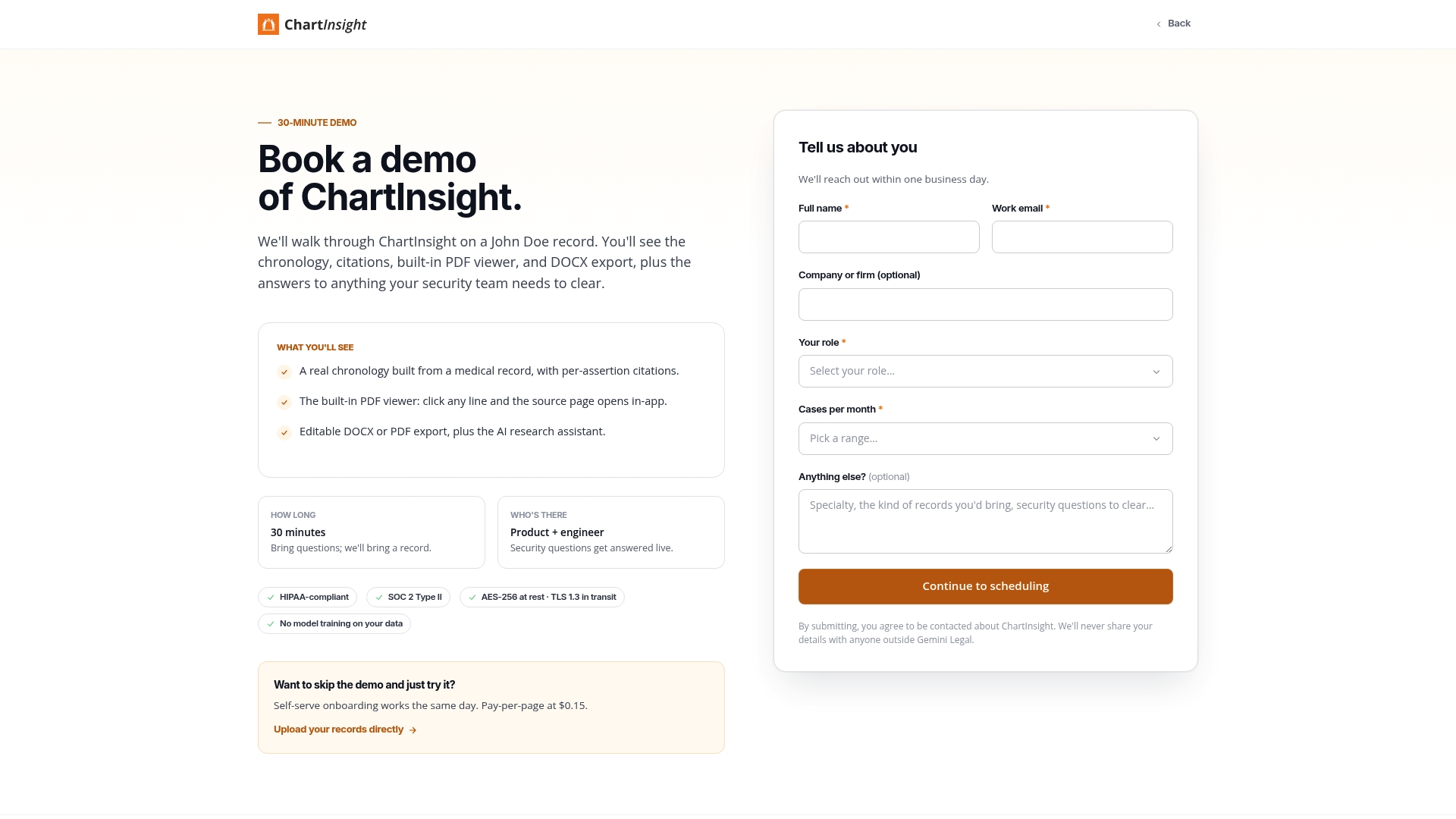
See Page-Linked Verification in Action
Reviewers who spend their days tracing claims back through thousand-page files know the real cost isn't writing the summary, it's proving every line of it. ChartInsight™ builds that proof into the workflow itself: every extracted fact in the chronology, narrative summary, vitals table, or medications list opens directly to its source PDF page with one click, so you verify as you write instead of after.
That matters most on the records that eat the most time, psychiatric histories with decades of scattered notes, multi-provider workers' comp files stitched from a dozen sources, or a personal injury record running past 100,000 characters.
Teams also use document classification and staff role settings to keep verification consistent across a firm, not just one reviewer's habits. If you're managing audit trails alongside AI outputs, the same discipline that regulated healthtech applies to software validation and QA checklists is worth borrowing for your own review process.
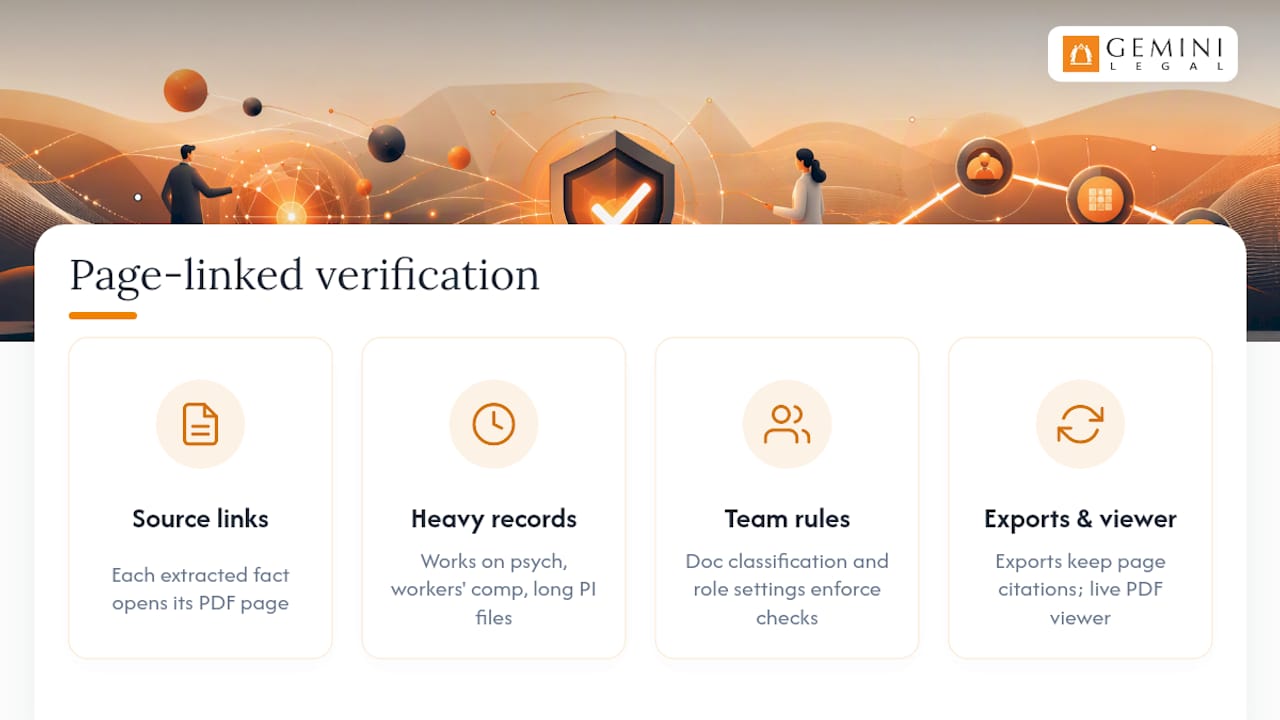
See how the exports preserve page citations and how the live PDF viewer works inside a real record. Book a demo and bring one of your own files to test it against.
Sources
- VeriFact: proposition-level evaluation and LLM-as-a-Judge for EHR summaries (arXiv)
- Validation of Accuracy for LLM-/ML-extracted information and data (VALID framework) - PMC
- Traceability and provenance in LLM medical outputs (Nature Digital Medicine)
This article is general information, not a substitute for advice from a qualified lawyer. Consult a qualified legal professional about your own circumstances before acting on anything here.
FAQ
What Does It Mean to Verify an AI Summary?
It means tracing every AI-extracted claim back to its exact source page and assigning a verdict, Supported, Not supported, or Not addressed, rather than trusting the summary at face value.
How Accurate Are AI Medical Summary Tools?
Accuracy varies by system and record complexity. Research on proposition-level evaluation, including VeriFact, shows agreement with clinician judgment as high as 92.7% when claims are checked individually against source evidence rather than judged as a whole summary.
What Is Proposition Decomposition?
It's the practice of breaking a summary sentence into single, atomic claims, so each one can be independently traced to a source page and labeled rather than accepting or rejecting an entire sentence at once.
How Does ChartInsight™ Help Verify AI Summaries?
ChartInsight™ attaches a live citation to every extracted fact, so clicking it opens the exact source PDF page inside the app, turning a verification step that once took hours of page-flipping into a matter of seconds per claim.
How Often Should Verification Checks Be Repeated?
Run spot checks on every new summary and full regression checks monthly or immediately after any model, prompt, or data change, since even minor updates can shift how a system extracts information.