

TL;DR:
- AI medical record review platforms that attach page-level citations to extracted facts, carry those citations into editable exports, and build in human verification are the ones that hold up in a deposition, a QME report, or a claims audit. They can turn multi-day manual review into hours of structured review work, and they support traceability rather than guaranteeing compliance. Run a structured pilot on your own records and verify extractions against source pages before committing.
For legal and insurance reviewers who need to defend every line of a summary, the right AI medical record review platform produces page-cited chronologies, editable exports with citations preserved, and a human-in-the-loop verification step. Without all three, the output is not defensible in a deposition, a QME report, or a claims audit.
- Time savings are real and measurable. A large medical record that would take several days to review manually can be processed into a structured chronology and a narrative summary in hours, with extracted facts linked to their source pages.
- Live PDF citations are the standard. ChartInsight attaches a page citation, a page or a page range, to extracted facts; clicking it opens the source PDF at that page inside the app, so a reviewer can verify a disputed injection date or medication start without leaving the platform.
- Specialist workflows matter. Med-legal use cases, including workers' comp, personal injury, and IME/QME reports, require templates built for those deliverables and the vocabulary they use, AMA Guides, MTUS, and DWC in California work comp, supporting those documentation requirements rather than generic clinical documentation tools.
The next step is a structured demo or pilot using your own records. The evaluation criteria below will tell you exactly what to ask.
Table of Contents
- How do you evaluate and choose the right platform?
- Where does AI medical record review add the most value?
- What does implementation actually look like?
- How accurate is AI medical record review, and how do you verify it?
- How fast is the turnaround, and what should you lock down in procurement?
- Key Takeaways
- Why live citations change how a record gets read
- ChartInsight gives legal and claims reviewers a faster path to defensible outputs
- FAQ
How do you evaluate and choose the right platform?
Vendor demos are polished. The evaluation process below is designed to get past the polish and test what actually matters in production.
Demo questions worth asking verbatim
- "Show me what happens when I click a citation in the chronology."
- "Can you run a 1,000-page ingestion right now and show me the output?"
- "Export this summary as a DOCX. Are the page citations in the document?"
- "What is your documented hallucination rate, and how do you measure it?"
- "Who signs the BAA, and what does your data retention policy say?"
Red flags to walk away from
- No page-level provenance on extracted facts, only section references or paragraph summaries.
- Exports that strip citations or require manual re-entry of source references.
- Accuracy claims with no underlying study, no sample size, and no methodology.
- Vague answers on PHI handling or an unwillingness to provide a BAA.
- No editable export format, only locked PDFs.
Where does AI medical record review add the most value?
The workflows below are where the time savings are sharpest and the defensibility requirements are highest. These are the right places to start a pilot.
- Personal injury and plaintiff/defense chronologies. A 500 to 1,500 page record from multiple treating providers can be reduced to a citation-ready chronology in hours rather than days. Attorneys preparing for deposition or drafting a demand letter get a navigable timeline with entries linked to their source pages. ChartInsight's personal injury workflows are built for this use case, with templates aimed at the deliverables PI attorneys actually produce.
- Workers' comp and QME/IME reports. Apportionment analysis under the AMA Guides requires a precise treatment history. A chronology focused on injury dates, treatment events, MMI/P&S determinations, and MTUS-relevant procedures gives a QME physician a structured starting point rather than a blank page. The workers' comp workflow in ChartInsight includes templates that support DWC documentation requirements.
- Psychiatric IME and expert review. Psychiatric records present unique extraction challenges: medication histories spanning years, multiple DSM diagnoses, and treatment gaps that matter for apportionment. Specialized psychiatric review workflows handle these records differently from orthopedic or physical medicine records.
- Insurance underwriting and accelerated underwriting. Extracting diagnosis codes, treatment patterns, and mortality-risk signals from applicant records at scale is a high-volume abstraction problem. A normalized vitals table and a medications list give underwriters structured data without manual abstraction.
- Claims handling and post-issue audits. Exportable vitals and medications tables in CSV format feed directly into actuarial review. An audit trail showing each extraction and its source page supports claims defense if a coverage decision is challenged.
For a practitioner-side view of how medical records function in injury claims, the 2026 injury claim records guide from Calil Law, a Miami personal injury firm, is useful further reading for teams assembling record sets before review. It is a Florida plaintiff-side perspective offered as context, not as authority on California work-comp requirements.
What does implementation actually look like?
Getting from a signed contract to a production workflow takes planning. The checklist below covers the operational steps that matter most.
Ingestion and setup
- Confirm the platform handles multi-provider PDF sets, including scanned documents with variable OCR quality.
- Set up Document Classifications so records are auto-categorized on intake by provider type, date range, or matter.
- Configure roles and access for everyone who touches the record: attorneys, paralegals, adjusters, and reviewing physicians. In ChartInsight, Staff Roles is part of the Matters preview and has to be enabled for your team.
- Load your Templates and Prompt Library before the first production record. A QME template and a personal injury template are different outputs; configure them before you need them.
Security and compliance
- Execute the HIPAA BAA before any PHI enters the platform.
- Confirm SOC 2 certification and ask for the most recent report.
- Verify encryption at rest and in transit, and confirm where customer data is stored.
- For ambient AI scribes used in clinical encounters, note that patient disclosure and consent are standard practice in many health systems before recording begins.
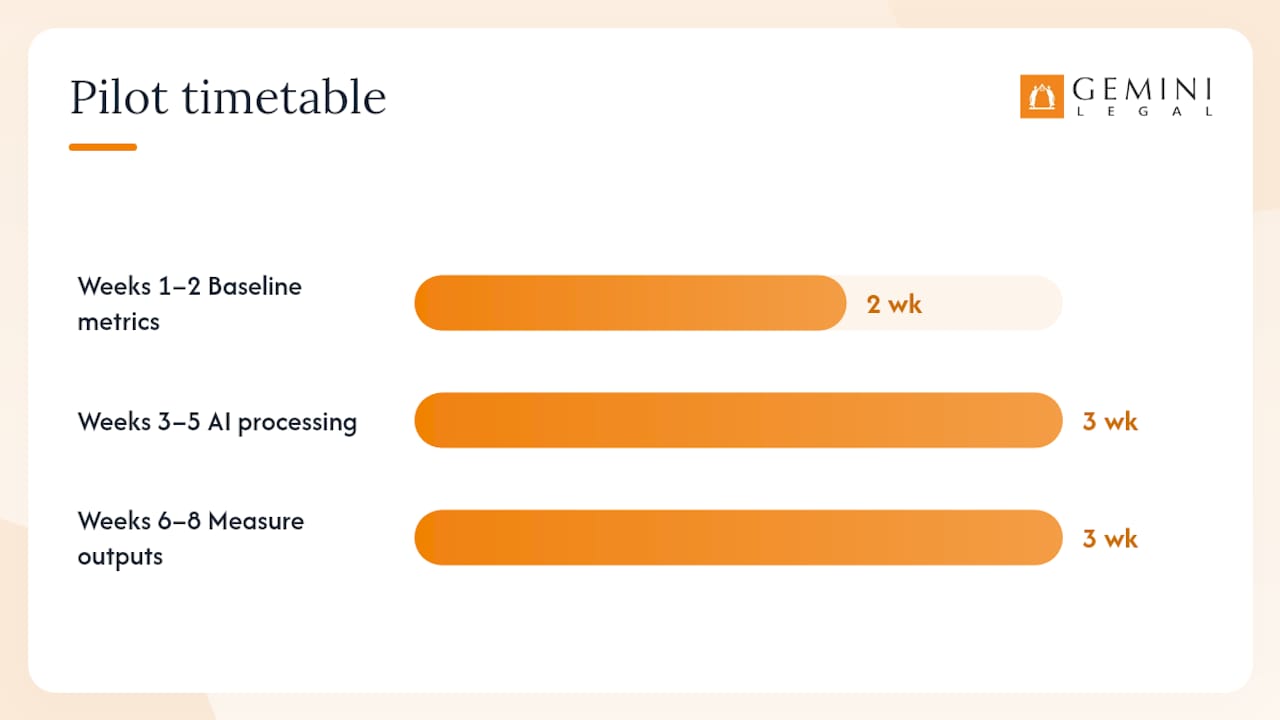
Pilot timetable: 4 to 8 weeks
- Weeks 1 to 2: Select 10 to 20 representative records. Establish baseline manual review times and output quality metrics.
- Weeks 3 to 5: Run AI processing on the same records. Compare outputs to the manual baseline using pre-defined disagreement metrics.
- Weeks 6 to 8: Measure time saved, citation accuracy, and export quality. Set SLAs for turnaround and accuracy before moving to production.
Pro Tip: Preserve the original record exactly as received. Never alter the source PDF. Every AI-extracted fact should link to that unaltered original, and the audit log should show the chain from ingestion to output.
How accurate is AI medical record review, and how do you verify it?
The honest answer is that AI improves speed significantly and can match human accuracy in controlled comparisons, but hallucinations and omissions are documented failure modes that require human oversight. A scoping review published in PMC found that AI tools using NLP and machine learning reduce clinician workload and can improve documentation accuracy, while also producing hallucinations, omissions, and fabricated information that require rigorous validation and continuous oversight. That finding was made in clinical documentation settings, and it carries the same warning into med-legal record review: the AI output is a starting point, not a finished product.
"The tool allows me to review a transcript of the encounter as well as 'linked evidence' that was used to produce a specific portion of the summary. This can be helpful if I find gaps in the summary that I need to fill in."
Paul M. Scholten, M.D., physiatrist, in a Mayo Clinic Q&A on AI clinical documentation tools
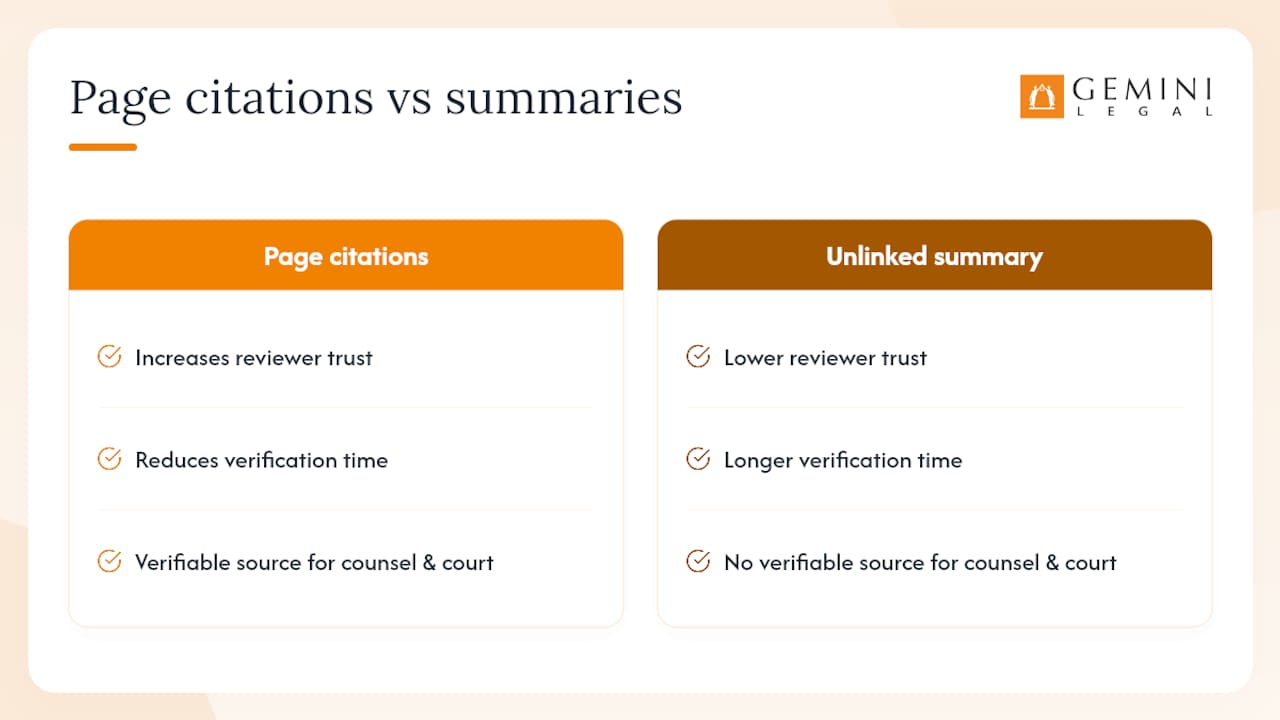
One physician's account is not a study, but it names the mechanism reviewers rely on: a path from the summary back to the underlying evidence. For legal and claims work, that has a direct implication. An AI summary without page-level citations is not verifiable in the time a reviewer has, because checking it means going back to the raw PDF, which defeats the purpose.
ChartInsight addresses this directly. Chronology entries, narrative summary statements, vitals, and medications carry page citations back to the source record, which the default templates enable. Clicking a citation opens the source PDF at that page inside the platform. The page citation mechanics are documented publicly. For extraction reliability, ChartInsight published an internal AI Indexing Accuracy study that compared 433 expert human summaries against its AI indexes. In 384 of the 433 records, the AI index surfaced at least one finding absent from the human summary. It is a company study rather than independent validation, and the methodology is published for review.
Understanding where AI can fail in legal and medical contexts is also worth reading before a pilot. ChartInsight's AI mistakes resource for legal and medical reviewers covers the common failure modes and how human verification catches them.
Verification workflow for production use
- Spot-check a defined percentage of extracted events against the source pages on every record.
- Flag any extracted fact involving a disputed date, a medication dosage, or a diagnosis code for mandatory human review.
- Set an escalation rule: if the AI flags a conflict between two provider records, a human reviewer resolves it before the output is finalized.
- Document every spot-check in the audit log with the reviewer's name, the page checked, and the outcome.
Pro Tip: During the pilot, run a blinded comparison: give the same record to a trusted human reviewer and to the AI platform, then compare outputs using pre-defined disagreement metrics. That test says more about real-world accuracy than any vendor study.
How fast is the turnaround, and what should you lock down in procurement?
Turnaround varies with page count, OCR quality, and how much human QA sits in the workflow. Rather than accepting a vendor's stated throughput, set the targets during the pilot and write them into the agreement.
What to measure in the pilot
- Time from upload to a reviewable chronology on your own records, at the page counts you actually handle.
- Citation spot-check pass rate: how often a sampled citation opens the page that supports the extraction.
- Export quality: whether the DOCX or PDF you hand to a client or file with a court needs rework.
What to put in the agreement
- SLAs for turnaround time, citation accuracy rate, and support response time.
- How duplicate pages are handled: whether they are de-duplicated before processing, and whether the de-duplicated set is what gets reviewed.
- Whether concurrent processing of several records is demonstrated on your own files, not just stated as a batch limit.
- The page ceiling. ChartInsight publishes support for records of any size, including sets exceeding 70,000 pages, with no artificial page-count limit; ask any vendor to demonstrate that on the largest file you actually handle.
- Commercial terms, which are worked out with the vendor directly rather than inferred from a website.
Key Takeaways
AI medical record review tools that combine page-level citations, human-in-the-loop verification, and editable exports that carry those citations are the ones that hold up under scrutiny in legal, insurance, and QME/IME workflows.
| Point | Details |
|---|---|
| Defensibility is non-negotiable | Require live page-level citations and a full audit trail on extracted facts. |
| Human verification is mandatory | Run a blinded pilot and build spot-check and escalation rules into every production workflow. |
| Exports must carry citations | Editable DOCX/PDF with page references carried through is what to require for pleadings and reports. |
| Pilot before you commit | A 4 to 8 week pilot with baseline metrics and SLAs for accuracy and turnaround protects procurement decisions. |
| ChartInsight for med-legal review | ChartInsight delivers page-cited chronologies, a structured narrative summary, and editable exports built for legal and claims workflows. |
Why live citations change how a record gets read
There is a moment in most complex IME or personal injury reviews where a date does not add up. The treating physician's note says one thing, the pharmacy record says another, and the claimant's deposition says a third. Without page-cited outputs, resolving that means page-flipping across a 1,200-page PDF to find the three competing entries.
When each extracted event carries a citation to its source page, that check becomes a click: the source page opens, and the reviewer either confirms the extraction or flags it for correction. The chronology becomes a working document rather than a finished artifact to be distrusted. For a QME preparing an apportionment analysis under the AMA Guides, or a paralegal building a deposition exhibit, that shift from document hunting to clinical audit is where the real time savings live. The reviewer still reads the record; what goes away is the manual work of proving where each fact came from.
ChartInsight gives legal and claims reviewers a faster path to defensible outputs
A record ChartInsight processes comes back with a page-cited chronology, a narrative summary (nine sections in the general format, with specialty variants for orthopedic, psychiatric, and internal-medicine reviews), normalized vitals across up to 10 measures including blood pressure, heart rate, oxygen saturation, pain, and BMI, and a medications table, all exportable as editable DOCX or PDF with page references carried through. Workers' comp adjusters, personal injury attorneys, and QME physicians use it to turn multi-day manual reviews into hours of structured review work. The time comes out of manual assembly and citation work, not out of reading the record, and the provenance chain stays intact so a reviewer or opposing counsel can check any entry.
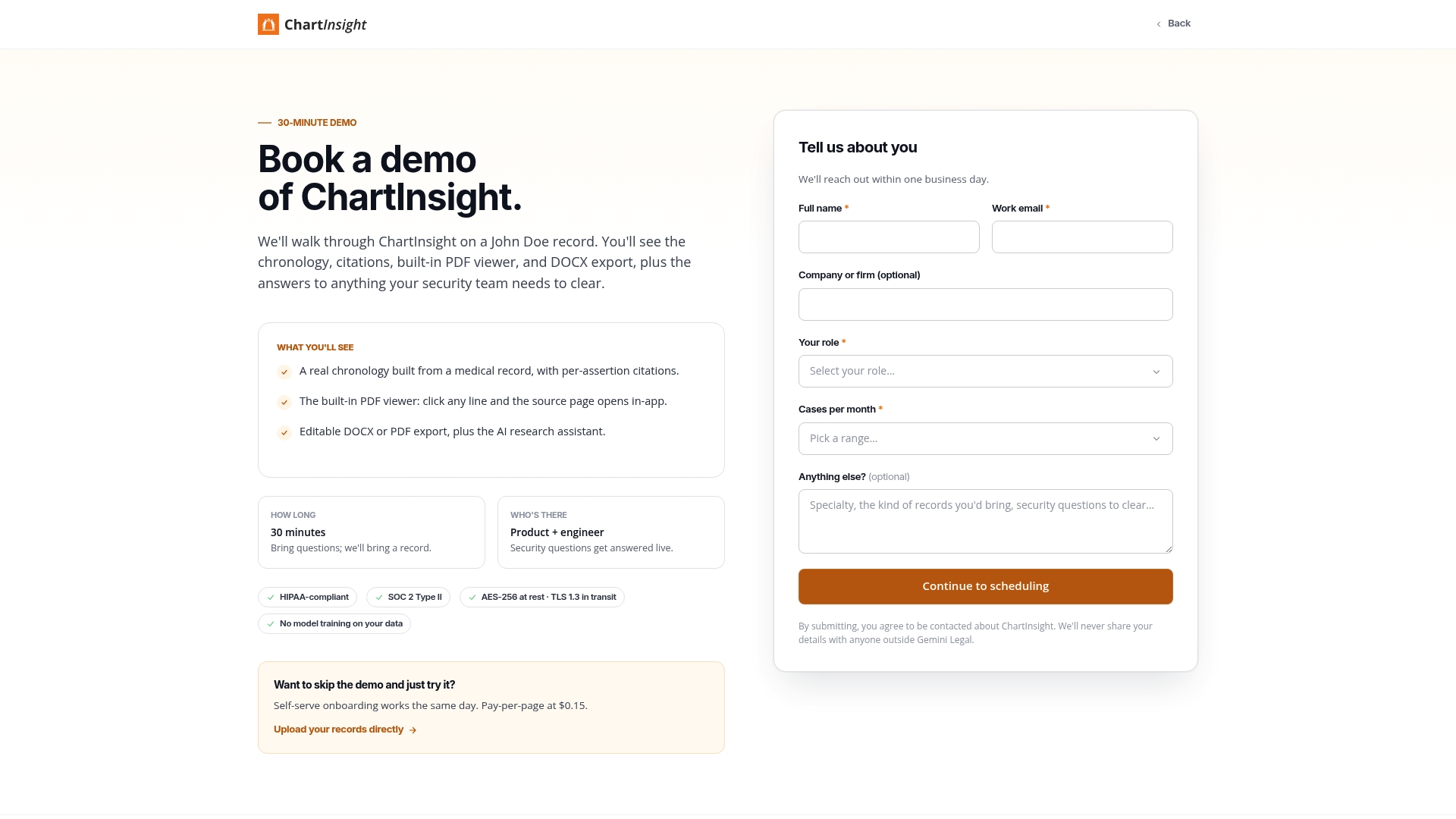
A 4 to 8 week pilot with your own records, a blinded accuracy check against your current manual process, and a clear SLA for turnaround and citation accuracy is the right way to evaluate whether ChartInsight fits your workflow. Book a demo to set up the pilot and see the live PDF viewer on a record that looks like yours.
FAQ
What is the most accurate AI tool for analyzing medical reports?
Accuracy depends on the extraction method and whether human verification is built into the workflow. ChartInsight publishes an internal 433-record indexing accuracy study and attaches page citations to extracted facts, so reviewers can verify outputs directly against the source record.
Does AI medical record review work for QME and IME reports?
Yes, particularly for building treatment histories and apportionment chronologies using AMA Guides and MTUS vocabulary. ChartInsight includes templates configured for QME and workers' comp workflows, with outputs exportable as editable DOCX. A QME still reviews the entire record; what the tool removes is the manual assembly and citation work, not the reading obligation.
How do page citations make AI summaries defensible in legal proceedings?
Research on AI clinical documentation and practitioner accounts point the same way: a path from the summary back to the underlying evidence is what lets a reviewer check the output instead of trusting it. In legal proceedings, a citation to a specific page in the original record gives opposing counsel and the court a verifiable source, which an unlinked summary cannot provide.
How long should a pilot take, and what should it measure?
Four to eight weeks on 10 to 20 representative records is enough to produce a defensible decision. Measure a manual baseline first, then run the same records through the platform and compare using pre-defined disagreement metrics, a citation spot-check pass rate, and the amount of rework each export needs before it can be filed or sent.
Is AI-generated medical record documentation HIPAA compliant?
Compliance depends on the vendor's infrastructure and contractual commitments. Require a signed HIPAA Business Associate Agreement, SOC 2 certification, and documented encryption at rest and in transit before any PHI enters the platform. ChartInsight operates a HIPAA-compliant privacy and security program: it executes Business Associate Agreements with customers and with every service provider that may handle PHI, maintains a current SOC 2 Type II report examined twice a year by an independent CPA firm, encrypts files and databases at rest with AES-256 and connections with TLS 1.3, stores primary customer data in United States based AWS infrastructure, and does not use customer records, prompts, or outputs to train AI models.