

TL;DR:
- Common IME report errors include incomplete documentation, vague phrasing, and poorly organized structure. These mistakes undermine report credibility, especially if exam details and references are missing or inconsistent. Proper citations, confident language, and clear sectioning improve report defensibility and legal effectiveness.
Common IME report mistakes are specific errors in Independent Medical Examination reports that compromise accuracy, clarity, and legal defensibility. These errors range from missing documentation and vague phrasing to poor report structure that frustrates attorneys, adjusters, and administrative law judges. Oregon Workers' Compensation Division standards require physicians to sign a formal quality assurance statement acknowledging that all statements in the report are true and accurate, which means report defensibility carries regulatory weight, not just professional preference. Whether you write IME reports or challenge them, knowing where they break down is the first step toward producing evaluations that hold up under cross-examination.
1. Common IME report mistakes in documentation
Documentation failures are the most exploitable category of IME report errors. Opposing counsel can attack a report far more effectively when the examiner has not listed every record reviewed, skipped standard physical exam measurements, or failed to note how long the examination lasted.

IME exams are notoriously brief: an IME physician often spends far less time examining a claimant than a treating physician spends in a routine visit, and reported IME exam times as short as 10 to 12 minutes are common. That brevity becomes a liability when the report does not document the exam's scope, methodology, or duration. An attorney who can show a jury that a physician spent roughly 10 minutes forming a permanent disability opinion will undermine that opinion without needing a single counter-expert.
Frequent documentation gaps include:
- No list of specific records reviewed (radiology reports, operative notes, prior IME reports)
- Absent or incomplete range-of-motion measurements without goniometer use
- No notation of exam duration or the presence of a third party
- Missing documentation of diagnostic imaging reviewed or contradicted
- Failure to note which AMA Guides edition was applied for impairment rating
Pro Tip: Record the exact start and end time of every IME examination. That single habit eliminates one of the most common cross-examination targets.
Poor documentation also produces conclusions that appear in the report without any traceable clinical basis. Claims reviewers report that IME documentation frequently introduces ambiguity rather than clarity: a report can read as complete and detailed yet still fail to answer basic questions on causation, impairment, or work restrictions, which suggests the examiner reached a conclusion the record does not fully support.
2. How improper language weakens IME reports
Phrasing is where many technically competent IME physicians lose credibility. The words chosen in a report signal either clinical confidence or uncertainty, and opposing counsel reads every sentence looking for both.
The most damaging language falls into two categories. The first is credibility and legal judgment language. Using terms like "malingering" or opining that a claimant is or is not "credible" crosses from medical opinion into legal territory. Physicians are not fact-finders. Terms like "malingering" invite immediate attack because they require the examiner to defend a legal conclusion, not a medical one.
The second category is hedging language. Words like "appears," "presumably," "seems," and "possibly" reduce the weight of an opinion. A report that states a claimant "appears to have reached" MMI carries far less force than one stating the claimant "has reached" MMI. Hedging words signal uncertainty and give opposing counsel a direct line of attack.
Red-flag words and phrases to remove from IME reports:
- "Malingering," "exaggerating," "credible," or "not credible"
- "Appears to," "seems to," "presumably," "possibly"
- "Thorough" or "exhaustive" as self-descriptions of the exam
- "In my opinion" repeated excessively, which signals defensiveness
- Vague causation language like "may have contributed"
"These self-serving words will hold the examiner and her report to an extremely high standard." — SEAK, on describing an exam as "complete," "thorough," or "exhaustive" ("IME Reports: Words That Raise Red Flags for Attorneys")
Confident, precise medical phrasing does not mean overstating findings. It means stating what the clinical evidence supports, directly and without qualification that the evidence does not require.
3. Why report structure and clarity matter for legal use
A well-documented IME report can still fail if its structure makes key findings hard to locate. Attorneys and adjusters work under time pressure. When conclusions are buried in dense narrative paragraphs, claims decision-making slows and the report's practical value drops.
The structural problems that appear most often in IME reports are inconsistent terminology across sections, rationale and opinion blended into the same paragraph, and no clear separation between history, examination findings, and conclusions. A judge who must re-read three pages to find the P&S date will not view that report favorably.
| Structural problem | Effect on legal use |
|---|---|
| Conclusions buried in narrative | Attorneys miss key findings; delays claims decisions |
| Inconsistent terminology | Creates ambiguity about diagnosis or causation |
| Rationale and opinion blended | Harder to challenge or defend specific conclusions |
| No section for records reviewed | Opposing counsel can allege incomplete review |
| Missing impairment rating section | Adjuster cannot act without a separate follow-up |
Pro Tip: Separate your report into clearly labeled sections: records reviewed, history, examination findings, diagnosis, causation opinion, and impairment rating. Each section should stand alone so a reader can locate any conclusion in under 30 seconds.
Good medical evaluations lose value to claims handlers when formatting makes them difficult to navigate. Structure is not a cosmetic concern. It is a functional one that directly affects whether your opinion gets used or ignored.
4. Tactical strategies to identify and address errors during review
Legal practitioners reviewing an IME report for weaknesses follow a systematic process. The goal is to identify documentation gaps, language problems, and structural failures that can be raised in deposition, at hearing, or in a written rebuttal.
- Verify the records list. Compare every record cited in the IME report against the full medical record. IME physicians often omit diagnostic imaging or minimize treating physician notes that contradict their conclusions. Any omission is a cross-examination point.
- Document exam duration. Request the examiner's sign-in log or billing records. IME exam times as short as 10 to 12 minutes create a direct contrast with treating physician encounters and expose superficial opinions.
- Flag hedging and credibility language. Mark every instance of "appears," "presumably," or credibility judgments. Each one is a point where the examiner's confidence can be questioned.
- Compare findings to treating physician records. Side-by-side comparison of range-of-motion measurements, pain ratings, and functional limitations often reveals contradictions that a treating physician can address in a rebuttal declaration.
- Check AMA Guides compliance. Confirm which edition was applied and whether the impairment rating methodology follows that edition's requirements. Errors in impairment-rating methodology are among the most technically defensible challenges available, and they surface often in the panel QME selection process.
- Assess the physical exam section. Confirm that goniometer measurements appear for range-of-motion findings. Absent measurements, combined with a brief exam duration, support an argument that the examination was inadequate.
- Prepare a structured rebuttal. Organize identified errors by category: documentation, language, structure, and methodology. A rebuttal that groups errors systematically is easier for a judge or hearing officer to follow than one that lists problems in narrative form.
Practitioners who review page-level citations in medical records can cross-reference IME conclusions against source documents far faster than those working from printed summaries alone.
Key takeaways
Avoiding common IME report mistakes requires precise documentation, confident phrasing, and a clear structure that lets attorneys and adjusters locate every conclusion without re-reading the full report.
| Point | Details |
|---|---|
| Document exam duration | Record exact start and end times to prevent cross-examination on exam brevity. |
| Avoid credibility language | Remove terms like "malingering" and "credible" to stay within medical opinion boundaries. |
| Separate report sections | Label records reviewed, findings, causation, and impairment rating as distinct sections. |
| Verify records completeness | Compare the IME records list against the full file to identify omissions before hearing. |
| Use confident phrasing | Replace hedging words like "appears" with direct clinical statements supported by findings. |
The pattern behind most IME report failures
Across the medical-legal reports ChartInsight helps teams review, the most common weakness is not carelessness. It is a mismatch between what physicians think they are writing and what attorneys and adjusters actually need to use.
A physician who writes that a claimant "appears to have reached" permanent and stationary status may intend a careful, measured opinion. An attorney reads it as an opinion the examiner is not fully committed to, and that gap costs cases. The fix is not more caution in phrasing. It is recognizing that medical certainty and legal defensibility require the same thing: a direct statement backed by documented findings.
A second recurring pattern is examiners underestimating how thoroughly their records review will be scrutinized. When an IME report omits a treating physician's surgical note or a radiology report that contradicts the examiner's conclusions, that omission does not go unnoticed. Reviewers who handle psychiatric record review and complex multi-provider files know exactly how to find what is missing.
The most defensible reports read as though every section will be read aloud in a deposition. That standard, applied consistently, removes most of the errors covered here before the report leaves the examiner's desk.
ChartInsight reduces IME review errors at the source
IME report review is faster and more defensible when every finding traces back to the page that supports it.
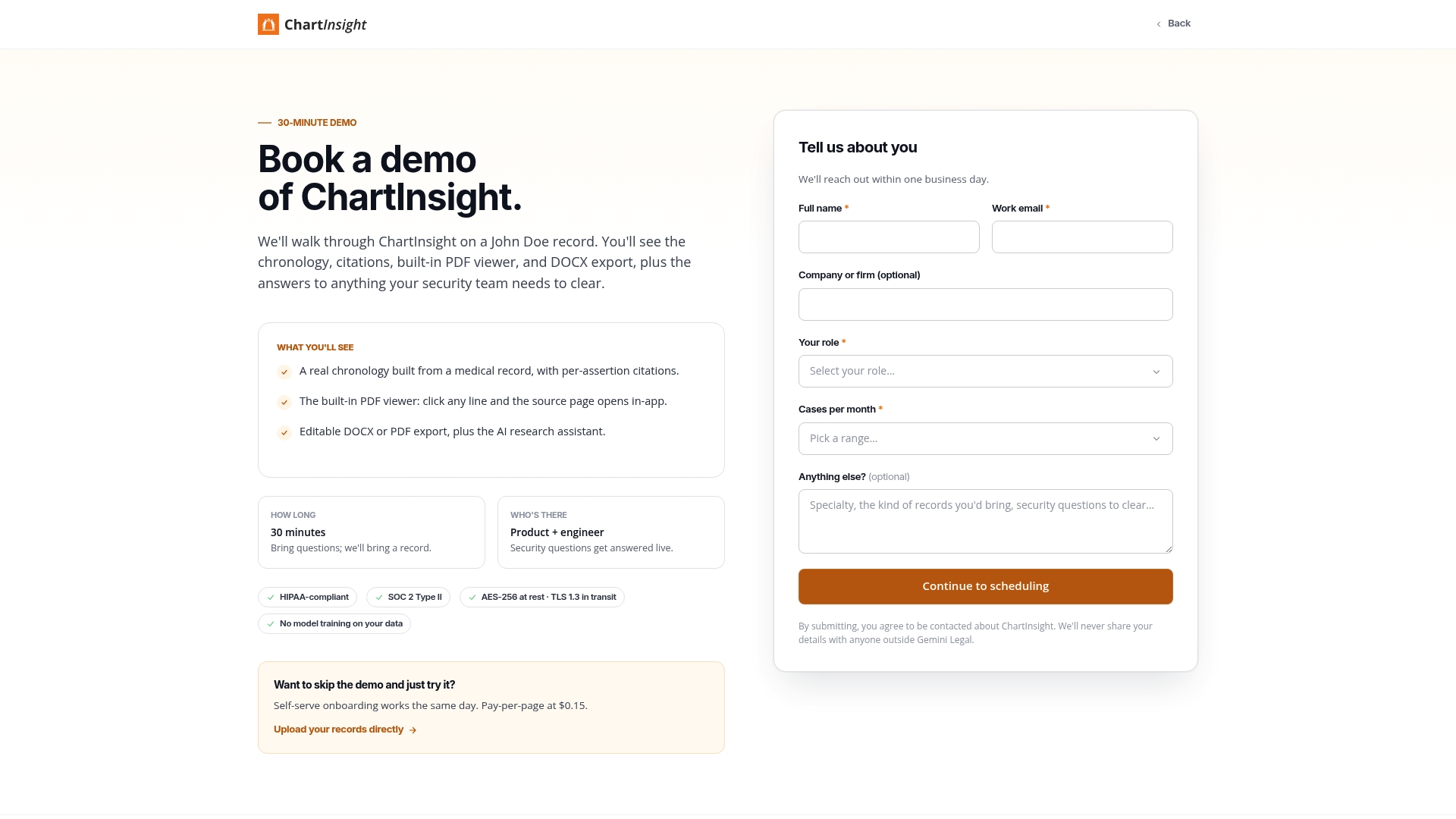
ChartInsight takes the full medical record, often tens of thousands of pages across multiple providers, and produces a structured chronology, a nine-section narrative summary, a vitals table, and a medications table. Every extracted fact carries a live citation to its source page, and clicking that citation opens the PDF directly in the app. Reviewers working on workers' comp, personal injury, and QME matters cut review time from days to hours without losing the citation accuracy that makes their work defensible. Teams configure Templates so that every IME record summary comes back in a consistent format, ready to export as an editable DOCX or PDF with page citations preserved. To see how it works on your records, book a demo.
FAQ
What are the most common IME report mistakes?
The most frequent errors are missing records documentation, absent exam duration notation, hedging language like "appears" or "presumably," and conclusions buried in dense narrative rather than clearly labeled sections.
Why should IME physicians avoid terms like "malingering"?
"Malingering" is a legal conclusion, not a medical diagnosis. Using it in an IME report crosses into the fact-finder's role and gives opposing counsel a direct basis to challenge the examiner's credibility and methodology.
How does exam brevity affect an IME report's defensibility?
IME exam times as short as 10 to 12 minutes create a sharp contrast with treating physician encounters. When the report does not document exam duration, attorneys can argue the opinion is superficial relative to the longitudinal care record.
What structure should a defensible IME report follow?
A defensible report separates records reviewed, history, examination findings, diagnosis, causation opinion, and impairment rating into clearly labeled sections. Each section should be locatable in under 30 seconds.
How can AI tools help reduce IME report errors during review?
AI tools that produce page-cited summaries let reviewers cross-reference IME conclusions against source documents without manual page-flipping, which surfaces omissions and contradictions faster than traditional review methods.