

Documenting diagnostic history, for medico-legal purposes, means extracting, structuring, and page-citing every diagnostic event from multi-provider PDFs into a defensible chronology and narrative summary. Three criteria separate a defensible product from a liability:
- Every chronology entry cites the exact source page in the original PDF.
- The report includes a methodology statement and a custodian declaration.
- Outputs preserve an audit trail and the original files remain unaltered.
CMS CoPs §482.24 and FRE 803(6) together with the Uniform Business/Public Records Acts (UBPRA) underpin all three requirements.
Key Takeaways
| Point | Details |
|---|---|
| Cite every chronology row | Each entry must reference the exact PDF file name and page number. |
| Include methodology statement | Name the custodian, sampling method, and how conflicts were resolved. |
| Preserve originals with access logs | Store source files read-only; log every access for chain-of-custody. |
| QC with a 20% second review | Sample critical entries with a second reviewer and document the method. |
| Use ChartInsight™ for cited exports | ChartInsight™ exports DOCX/PDF with live page citations and audit trails, cutting review from days to hours. |
Table of Contents
- What makes a diagnostic-history summary legally defensible?
- What legal authorities require defensible documentation?
- How do you extract a defensible diagnostic history from multi-provider PDFs?
- What technical controls preserve record integrity and admissibility?
- What should a defensible deliverable package contain?
- How do you handle conflicting notes, missing pages, and suspected alterations?
- How ChartInsight™ supports defensible diagnostic-history documentation
- ChartInsight™ cuts review time from days to hours
- Sources
- FAQ
What makes a diagnostic-history summary legally defensible?
A defensible summary ties every assertion to a dated, timed, and authenticated source page and describes the methodology used to assemble it. Without that traceability, the summary is an opinion, not evidence.
Every entry in the chronology needs these elements:
- Date and time of the encounter or event
- Provider identity and specialty
- Encounter type (ED visit, office note, imaging, operative report)
- Direct quote or clearly labeled paraphrase
- Page citation in the source PDF
- Artifact type (H&P, discharge summary, radiology report)
- Custodian and methodology statement at the report level
A citation entry looks like this in practice: ED progress note | 2024-03-12 | Dr. J. Reyes, Emergency Medicine | p. 14, HospitalDischarge_2024.pdf.
Format matters too. A sortable chronology table handles verification and exhibits; a short narrative summary tied to specific chronology entries supports opinion and case strategy. Standard chronology practice recommends both, and practitioners who skip the narrative often find themselves reconstructing it under deposition pressure.
What legal authorities require defensible documentation?
FRE 803(6) provides the hearsay exception that makes health records admissible, but four conditions must all be met:
- The record was made near the time of the event.
- It was made by a person with knowledge.
- It was kept in the ordinary course of business.
- Maintaining such records is a regular business practice.
An EHR entry that satisfies all four still fails if authentication is defective. CMS §482.24 interpretive guidance is explicit on this point:
Late entries and addenda require their own handling. Mark them as "late entry" or "addendum." Include the current date and time alongside the original event date and note the reason for the delay. Your methodology statement should describe how you identified and treated late entries, because opposing counsel will ask.
Pro Tip: When you encounter a suspected alteration, preserve the original file hash, note the discrepancy in the methodology statement, and escalate to custodian verification before finalizing the report. Never overwrite or annotate the original.
How do you extract a defensible diagnostic history from multi-provider PDFs?
Follow a reproducible six-step workflow. Every chronology entry must trace back to a specific PDF page; that traceability is what makes the summary usable in discovery, at deposition, and before a QME or AME.
- Intake and authorization. Confirm you have a signed authorization and a complete file inventory before opening any record.
- File verification and hashing. Generate a hash for each PDF on receipt. Store originals read-only. Any downstream copy is a working copy.
- Document classification. Sort files by encounter type: hospital records, office notes, imaging, pharmacy, and independent evaluations. This step prevents duplicate entries and missed providers.
- Event extraction to chronology. Extract each diagnostic event with date, time, provider, encounter type, key findings, and page citation. Standard step-by-step practice recommends standardizing the column structure before extraction begins, not after.
- Cross-source reconciliation. Compare entries across providers for date conflicts, duplicate events, and gaps. Flag every discrepancy; do not silently resolve it.
- QC spot-check and second review. Sample at least 20% of critical entries for date/time accuracy, author identity, and citation fidelity. Document the sampling method in the methodology statement.
The QC checklist at step 6 should cover: date and time verification, author identity confirmation, duplicate page detection, late entry flagging, and audit-trail confirmation (who exported the report and when).
What technical controls preserve record integrity and admissibility?
Technical controls (file hashing, read-only originals, PDF page citations, and access logs) are the chain-of-custody foundation that admissibility arguments rest on. Without them, a well-structured chronology can still be challenged on provenance.

Different source document types carry different risks:
Paper scans carry the highest authentication burden. There is no native author identity evidence; you rely on facility letterhead, provider signatures, and custodian declarations. Page citation is straightforward if the scan is sequential, but multi-provider compilations often are not.
Scanned multi-page PDFs are the most common format in workers' comp and PI matters. Page citation is precise when the PDF is properly indexed. The failure mode is out-of-order scanning or missing pages, which the Tenet Health HIM legal records policy addresses through scanning and indexing procedures.
Native EHR exports offer the strongest author authenticity evidence but require verification that the export is complete and unmodified.
A citation template that survives scrutiny: FileName.pdf | p. 47 | DOS: 2024-03-12 | Provider: Dr. A. Kim, Orthopedics | Hash: [SHA-256]
Pro Tip: Store original files read-only with access logs enabled. The methodology statement should name the custodian, the storage location, and the access-log retention period. Reviewers who skip this step often discover the gap when opposing counsel requests chain-of-custody documentation.
For a deeper look at how page citations work in AI-assisted review, the mechanics matter more than most reviewers realize.
What should a defensible deliverable package contain?
A complete deliverable contains five components: (A) a date-ordered chronology with page citations, (B) a narrative summary keyed to chronology entries, (C) vitals and medication tables, (D) a methodology and custodian declaration, and (E) an exhibit list mapping every chronology entry to its source PDF pages.
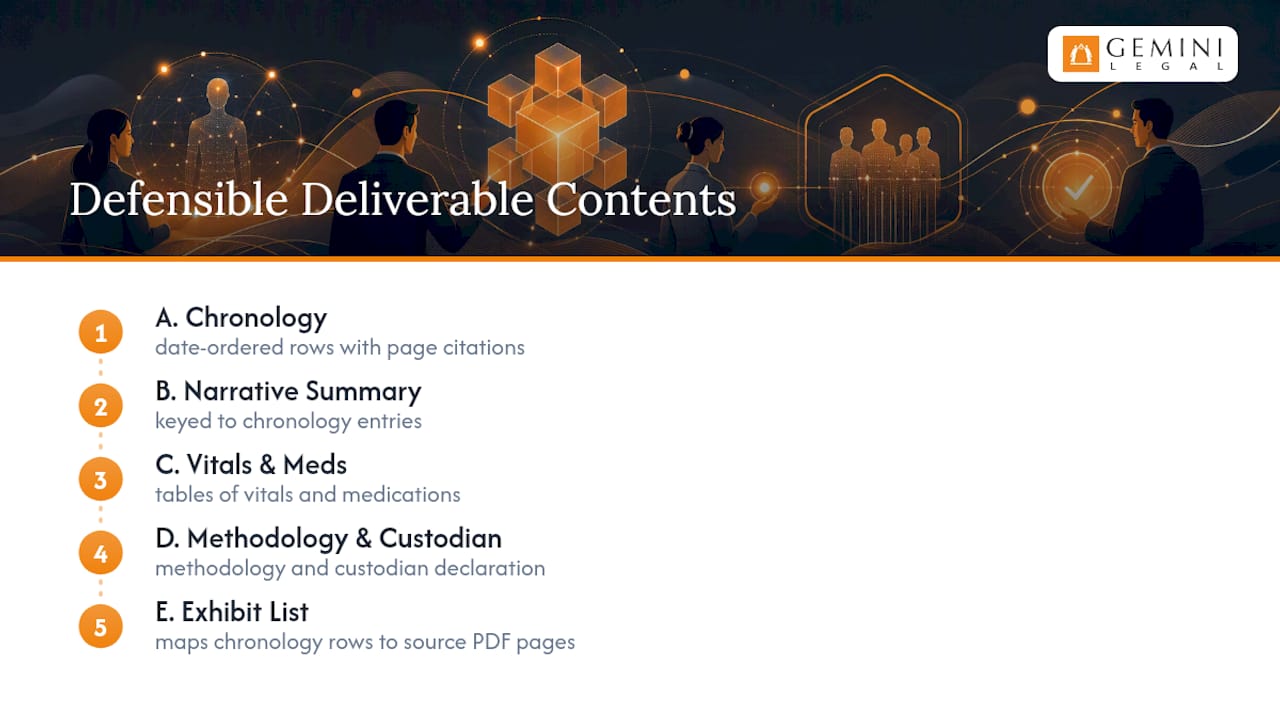
The chronology table structure:
Export in both DOCX and PDF with citations preserved. The DOCX allows the attorney or QME to annotate; the PDF preserves the exhibit structure for filing. Append a hash summary and access log to the final export. Standard practice recommends an exhibit index that maps every chronology row to its source document, a step that pays off immediately when deposition exhibits need to be pulled.
How do you handle conflicting notes, missing pages, and suspected alterations?
Use a consistent evidence standard and an explicit methodology statement. Document the discrepancy, cite both sources, and state how you resolved or flagged it. Never silently pick one version.
- Missing records: Issue specific subpoenas identifying the provider, date range, and record type. Track responses and note outstanding requests in the methodology statement. Per practitioner guidance, reviewers should compare imaging reports against actual images where possible; a missing image is a different problem than a missing report.
- Conflicting dates or times: Preserve both entries. Annotate with: "Conflicting dates noted between [Source A, p.X] and [Source B, p.Y]; reconciliation pending custodian verification."
- Late entries and addenda: Mark clearly with current timestamp and original event date. Validate the source.
- Suspected tampering: Preserve the original hash, note the discrepancy, and escalate. Do not finalize the report until custodian verification is complete.
For patient-reported history, state the source explicitly, treat it as a separate chronology entry, and never conflate it with contemporaneous clinical documentation. Sample neutral language: "No contemporaneous record located for [date]; client statement not used as sole basis for chronology entry."
How ChartInsight™ supports defensible diagnostic-history documentation
ChartInsight™ produces structured chronologies, narrative summaries, and vitals and medication tables where every extracted fact carries a live page citation back to the source PDF. The AI output and the underlying evidence are the same workflow, not two separate steps.
Key features tied directly to the defensibility checklist:
- Page-level citations on every chronology entry, narrative sentence, vitals row, and medication entry
- Exportable DOCX and PDF with citations preserved and an exhibit map
- Audit trail and access logs built into the platform
- Templateable methodology statements configurable per matter type (workers' comp, PI, IME/QME)
- Role-based access so only authorized reviewers touch a given matter
A typical workflow: intake a 2,500-page multi-provider PDF, automated document classification by encounter type, chronology extraction with page anchors, human QC against the live PDF viewer, then DOCX/PDF export with exhibit mapping. The workflow is designed to turn multi-day review cycles into hours, with the reviewer verifying sampled entries against the cited pages. The accuracy study on 433 records gives a concrete benchmark for indexing fidelity.
For workers' comp record review specifically, ChartInsight™ supports apportionment analysis, MTUS/AMA Guides cross-referencing, and P&S/MMI documentation within the same structured output.
What experienced reviewers know about defensible chronologies
Converting a noisy, multi-provider record into a defensible chronology is investigative work. The records rarely arrive in order, providers use different date formats, and a late entry buried on page 1,847 can shift the entire causation analysis. The reviewers who produce the most defensible outputs share one habit: they document their methodology as they go, not after the fact. A methodology statement written at the end from memory is weaker than one built entry by entry.
Something like: "This chronology was extracted from [N] source documents totaling [X] pages. Original files are stored read-only with access logs retained."
ChartInsight™ cuts review time from days to hours
Attorneys and adjusters handling workers' comp and PI matters face the same problem: a 3,000-page multi-provider record, a tight deadline, and a summary that has to hold up in deposition. ChartInsight™ takes that record and returns a page-cited chronology, nine-section narrative summary, vitals table, and medications table, every fact linked to its source page via a live PDF viewer. Exports go out as DOCX or PDF with citations intact and an audit trail attached.
No separate file-hunting. No citation reconstruction under pressure. Book a demo to see the live PDF viewer and citation exports in action.
Sources
- CMS SOMA transmittal R47 (interpretive guidance §482.24)
- AHIMA, Maintaining a Legally Sound Health Record
- FRE 803(6), Records of a Regularly Conducted Activity (Cornell LII)
- 42 CFR 482.24, Medical record services (eCFR)
FAQ
What is the minimum a chronology entry must include to be defensible?
Date, time, provider identity and specialty, encounter type, a direct quote or labeled paraphrase, and the exact source PDF page citation. A methodology statement at the report level ties the entries together under FRE 803(6).
How should late entries and addenda be handled in a diagnostic history?
Mark them explicitly as "late entry" or "addendum" with the current date and time, retain the original event date, and note the reason for the delay in the methodology statement. AHIMA guidance specifies this procedure for records to remain legally sound.
What QC standard should reviewers apply to a completed chronology?
Sample at least 20% of critical entries for date/time accuracy, author identity, and citation fidelity against the source page, and document the sampling method in the methodology statement.
How does ChartInsight™ preserve page citations in exported reports?
Every chronology entry, narrative sentence, and table row in ChartInsight™ carries a live citation to its source PDF page. Exports to DOCX and PDF retain those citations with an exhibit map, so the link between the summary and the underlying record survives the export.
What should reviewers do when records are missing or suspected of tampering?
For missing records, issue specific subpoenas and track responses in the methodology statement. For suspected tampering, preserve the original file hash, document the discrepancy, and escalate to custodian verification before finalizing the report.