

A defensible merged medical record is not a single stitched-together PDF. It is a page-cited chronology paired with structured summaries and exportable files where every material fact links back to its exact source page. Reviewers who skip that citation layer end up rebuilding it later, usually right before a deposition or a QME report deadline, which is the worst time to discover a missing operative report.
TL;DR:
- Proper medical record merging creates a citable, source-linked chronology and summary, not just a single combined PDF, to support quick verification and reduce disputes.
- The workflow includes preserving original files, OCR reordering by date, provider tagging, building a source-cited timeline, and exporting editable files with maintained citations.
- Each chronology entry must include key fields such as date, provider, record type, diagnosis, treatment, and an exact source citation, especially for diagnoses and work restrictions.
- Verification requires spot-checking citations against source pages and generating missing records reports to address gaps that could impact causation or permanency determinations.
- Tools like ChartInsight™ automate this process by producing source-cited, editable summaries, while manual review is only suitable for small, single-provider records.
Table of Contents
- What Does "Merge Medical Records PDF" Actually Mean for Med-Legal Review?
- The Workflow: From Intake to a Page-Cited Export
- The Fields Every Chronology Entry Needs
- How to Verify Citations and Build a Missing Records Report
- What to Require From Any Merging Tool or Vendor
- When Manual Review Still Makes Sense
- How ChartInsight™ Handles the Chronology and Citation Work
- FAQ
What Does "Merge Medical Records PDF" Actually Mean for Med-Legal Review?
Searching "merge medical records pdf" usually turns up instructions for combining files into one PDF. That is not the task facing a workers' comp attorney, a QME, or a claims adjuster staring at 8,000 pages from six providers. The real job is extracting structured, citable outputs from that pile: a chronology, standardized abstraction fields, and a summary a physician or judge can trust without re-verifying every line.
A cited chronology does specific evidentiary work. It supports causation analysis, helps establish the P&S/MMI date, and clarifies apportionment when multiple injuries or pre-existing conditions are in play. When every entry links to a page, an AME or defense counsel can check a claim in seconds instead of flipping through a scanned exhibit stack.
The bottleneck is rarely the medicine. It is the format. The primary obstacle in medical record review is unstructured "digital dumps" from multiple providers, not any particular diagnosis or treatment history. Records arrive out of order, duplicated across providers, and scanned at inconsistent quality. Fixing that structural problem, not merely combining files, is what actually produces a usable, defensible record.
The Workflow: From Intake to a Page-Cited Export
Treat this as a checklist you either follow yourself or demand from a vendor:
- Preserve the original file. Never alter or overwrite the source PDF during intake. Every downstream extraction should trace back to that untouched file, and your audit trail should show it was never modified.
- Run OCR and reorder by date of service. Multi-provider PDFs arrive as scanned dumps with no logical order. Solving that with OCR and strict date-of-service reordering is the step that turns a dump into a usable record.
- Classify by provider and record type. Tag each document as an orthopedic note, PT record, imaging report, or QME evaluation so related entries across different providers link together logically.
- Build the chronology and narrative summary. Extract a date-based timeline with standardized fields, then generate a structured narrative summary covering history, diagnoses, treatment, and work status.
- Export with citations intact. Deliver editable DOCX or PDF files where every extracted fact still carries its page citation, ideally as a clickable link back to the source page.
Pro Tip: Before you accept any chronology as final, spot-check five entries at random against the cited page. If even one citation points to the wrong page or the wrong provider, the whole chronology needs a re-run, not a manual patch.
Skipping step one is the mistake that sinks credibility fastest. If a reviewer cannot prove the source record was never touched, opposing counsel has a clean line of attack on every downstream summary you produce.
The Fields Every Chronology Entry Needs
A consistent template is what turns a chronology from a narrative aid into an exhibit. At minimum, each entry needs:
- Date of service (not date of transcription or receipt)
- Provider name and specialty
- Record type (progress note, operative report, imaging, PT note, QME/AME evaluation)
- Chief complaint as documented
- Diagnosis or objective findings
- Treatment rendered or recommended
- Imaging or lab result, where applicable
- Work restriction or disability status, if stated
- Citation to the exact source page
- Reviewer note, flagging anything ambiguous or contradictory
Not every field carries equal evidentiary weight, but some absolutely require a citation every time: diagnoses, imaging findings, procedures, work restrictions, and anything tied to permanency or apportionment. Guidance from practitioner sources is consistent on this point. Skip citations on those fields and you have built a summary someone can dispute; include them and you have built one they have to rebut with equally specific evidence.
Locking a standard template across a firm or review team pays off beyond any single case. When the same fields and citation format are used firm-wide, reviewers stop reinventing structure case by case, and opposing counsel sees the same consistent format every time, which makes disputing format itself a much weaker line of attack.

How to Verify Citations and Build a Missing Records Report
Extraction is only half the job. Verification catches the errors that actually cost cases.
- Spot-check the chronology against source pages. Confirm the date, provider, and any quoted finding match exactly what the cited page says. Do this for a meaningful sample, not just the entries that look suspicious.
- Watch for four red flags: date mismatches between the chronology and the source document, imaging studies referenced in notes but not present in the record, unexplained gaps in treatment, and pain scores or functional ratings that swing inconsistently between visits.
- Draft a Missing Records Report. List what is referenced in existing notes but absent from the file (a referral, a specific MRI, a prior surgical history), then list targeted record requests to close each gap. Expert reviewers use this exact structure to surface omissions before they become deposition surprises.
- Escalate when the gaps affect causation or permanency. If a missing operative report or imaging study could change the apportionment analysis or the AMA Guides rating, that goes to formal expert review, not a footnote.
For a cross-practice example of how supporting evidence gets packaged for a decision-maker, see this mitigation letter evidence checklist from a treatment-provider perspective.
What to Require From Any Merging Tool or Vendor
Before you trust any platform with a client's medical record, run it through a short checklist. It should offer live page citations on every extracted claim, an integrated PDF viewer so you can click straight from a chronology entry to the source page, and editable export formats (DOCX or PDF) that keep those citations intact after export. It should also support locked templates for consistent output, maintain an audit log, offer role-based access control, and guarantee that original records are never altered.
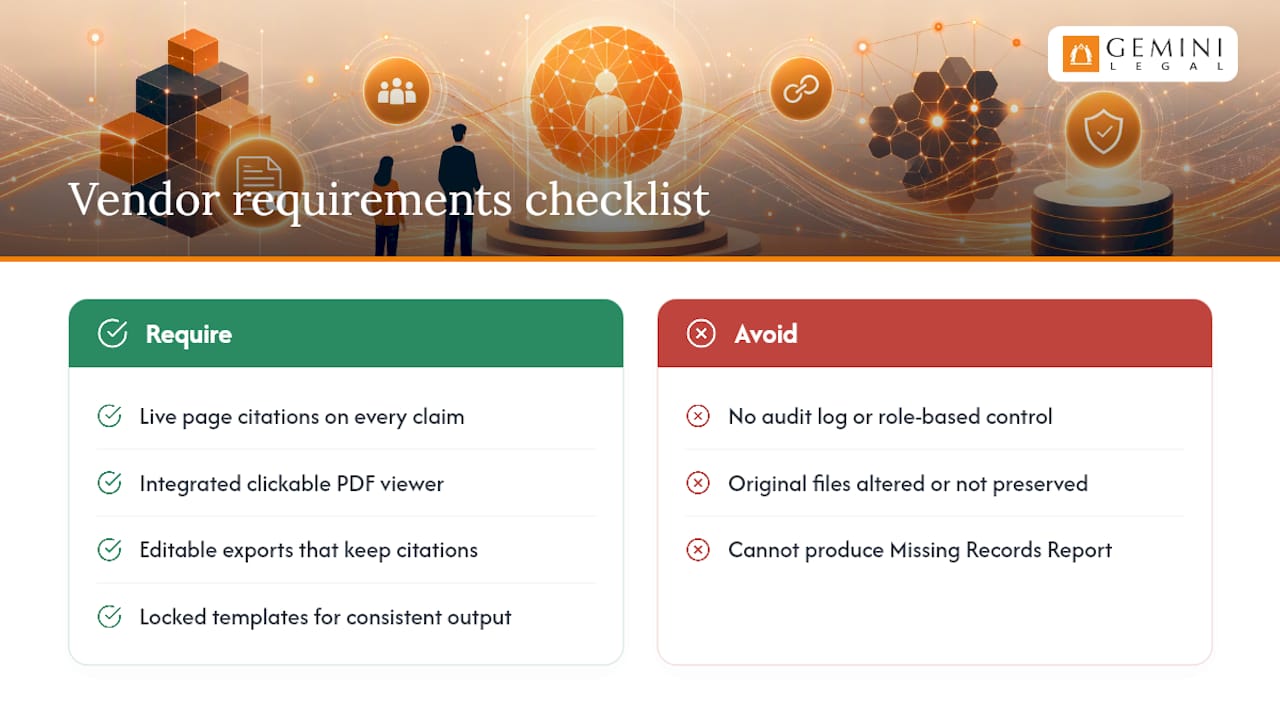
On the contract side, ask for a sample deliverable before you sign anything. Request documented SLAs, written confirmation that source files are preserved unmodified, and a live demonstration of citation fidelity, not a marketing slide.
Pro Tip: Run this test in any demo: click a random chronology entry, confirm it opens the exact cited page, then export the file and check that the citation survived the export. If it does not survive export, the tool is not solving the defensibility problem, it is just summarizing.
Ask for a Missing Records Report example too. If a vendor cannot produce one on request, they likely are not running the verification pass this workflow depends on.
When Manual Review Still Makes Sense
A short file from a single provider, maybe a few dozen pages covering one course of treatment, is often fine to review manually. Once you are past a few hundred pages, multiple providers, or a case value that justifies expert scrutiny, manual chronology-building starts eating hours that add no defensibility. A structured platform shifts your time from extraction to verification, which is where the real risk of error actually lives, and shortens QME or expert prep accordingly. The threshold is not a fixed page count. It is whether a missed citation or an overlooked record could move the causation or apportionment finding.
How ChartInsight™ Handles the Chronology and Citation Work
ChartInsight™ is built around the checklist above, not a generic AI summary tool bolted onto a document store. It takes the full record, often tens of thousands of pages from multiple providers, and produces a page-cited chronology, a structured narrative summary, normalized vitals, and a medications table, with every extracted fact linked to the exact source page through an integrated PDF viewer.
For attorneys handling personal injury record review or workers' comp files, that citation layer is what turns a review that used to take days into one that takes hours, because the verification pass happens inside the same viewer where the chronology lives. Templates lock the same fields and citation format across your whole team, exports preserve those citations in editable DOCX or PDF, and the Research Assistant on every record lets you ask a direct question and get a cited answer instead of hunting for it yourself. The original record is never altered. See the full workflow on the ChartInsight™ site, or book a demo and run the exact click-to-page test described above on one of your own files.
FAQ
What Does "Merge Medical Records PDF" Mean in a Legal Context?
It means converting large, multi-provider PDF records into a structured, page-cited chronology and summary, not simply combining files into one document.
Why Does a Chronology Need Page Citations?
Citations let attorneys, adjusters, and QMEs verify any claim in minutes instead of re-reading the full record, which speeds negotiation and expert prep according to practitioner sources.
What Is a Missing Records Report?
It is a short document listing records referenced in existing notes but absent from the file, paired with targeted requests to close each gap, a structure expert reviewers use to catch omissions early.
Can I Trust an AI-Generated Chronology for a QME or Court Filing?
Only if every extracted fact carries a citation you can click and verify against the source page. Without that citation layer, an AI summary is a draft, not a defensible record.