

A functional capacity evaluation (FCE) is a standardized, objective assessment of an individual's physical and functional abilities relative to the demands of a specific job or occupational role. Three situations drive most referrals: determining whether an injured worker can safely return to their job, establishing medically defensible restrictions or accommodations, and generating objective documentation for workers' compensation or disability claims. The sections below cover who orders and performs FCEs, what happens during testing, how to read the report, and where ADA limits apply.
Key Takeaways
A functional capacity evaluation is a standardized, objective assessment of job-specific physical abilities used to determine return-to-work capacity, set defensible restrictions, and document functional status for workers' compensation or disability claims.
| Point | Details |
|---|---|
| Definition and primary uses | An FCE objectively measures job-specific physical capacity for return-to-work, restrictions, and workers' comp documentation. |
| Duration and format | Comprehensive FCEs run 6–8 hours, often over two days, and include work simulations for job-focused referrals. |
| Legal guardrails | Employer-ordered FCEs must be job-related, consistent with business necessity, and limited in scope under the ADA. |
| Evaluator selection | Choose a licensed PT or OT with documented protocol training, job-matching experience, and willingness to supply raw test data. |
| ChartInsight™ for record review | ChartInsight™ integrates FCE reports into page-cited case summaries, reducing review time from days to hours. |
Table of Contents
- What does a functional capacity evaluation actually measure?
- Who orders an FCE and who is qualified to perform one?
- What happens during a functional capacity evaluation?
- How should patients and clinicians prepare for an FCE?
- What does the FCE report contain, and who receives it?
- What are the legal and ADA limits on employer-ordered FCEs?
- How do you choose a credible FCE provider?
- The FCE's role in defensible claims work
- How chartinsight (tm) Speeds FCE Integration Into Claims Workflows
- Sources
- FAQ
What does a functional capacity evaluation actually measure?
The AMA-style definition frames an FCE as a systematic method to measure an individual's ability to perform meaningful, role-specific tasks safely and dependably. That framing matters because "functional" is not a synonym for "general fitness." The evaluation targets the specific physical demands a job places on a worker.
Domains typically assessed include:
- Strength and lifting capacity (floor-to-waist, waist-to-shoulder, overhead)
- Carrying, pushing, and pulling tolerances (weight and distance)
- Postural tolerances (sitting, standing, walking, bending, kneeling)
- Grip and pinch strength
- Endurance and cardiovascular tolerance during sustained or repetitive tasks
- Balance and mobility
- Work-simulation tasks matched to the job description when the referral is job-focused
- Self-report measures (pain ratings, perceived exertion)
Results are expressed in concrete, numeric terms: "tolerated 35 lbs floor-to-waist lifting for 30 repetitions over a two-hour period" rather than "light-duty capable." That specificity is what makes the report usable for return-to-work determinations, pre-vocational baselines, and job-modification decisions.
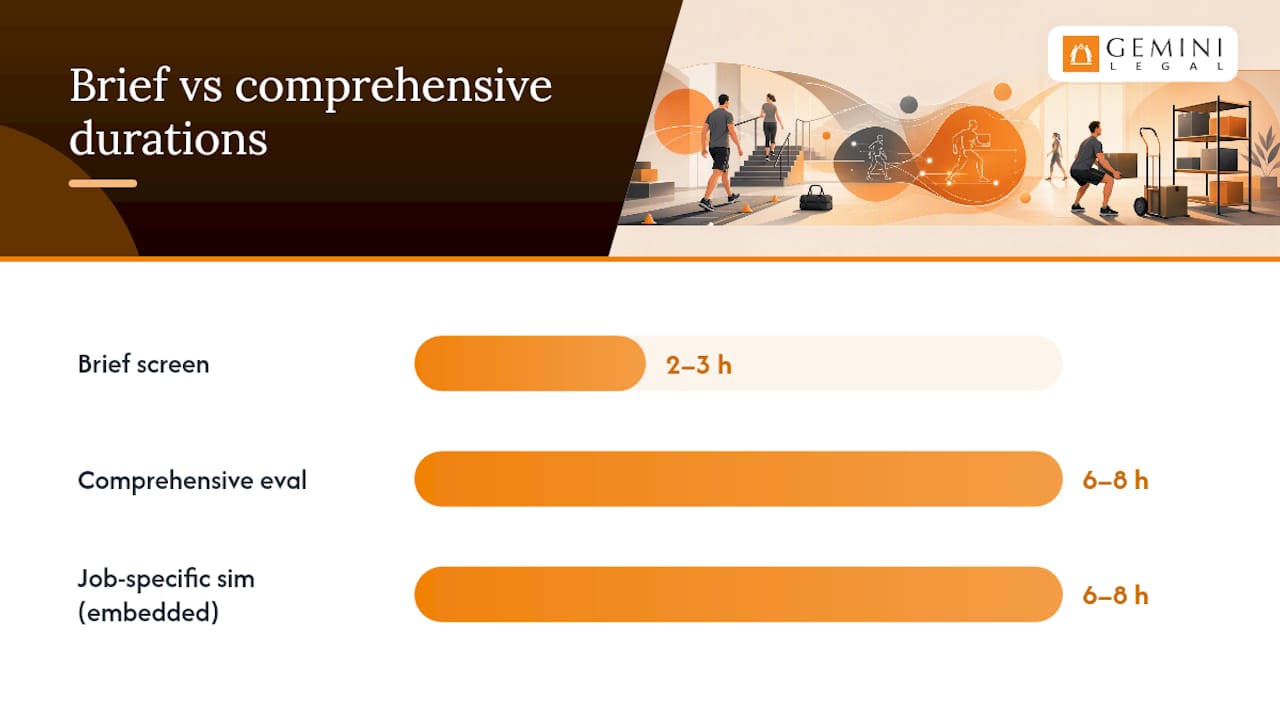
A comprehensive FCE commonly runs 6–8 hours, often split across two days, and includes work simulations when the goal is job-specific capacity.
| FCE Format | Typical Duration | Primary Use |
|---|---|---|
| Brief functional screen | 2–3 hours, single session | Baseline screening, early return-to-work triage |
| Comprehensive evaluation | 6–8 hours, one or two days | Workers' comp, disability, job-specific return-to-work |
| Job-specific simulation | Varies; embedded in comprehensive | Matching capacity to essential job functions |
Pro Tip: When reviewing an FCE report, check whether objective measures (dynamometer readings, timed tolerances) are reported separately from self-report data. A report that blends the two without distinguishing them is harder to defend at deposition or in a QME narrative.
Who orders an FCE and who is qualified to perform one?
Common referral sources
- Treating physicians (MD, DO) at or near maximum medical improvement (MMI) or permanent and stationary (P&S) status
- Workers' compensation adjusters and case managers
- Vocational rehabilitation counselors and ACCES-VR specialists
- Employers or HR departments (subject to ADA constraints; see Section 7)
- Defense or applicant attorneys when clinically indicated and authorized
- IME and QME physicians who need objective functional data to supplement their medical opinion
Evaluator credentials
The evaluator is almost always a licensed physical therapist (PT) or occupational therapist (OT). Defensible credentials include documented training in a recognized FCE protocol (such as WorkWell, Isernhagen, or Blankenship), experience with ergonomic job analysis, and familiarity with medico-legal reporting standards. Some states require physician oversight or a physician referral before an OT or PT can conduct a comprehensive FCE; confirm the requirement in your jurisdiction.
In workers' comp contexts, the FCE may be ordered by the treating physician as part of the return-to-work plan, or by the claims administrator as an independent functional assessment. When the employer or agency requires the evaluation, procedural best practice calls for written authorization, a documented job description, and the ordering party generally bearing the cost.
What happens during a functional capacity evaluation?
Best-practice FCE protocols follow a structured sequence. Here is what a comprehensive evaluation looks like from intake to debrief:
- Intake interview. The evaluator reviews the referral question, injury history, current symptoms, medications, and prior restrictions. This is also when the job description is confirmed and the scope of testing is set.
- Medical-record review. Diagnostic imaging, therapy notes, and prior functional assessments are reviewed before physical testing begins. Residual functional capacity conclusions should integrate records, not replace them.
- Baseline physical examination. Range of motion, neurological screen, posture, and musculoskeletal findings are documented. This establishes the clinical context for interpreting test performance.
- Standardized functional testing. Lifting, carrying, pushing, pulling, and postural tolerance tests are administered using validated protocols. Dynamometers, force gauges, and timed observation are standard tools.
- Work-simulation tasks. When the referral is job-specific, the evaluator replicates essential job functions, such as assembly tasks, tool use, and sustained overhead work, and records performance against the job description's physical demands.
- Effort and validity testing. Grip strength coefficient of variation, Waddell signs, Matheson's protocols, and behavioral observation are used to assess whether performance reflects maximal safe effort. An FCE is not a simple pass/fail exam; best practice integrates objective testing with psychosocial context and clinician judgment rather than relying on a single effort indicator.
- Debrief. The evaluator discusses preliminary findings with the patient before they leave. The formal written report follows separately.
A comprehensive evaluation split across two days typically places the heavier physical testing on day one and the work simulations or endurance tasks on day two, after the evaluator has observed how the patient responds to initial loading.
Pro Tip: Ask the provider whether their protocol is modular or fixed. A fixed protocol applies the same test battery regardless of job demands. A modular protocol selects and sequences tests based on the specific physical demands in the job description. For medico-legal purposes, modular and job-specific is the defensible standard.
How should patients and clinicians prepare for an FCE?
Preparation reduces no-shows, speeds intake, and protects the validity of results. Share this checklist with patients and referring clinicians before the appointment.
What to bring:
- Signed medical-release authorization and any insurer-required consent forms
- Current job description listing essential functions and physical demand levels
- Recent diagnostic results (MRI, X-ray reports, EMG/NCS)
- Therapy notes or prior functional assessments
- List of current medications (name, dose, frequency)
- Any prescribed assistive devices (cane, brace, splint)
- Prior work restrictions in writing
What to wear and do:
- Comfortable, loose-fitting clothing appropriate for physical activity
- Closed-toe, supportive footwear (no sandals or dress shoes)
- Avoid heavy physical exertion the day before testing; fatigue affects performance and can bias results
- Take medications on the normal schedule unless the prescribing physician instructs otherwise
- Eat a normal meal; testing is physically demanding and spans several hours
Pro Tip: Before the referral goes out, confirm in writing: who ordered the FCE, who will receive the report, and what the specific referral question is. "Can this worker return to their pre-injury job as a warehouse picker?" produces a more defensible report than "assess functional capacity." The referral question shapes the entire testing protocol.
What does the FCE report contain, and who receives it?
The written report is the deliverable that matters in claims and litigation. A defensible FCE report includes:
- Referral question (verbatim or closely paraphrased)
- Brief medical summary drawn from records reviewed
- Testing protocol identified by name and version
- Objective measures for each domain tested (weights, repetitions, timed tolerances, grip force in lbs or kg)
- Effort and validity findings with the specific indicators used
- Functional limitations and contraindications (e.g., conditions that prevented full testing)
- Return-to-work recommendations or functional restrictions stated in numeric terms
- Job-matching analysis comparing test results to the physical demands in the job description
Sample restriction language looks like this: "No lifting greater than 30 lbs from floor to waist; intermittent bending limited to 15 minutes per hour; no sustained overhead reaching beyond 10 minutes per hour." Exact numeric phrasing must come from the evaluator's objective test data and the job-match analysis, not from clinical impression alone.
| Report Element | Purpose in Claims Workflow |
|---|---|
| Objective measures (weights, reps, time) | Supports apportionment analysis and AMA Guides work-capacity ratings |
| Effort/validity findings | Addresses credibility challenges at deposition or hearing |
| Job-matching analysis | Ties restrictions directly to essential job functions |
| Return-to-work recommendation | Gives the adjuster or vocational consultant a clear action item |
Report turnaround is typically 5–10 business days after testing. Results are shared with the referring physician and authorized stakeholders, meaning case managers, adjusters, vocational specialists, and attorneys when authorization is on file. The patient receives a copy or a summary at the debrief, depending on the referral agreement.
Practitioners who handle high-volume claims favor providers who supply itemized raw scores rather than summary phrases. Raw data makes AMA Guides-related analyses and apportionment calculations far easier to defend.
What are the legal and ADA limits on employer-ordered FCEs?
The Americans with Disabilities Act (ADA) and EEOC guidance impose meaningful constraints on when and how employers can require a medical examination. The core standard: any disability-related inquiry or medical exam must be job-related and consistent with business necessity. An FCE ordered post-offer, pre-employment, or after a return-to-work request generally satisfies this standard when it is limited to the physical demands of the specific position.
Key procedural safeguards:
- Written authorization from the employee or applicant before any testing
- Documented job description used as the basis for job-matching; this is the paper trail that ties the FCE to business necessity
- Limited scope of medical inquiry: the FCE should assess only the physical demands relevant to the job, not general health status
- Cost allocation: when the employer or agency requires the FCE, the ordering party generally bears the cost and should document the job-related rationale
- Confidentiality: FCE results are medical records and must be kept separate from the general personnel file
The EEOC's position is that a post-offer medical exam is permissible if all entering employees in the same job category are required to take it. Selective testing of only employees with known or suspected disabilities is the scenario that creates ADA exposure.
Important: This article provides general information about FCE procedures and legal context. It is not legal advice. Consult qualified legal counsel before implementing mandatory FCE requirements or modifying return-to-work policies.
Pro Tip: Document job-relatedness in the referral letter itself, not just in the job description. A one-paragraph statement explaining why the specific physical demands of the role require objective functional testing gives legal counsel something concrete to work with if the testing is later challenged.
How do you choose a credible FCE provider?
The FCE report is only as defensible as the provider who produced it. Use this checklist when vetting a prospective evaluator. For additional guidance on selecting and documenting evaluators in workers' comp matters, the panel QME selection process involves similar credentialing considerations.
Selection criteria:
- Current PT or OT licensure in the state where testing occurs
- Documented training in a named, validated FCE protocol
- Experience with job-specific testing and ergonomic job analysis
- Familiarity with medico-legal reporting (AMA Guides terminology, work-capacity classifications)
- Willingness to provide raw test data and original scoring sheets for audit
- Transparent turnaround time and clear policy on who receives the report
Red flags that undermine defensibility:
- A fixed, one-size-fits-all protocol with no job-matching component
- Report language that summarizes findings without numeric outputs ("patient demonstrated limited lifting ability")
- No documented effort or validity testing
- Unusually rapid conclusions (a two-hour "comprehensive" FCE for a physically demanding job)
- Inability or unwillingness to produce original testing data if challenged
Questions to ask before engaging a provider:
- Which FCE protocol do you use, and is it validated?
- How do you handle job-specific task simulations when a job description is provided?
- What effort-testing methods do you use, and how are findings documented?
- What is your standard report turnaround, and who receives the final report?
- Can you provide a sample de-identified report?
Clinical guidance is explicit: standardization in FCEs means consistent use of validated modules and reporting taxonomies, not identical testing for every job. A provider who cannot explain how their protocol adapts to the job description is a liability in a contested claim.
The FCE's role in defensible claims work
ChartInsight™ is built for the workers' comp attorneys, QME physicians, and paralegals who handle high-volume, high-stakes claims. The recurring pattern: the FCE report arrives as a PDF buried in a record that may run thousands of pages across multiple providers. The evaluator's numeric findings, the job-match analysis, and the effort documentation are all there, but locating and cross-referencing them against the treating physician's P&S report, the MTUS guidelines, and the prior therapy notes takes hours of manual page-flipping.
The defensibility of a claim rarely hinges on whether an FCE was ordered. It hinges on whether the FCE findings are accurately integrated with the rest of the medical record and cited precisely when the QME or attorney writes their opinion. A missed validity flag, a restriction that contradicts a prior IME, or a job-match analysis that references a different job description than the one in the employer's file: these are the gaps that get exploited at deposition. Catching them requires reading the whole record, not just the FCE summary.
How chartinsight (tm) Speeds FCE Integration Into Claims Workflows
Workers' comp adjusters and attorneys who manage complex files know the bottleneck: the FCE report is one document in a record that may span tens of thousands of pages. Cross-referencing the evaluator's restrictions against the treating physician's P&S findings, the prior IME opinion, and the MTUS guidelines is where hours disappear.
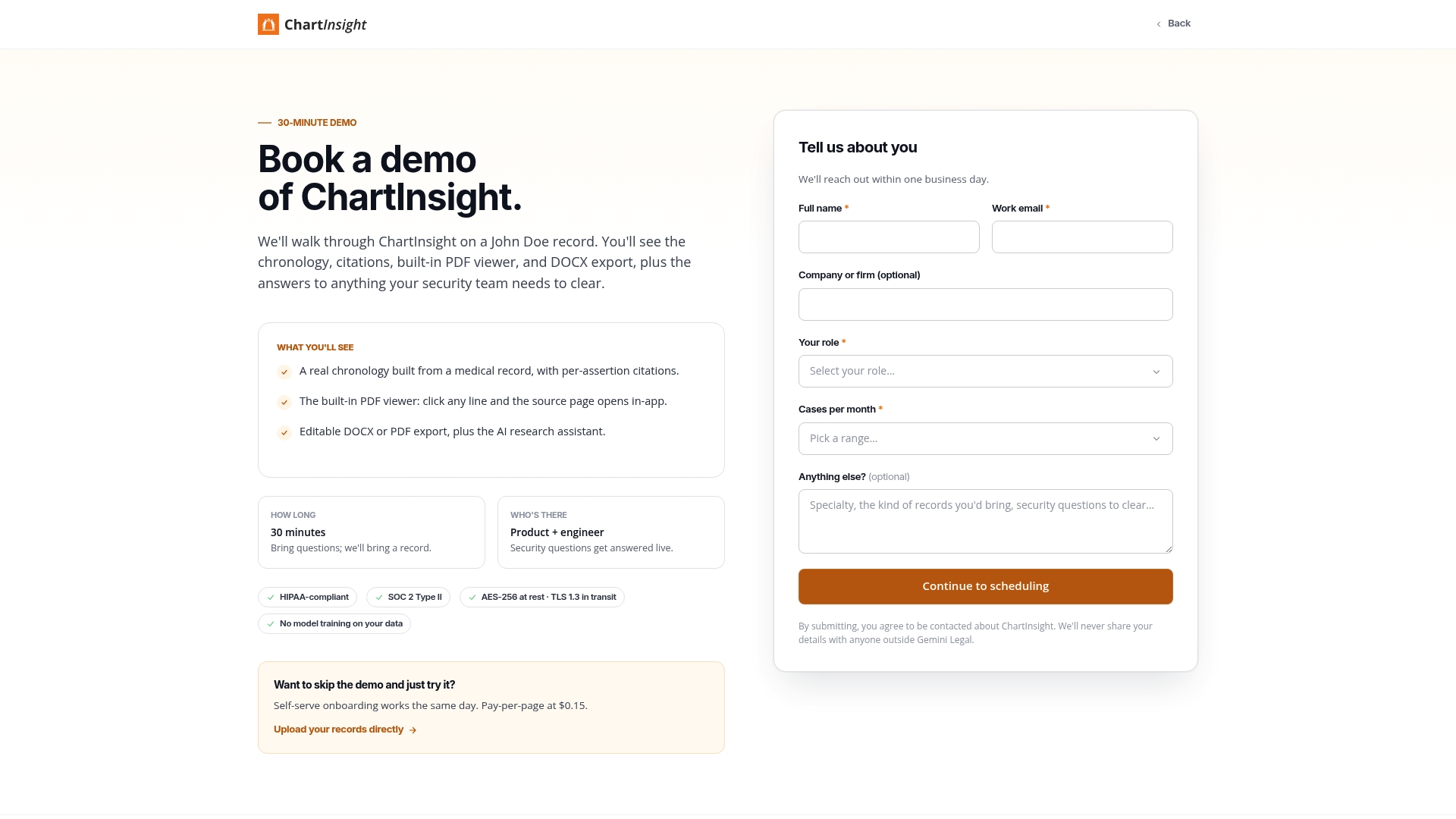
ChartInsight™ processes the full medical record (including FCE reports) and produces a structured, page-cited chronology and nine-section narrative summary that links every extracted fact back to its exact source page. Click a citation and the source PDF opens in the integrated viewer. No downloading, no tab-switching, no losing your place. Customizable templates mean your med-legal report and peer review come back in a consistent format every time. Exports go to editable DOCX or PDF with citations preserved, so the record is audit-ready from the moment it leaves the platform. ChartInsight™ is a record-review tool, not a clinical evaluator ; it does not perform or interpret FCEs, but it does make integrating FCE findings into a defensible case file significantly faster. Book a demo to see how it handles a complex workers' comp record.
Sources
- Frontiers in Rehabilitation Sciences ; Current practices and medico-legal considerations (2026)
- What is a Functional Capacity Evaluation? | MedStar Health
- Functional Capacity Evaluation | Ohio State Wexner Medical Center
- Functional Capacity Evaluation (FCE) | ACCES-VR (NYS Education Department)
This article is general information, not a substitute for advice from a qualified doctor. Consult a qualified healthcare professional about your own circumstances before acting on anything here.
FAQ
What happens if you fail an FCE?
An FCE does not produce a pass/fail result. It documents what a person can and cannot do safely, and those findings are used to set restrictions, plan rehabilitation, or support a return-to-work decision. Low performance on validity indicators may be noted in the report and can affect how the findings are weighted in a claim.
How much does a functional capacity evaluation cost?
Costs vary by provider, region, and evaluation scope. A comprehensive two-day FCE typically runs several hundred to over a thousand dollars. The ordering party (employer, insurer, or agency) generally bears the cost when the FCE is required as a condition of return to work.
Who qualifies for an FCE?
Any worker whose treating physician, employer, insurer, or vocational counselor needs objective data on physical work capacity may be referred for an FCE. Common triggers include reaching MMI or P&S status, a disputed return-to-work determination, or a workers' compensation claim requiring functional documentation.
Does an FCE determine disability?
An FCE informs disability determinations but does not make them. The evaluation provides objective functional data that physicians, vocational experts, and adjudicators use alongside medical records, diagnostic findings, and clinical judgment to reach a disability conclusion.