

Editable exports that preserve page-level citations let reviewers produce defensible summaries faster and keep the evidentiary link intact through every revision. That single feature, a citation tied to a source page, changes how attorneys, QMEs, and adjusters work: claims survive scrutiny because every sentence traces back to a specific PDF page instead of a reviewer's memory of the file.
A 433-record study comparing AI-generated indexes to expert human medical summaries of the same records found the AI recovered 1,318 clinician-documented findings the human summaries missed, across 92% of cases. Three things follow from that:
- Facts stay checkable during edits, not just at first draft.
- Templates and consistent reviewer roles keep output consistent across a team.
- Opposing counsel gets fewer openings to challenge a summary's accuracy.
The practical payoff is a summary that moves faster through review and survives deposition without a scramble back through boxes of records.
Key Takeaways
Editable exports with preserved page-level citations produce faster, more defensible medical-legal summaries because every claim stays traceable to its source page through every revision.
| Point | Details |
|---|---|
| Define scope clearly | Editable reports here means exported summaries, not edits to the original EMR or chart. |
| Prioritize high-value citations | Diagnoses, imaging, work restrictions, and MMI findings need page links before you rely on them. |
| Preserve provider wording | Avoid characterization; paraphrase with the original qualifier and a citation. |
| Verify before exporting | AI-first extraction plus targeted human review on high-value entries produces a defensible deliverable. |
| ChartInsight™ anchors citations to source pages | Chronology entries, narrative statements, vitals, and medications each link to the exact source page, and exports preserve those citations. |
Table of Contents
- What Editable Medical Reports Mean for Med-Legal Review
- Why This Matters to Attorneys, Physicians, and Adjusters
- Which Facts Need Page-Level Citations Before You Rely on Them?
- Editing Rules That Keep a Summary Defensible
- The Verification Workflow That Makes AI Output Defensible
- What the Evidence Says About Accuracy and Time Savings
- Setting Up an Editable, Citation-First Review Process
- ChartInsight: Built for Defensible, Editable Record Review
- Sources
- FAQ
What Editable Medical Reports Mean for Med-Legal Review
In this context, an editable medical report is an exported chronology, narrative summary, or analysis that a reviewer can revise in DOCX or PDF while every extracted fact keeps its link to the source page it came from. This is not about editing the original electronic medical record or a patient's chart. That's a different task entirely, governed by different rules, and it's not what attorneys, QMEs, or adjusters need when preparing a summary for a claim or report.
A defensible editable export typically includes:
- A chronology of treatment events, ordered by date
- A narrative summary broken into standard sections (history, diagnosis, treatment, impairment, and so on)
- Normalized vitals and a medications table
- Citations attached to each fact, pointing to the exact source PDF page
Every generated output exports as editable DOCX or PDF with its page citations preserved, so the reference to page 214 of the imaging report travels with the document into the attorney's redline.
Why This Matters to Attorneys, Physicians, and Adjusters
Time savings is the first thing reviewers notice. Cited chronologies let attorneys jump straight to the exact page that supports a claim instead of searching the file for it, which moves the work from locating evidence to confirming it.

Defensibility follows close behind. At deposition or mediation, a claim that traces to a specific page holds up; a claim that doesn't invites a fight. That distinction shows up constantly in QME and AME work, where every finding on permanency or apportionment gets tested.
Three other benefits compound over a caseload:
- Consistency. Standardized templates mean a med-legal report and a peer review come back in the same structure every time, cutting attorney rework.
- Fewer disputes with adjusters. Claims anchored to a page number are harder to argue with than a paraphrase.
- Faster expert prep. A structured, cited timeline lets experts spend their time analyzing instead of orienting themselves to the file.
Which Facts Need Page-Level Citations Before You Rely on Them?
Not every line in a summary carries equal risk. Focus verification on the facts that actually move a case, in roughly this order of priority:
- Diagnoses — the foundation for every downstream argument about causation and apportionment.
- Imaging findings — MRI, X-ray, and CT results get quoted directly in demands and reports; a misstated finding is easy to catch and costly to defend.
- Procedures and surgeries — dates and details here anchor treatment timelines and cost calculations.
- Pain ratings — numeric scores get compared across visits to argue progression or malingering.
- Work restrictions — these drive wage-loss and return-to-work disputes directly.
- MMI and permanency findings — the numbers AMA Guides ratings depend on.
- Medications — dosage changes often signal treatment escalation or gaps.
- Treatment gaps — opposing counsel routinely uses uncited gaps to argue against causation.
Administrative metadata, like a provider's fax cover sheet or an intake form's boilerplate, rarely needs the same citation discipline. Save your verification time for the items above.
Editing Rules That Keep a Summary Defensible
A summary written with objective, traceable language holds up; one that leans into characterization invites attack. Federal Rule of Evidence 702 makes the underlying point: expert testimony is admissible only if it is based on sufficient facts or data and reliably applies its method to those facts.
A few rules keep editable exports defensible:
- Report the provider's own wording and qualifiers rather than substituting adjectives. "Moderate degenerative changes" stays that way; it doesn't become "significant."
- When you paraphrase, keep the original qualifier and cite the page it came from.
- Use a controlled template with fixed section language rather than freehand phrasing that varies reviewer to reviewer.
- Log every substantive edit and who approved it, so the export has a clear reviewer trail.
Pro Tip: Before finalizing a narrative summary, pick the three strongest sentences in it and trace each one back to its cited page. If even one doesn't hold up, opposing counsel will find it first.
The Verification Workflow That Makes AI Output Defensible
AI extraction gives you coverage and speed; a defined human verification step is what makes the output usable in a filing. Pairing the two is standard practice, not an extra safeguard, when the summary will face cross-examination.
A workable sequence looks like this:
- Ingest the full record, however large or however many providers it spans.
- AI extract and cite, producing a first-pass chronology, narrative, and vitals table with page links attached.
- Reviewer verifies high-value entries — the diagnoses, imaging, work restrictions, and permanency findings from the checklist above.
- Approve the editable export once verification is complete, locking in a defensible DOCX or PDF.
A named sign-off step matters here too: routing the final export through a senior reviewer or attorney of record catches errors before they reach a demand letter.
Pro Tip: Prioritize the handful of facts that actually decide the case, and keep the routine line items to a lighter confirmation pass.
What the Evidence Says About Accuracy and Time Savings
Completeness is the first question behind any AI-assisted summary: did the review catch everything the record documents? The 433-record study answered that one by reading each AI-generated index alongside the expert human summary of the same record. Across 433 records, 384 (89%) contained at least one clinician-documented finding that was absent from the human summary. Citation accuracy is a separate question, and it is the reviewer's to confirm, which is why page-level citations have to be checkable in seconds.
In practice, cited chronologies shift attorney effort from reconstructing the file to confirming the entries that carry the case.
The practical outcomes line up with that: shorter expert orientation time, fewer record disputes during negotiation, and demand packages that hold up when adjusters push back on specific claims.
Setting Up an Editable, Citation-First Review Process
Adopting this workflow doesn't require rebuilding your whole intake process. A few concrete setup steps get most teams there:
- Build case templates for each report type (med-legal, peer review, demand support) so structure stays consistent.
- Set citation rules specifying which fact categories always require a page link.
- Assign reviewer roles and a named sign-off owner so exports don't go out unverified.
- Enable live PDF viewer links in every export so a reader can click a citation and land on the source page directly.
For exports, editable DOCX works best for attorney redlines, while the original record stays read-only. Track three numbers to know it's working: review time per file, disputes avoided, and expert prep hours saved.
| Point | Details |
|---|---|
| Templates cut variance | Standardized peer review templates keep output consistent across reviewers and case types. |
| Citations gate approval | Route high-value entries (diagnoses, MMI, work restrictions) through a reviewer before export. |
| Read-only source, editable output | Keep the original record unaltered while exports move freely for attorney edits. |
A Reviewer's Morning With a Cited, Editable Export
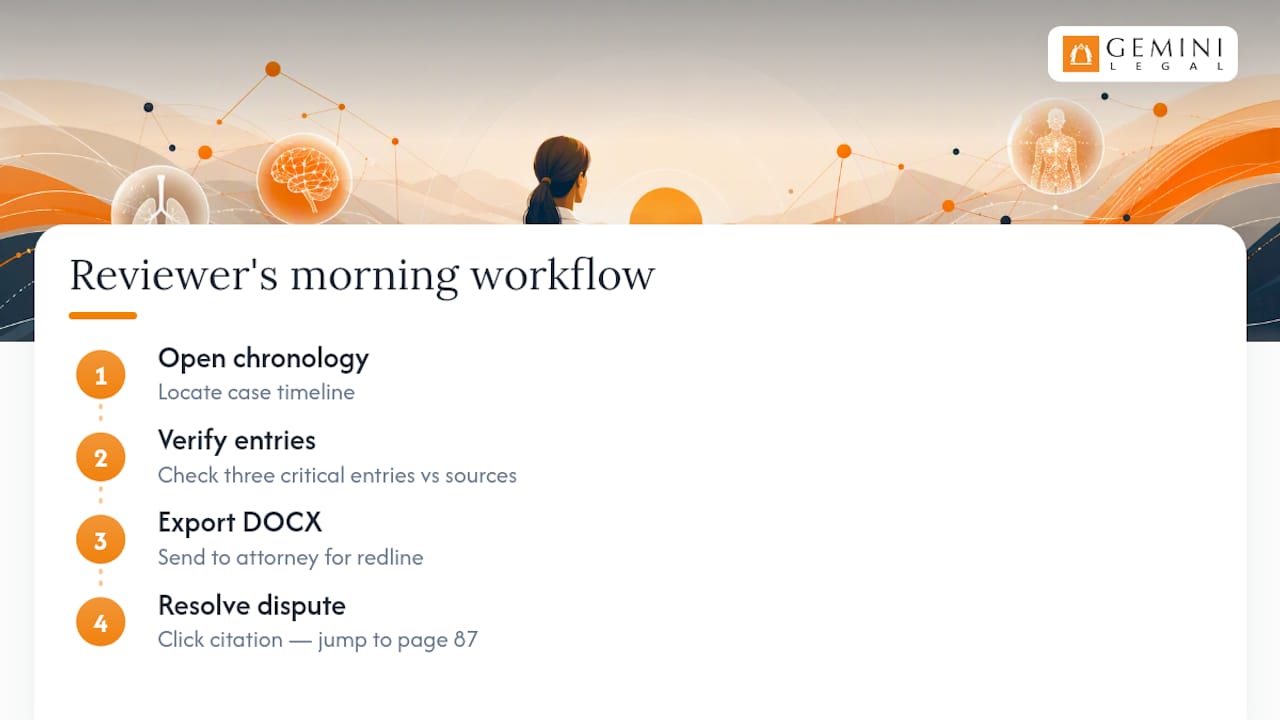
You open the chronology, verify three critical entries against their source pages, and export a DOCX for the attorney to redline. When the adjuster later disputes a work restriction, you click the citation, land on page 87 of the QME report, and the argument ends there. No re-flip through the file, no rework.
ChartInsight: Built for Defensible, Editable Record Review
ChartInsight™ turns a stack of large, multi-provider records into a chronology, a nine-section narrative summary, normalized vitals, and a medications table, with every fact linked to the exact source page. Click a citation and the source PDF opens inside the app, so you verify without downloading a separate file or losing your place in the review.
Teams working workers' comp files or personal injury records set up templates and prompt libraries, with role-based access across the matter, so a QME report and a peer review come back structured the same way every time. Exports go to editable DOCX or PDF with citations preserved, and the original record is never altered.
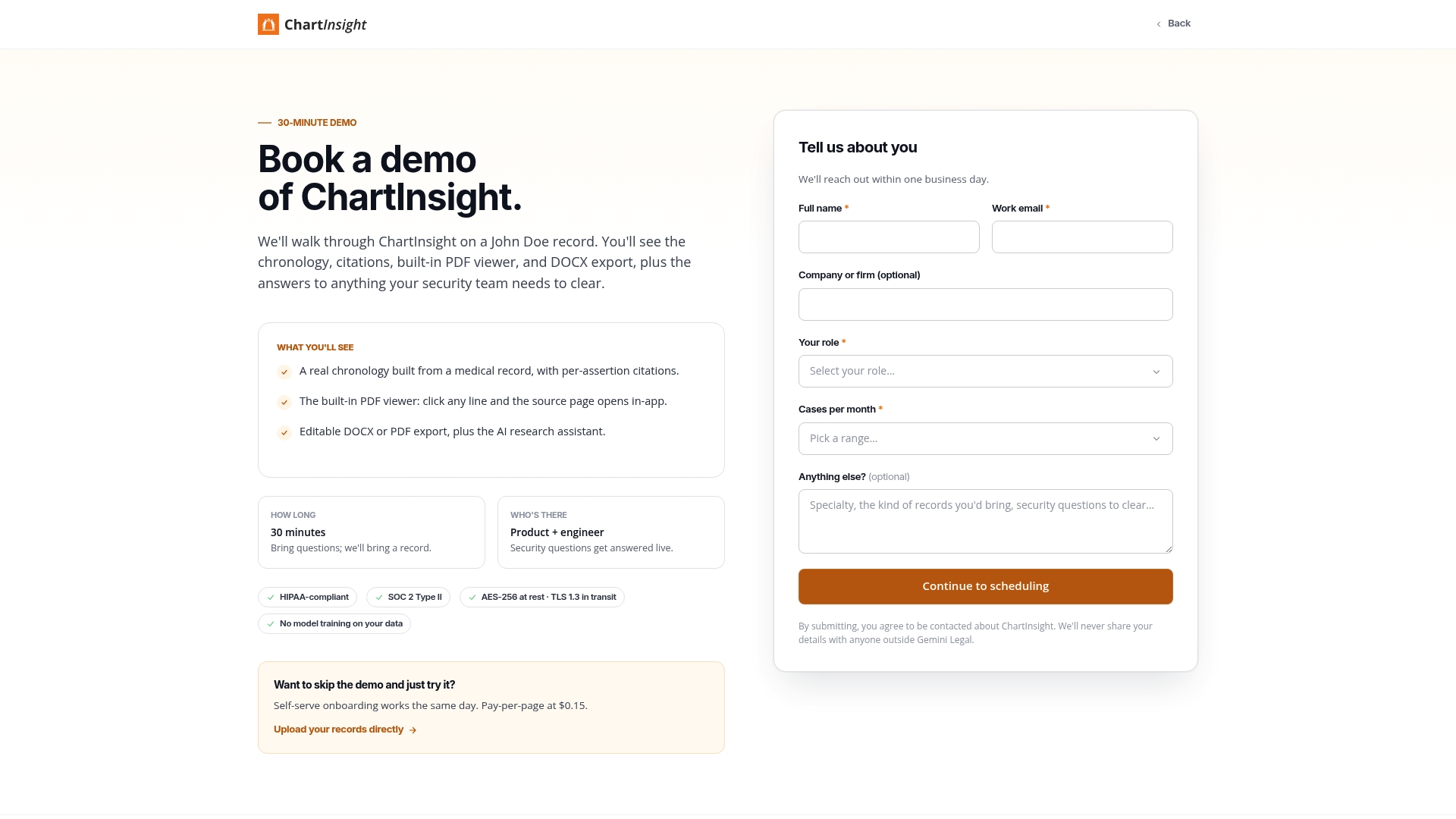
If your caseload includes files where every claim needs to survive a challenge, book a demo and see how the citations hold up on your own records.
Sources
- AI Indexing Accuracy: the 433-record study (ChartInsight™)
- Federal Rule of Evidence 702, testimony by expert witnesses (Cornell LII)
FAQ
What Makes a Medical Report "Editable" in This Context?
It means an exported chronology, narrative, or analysis in DOCX or PDF that a reviewer can revise while every extracted fact keeps its citation to the source PDF page. It does not refer to editing the original EMR.
Which Facts Absolutely Need a Page Citation?
Diagnoses, imaging findings, procedures, pain ratings, work restrictions, MMI and permanency findings, medications, and treatment gaps all need a traceable citation before you rely on them in a summary.
How Much Time Does a Cited Chronology Actually Save?
Cited chronologies let attorneys confirm key entries directly rather than reconstructing the file. The saving comes from removing manual assembly and evidence hunting, not from reading less of the record.
Does ChartInsight Alter the Original Medical Record?
No. ChartInsight™ keeps the original record read-only and produces editable exports separately, with every citation pointing back to the unaltered source page.
Why Does Characterization Hurt a Summary's Defensibility?
A single exaggerated word, like calling pain "disabling" without a citation, gives opposing counsel grounds to attack the entire document at deposition rather than just that sentence.