

A defensible medical peer-review report connects the relevant history and objective findings to a reasoned opinion, and makes it easy for a reader to find the record pages behind each material fact. A complete intake log, a dated chronology, and a consistent report structure all support that traceability. Page citations do not make a report correct on their own, but they make the factual basis of the reviewer's work easier to check.
TL;DR:
- Tying material factual statements to specific source pages makes a peer-review report easier to audit and to defend.
- A complete record, a clear chronology, and evidence cited close to each opinion help reduce avoidable challenges later.
- A consistent report structure with inline page citations supports traceability and faster verification by the next reader.
- Writing the conclusion first and backfilling support later is a common way unsupported statements reach a final report.
- ChartInsight™ supports this workflow with page-cited chronologies, summaries, and medication lists, plus structured vitals tables, while the original record stays untouched.
Table of Contents
- Steps every reviewer should follow from intake to delivery
- Step-by-step workflow and time management for reviewers
- The legal and standards checklist behind a defensible report
- Report templates that hold up: structure by section
- How ChartInsight™ outputs map to these requirements
- What experienced reviewers get wrong under deadline pressure
- ChartInsight™: see a page-cited report built from your own record
- FAQ
- Sources
Steps every reviewer should follow from intake to delivery
Many defensibility problems start with shortcuts early in a review rather than with errors on the last page. A consistent sequence helps:
- Confirm the record is complete enough for the referral question, and document anything missing, before drafting.
- Build a dated chronology and intake log, noting gaps and page ranges as you go.
- Extract objective findings, vitals, and medications, with a page citation attached to each entry.
- Draft opinions that reference the pages and data supporting them, not just the conclusion.
- Complete the applicable peer, committee, or quality-assurance check before the report is delivered.
Each stage produces an artifact the reviewer can point to later: the intake log documents the effort to obtain records, the chronology documents what was reviewed, and the cited opinions show the reasoning. None of these steps replaces the reviewer's obligation to read the complete record and apply independent professional judgment.
Step-by-step workflow and time management for reviewers
Before opening the record, clarify the referral question, request anything missing, and set a due date with a realistic time allocation. The AMA Guides Newsletter's IME best-practices article advises that records be provided at least two weeks before an evaluation and notes that reviewing records before the evaluation helps the examiner prepare.
Organize the record before analyzing it:
- Sort pages into date order and label document types as you encounter them.
- Create classifications for imaging, operative notes, and medication lists so they can be found again.
- Map page numbers to source documents so later citations point to something retrievable.
From there, a short summary chronology can serve as a quick reference, while a detailed chronology preserves the page-level support needed later. Vitals and medications are easier to audit when each entry carries its own source page rather than one citation for an entire table.
When writing the analysis, connect each material piece of evidence to the finding it supports, and place the page citation next to the claim rather than bundling citations at the end of a paragraph.
Pro Tip: Write the citation first, then the sentence; it forces a check that the evidence exists before the claim is committed to the report.
Before export, complete the required review, lock the version, and verify that the final citations resolve to the intended pages. Keep the original record unaltered so the audit trail stays intact.
The legal and standards checklist behind a defensible report
The governing standard depends on the type of review and the jurisdiction. For hospital professional review actions, the federal Health Care Quality Improvement Act (HCQIA) conditions its immunity protections on, among other things, the action being taken "after a reasonable effort to obtain the facts of the matter" (42 U.S.C. § 11112(a)(2)), so documenting that effort is worth building into the checklist. HCQIA does not prescribe a report template or require page citations; those are good practice, not a legal guarantee.
- Document the scope of the review and the efforts made to obtain complete records.
- Record which documents, dates, and pages were reviewed, cited inline rather than summarized separately.
- Show the chain of clinical reasoning from objective findings to opinion, referencing the AMA Guides edition required by the applicable rules when impairment ratings are at issue.
- Preserve an audit trail: reviewer credentials, dates, version history, and any committee sign-offs.
- Record material limitations, missing records, or scope restrictions.
Surveyors also distinguish internal quality-program records from other evidence. CMS hospital QAPI guidance states that, with rare exceptions, surveyors must not use information gathered from QAPI program records as the basis for a deficiency citation under other Conditions of Participation. That guidance is specific to hospital surveys, but the broader point carries over: a conclusion backed by page-level record evidence is easier to check than one backed only by an internal summary.
Report templates that hold up: structure by section
A consistent template helps a reader, including a cross-examining attorney, find the support for a claim quickly. The exact sections should follow the referral question and the applicable rules, but a practical structure for peer-review and QME/IME-style reports often includes:
- Administrative header with case identifiers and reviewer credentials.
- Summary of records reviewed, listing documents and date ranges.
- Chronology of relevant clinical events, each tied to a page number.
- Objective findings, including vitals and diagnostic results.
- Medications reviewed, with dosing history where relevant.
- Opinion with rationale, linking findings to conclusions explicitly.
- Limitations, noting any gaps in the record or scope restrictions.
- Recommendations, where the referral question calls for them.
- References and signature block with credentials.
Place the page citation immediately after the sentence or fact it supports, not at the end of a paragraph covering several claims. Quote verbatim only when exact wording matters, such as a diagnosis or a prior opinion, and mark it clearly as a quotation so it is never mistaken for a summary. A chronology line might read: "Applicant reported persistent lower back pain radiating to the left leg (Ex. 14, p. 212)." That format gives anyone checking the work a page to turn to.
How ChartInsight™ outputs map to these requirements
ChartInsight™ produces structured outputs with live page citations, so an extracted fact can be traced back to its source page.
- The chronology output organizes events by date with citations to the pages that support them, which makes timeline claims faster to check against the record.
- Narrative summaries are built from templates, so section structure can stay consistent across a team's cases.
- Medications are extracted into a consolidated list where each entry shows its date range and links to the pages it appears on.
- Vitals are extracted into a date-ordered table and trend view, organized by date of service and provider, for review alongside the record.
- Templates and a company-provided Prompt Library help keep report wording and section order consistent across a team.
- Exports to DOCX or PDF can keep citations linked, every output is editable, and the original record stays untouched.
The built-in PDF viewer opens the cited page when a citation is clicked, so checking a claim does not require searching through a long PDF. The how ChartInsight™ works page shows the chronology and citation behavior, and specialty pages for orthopedic QME reviews and psychiatric record review describe specialty-specific extraction. The reviewer still reads the full record and forms the opinion; the product removes manual assembly and citation work.
What experienced reviewers get wrong under deadline pressure

A common failure is not a wrong opinion but an opinion with too little documented support underneath it. Under deadline pressure, it is tempting to write the conclusion first and backfill support later, which is how unsupported statements can end up in a final report. A missing page citation or a thin chronology often goes unnoticed until someone reads the report adversarially. For a plaintiff-side perspective on how attorneys look at diagnoses, treatment records, and documented timelines when evaluating an emotional injury claim, see this accident emotional injury attorney evaluation guide.
A practical safeguard is to write one linking sentence for every major opinion and attach a specific page citation to it before moving on. When the record is unusually large, conflicting, or outside the reviewer's specialty, the appropriate response depends on the assignment and professional obligations, and may include requesting more records, committee review, or referral to an appropriate specialist.
ChartInsight™: see a page-cited report built from your own record
ChartInsight™ processes a full medical record into structured outputs such as a chronology, narrative summary, vitals, and medications, with chronology entries, summary findings, and medication entries tied to live citations back to their source pages. Attorneys and physician reviewers use the same underlying outputs for different report types.
- See a chronology built from a multi-provider record during a walkthrough.
- Review a narrative summary with citations that open the source page.
- Confirm that the original record stays untouched while every output remains editable.
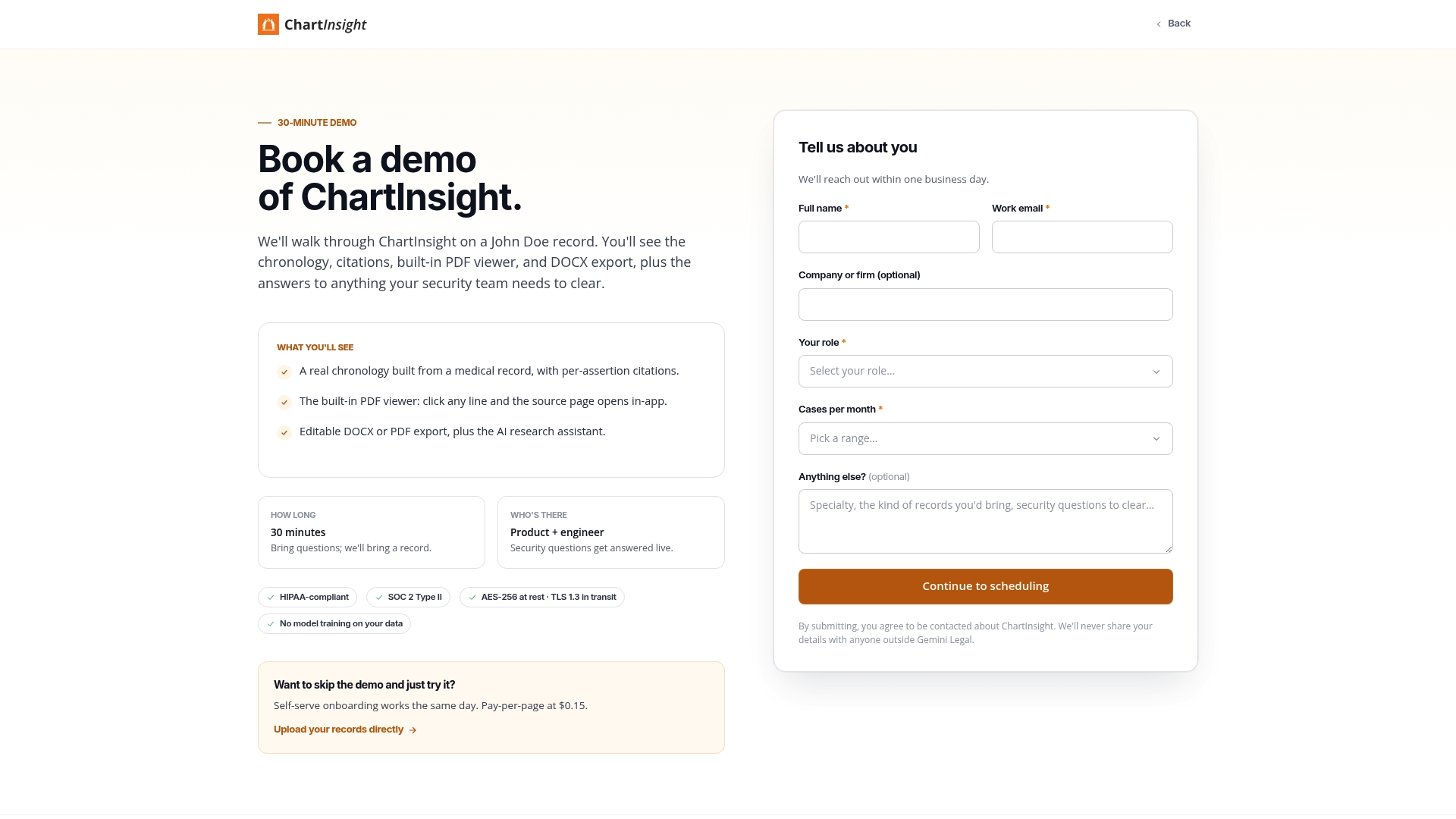
Teams that review records for personal injury claims or workers' compensation matters can book a demo of ChartInsight™ to see how the citation workflow fits their current reports.
FAQ
What makes a medical peer review report legally defensible?
No single feature guarantees defensibility, and requirements vary by review type and jurisdiction. Reports are easier to defend when they state the scope and records reviewed, document the effort to obtain the facts, connect objective findings to the opinion, and tie material facts to specific record pages. For hospital professional review actions, HCQIA's immunity standards include a reasonable effort to obtain the facts of the matter (42 U.S.C. § 11112(a)(2)).
How does page-level citation improve peer review quality?
Page-level citation lets anyone checking the report, whether a judge, opposing counsel, or a committee, verify a claim against the source page instead of relying on a summary. In ChartInsight™, clicking a citation opens the cited page in the built-in PDF viewer. Citations support traceability; they do not replace the reviewer's own reading and judgment.
What is the role of the AMA Guides in a peer review opinion?
When an opinion addresses impairment, the reviewer applies the AMA Guides edition and method required by the applicable rules. The AMA Guides Newsletter's IME best-practices article stresses that reasoning, such as the basis for apportionment, must be carefully explained. Citing the Guides alongside the objective findings that support a rating makes the reasoning easier to follow.
Can internal QAPI records serve as the sole basis for a finding?
In the hospital survey context, CMS guidance states that, with rare exceptions, surveyors must not use information gathered from QAPI program records as the basis for a deficiency citation under other Conditions of Participation. Whether particular records can support a finding in other review settings depends on the applicable rules.
How long should a medical record peer review take?
There is no universal time. Review duration depends on record size, completeness, scope, and specialty. IME best-practice guidance recommends that records be provided at least two weeks before an evaluation. Tools that automate chronology-building and citation can reduce manual organization and verification work, but they do not remove the need for a complete review.
Sources
- Independent Medical Evaluation Best Practices in: AMA Guides® Newsletter Volume 22 Issue 5 (2017)
- State Operations Manual (SOM) Hospital Appendix A - Interpretive Guidelines for 42 CFR 482.21, QAPI (CMS)
- 42 U.S. Code § 11112: Standards for professional review actions (Cornell Law School LII)